
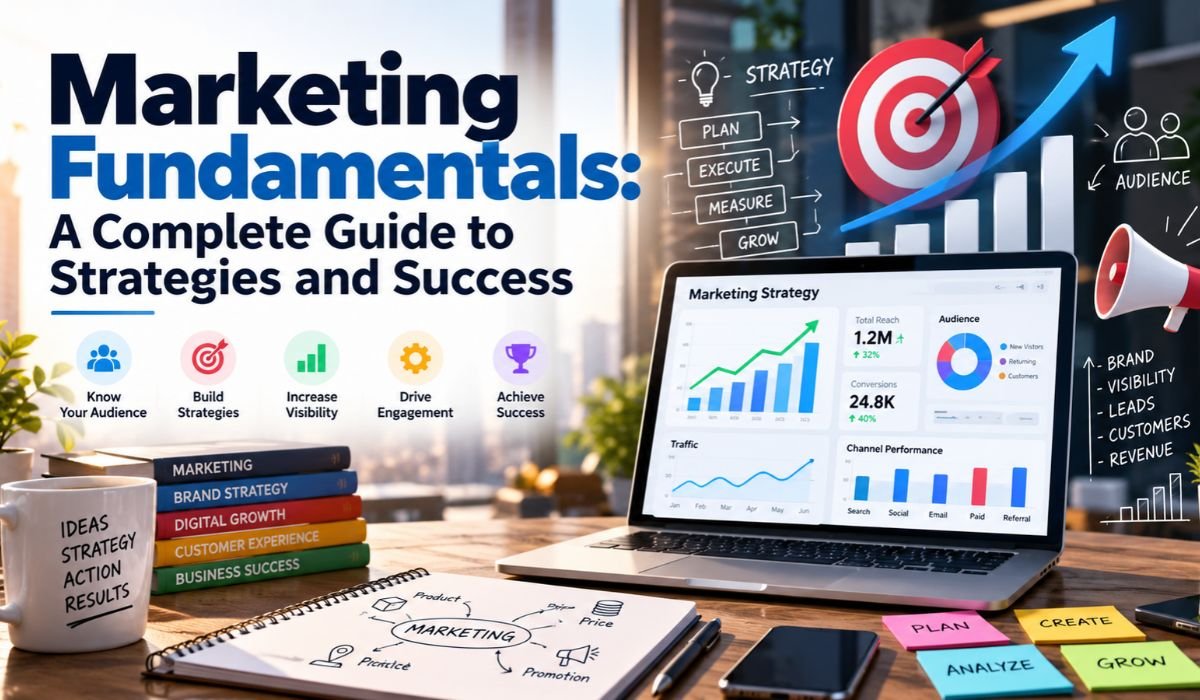
A great product doesn’t automatically lead to a successful business. People first have to discover it, understand what makes it useful, trust the company behind it, and feel confident enough to buy. That journey sits at the heart of Marketing Fundamentals.
Marketing is sometimes treated as another word for advertising, but its role is much broader. It includes understanding customers, researching markets, developing products and services, setting prices, choosing distribution channels, communicating value, building relationships, and measuring results.
The American Marketing Association describes marketing in terms of creating, communicating, delivering, and exchanging offerings that provide value to customers, clients, partners, and society. That broad definition is important because marketing decisions can influence almost every stage of the customer experience, not just the advertisements people see.
The tools available to marketers are changing rapidly in 2026. Artificial Intelligence, automation, advanced analytics, social platforms, evolving search experiences, and personalization technologies are becoming increasingly important. Even so, the essential questions haven’t changed much. Who is the customer? What do they need? What value can a business provide? And why should someone choose one solution over another?
Those questions are where good marketing begins.
What Are Marketing Fundamentals?
Marketing Fundamentals are the basic principles businesses use to understand customers, create useful offerings, communicate their value, and develop sustainable customer relationships.
Importantly, marketing usually starts long before a campaign goes live.
Before creating an advertisement or publishing content, a business needs to understand the market it’s entering. That means studying customer problems, purchasing behavior, competing products, available alternatives, demand, and the factors that influence buying decisions.
Research turns those observations into useful information. Strategy then helps a business decide which customers to serve, how to position its offering, and what makes it different. Execution brings that strategy into the real world through products, websites, content, email, advertising, events, sales materials, and customer experiences.
Measurement completes the process. It allows marketers to see what happened, determine what contributed to the outcome, and decide what needs improvement.
Seen this way, marketing isn’t simply promotion. Pricing, product development, positioning, distribution, customer service, communication, and retention can all influence marketing success.
Quick Bio Information
| Marketing Fact | Quick Information |
|---|---|
| Main Topic | Marketing Fundamentals |
| Core Purpose | Creating And Delivering Customer Value |
| Starting Point | Customer And Market Research |
| Classic Framework | Four Ps Of Marketing |
| Four Ps | Product, Price, Place, Promotion |
| Extended Framework | Seven Ps Of Marketing |
| Additional Ps | People, Process, Physical Evidence |
| Major Market Models | B2B And B2C |
| Early Customer Stage | Awareness |
| Evaluation Stage | Consideration |
| Action Stage | Conversion |
| Post-Purchase Focus | Retention And Loyalty |
| Major Organic Channel | Search |
| Direct Relationship Channel | |
| Educational Strategy | Content Marketing |
| Essential Strategic Tool | Market Segmentation |
| Key Business Principle | Customer Value |
| Measurement Focus | Business Outcomes |
| Modern Development | AI And Marketing Automation |
Why Marketing Fundamentals Matter
Marketing helps businesses answer questions that directly affect their ability to compete. Who should they serve? What does that audience actually care about? Which alternatives are customers already considering? What makes one company’s offer more relevant than another? And where can potential customers realistically be reached?
Market research gives businesses a stronger basis for answering those questions instead of relying purely on assumptions.
The insights gained can influence far more than advertising. Customer research may lead a company to change a product feature, simplify its pricing, improve packaging, choose a different distribution model, refine its positioning, or redesign part of the customer experience.
Consistency matters as well. When customers repeatedly hear a clear brand promise and then receive an experience that supports it, credibility can grow over time.
There are limits, though. Clever promotion can’t permanently compensate for a poor product, disappointing service, misleading claims, or an experience that fails to meet expectations. Sustainable marketing connects a real customer need with an offering capable of delivering the value being promised.
Understanding Your Target Market
Knowing the customer is one of the most important Marketing Fundamentals, yet it’s also an area where businesses can easily go wrong.
Trying to appeal to everyone often produces vague messaging. Market Segmentation offers a more focused approach by dividing a broad market into groups that share meaningful characteristics.
Depending on the business, segmentation may consider geography, demographics, interests, behavior, purchasing habits, customer needs, industry, company size, or other relevant factors.
Once those groups are understood, a business can evaluate which segments best match its products, capabilities, objectives, and resources.
Buyer personas can also be useful, provided they’re based on evidence rather than stereotypes. Interviews, surveys, customer-service conversations, sales discussions, purchase patterns, website analytics, and other appropriate research can reveal what customers genuinely care about.
There’s a practical lesson here: listen before launching campaigns.
The words customers use to describe their problems can reveal what matters to them, which objections stand in the way of a purchase, and which benefits deserve greater emphasis. Those insights can strengthen everything from advertising copy to product pages and sales conversations.
The Four Ps Of Marketing
Few marketing frameworks are as widely recognized as the Four Ps Of Marketing: Product, Price, Place, and Promotion.
Product refers to what the business offers and the value customers receive from it. Decisions may involve functionality, quality, features, design, packaging, branding, and differentiation. A successful product doesn’t simply exist; it needs to address a meaningful need or desire within its intended market.
Price covers what customers pay and how that amount relates to costs, competition, perceived value, and market positioning. Depending on the circumstances, businesses may use approaches such as cost-based, competition-based, or value-based pricing.
Place describes how customers gain access to the offering. Physical stores, wholesalers, distributors, company websites, marketplaces, mobile applications, and direct sales can all form part of a distribution strategy.
Promotion is the communication side of the mix. It can include advertising, public relations, content marketing, social media, email, events, sales promotions, and personal selling.
The real strength of the Four Ps becomes clear when they’re considered together. A company promising a premium experience, for example, can weaken that position if poor product quality, inconsistent distribution, aggressive discounting, or low-quality communication tells customers a different story.
The Seven Ps Of Marketing
The Seven Ps Of Marketing build on the traditional framework by adding People, Process, and Physical Evidence.
These additional elements are especially useful when considering services and broader customer experiences.
People includes employees and others whose interactions influence the customer’s view of a company. A knowledgeable salesperson, helpful consultant, or responsive support representative can have a substantial effect on how a brand is perceived.
Process refers to the systems customers encounter when discovering, purchasing, receiving, using, or seeking support for a product or service. Even an excellent offering can become frustrating when ordering is confusing, delivery is unreliable, onboarding is difficult, or support is slow.
Physical Evidence covers tangible signals that can shape perceptions of an otherwise intangible service or experience. These might include premises, packaging, documentation, website quality, uniforms, certificates, or other visible indicators.
Taken together, the Seven Ps encourage businesses to look beyond campaigns and consider the full experience surrounding what they sell.
The Marketing Funnel And Customer Journey
The Marketing Funnel provides a simple way to understand the stages people may move through before and after becoming customers.
Awareness begins when someone first recognizes a problem, discovers a brand, or becomes aware of a possible solution. During Consideration, that person starts researching and comparing available options. Conversion happens when the customer takes the intended action, whether that’s purchasing a product, requesting a quote, booking a consultation, or starting a trial.
But the story shouldn’t end when money changes hands.
Onboarding, customer support, product quality, follow-up communication, and loyalty initiatives can all influence whether someone stays with a company. A satisfied customer may eventually purchase again or recommend the business to others.
The traditional funnel is useful, but real customer behavior isn’t always so tidy.
Someone might first encounter a business through social media, forget about it, discover it again through search several weeks later, read customer reviews, visit the website more than once, subscribe to an email list, compare competitors, and finally make a purchase.
That’s why modern marketers need to think in terms of connected customer journeys rather than assuming one advertisement or final click deserves all the credit.
B2B Marketing And B2C Marketing
B2B Marketing primarily targets organizations, while B2C Marketing primarily targets individual consumers. The distinction sounds straightforward, but it can significantly affect how marketing is planned.
Business purchases may involve several stakeholders, technical requirements, procurement processes, product demonstrations, negotiations, and lengthy evaluation periods. This is particularly common when the purchase is expensive or important to business operations.
Detailed guides, webinars, case studies, demonstrations, and direct sales conversations can therefore play an important role in B2B Marketing.
B2C purchases may happen more quickly. Consumers can be influenced by convenience, personal preferences, identity, emotion, recommendations, urgency, and price.
Still, these aren’t rigid rules. Buying a house or expensive vehicle is a consumer decision that may involve months of research, while a routine business purchase might take only a few minutes.
Whether the audience is a company or an individual, the underlying principle remains the same: understand how real customers make decisions rather than assuming how they should behave.
Traditional And Digital Marketing
Traditional and digital marketing are sometimes discussed as if businesses must choose one side. In practice, they can complement each other.
Traditional Marketing may include television, radio, magazines, newspapers, outdoor advertising, direct mail, sponsorships, trade shows, networking, and physical events.
Digital Marketing includes websites, search engines, social media, online advertising, email, video platforms, mobile experiences, and other internet-based channels.
Digital channels often provide detailed targeting, fast experimentation, and extensive performance data. Traditional channels can still deliver valuable local visibility, physical presence, or broad exposure, depending on the market.
The best combination depends on customer behavior.
A local professional service might benefit from search visibility, referrals, community involvement, and carefully selected local advertising. A software company, by contrast, may rely more heavily on educational content, search, webinars, email nurturing, demonstrations, and sales conversations.
The key is to follow the customer rather than the latest marketing trend.
Major Types Of Marketing
Modern marketers can choose from a wide range of approaches, but more choice doesn’t automatically produce better results.
Content Marketing uses useful information to educate, attract, or retain an audience. Search Engine Optimization helps relevant webpages become more discoverable through search, while Search Engine Marketing commonly involves paid visibility for selected searches.
Social Media Marketing can support brand discovery, communication, customer service, community development, and content distribution. Email Marketing gives businesses a direct way to nurture prospects and maintain relationships with existing customers.
Influencer Marketing involves working with creators or other individuals who have relationships with relevant audiences. Affiliate Marketing typically rewards partners for generating agreed outcomes, such as qualified leads or purchases.
Account-Based Marketing takes a more concentrated B2B approach by focusing resources on selected accounts. Relationship Marketing emphasizes longer-term customer connections, while Experiential Marketing creates direct or interactive experiences with a brand.
There isn’t one universally superior approach. The right mix depends on customer behavior, objectives, resources, economics, and evidence of what actually works.
How To Build A Marketing Strategy
A useful Marketing Strategy should begin with a business objective, not a random collection of promotional ideas.
Perhaps a company wants to launch a new product, enter another market, increase qualified leads, encourage repeat purchases, strengthen awareness, or improve customer retention. Marketing objectives should support those wider business priorities.
Research then provides context. Businesses need to understand their customers, competitors, market conditions, available demand, and internal capabilities.
From there, a clear value proposition can answer one of the most important questions in marketing: why should a customer choose this solution instead of another available option?
Once that position is established, marketers can select appropriate channels, create campaigns, establish a realistic budget, and decide how results will be measured.
Strategy also requires discipline. Being present on every available platform can consume money and time without producing meaningful results. Smaller businesses, in particular, may benefit from becoming effective in a limited number of relevant channels before expanding further.
Applying Marketing Fundamentals In Practice
Consider a small company launching an online accounting service for independent businesses.
It could immediately spend money on advertisements. A more thoughtful approach would begin with customer research.
Interviews and conversations with potential customers might reveal that many aren’t particularly interested in sophisticated accounting terminology. Instead, they’re worried about saving time, understanding cash flow, keeping financial records organized, and avoiding preventable mistakes.
That insight would influence the entire marketing strategy.
Rather than positioning itself around technical complexity, the company could emphasize clarity and convenience. It might publish educational material that answers common financial questions, create useful search-focused pages, offer demonstrations, and use email to help interested prospects understand how the service works.
Measurement would then focus on meaningful outcomes such as qualified inquiries, trials, conversions, customer retention, and feedback rather than simply celebrating increases in website traffic.
The example illustrates an important distinction. Marketing channels are tools for execution. Customer understanding and positioning should come first.
Content, Branding And Customer Trust
Content and branding work together to shape what customers believe a business represents.
Useful content can answer questions, explain difficult subjects, demonstrate knowledge, reduce uncertainty, and help people make better-informed decisions. Branding adds recognizable meaning through positioning, identity, voice, reputation, and the experience customers associate with the company.
Trust develops when those elements match reality.
A company that promotes exceptional customer service needs to provide exceptional service. A business built around transparency should communicate prices, limitations, conditions, and policies clearly.
Accuracy matters as well. Marketing claims should be truthful and appropriately supported. In the United States, Federal Trade Commission guidance requires advertising to be truthful and not misleading, while certain material relationships between businesses and endorsers may need clear disclosure.
The wider principle applies regardless of the campaign: don’t promise an experience the business can’t deliver.
Measuring Marketing Performance
Measurement gives marketers a way to replace guesswork with evidence.
Website traffic, impressions, followers, clicks, views, and engagement can all provide useful information. But large numbers don’t automatically mean that marketing is helping the business.
The right Marketing KPIs depend on the original objective.
A campaign designed to generate customers might be evaluated through qualified leads, conversion rates, customer acquisition cost, revenue, or return on marketing investment. A retention campaign may be better assessed through renewals, repeat purchases, churn, or customer lifetime value.
Attribution deserves careful treatment too.
Customers commonly encounter several touchpoints before purchasing. Giving all the credit to the final click can therefore create an incomplete picture of how the decision developed.
A stronger measurement process asks a more useful question: did the marketing activity contribute to the intended business outcome, and what evidence supports that conclusion?
AI And Marketing Automation In 2026
Artificial Intelligence and automation are becoming increasingly integrated into everyday marketing.
AI can assist with research, audience analysis, forecasting, personalization, data interpretation, campaign optimization, customer support, and content development. Automation can handle repetitive processes such as email sequences, lead routing, customer follow-ups, and campaign triggers.
These capabilities can save time and help teams operate at greater scale. They don’t, however, remove the need for strong Marketing Fundamentals.
Poor-quality data can lead to poor recommendations. Weak positioning doesn’t become effective simply because AI produces more content around it. Automated systems can also spread errors quickly when campaigns aren’t properly supervised.
Human judgment therefore remains essential. Marketers still need to check factual accuracy, protect brand consistency, understand context, respect privacy, recognize customer sensitivities, and make strategic decisions.
The strongest use of AI in 2026 isn’t about replacing marketing judgment. It’s about using technology to support better research, faster execution, stronger analysis, and more informed decisions.
Common Marketing Mistakes
Many disappointing campaigns fail because of basic strategic weaknesses rather than a shortage of sophisticated technology.
A company may target an audience that’s too broad, copy competitors without developing a clear point of difference, publish content without understanding customer or search intent, or spend heavily on a fashionable platform that its customers barely use.
Another frequent mistake is concentrating almost entirely on acquisition while paying too little attention to existing customers. Retention, customer support, referrals, repeat purchases, and loyalty can all contribute to long-term business performance.
Vanity metrics can be misleading as well. Thousands of followers or millions of views may look impressive, but their business value depends on the objective and what happens afterward.
When performance becomes confusing, marketers can return to a few basic questions. What are we trying to achieve? What evidence tells us whether we’re getting there? And what should change based on what we’ve learned?
Those questions keep strategy connected to outcomes.
The Future Of Marketing Fundamentals
Marketing will continue to change. AI-assisted discovery, automation, personalization, creator-led media, changing search behavior, privacy expectations, and emerging platforms are already reshaping how companies reach audiences.
Some of today’s dominant channels may eventually lose influence. New ones will appear.
The underlying principles are far more durable.
Businesses will still need to understand customers, recognize meaningful problems, create useful products and services, communicate their value clearly, earn trust, and evaluate results.
That’s why learning Marketing Fundamentals remains worthwhile even when individual platforms and technologies change. Tools provide capabilities; strategy determines when and how those capabilities should be used.
Organizations that combine customer knowledge, reliable evidence, ethical communication, thoughtful experimentation, and adaptable technology will generally be better prepared for change than businesses whose entire strategy depends on a single platform or temporary trend.
Final Thoughts
Marketing Fundamentals aren’t simply a collection of techniques designed to persuade people to buy something. At their best, they provide a structured way for businesses to understand customers and create genuine value.
Research reveals what customers need. Segmentation identifies the audiences a business can serve effectively. Positioning explains why an offering deserves consideration. The Marketing Mix shapes how that value reaches the market, while content and communication help customers understand it. The customer experience then has to support those promises, and measurement reveals whether the strategy is producing meaningful results.
The tools surrounding this process will keep changing. AI, automation, search platforms, social networks, analytics, and advertising technologies will almost certainly look different in the years ahead. Businesses need to adapt to those developments, but they shouldn’t mistake a new tool for a complete marketing strategy.
Strong marketing still comes back to a remarkably human set of questions: Who are we trying to help? What do they genuinely need? How can we create something valuable for them? How do we communicate that value clearly and honestly? And what can real results teach us about what to do next?
Technology may continue to evolve, but those fundamentals remain at the center of effective marketing.
FAQs About Marketing Fundamentals
What Are Marketing Fundamentals?
Marketing Fundamentals are the core principles businesses use to understand markets and customers, create value, position products or services, communicate with target audiences, choose appropriate channels, develop customer relationships, and measure performance. They form the foundation for both traditional and digital marketing strategies.
What Are The Four Ps Of Marketing?
The Four Ps are Product, Price, Place, and Promotion. Product concerns what the customer receives, Price covers what customers pay, Place explains how the offering becomes available to them, and Promotion deals with communicating its value to the market.
What Are The Seven Ps Of Marketing?
The Seven Ps add People, Process, and Physical Evidence to the original Product, Price, Place, and Promotion framework. The expanded model can be particularly helpful when examining services and the wider customer experience.
Why Are Marketing Fundamentals Important?
Marketing Fundamentals help businesses make decisions based on customer needs and market evidence instead of relying entirely on assumptions. A strong foundation can improve targeting, positioning, communication, channel selection, customer experience, and performance measurement.
What Is The Difference Between Marketing And Advertising?
Marketing is the broader process of understanding customers and creating, communicating, delivering, and measuring value. Advertising is one promotional method that businesses may use within a larger marketing strategy. In other words, advertising can be part of marketing, but it isn’t the whole discipline.
What Is The Difference Between B2B And B2C Marketing?
B2B Marketing primarily targets organizational buyers, while B2C Marketing primarily serves individual consumers. Buying processes, decision-makers, messaging, sales cycles, and preferred channels may differ between the two, although both ultimately depend on understanding customer needs.
How Do Businesses Measure Marketing Success?
Businesses should choose measurements that match their objectives. Depending on the campaign, relevant metrics may include qualified leads, conversions, customer acquisition cost, revenue, retention, repeat purchases, customer lifetime value, and return on marketing investment. No single metric is suitable for every marketing activity.
What Should A Beginner Learn About Marketing First?
Beginners should start by understanding customer needs, Market Research, Segmentation, Targeting, Positioning, the Marketing Mix, customer journeys, branding, channel selection, and measurement. Once these principles make sense, individual marketing platforms and technologies become much easier to evaluate and use effectively.
Learn more and explore exciting content on: Platform Event Trap: Key Features, Benefits, and Real-World Uses
[…] Learn more and explore exciting content on: Marketing Fundamentals: A Complete Guide to Strategies and Success […]