
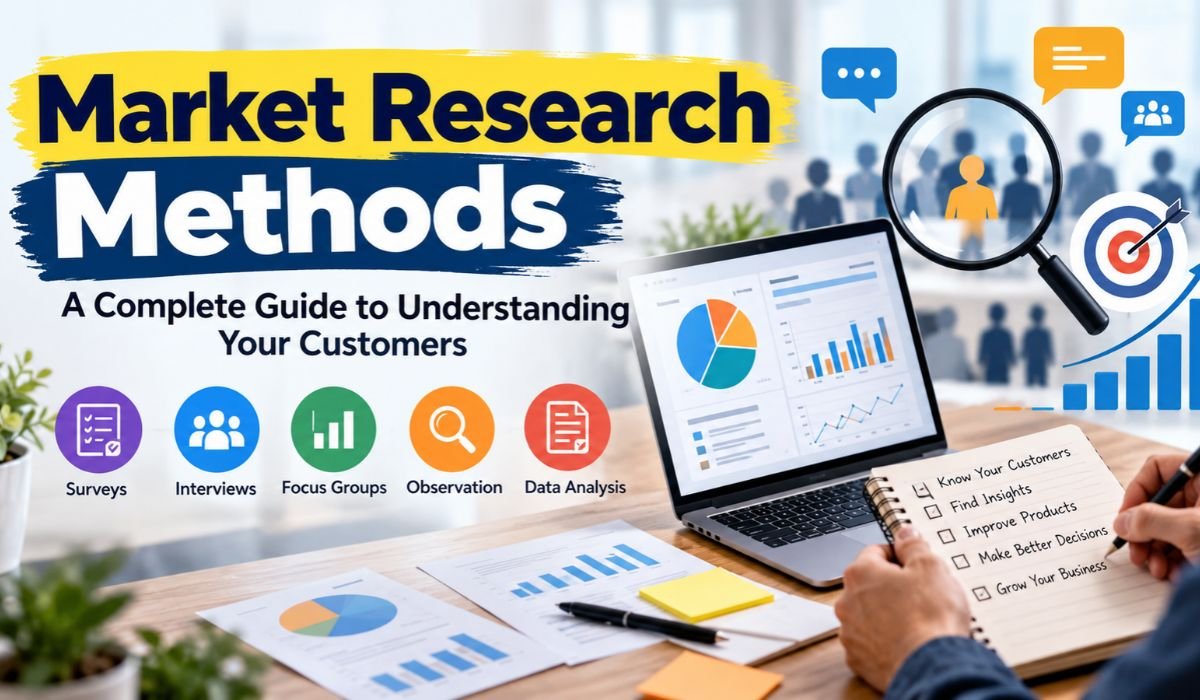
What makes someone choose one brand over another? Is it the price, product quality, convenience, or simply a better shopping experience? For businesses, understanding these decisions can make the difference between creating something customers genuinely want and investing in an idea that never takes off.
That’s why Market Research Methods play such an important role in business planning. They help companies understand what customers think, how they behave, and what influences their purchasing decisions. Instead of relying on assumptions, businesses can gather meaningful information and use it to make smarter choices.
In 2026, understanding customers involves more than conducting occasional surveys. Digital shopping habits, changing expectations, and new technologies have created additional ways to study consumer behavior. Yet the basic principle remains unchanged: good decisions begin with reliable information.
Whether you’re starting a business, developing a product, or looking for ways to improve customer satisfaction, this guide explains the most useful market research methods and how to apply them effectively.
Quick Information About Market Research Methods
| Information | Details |
|---|---|
| Main Topic | Market Research Methods |
| Primary Purpose | Understanding Customers And Markets |
| Main Research Categories | Primary And Secondary Research |
| Research Approaches | Qualitative And Quantitative |
| Common Methods | Surveys, Interviews, And Observation |
| Primary Research | Collecting New Information |
| Secondary Research | Studying Existing Information |
| Qualitative Research | Exploring Opinions And Motivations |
| Quantitative Research | Measuring Numerical Patterns |
| Customer Research Focus | Needs, Preferences, And Buying Habits |
| Competitor Research | Pricing, Products, And Market Positioning |
| Product Research | Testing Ideas And Customer Demand |
| Research Planning | Goals, Audience, Budget, And Timeline |
| Research Analysis | Identifying Patterns And Useful Insights |
| Common Research Challenge | Sampling And Response Bias |
| Digital Research Tools | Online Surveys And Website Analytics |
| Emerging Technology | AI-Assisted Research And Analysis |
| Data Protection | Privacy, Consent, And Secure Storage |
| Business Applications | Marketing And Product Development |
| Main Business Benefit | Better-Informed Decisions |
What Are Market Research Methods?
Market Research Methods are techniques businesses use to gather and examine information about customers, competitors, and market conditions. Their purpose is to answer practical questions about what people need, how they make purchasing decisions, and where new opportunities might exist.
Research can take several forms. A company might ask customers about their experiences, observe how shoppers interact with products, test different advertising messages, or examine published industry information.
Consider a clothing retailer preparing to introduce a summer collection. Before ordering inventory, the retailer could interview customers about preferred styles, review previous sales, and compare prices across competing stores. Those findings would provide a stronger foundation for purchasing decisions than personal preferences alone.
What matters most isn’t the amount of information collected. It’s whether the research answers a meaningful question and helps the business make a more informed decision.
Why Market Research Methods Matter For Businesses
Running a business involves constant decisions, from choosing products to setting prices and developing marketing campaigns. Without reliable customer information, even experienced business owners can misjudge what their audience wants.
Market research helps close that knowledge gap.
For example, a company experiencing declining sales might assume its prices are too high. Customer interviews could reveal a different problem, such as slow delivery, unclear product descriptions, or disappointing customer support.
Understanding the actual cause allows the business to focus on improvements that matter.
Research can also uncover opportunities that aren’t immediately obvious. Customers may be looking for features competitors don’t offer or struggling with problems that existing products haven’t solved.
Of course, research can’t predict every outcome. Consumer preferences change, and even carefully conducted studies have limitations. Still, reliable evidence offers a much better starting point than guesswork.
Understanding The Main Types Of Market Research
Before choosing a research technique, it’s helpful to understand how market research is classified.
The two main categories are primary and secondary research.
Primary Market Research involves collecting new information for a specific purpose. Businesses might conduct customer interviews, distribute surveys, organize focus groups, or test products. Because the information is collected directly for the project, researchers have greater control over the questions and methods used.
However, primary research can require considerable preparation, time, and money.
Secondary Market Research takes a different approach. Rather than collecting new information, businesses examine existing material, such as government statistics, academic studies, industry reports, and internal sales records.
This approach can be faster and more affordable, although the available information may not answer every question.
Research is also described as qualitative or quantitative.
Qualitative research explores people’s opinions, experiences, and motivations. Quantitative research focuses on numerical information, such as purchasing frequency, satisfaction scores, or sales patterns.
These categories often overlap. A customer survey, for instance, can include numerical ratings alongside open-ended questions.
Surveys And Customer Interviews
Surveys remain among the most widely recognized market research methods because they allow businesses to collect feedback in a structured format.
A company might ask customers how frequently they purchase a product, which features they value, or how satisfied they are with a recent experience.
Closed-ended questions make responses easier to compare, while open-ended questions give participants room to explain their opinions.
Interviews provide a more personal perspective.
Rather than working through a fixed questionnaire alone, researchers can ask follow-up questions and explore individual experiences in greater detail.
Imagine a software company trying to understand why customers cancel their subscriptions. A survey might show that users are dissatisfied, but interviews could uncover the reasons behind that dissatisfaction.
Perhaps customers find the interface confusing, encounter technical problems, or feel that important features are missing.
Neither method is automatically reliable. Poorly written questions, unrepresentative participants, and inaccurate responses can affect the findings. Careful research design is essential.
Customer Observation And Focus Groups
People don’t always behave the way they say they will. That’s one reason observation is valuable in customer research.
Instead of asking shoppers how they navigate a store, researchers can observe their actual behavior. They might examine which displays attract attention, where customers hesitate, or how easily visitors find products.
Online businesses can use moderated usability sessions to understand how people interact with websites and applications.
Focus groups offer a different kind of insight.
These sessions bring together a small number of participants to discuss a product, service, advertisement, or business idea. A moderator guides the conversation and encourages participants to share their perspectives.
The discussion may reveal concerns or preferences that wouldn’t emerge from a simple questionnaire.
However, group discussions have limitations. Confident participants can influence others, and a small group cannot represent an entire market.
Observation also has boundaries. Researchers may see what customers do without fully understanding why they do it.
Using interviews alongside these methods can help explain the behavior being observed.
Experiments And Field Trials
Sometimes businesses need more than customer opinions. They need evidence showing whether a particular change actually makes a difference.
That’s where experiments become useful.
A familiar example is A/B testing. An online retailer might compare two versions of a product page to determine which produces more completed purchases.
When properly designed, an experiment helps researchers examine whether a specific change affects customer behavior.
Field trials take testing into everyday business environments.
A food manufacturer, for example, might introduce a new snack in selected stores before committing to a wider launch. The company could examine sales, customer reactions, and practical distribution challenges.
These tests provide valuable real-world information, but their findings require careful interpretation.
A product that performs well in one location may not achieve the same results elsewhere. Seasonal demand, customer demographics, and local competition can all influence outcomes.
Desk Research And Purchased Market Data
Not every business question requires collecting new information.
Desk research involves examining material that already exists, including public statistics, academic publications, industry reports, and company records.
For a startup exploring a new market, this can be an efficient first step. Existing information may reveal population characteristics, consumer spending patterns, market conditions, or established competitors.
Businesses can also purchase specialized market data from commercial research providers.
These datasets may include consumer panel findings, industry forecasts, or information about particular customer groups.
Although purchased research can save time, its quality shouldn’t be taken for granted.
Before relying on a report, businesses should consider who collected the information, how the study was conducted, when the data was gathered, and whether the findings apply to their intended audience.
An expensive report isn’t necessarily more useful than a reliable public dataset.
Social Listening And Competitor Benchmarking
Customers regularly discuss their experiences through public reviews, online communities, and social platforms. These conversations can provide useful clues about what people appreciate and what frustrates them.
Social listening involves examining relevant public discussions to identify recurring opinions, concerns, and emerging interests.
For example, repeated complaints about difficult returns might encourage an online retailer to review its return process.
Still, online comments need context. People who post publicly may have unusually positive or negative experiences, meaning their opinions don’t necessarily reflect the wider customer base.
Competitor benchmarking focuses on understanding how other businesses operate.
A company might compare competing products, delivery options, pricing structures, customer service, or market positioning.
The purpose isn’t to copy another brand. It’s to understand the competitive environment and identify areas where the business could offer something better or different.
Mystery Shopping And Customer Experience Research
Customer service can look excellent in a company handbook while feeling very different to the people receiving it.
Mystery shopping helps businesses examine that gap.
Trained evaluators interact with a company as customers, following a planned assessment process. They may visit stores, contact support teams, or complete purchases while evaluating specific service standards.
A restaurant group, for example, could use mystery shopping to examine whether staff across different locations provide consistent information about menu ingredients and service procedures.
The findings may highlight training needs, confusing processes, or inconsistent experiences.
However, one visit offers only a limited view. Businesses should use clear assessment criteria and avoid drawing broad conclusions from isolated observations.
Mystery shopping should also respect applicable privacy rules, workplace requirements, and fair evaluation practices.
How To Conduct Market Research Step By Step
Good market research begins with a clear question.
A business asking why customers don’t return after their first purchase has a more useful starting point than one simply asking whether customers are happy.
Once the question is defined, the next task is identifying the people whose experiences matter most.
Researchers can then review existing information, choose appropriate methods, and prepare questions that are clear and neutral.
Participant selection is especially important. If a company wants to understand first-time buyers, surveying only loyal customers could produce misleading results.
After collecting information, researchers examine patterns and differences. Numerical responses may require statistical analysis, while interviews often involve identifying recurring themes.
The final stage is deciding what to do with the findings.
Research shouldn’t end with a report that nobody uses. Its purpose is to support decisions, guide improvements, and provide a way to evaluate whether those changes work.
How To Choose The Right Market Research Method
There’s no single research technique that works for every situation.
The right choice depends on what a business wants to learn.
Interviews can help explain customer motivations, while surveys may be more suitable for measuring how widespread particular opinions are.
Experiments are useful when businesses want to test specific changes. Desk research, meanwhile, provides valuable background information about markets and industries.
Practical considerations matter too. Budget, available time, access to participants, and the complexity of the research question all influence the decision.
For smaller businesses, existing customer records, public statistics, and carefully planned interviews can provide a useful starting point.
Larger or more complex studies may benefit from professional research expertise.
Often, the strongest approach combines several methods. Interviews can identify a possible problem, surveys can examine its frequency, and experiments can evaluate potential solutions.
Market Research Tools And Technology In 2026
Technology has made many research activities easier to manage.
Survey platforms such as Google Forms, SurveyMonkey, and Typeform allow businesses to prepare questionnaires and organize customer responses.
Website analytics tools help companies understand digital interactions, while spreadsheets and data visualization software make it easier to examine results.
Artificial intelligence is also becoming part of the research process.
AI-assisted tools can help organize interview transcripts, summarize written feedback, and identify recurring themes across large collections of responses.
However, automated analysis isn’t always accurate. AI systems may misunderstand context, overlook less common viewpoints, or generate misleading summaries.
Human review remains important, particularly when findings influence major business decisions.
Customer privacy also deserves attention. Businesses should collect information responsibly, explain its intended use, protect sensitive records, and follow applicable data protection requirements.
Common Market Research Mistakes To Avoid
Even a well-funded research project can produce disappointing results when the underlying methods are weak.
One common problem is asking leading questions.
Consider the difference between asking customers why they love a product and asking how they would describe their experience. The first assumes a positive opinion, while the second leaves room for an honest response.
Another mistake is studying the wrong audience.
A business hoping to attract new customers may learn little about potential buyers if it interviews only its most loyal existing customers.
Sample size matters, but numbers alone don’t guarantee accuracy. A large, poorly selected sample can still produce biased findings.
Researchers should also be cautious about outdated reports, unsupported conclusions, and confusing correlation with causation.
Perhaps the most overlooked mistake is failing to act on research findings. Information has limited business value when it never influences decisions.
How To Evaluate The Reliability Of Market Research
Not all research findings deserve equal confidence.
Before relying on a study, businesses should examine how the information was collected and whether the methods were appropriate.
A trustworthy research report should explain its purpose, target population, participant selection process, data collection period, and relevant limitations.
Sampling deserves particular attention.
For example, a survey of 200 existing customers might reveal useful information about current service experiences. However, those responses cannot automatically represent everyone in the wider market.
Question wording, response rates, missing information, and the timing of a study can also influence results.
Researchers should be transparent about uncertainty rather than presenting every finding as an unquestionable fact.
Understanding these limitations doesn’t make research less valuable. It makes the conclusions more responsible and useful.
Turning Market Research Into Better Customer Experiences
The real value of market research appears when businesses turn what they’ve learned into meaningful improvements.
Customer feedback may reveal confusing product descriptions, frustrating checkout processes, missing features, or problems with support services.
These findings can guide practical changes.
Suppose an online retailer discovers that customers frequently abandon purchases during checkout. Rather than immediately offering discounts, the business could investigate whether complicated forms, unclear delivery charges, or technical problems are creating difficulties.
After making improvements, the retailer could examine whether checkout completion rates increase.
This creates a useful cycle: investigate a problem, make an informed change, and measure the result.
Over time, this approach can help businesses build better products, improve customer experiences, and respond more effectively to changing expectations.
The Future Of Market Research Methods
Market research is evolving alongside digital technology and consumer behavior.
AI-assisted analysis can help researchers process certain kinds of information more efficiently. Digital platforms also make it possible to collect feedback through a wider range of channels.
Yet greater access to information brings new responsibilities.
Businesses must think carefully about privacy, informed consent, data security, and the limitations of automated analysis.
More data doesn’t automatically lead to better understanding. A smaller, carefully designed study may answer a business question more effectively than a large collection of poorly understood information.
As research technology develops, the most valuable skills will remain familiar: asking thoughtful questions, evaluating evidence, recognizing uncertainty, and listening carefully to customers.
Conclusion: Understanding Customers Through Better Research
Understanding customers has always been essential to building a successful business, but knowing what people genuinely want requires more than intuition.
Market Research Methods provide a practical way to explore customer needs, study purchasing behavior, evaluate competitors, and test business ideas before making major commitments.
Surveys, interviews, observation, experiments, and secondary research each offer a different perspective. Choosing the right combination depends on the questions being asked and the resources available.
In 2026, digital tools and artificial intelligence can make parts of the research process faster and more accessible. Still, technology cannot replace sound judgment, careful research design, or a genuine willingness to listen.
The businesses that benefit most from market research aren’t necessarily those collecting the largest amounts of data. They’re the ones that ask better questions, recognize what the evidence can and cannot tell them, and use those insights to make customers’ experiences better.
Ultimately, market research isn’t simply about understanding a market. It’s about understanding the people who make that market possible.
FAQs About Market Research Methods
What Are Market Research Methods?
Market Research Methods are techniques businesses use to collect and analyze information about customers, competitors, and market conditions. Common approaches include surveys, interviews, observation, focus groups, experiments, and desk research. Each method helps answer different questions about customer needs, purchasing behavior, and business opportunities.
What Are The Four Main Types Of Market Research?
The four commonly discussed categories are primary, secondary, qualitative, and quantitative research. Primary and secondary research describe where information comes from, while qualitative and quantitative research describe the type of information being examined. These categories overlap, and businesses often combine them within one research project.
Which Market Research Method Is Best For Small Businesses?
Small businesses can often begin with customer interviews, short surveys, existing sales records, and trustworthy public information. These methods may provide useful insights without requiring a large budget. However, the most suitable approach depends on the business question, target audience, and resources available.
What Is The Difference Between Qualitative And Quantitative Research?
Qualitative research explores customer opinions, experiences, and motivations through detailed responses. Quantitative research examines numerical information to identify measurable patterns. Interviews commonly support qualitative research, while structured surveys often provide quantitative data. Using both approaches can help businesses understand not only what customers do but also why they do it.
Can Businesses Conduct Market Research For Free?
Yes. Businesses can use existing sales information, public statistics, customer conversations, and free versions of certain survey tools. These resources can be particularly helpful for startups and smaller companies. However, research still requires time and careful planning, and free information should be evaluated for accuracy and relevance.
How Often Should Businesses Conduct Market Research?
The appropriate frequency depends on the industry, customer expectations, and business objectives. Some companies collect feedback continuously, while others conduct larger studies before product launches or strategic decisions. Significant changes in sales, customer behavior, or market conditions may also create a need for additional research.
How Does Market Research Improve Customer Satisfaction?
Market research helps businesses identify customer frustrations, understand expectations, and discover opportunities for improvement. Companies can use the findings to refine products, improve support, and simplify purchasing experiences. Follow-up research then helps determine whether those changes have made a measurable difference.
Learn more and explore exciting content on: Irish Business Systems: Complete Guide to Services, AI Automation, and Benefits
[…] Learn more and explore exciting content on: Market Research Methods: A Complete Guide to Understanding Your Customers […]