
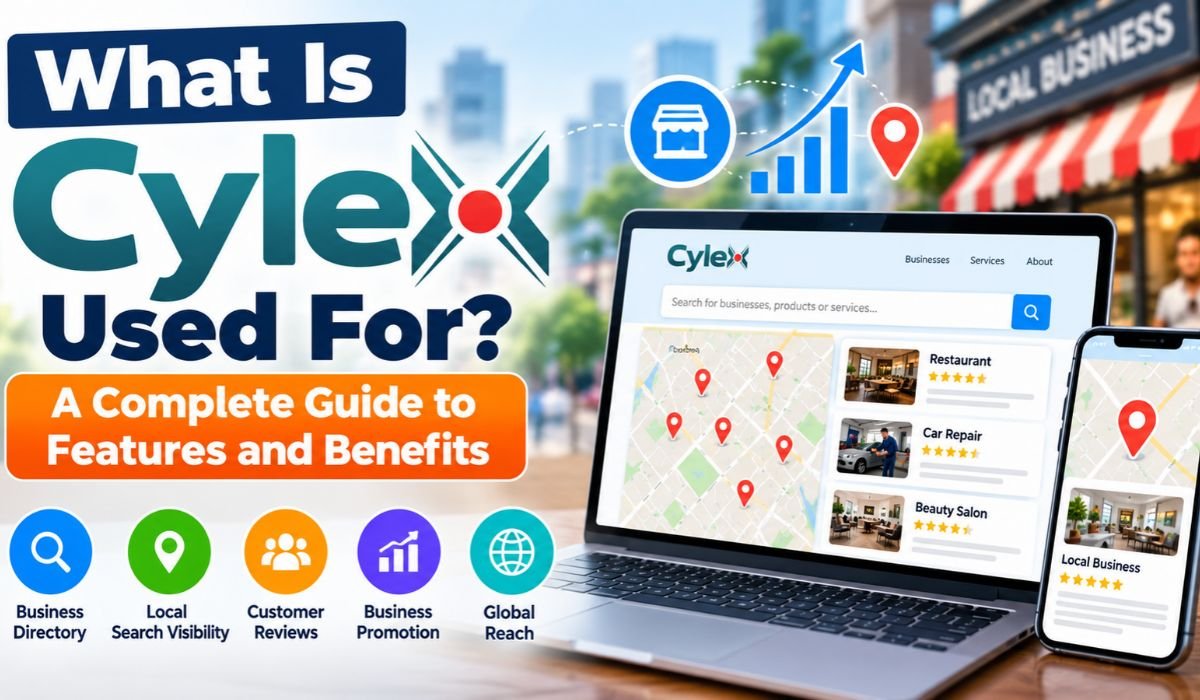
Finding a reliable local business shouldn’t be complicated. Whether someone needs a plumber, a nearby restaurant, or a professional service provider, the first step is often an online search. People want clear information, accurate contact details, and a quick way to decide which company meets their needs.
That’s where business directories come into the picture. They bring company information together, making it easier for customers to discover services and for businesses to reach potential clients.
But what is Cylex used for, and why should business owners pay attention to it?
Cylex is an international business directory network that helps people find local companies while giving businesses tools to manage their online presence. Alongside standard business listings, it offers premium profiles, data synchronization, reputation-related services, and advanced solutions for marketing agencies.
For a small business, Cylex can provide another opportunity to reach customers. For larger organizations, its technology can simplify the management of hundreds or even thousands of business listings.
This guide explores how Cylex works in 2026, what its main features offer, and how businesses can decide whether the platform deserves a place in their marketing strategy.
What Is Cylex International?
Cylex International is a business directory and local search technology company that has been operating since 1997. Over the years, it has developed an international network designed to connect customers with businesses and help organizations manage company information online.
According to its published company information, Cylex operates in 32 countries and regions, with offices in Germany and Romania.
Although many people recognize Cylex as a business directory, its services extend well beyond basic company listings. The company also develops technology that helps businesses, agencies, and digital platforms collect, organize, update, and distribute business information.
Its network includes Cylex, Yably, FindOpen, and Firmania. These platforms serve different purposes, including business discovery, opening-hours information, and online reputation management.
Cylex also reports 91 directory integrations. This reflects the reach of its broader technology network, although it doesn’t mean every business listing automatically appears in all 91 directories.
Cylex Quick Bio Information
| Information | Details |
|---|---|
| Company Name | Cylex International |
| Founded | 1997 |
| Industry | Business Directories and Local Search |
| Main Purpose | Business Discovery and Listing Management |
| International Coverage | 32 Countries and Regions |
| Offices | Germany and Romania |
| Directory Integrations | 91 |
| Reported Pageviews | 196,726,052 |
| Reported Annual Active Users | Over 115 Million |
| Reported Business Profiles | More Than 54 Million Companies |
| Standard Listings | Free Registration Available |
| Premium Services | Enhanced Business Profiles |
| Main Customers | Businesses, Agencies, and Partners |
| Data Management | Bulk Uploads and Data Synchronization |
| Developer Tools | REST APIs |
| AI Technology | Entity Matching and Deduplication |
| Quality Control | Automation and Human Review |
| Associated Platforms | Yably, FindOpen, and Firmania |
| Analytics | Profile Views, Actions, and Search Performance |
| Newer Features | B2B Reviews and Profile Analytics |
These figures reflect Cylex’s published company information. Pageviews, annual active users, and business profile counts measure different things, so they shouldn’t be interpreted as equivalent statistics.
What Is Cylex Used For?
At its core, Cylex helps customers find businesses and gives companies another way to make their services visible online.
Imagine someone searching for an electrician in their neighborhood. They may not know which businesses operate nearby or where to find reliable contact information. A Cylex directory listing can help by presenting relevant company details in one place.
For business owners, the value works in the opposite direction. Instead of waiting for customers to discover their websites, they can maintain directory profiles that introduce their services to people searching for local companies.
Cylex is also used for business listing management. Companies can review their information, update contact details, and maintain more consistent records across supported platforms.
Larger businesses and marketing agencies use its professional services for bulk uploads, automated updates, and data integration.
In other words, Cylex serves both sides of the local search experience. It helps customers discover businesses while giving companies tools to manage how they’re represented online.
How Does Cylex Work?
Cylex works by organizing business information into searchable directory profiles. Visitors can look for companies using relevant locations, services, or business categories, depending on the regional directory.
A typical profile may contain the business name, address, phone number, opening hours, service description, and other useful details.
Consider a customer looking for an appliance repair company. Instead of visiting several unrelated websites, they may find a directory profile that provides enough information to contact a suitable provider.
Business owners can also use Cylex to manage their company information. Depending on the regional platform, they may be able to register a business, claim an existing profile, or request corrections.
Behind the scenes, Cylex uses data processing technology to organize information from different sources. Automated systems help standardize records, identify possible duplicates, and distribute updates through supported integrations.
That combination of customer-facing directories and business data technology makes Cylex more than a traditional listing website.
Key Features of Cylex Business Directory
One of Cylex’s most practical features is its business profile system. It gives companies a dedicated place to present information that customers often need before making contact.
A complete profile can explain what a business offers, where it operates, and how customers can reach it. Clear descriptions and accurate details make the listing more useful.
Cylex also offers premium business listings. These may include enhanced company information, photographs, and featured placements within supported directories.
For businesses managing multiple locations, the platform provides Bulk Upload services. Instead of updating every location individually, organizations can submit structured information using XLSX spreadsheets.
Cylex describes a process that includes validation, normalization, and duplicate checks to help improve data quality.
Its Developer APIs offer additional flexibility. Authorized organizations can integrate business information into their own software systems, reducing the need for repeated manual updates.
Not every business needs these advanced features. A neighborhood shop may benefit from a simple, accurate listing, while a company with hundreds of branches may find automation far more valuable.
How to Claim and Manage a Cylex Business Listing
For business owners interested in using Cylex, the first step is to find out whether their company already has a listing.
Searching the relevant regional directory using the business name and location can help identify an existing profile. If one appears, the owner should review the information carefully.
Where listing management is supported, the platform may provide an option to claim the profile or request editing access. Ownership verification may be necessary before changes are approved.
Once access is available, attention should turn to the details customers rely on most.
The company name, address, telephone number, website, business category, and opening hours should all be correct. Even small mistakes can create confusion, particularly when customers are trying to visit a physical location.
Business descriptions deserve equal attention. Rather than repeating keywords, owners should explain their services naturally and provide information that helps customers understand what makes the company relevant.
It’s also worth reviewing the listing whenever important business details change.
For organizations managing many branches, Cylex offers a Bulk Upload service that uses spreadsheet templates and unique entry identifiers. This is a paid service, and costs can vary depending on the market and volume of listings.
How Cylex Helps With Local SEO
Local SEO is about making a business easier to discover when people search for products or services in a particular area.
Cylex can support this process by giving companies another place to publish accurate business information.
One important part of local SEO is NAP consistency. NAP stands for Name, Address, and Phone Number. Keeping these details consistent across a company website, directory profiles, and other online platforms helps prevent conflicting information.
Business directories can also provide local citations. These are online references to a company’s identifying details.
However, it’s important to understand what directory listings can and cannot do.
Creating a Cylex profile doesn’t guarantee higher Google rankings. Google’s local search results depend on several factors, including relevance, distance, and prominence.
A directory listing is therefore best viewed as one part of a broader online strategy.
Businesses should also maintain their websites, keep Google Business Profile information accurate, publish useful content, and make it easy for customers to get in touch.
The goal isn’t simply to appear in more directories. It’s to make sure customers can find reliable information wherever they encounter the business.
Benefits of Cylex for Small Businesses
For small businesses, online visibility can be difficult to build. Advertising budgets may be limited, and owners often handle marketing alongside daily operations.
Cylex offers another opportunity to introduce a business to potential customers without requiring an entirely new website or marketing campaign.
Free business registration is available through its directory network, although features and eligibility may differ between countries.
An accurate listing can help customers find essential details, including where a company operates and how to contact it.
This is especially useful for businesses that depend on local customers, such as repair services, independent shops, and professional service providers.
There’s also a practical benefit to keeping information organized. Customers who can quickly confirm opening hours or contact details are less likely to waste time searching elsewhere.
Still, businesses shouldn’t assume that every directory listing will generate new customers.
The value depends on whether people in the relevant market use Cylex, how competitive the business category is, and whether the profile provides useful information.
For most small companies, the sensible approach is to maintain an accurate listing and evaluate its results before paying for additional features.
Cylex Reviews and Reputation Management
Customer reviews have become an important part of how people evaluate unfamiliar businesses.
A thoughtful review can tell potential customers about service quality, communication, reliability, and the overall experience of working with a company.
Cylex’s wider ecosystem includes Yably, a platform associated with collecting and presenting business reviews from different sources.
In July 2026, Cylex also announced B2B Reviews, allowing businesses to recommend other businesses in a professional context.
This feature introduces another dimension to online reputation management.
For example, a company that has worked with a reliable supplier or professional service provider may want to share its experience with other businesses.
However, reviews are most useful when they reflect genuine experiences.
Companies should avoid misleading testimonials or attempts to manipulate ratings. Constructive criticism also deserves attention, since it can reveal areas where customer service needs improvement.
A respectful response to a negative review may demonstrate professionalism more effectively than an argument.
Because review features can differ across Cylex platforms and countries, businesses should check which options are available in their region.
Cylex Free Listings vs. Premium Listings
One question business owners frequently ask is whether they need to pay to use Cylex.
The company offers free business registration alongside premium services designed to enhance directory profiles.
A standard listing generally focuses on essential business information, giving customers another way to discover and contact a company.
Premium listings may provide additional presentation features, including photographs, expanded descriptions, and featured placements.
These enhancements can make a profile more noticeable or informative within the relevant directory.
But paying for a premium listing isn’t automatically the right choice for every business.
A company should first consider whether Cylex attracts customers in its industry and location. It should also examine available performance information and compare the service cost with potential benefits.
For instance, a business already receiving relevant inquiries through its profile may have a stronger reason to explore premium options.
On the other hand, a company seeing little useful activity might be better served by improving its website or another marketing channel.
Premium placement doesn’t guarantee higher search rankings, additional sales, or a particular number of customer inquiries.
How Cylex Uses AI and Automation
Managing business information across several countries is a complex task. Company details change constantly, and the same business may appear in different databases under slightly different names.
Cylex uses automation and AI-supported technology to help manage these challenges.
One important process is entity matching, which helps determine whether separate records refer to the same business.
Another is deduplication, which identifies potential duplicate listings that could create confusion or lead to inconsistent information.
Automated systems also help normalize data, making records easier to organize and distribute across connected platforms.
However, technology doesn’t solve every problem.
A business may move to a new address, change ownership, or operate under a name that resembles another company. Situations like these can require human judgment.
Cylex describes its approach as human-in-the-loop AI, combining automated processing with employee reviews for unusual cases, disputes, and complex corrections.
The purpose is to manage information efficiently without relying entirely on automated decisions.
Even with these systems in place, business owners should regularly review their profiles. No data management process can guarantee that every listing will always be accurate.
Cylex Tools for Marketing Agencies and Business Partners
Cylex isn’t designed exclusively for individual business owners. It also provides technology for agencies, enterprises, and organizations responsible for large numbers of business locations.
For a marketing agency managing several clients, updating directory information manually can become time-consuming.
Cylex’s Bulk Upload service allows organizations to submit structured business information through spreadsheets. Validation and duplicate detection help identify potential issues before data is processed.
The company also provides Data Sync services for larger organizations, particularly those managing 500 or more active locations.
These services can collect publicly available business information from sources such as branch locators, XML sitemaps, and location-page lists.
Developer APIs provide another option for companies that want to integrate business data directly into their existing systems.
Cylex’s published partner section includes organizations such as Yext, Vendasta, SOCi, Uberall, Rio SEO, DAC, and 11880.com.
For agencies, the main attraction is efficiency. Automated systems can reduce repetitive work and make it easier to maintain consistent information across multiple locations.
Before adopting these services, however, organizations should confirm pricing, technical requirements, supported markets, and update procedures.
Cylex Network and Profile Analytics in 2026
Cylex operates several discovery platforms rather than relying on a single directory.
Its network includes Cylex, Yably, FindOpen, and Firmania, each contributing to the wider business information ecosystem.
The company reports 91 directory integrations across 32 countries and regions, although coverage and individual services can differ by market.
One of its more recent developments is Profile Analytics, announced in July 2026.
This feature is designed to help businesses understand how people interact with their directory profiles.
According to Cylex, the reporting tools can provide insights into profile views, visitor actions, search appearances, and traffic sources.
The company also describes competitor benchmarking and information related to search visibility.
For business owners, these insights can help answer practical questions. Are people viewing the profile? Are they taking action after finding it? Is the listing attracting meaningful attention?
It’s worth remembering that the feature initially launched in beta in selected countries, with wider availability planned.
Analytics can reveal useful patterns, but a profile view isn’t the same as a sale. Businesses should connect available directory data with actual inquiries and customer outcomes whenever possible.
Is Cylex Legitimate, Safe, and Worth Using?
Cylex is an established business directory company with an operating history dating back to 1997.
Its international presence, published services, and directory technology provide a clear picture of its business activities.
That said, a legitimate directory company can still contain individual listings with outdated or incorrect information.
Business owners should therefore verify that they’re using the appropriate regional Cylex platform before registering, claiming a profile, or purchasing a service.
It’s also important to understand what information will be displayed publicly, how corrections are handled, and whether a premium service involves ongoing charges.
Businesses considering paid features should review the applicable terms and assess whether the service fits their marketing goals.
For companies seeking another place to publish accurate business details, Cylex may be a useful option.
For agencies and larger brands, its listing management and integration tools may provide additional value.
The key is to approach the platform as part of a wider digital strategy rather than expecting one directory listing to transform business performance.
How to Measure Whether Cylex Is Helping Your Business
Having a business listing is one thing. Knowing whether it’s useful is another.
Rather than focusing only on how many directories display a company, business owners should consider whether those listings help customers take meaningful action.
Where analytics are available, profile views, website visits, telephone inquiries, and other interactions can provide useful information.
Looking at results over several months is often more informative than judging performance after a few days.
It’s also worth considering the quality of customer inquiries.
A business receiving a small number of relevant calls may benefit more than one attracting many visitors who aren’t interested in its services.
For companies paying for premium listings, comparing the cost with measurable customer activity is particularly important.
If the results are disappointing, the answer isn’t always to spend more. Sometimes a clearer business description, more accurate contact information, or better-targeted marketing channels will make a greater difference.
The most effective directory strategy is one based on useful information, regular maintenance, and realistic expectations.
Final Thoughts
So, what is Cylex used for, and does it still have a place in digital marketing in 2026?
The answer depends on what a business needs.
For local companies, Cylex provides another opportunity to make important information available to potential customers. An accurate directory profile can help people find a business, understand its services, and get in touch.
For marketing agencies and larger organizations, the value may lie in Cylex’s more advanced technology. Bulk uploads, automated data synchronization, developer integrations, and analytics can make managing multiple business listings more practical.
Its wider network, which includes platforms such as Yably, FindOpen, and Firmania, also shows how business directories have developed beyond simple collections of company names and telephone numbers.
Still, online visibility should never be confused with guaranteed business growth.
A Cylex listing works best when it forms part of a thoughtful digital marketing strategy that includes an informative website, accurate business details, useful customer reviews, and consistent communication.
Businesses should start by checking their existing profiles, correcting outdated information, and evaluating which features genuinely serve their customers.
Ultimately, Cylex’s greatest value isn’t simply helping a company appear in another online directory. It’s helping businesses present reliable information where potential customers may be looking for it.
Frequently Asked Questions About Cylex
What Is Cylex Used For?
Cylex is used to help customers discover local businesses and to help companies manage their online directory information. Businesses can use it to publish contact details, describe their services, and maintain accurate listings. Cylex also provides premium profiles, data synchronization, and professional listing management tools for agencies and larger organizations.
Is Cylex Free to Use?
Cylex offers free business registration through its directory network. However, premium listings, bulk uploads, and certain professional services may require payment. The exact features and costs depend on the country and the type of service selected.
Can Cylex Improve Local SEO?
Cylex can support local SEO by providing an additional business listing and helping companies maintain accurate contact information online. These listings may contribute to a broader citation strategy. However, using Cylex doesn’t guarantee improved Google rankings, more website traffic, or additional customers.
How Do I Claim My Business on Cylex?
Start by searching for your business in the relevant regional Cylex directory. If an existing profile appears, look for an available claim or management option. Follow any required verification process before updating the listing. The exact steps may vary depending on the platform and country.
Does Cylex Offer Customer Reviews?
Yes. Cylex’s wider ecosystem includes review-related services such as Yably. The company also introduced B2B Reviews in July 2026, allowing businesses to recommend other businesses. Review submission and management options may differ between regional platforms.
What Is Cylex Profile Analytics?
Cylex Profile Analytics is a reporting feature introduced in July 2026. It helps businesses understand how people discover and interact with their profiles by providing information about views, actions, search appearances, and related performance measurements. The feature initially launched in selected markets.
Is Cylex Better Than Google Business Profile?
Cylex and Google Business Profile serve different purposes. Google Business Profile helps eligible businesses manage how they appear across Google’s services, while Cylex provides third-party directory visibility and business listing technology. Maintaining accurate information on both can be useful, depending on the business and its target audience.
Is Cylex Worth Using for Small Businesses?
Cylex can be worthwhile for small businesses that want another place to display their services and contact information. A complete, accurate listing may help customers discover the company. However, the actual value depends on local directory usage, customer interest, and whether the listing generates relevant inquiries.
Learn more and explore exciting content on: Seventh Avenue Explained: Your Complete Guide to Home Décor and Shopping
[…] Learn more and explore exciting content on: What Is Cylex Used For? A Complete Guide to Features and Benefits […]