
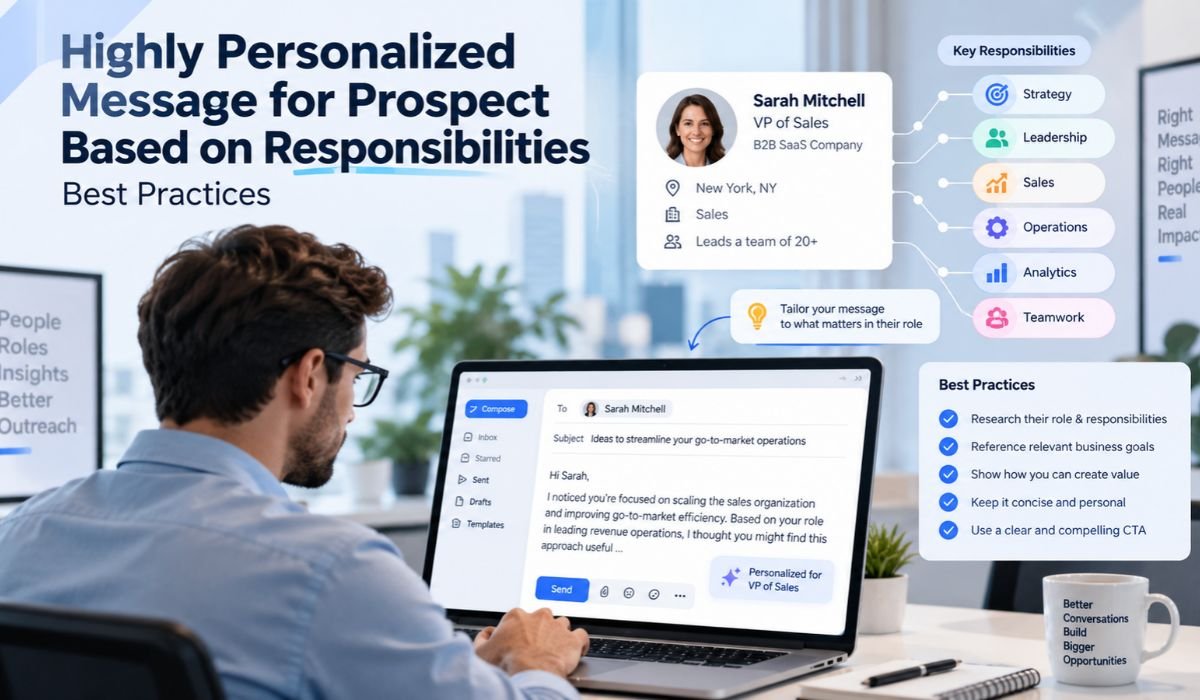
Most prospects can spot a generic sales message almost immediately. Their name may be correct, the company may be mentioned, and the opening line may even reference their job title. Yet none of that necessarily makes the message relevant.
A Highly Personalized Message for Prospect Based on Responsibilities takes a more thoughtful approach. Instead of simply proving that you’ve researched someone, it connects your reason for reaching out with that person’s professional role, business environment, and possible priorities.
For a sales leader, that conversation might involve pipeline visibility, forecasting, or team productivity. An operations leader could be more interested in process consistency or workflow efficiency. A technology executive may care about reliability, integrations, security, or scalability. Those are reasonable role-based considerations, but they shouldn’t be presented as facts unless you’ve verified them.
That distinction has become increasingly important. In 2026, buyers can research products, compare vendors, read customer feedback, and use AI tools long before they speak with a salesperson. A generic explanation of what your company sells may therefore offer little that the prospect couldn’t discover independently.
Good personalization gives them something more useful: context.
This guide explores how to research prospects carefully, understand their responsibilities, identify meaningful personalization opportunities, write better outreach, use AI responsibly, follow up effectively, and judge whether your approach is creating genuinely valuable conversations.
Quick Information
| Information | Details |
|---|---|
| Main Topic | Responsibility-Based Prospect Personalization |
| Primary Goal | Create Relevant Professional Outreach |
| Main Audience | Sales And Business Development Teams |
| Core Approach | Match Outreach With Professional Context |
| Research Focus | Role, Company, Priorities, And Recent Developments |
| Personalization Type | Role And Individual Context |
| Common Channel | Cold Email |
| Other Channels | LinkedIn And Professional Messaging |
| Main Objective | Start A Relevant Business Conversation |
| First Step | Research And Verify Information |
| Key Message Element | Relevant Business Context |
| Value Element | Connect The Solution With A Possible Need |
| Supporting Element | Credible Evidence |
| Recommended Tone | Clear, Professional, And Conversational |
| Main Risk | Unsupported Assumptions |
| AI Role | Research And Drafting Assistance |
| Scaling Approach | Frameworks, Automation, And Human Review |
| Success Indicators | Positive Replies, Meetings, And Opportunities |
What Is A Highly Personalized Message For Prospect Based On Responsibilities?
Responsibility-based personalization means building outreach around the professional context that may actually matter to a prospect. It goes considerably further than inserting a first name, company name, or job title into a prepared template.
Consider a simple opening such as, “I noticed you’re the VP of Sales at Company X.” It contains personalized information, but the prospect still doesn’t know why you’re contacting them or why the conversation should matter.
A stronger message creates that connection.
Suppose the company has publicly announced that it’s expanding into several new markets. An outreach message to its sales executive might discuss the challenges that can come with maintaining visibility across expanding territories. That gives the message a legitimate business context.
There’s an important boundary, though. You may know the company is expanding because that information was publicly announced. You don’t automatically know that its sales leader is experiencing forecasting problems, struggling with territory management, or looking for a new platform.
Professional personalization respects the difference between what you know and what you infer.
Language such as “if this falls within your remit” or “if this is currently a priority for your team” can preserve relevance without turning an educated possibility into a supposed fact.
Why Responsibility-Based Personalization Matters
Today’s buyers often arrive at sales conversations with far more information than buyers had in the past. Product websites, independent reviews, comparison tools, professional communities, customer stories, and AI-assisted research can help them investigate potential solutions without speaking to a representative.
That changes what good outreach needs to accomplish.
Simply introducing a product may not be enough. The message has to explain why the product deserves consideration in the recipient’s particular professional context.
Responsibility-based personalization can help establish that connection. It gives the prospect a clearer answer to three natural questions: Why me? Why this? Why now?
Even excellent personalization, however, doesn’t guarantee a response. A prospect might already have a suitable solution. Their budget may be committed elsewhere. The timing could be wrong, the project could lack priority, or the person receiving the message may not own the decision.
For that reason, personalization is best viewed as a way to improve relevance and conversation quality, rather than a shortcut to guaranteed conversions.
Research The Prospect Before Writing
The strongest personalized messages usually begin well before anyone starts drafting an email.
Start with the company. Look for developments that could provide a credible reason for reaching out. Relevant signals may include expansion plans, new products, leadership changes, partnerships, hiring activity, funding announcements, public interviews, strategic initiatives, or significant developments within the company’s industry.
Then narrow the research to the individual.
The most useful information isn’t necessarily the most interesting fact you can find. What matters is whether that information helps establish professional relevance.
Recency can also make a difference. A development announced recently is often a more natural conversation starter than an event from several years ago. Still, being recent doesn’t automatically make something relevant. A new office location might mean little to a software vendor, while a large hiring campaign could be highly relevant to a company selling employee onboarding technology.
Good research is selective.
You aren’t trying to assemble a biography of the prospect. You’re looking for a credible answer to one question: Why might this conversation be useful to this person now?
Verify Responsibilities Instead Of Assuming Them
A job title is a useful starting point, but it’s rarely the whole story.
Two Marketing Directors working at different companies can have dramatically different jobs. One might manage demand generation and customer acquisition. Another could oversee brand strategy, partnerships, communications, or several functions at once.
Whenever possible, look for supporting evidence. Professional biographies, company leadership pages, public interviews, presentations, role descriptions, official announcements, and professional content can all provide additional context.
When the evidence isn’t available, uncertainty should remain visible in the language.
Consider this statement: “Since your company is expanding into Europe, international demand generation must be your biggest challenge.”
It sounds confident, but it makes assumptions about both the person’s responsibilities and the company’s internal problems.
A more credible version would be: “I saw that the company recently announced its European expansion. If supporting demand generation across those markets is part of your team’s priorities, our approach may be relevant.”
The second version is still personalized. The difference is that it doesn’t pretend the sender has inside knowledge they don’t actually possess.
That restraint can make a message more trustworthy.
Match The Message With The Prospect’s Role
The same product can mean very different things to different people inside an organization.
A senior executive may consider strategic value, financial impact, growth, and organizational risk. A sales leader may be more interested in pipeline quality, forecasting, conversion, or team productivity. For a marketing leader, the conversation could center on customer acquisition, positioning, demand generation, or campaign performance.
Technology leaders may evaluate reliability, security, integration requirements, implementation effort, technical resources, and scalability. Operations leaders often look at efficiency, consistency, capacity, and workflow improvement.
These role-based patterns can guide your research, but they shouldn’t replace it.
Rather than deciding that “every CTO cares about scalability,” look for evidence that makes scalability relevant to this particular company and this particular moment.
Perhaps the business has announced rapid international expansion. Maybe it has launched a platform expected to serve a larger customer base. Those details can turn a broad role-based assumption into a much stronger personalization angle.
Find A Meaningful Personalization Angle
More personalization isn’t always better personalization.
A message containing several unrelated facts about a prospect can feel researched without ever becoming useful. In many cases, one meaningful signal creates a stronger opening than five superficial ones.
A straightforward framework can help:
Observation → Responsibility → Relevance → Value
Start with something you can verify. Consider how that development could reasonably connect with the recipient’s work. Then decide whether your product or service has genuine relevance to that situation.
Suppose a business announces plans to enter a new market. Depending on what you offer, that event could create a legitimate reason to discuss localization, logistics, recruitment, customer support, compliance, marketing, or sales infrastructure.
The key is connection.
Mentioning that the prospect recently appeared on a podcast doesn’t improve a sales message unless something from that appearance genuinely relates to the conversation you’re starting.
Effective personalization should leave the recipient with a clear answer to a simple question: Why did this person contact me specifically?
How To Write A Highly Personalized Prospect Message
Once the research is complete, the writing itself should be relatively straightforward.
Begin with the relevant context. Connect it naturally with the prospect’s possible area of responsibility. Explain what your solution can contribute, provide credible evidence when appropriate, and finish with an easy next step.
For example:
“I saw that your company recently announced expansion into two new markets. If maintaining pipeline visibility across new territories is part of your team’s priorities, our platform may be relevant because it brings regional sales activity into one reporting view. Would it be useful if I sent a short example of how another growing sales team approached this?”
There’s no elaborate sales language here.
The message doesn’t tell the prospect that their current process is broken. It doesn’t pretend to understand confidential internal problems. Nor does it make an exaggerated promise about what the product will achieve.
Instead, it gives the recipient enough context to decide whether the conversation is relevant.
That’s exactly what a good first message should do.
Write An Opening That Establishes Relevance
Opening lines carry more weight than many senders realize.
Phrases such as “I love what your company is doing” or “I’ve been following your impressive journey” can sound personalized, yet they often say very little. If the same compliment could be sent to hundreds of companies without changing its meaning, it isn’t particularly useful.
Specificity works better.
“I saw that your team recently launched its enterprise product” immediately establishes a concrete reason for the message. The next sentence can then connect that development with something relevant to the prospect’s role.
There’s no need to make the opening overly clever. A clear observation is often more convincing than a creative hook.
Professional boundaries matter too. Company announcements, published interviews, business initiatives, professional articles, and product launches usually provide more appropriate material than unrelated details from someone’s private life.
The purpose of personalization isn’t to show prospects how deeply you’ve investigated them. It’s to show that you’ve understood enough of their professional context to make the conversation worthwhile.
Connect Responsibilities With A Clear Value Proposition
One of the most common mistakes in personalized outreach happens immediately after the personalized opening.
The sender writes a thoughtful first sentence and then switches to a standard product pitch.
That breaks the connection you’ve just worked to establish.
Instead, the value proposition should continue the same line of relevance. When contacting a marketing leader, focus on the marketing outcome your solution could support. When writing to an operations executive, explain the operational value. For a technology leader, discuss the technical impact that genuinely relates to the situation.
There’s rarely a reason to describe every product feature in an introductory message.
Keep returning to three questions:
Why This Person?
Why This Solution?
Why Now?
When the message answers all three without forcing the connection, it feels purposeful. When it doesn’t, additional personalization rarely fixes the underlying problem.
Personalized Prospect Message Examples
Consider a company that has publicly announced plans to expand its sales organization.
An appropriate message to the sales leader could read:
“Your recent sales hiring announcement caught my attention. If maintaining consistent onboarding becomes more important as the team grows, our training platform may be relevant. It gives managers one place to organize onboarding material and monitor completion. Would a short example be useful?”
Now imagine a technology leader whose company has announced a new customer platform.
The message could instead say:
“I saw the announcement about your new customer platform. If integration monitoring is part of your team’s work around the rollout, I thought our monitoring solution could be relevant. Happy to send a brief example if useful.”
Both examples are personalized, but neither claims knowledge of an internal problem.
That’s an important distinction. The sender has used a verified business development to identify a plausible area of relevance, then invited the prospect to decide whether that relevance actually exists.
Personalize Cold Email And LinkedIn Outreach
The principles of responsibility-based personalization remain consistent across channels, but the delivery should change.
Cold email provides enough room to establish context, explain the relevant value, add supporting evidence, and suggest a next step. That doesn’t mean every email needs to be long. Prospects should be able to understand the purpose without digging through several paragraphs of background information.
LinkedIn and other professional messaging platforms usually reward even tighter communication.
A connection request, for example, doesn’t need to carry the entire sales pitch. A genuine professional reason to connect may be enough. If the prospect responds, the conversation can develop naturally from there.
Cross-channel consistency is equally important.
If someone receives a carefully researched email followed moments later by an obviously automated social message, the second interaction can undermine the credibility established by the first.
Treat email, professional networking, and follow-ups as parts of one conversation rather than unrelated campaign activities.
Use AI For Personalization Without Sacrificing Accuracy
AI can significantly reduce the time required to research accounts and prepare outreach. It can organize public information, summarize company developments, identify possible personalization signals, classify prospects, improve wording, and produce alternative drafts.
Those capabilities are useful, particularly for teams working across large prospect lists.
They also introduce a new responsibility: verification.
AI-generated content can misunderstand context, rely on outdated information, combine unrelated details, or produce unsupported statements that sound surprisingly convincing.
Before sending an AI-assisted message, verify the important pieces. Is the company development accurate? Does the prospect still hold the position you’re referencing? Is the responsibility actually documented, or are you inferring it? Does the proposed value accurately represent what your product can do?
The most practical approach is to treat AI as a research and drafting assistant, not an unquestioned authority.
Automation can accelerate preparation. Human judgment still determines whether the final message is accurate, relevant, and appropriate.
Personalize Prospecting At Scale
Personalized prospecting doesn’t have to mean spending an hour researching every contact.
Well-designed systems can make the process more efficient without reducing every message to a template. Teams can organize prospects according to industry, company characteristics, professional role, current business signals, and relevant use cases.
Reusable frameworks can then guide research. They can define which information needs verification, which business signals matter, and which value propositions may be relevant to different responsibilities.
Technology can handle much of the repetitive preparation. It can organize information, detect account changes, prepare initial drafts, and maintain CRM records.
Human review becomes especially important when the information is uncertain, the account is strategically valuable, or the personalization involves sensitive context.
A useful principle is:
Automate Preparation, Not Judgment.
Scale should make relevant communication more efficient. It shouldn’t turn personalized outreach back into mass messaging.
Follow Up With Additional Value
A follow-up shouldn’t exist simply because the prospect hasn’t replied yet.
Messages such as “Just checking whether you saw my previous email” ask for attention without providing much in return.
A stronger follow-up adds something.
That could be a relevant customer example, a useful observation, clarification of a benefit, or a recent development that makes the original conversation more timely.
Continuity also matters. If your first message focused on onboarding during rapid hiring, the follow-up should usually remain connected to that issue rather than abruptly promoting an unrelated feature.
Most importantly, respect the prospect’s signals.
Sending more messages doesn’t make the original message more relevant. Effective follow-up is about creating another useful opportunity to engage, not applying pressure until someone responds.
Privacy, Accuracy, And Responsible Personalization
Personalized outreach also comes with responsibilities around privacy, accuracy, and professional conduct.
Business communications may be subject to privacy, electronic marketing, and data-protection requirements. Those obligations can vary according to jurisdiction, communication method, organization type, and recipient.
Public availability shouldn’t automatically be interpreted as unlimited permission to use personal information in outreach.
From a practical standpoint, use only the information necessary to establish professional relevance. Avoid sensitive information and personal details that don’t contribute meaningfully to the business conversation.
Organizations should also accurately identify themselves, avoid deceptive statements or subject lines, honor applicable opt-out requirements, and respect previous objections or communication preferences.
Compliance requirements should be assessed according to the laws that apply to the campaign rather than assumed to be identical everywhere.
Beyond legal requirements, there’s a simpler principle at work: trust.
Accurate, transparent, restrained personalization is far more likely to build professional credibility than outreach that makes the recipient wonder how much unnecessary information has been collected about them.
Measure The Quality Of Personalized Outreach
It’s easy to become overly focused on open rates and total replies.
Neither metric tells the complete story.
Someone may reply because they’re interested, but they may also respond because they’re confused, irritated, or asking to be removed from future outreach.
More meaningful indicators include positive responses, qualified conversations, accepted meetings, genuine opportunities, pipeline progression, and eventual conversions.
Teams can also examine which personalization signals produce the strongest conversations. Outreach based on recent expansion, for example, may perform differently from messaging built around job titles alone.
Over time, those comparisons can reveal which signals are genuinely relevant to a particular audience.
Measurement should ultimately help teams improve targeting and communication, not merely increase activity.
The question isn’t simply, “How many people replied?”
A better question is, “Did this approach create more useful business conversations?”
Best Practices For Responsibility-Based Personalization
The most reliable principle behind responsibility-based outreach is simple: verify first, personalize second.
Begin with recent, credible professional information. Keep a clear distinction between what has been confirmed and what you’re reasonably inferring. Choose one strong personalization angle rather than filling the message with unrelated research.
Then connect that context with value your product or service can genuinely provide.
Use evidence carefully. If another customer achieved a particular result, that experience can provide useful context, but it shouldn’t be presented as a guaranteed outcome for every prospect.
Keep the language natural and respectful. Avoid artificial familiarity, unnecessary praise, exaggerated claims, and details that don’t contribute to the professional conversation.
Before sending anything, read the message from the prospect’s point of view.
Does the personalization make the message more useful?
Does it explain why you’re contacting this particular person?
Are the important claims accurate?
Would the message still feel professional if the prospect asked where the information came from?
Those questions provide a valuable final quality check.
Final Thoughts
A Highly Personalized Message for Prospect Based on Responsibilities isn’t successful because it contains more personal information. It’s successful when the information included makes the conversation more relevant.
That requires accurate research, professional context, thoughtful interpretation, a clear value proposition, credible evidence, and a simple next step.
AI can make parts of this process considerably faster in 2026. It can summarize research, surface useful signals, and help create first drafts. What it can’t replace is responsible human judgment.
The sender still has to decide whether the information is accurate, whether the connection makes sense, and whether the message deserves the prospect’s attention.
The most useful rule is therefore straightforward: research what is true, distinguish evidence from assumption, explain why your solution may matter, and respect the recipient’s time.
When those principles guide the process, personalization stops being a sales trick. It becomes what it should have been all along: a way to start a more relevant professional conversation.
FAQs About Highly Personalized Message For Prospect Based On Responsibilities
What Is A Highly Personalized Prospect Message?
A highly personalized prospect message is professional outreach built around information that is genuinely relevant to a particular recipient. Rather than changing only the person’s name, company, or job title, the sender connects verified business context with the recipient’s professional responsibilities and explains why the conversation may be useful.
How Do You Personalize A Message Based On Responsibilities?
Start by researching the prospect’s current role, company, and relevant business developments. Find a credible event or professional context, consider how it may relate to the person’s responsibilities, and connect that information with a genuine value proposition. When a responsibility hasn’t been verified, phrase it as a possibility rather than a fact.
What Should You Research Before Contacting A Prospect?
Useful research may include the person’s current professional role, official company announcements, expansion plans, product launches, partnerships, hiring activity, professional interviews, published content, and relevant industry developments. Focus on recent information that directly supports your reason for reaching out rather than collecting unrelated personal details.
How Long Should A Personalized Prospecting Message Be?
There’s no universal word count that works for every prospect or communication channel. The message should be long enough to establish context, relevance, and an appropriate next step while remaining easy to understand quickly. Anything that doesn’t help the recipient evaluate the conversation can usually be removed.
Can AI Write Personalized Prospecting Messages?
Yes. AI can help organize research, summarize company information, identify possible signals, prepare first drafts, and generate message variations. Human review is still important because AI-generated content may contain outdated information, incorrect interpretations, or unsupported assumptions. Important claims should always be checked before the message is sent.
How Can You Personalize Outreach Without Sounding Creepy?
Keep the personalization professionally relevant and proportionate. Company announcements, business initiatives, public interviews, professional content, and role-related information generally create more natural context than unrelated details about someone’s private life. If a detail doesn’t help explain why the business conversation matters, it probably doesn’t belong in the message.
What Makes A Good Personalized Call To Action?
A good call to action makes the next step clear without creating unnecessary pressure. Instead of immediately asking for a lengthy meeting, the sender might offer a short example, relevant comparison, case study, or brief conversation. The appropriate request depends on the relationship, offer, and stage of the conversation.
How Do You Know If Personalized Outreach Is Working?
Look beyond opens and total replies. Positive responses, qualified conversations, accepted meetings, genuine opportunities, pipeline progression, and conversions provide a better picture of whether the outreach is creating value. Comparing different personalization signals can also help reveal which approaches produce the most relevant conversations.
Learn more and explore exciting content on: Complete the Email With One Word in Each Gap: Exercises With Solutions
[…] Learn more and explore exciting content on: Highly Personalized Message for Prospect Based on Responsibilities: Best Practices […]