
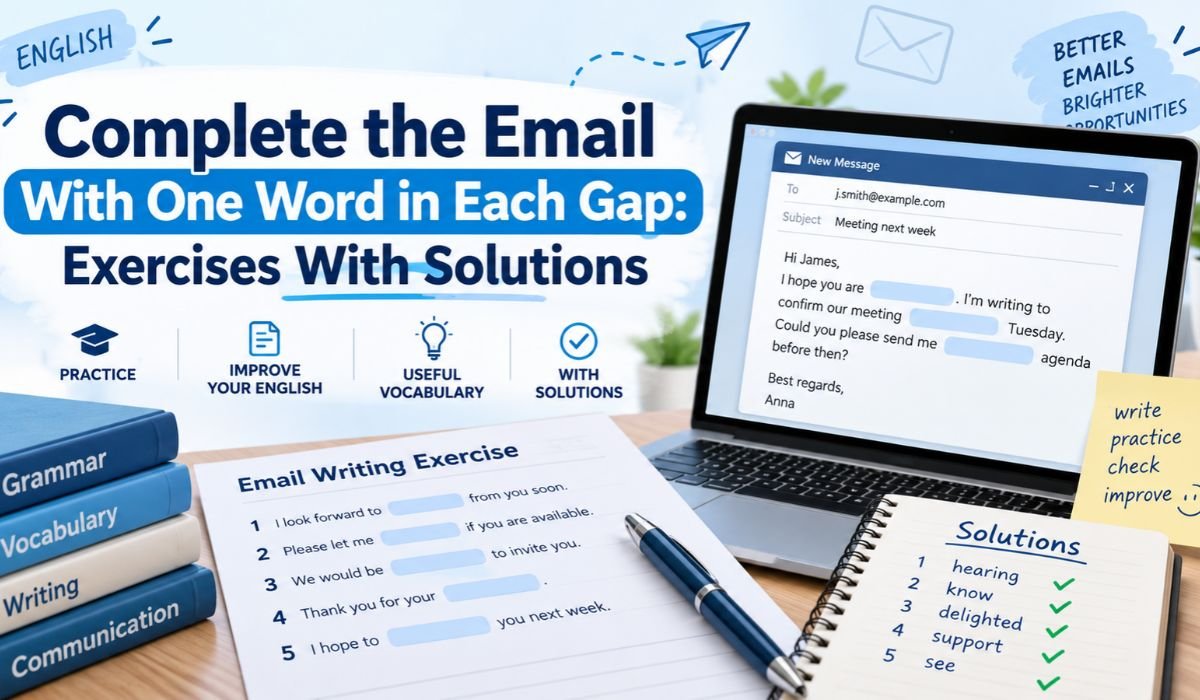
The instruction Complete The Email With One Word In Each Gap sounds straightforward. Read the email, find the blanks, and add the missing words. In practice, though, these exercises can test several areas of English at once.
To choose the right answer, you need to understand what the writer is saying, recognize the grammar around the blank, and notice how words naturally work together. A tiny word such as to, for, if, or the can determine whether an entire sentence sounds correct.
That’s what makes email gap-fill exercises so useful. Instead of studying grammar as a collection of isolated rules, learners see those rules working inside meaningful communication. Prepositions, articles, auxiliary verbs, pronouns, conjunctions, and fixed expressions all become easier to understand when they appear in context.
This guide takes a practical approach. It explains how one-word gap exercises work, shows you how to identify likely answers, and provides easy, intermediate, and advanced exercises with solutions. Along the way, you’ll also learn how these tasks relate to English exams and how to practice more effectively.
What Does Complete The Email With One Word In Each Gap Mean?
When an exercise asks you to Complete The Email With One Word In Each Gap, you’re given a message with several words removed. Each blank must be completed using one suitable word.
Here’s a simple example:
“Thank you ___ your message.”
The missing word is for, giving us the natural expression “Thank you for your message.”
The important detail is the instruction one word. If the task allows only one word per blank, writing a two-word expression doesn’t meet the requirement, even if the completed sentence would otherwise be grammatically correct.
When no possible answers are provided, this kind of activity is commonly described as an open gap-fill or open cloze exercise. Rather than recognizing the correct option from a list, you have to produce it yourself. That means grammar matters, but so do context, vocabulary, collocations, and your understanding of the message as a whole.
Quick Information
| Information | Details |
|---|---|
| Exercise Type | Open Gap-Fill Or Open Cloze |
| Main Task | Add One Word To Each Gap |
| Main Skill | Grammar In Context |
| Supporting Skill | Reading Comprehension |
| Typical Answers | Function Words |
| Common Prepositions | For, To, With, In, On, At |
| Common Articles | A, An, The |
| Common Pronouns | It, We, They, Who |
| Common Auxiliary Verbs | Be, Have, Do |
| Common Modal Verbs | Can, Could, Would, Should |
| Common Linkers | And, But, If, Because, Although |
| Important Rule | Follow The One-Word Limit |
| First Strategy | Read The Whole Text |
| Strongest Clue | Grammar Around The Gap |
| Useful Knowledge | Collocations And Fixed Expressions |
| Common Problem | Incorrect Prepositions |
| Final Check | Grammar, Meaning, And Spelling |
| Best Practice | Understand Why Each Answer Works |
Why One-Word Gap Exercises Matter
The value of an Email Gap-Fill Exercise goes beyond getting the missing word right. These activities train you to notice how English works when people actually communicate.
Take the sentence “I am interested on the course.” Most readers would probably understand the intended meaning, but standard English uses interested in. The correct sentence is “I am interested in the course.”
A gap-fill exercise makes you stop and notice that relationship.
With regular practice, patterns involving articles, prepositions, pronouns, verb forms, linking words, and common expressions gradually become more familiar. Eventually, you begin recognizing them without having to work through a grammar rule every time.
That can make a noticeable difference to everyday writing. The same patterns tested in an exercise appear in messages to teachers, colleagues, customers, friends, universities, and employers. Learning them in context can therefore support both exam performance and clearer real-world communication.
Words You Are Most Likely To Need
Many learners expect difficult vocabulary to be the biggest challenge in an open cloze. Often, the opposite is true. Some of the most important answers are very short, familiar words.
Prepositions such as in, on, at, for, to, and with appear frequently because they form part of countless English structures. Articles including a, an, and the can also be tested, particularly when a sentence requires you to decide whether a noun is general or specific.
Then there are pronouns, auxiliary verbs, modal verbs, and linking words. Depending on the sentence, the missing word could be it, we, have, be, can, would, if, because, although, or that.
Fixed expressions add another layer. English naturally uses combinations such as interested in, thank you for, and look forward to. Changing the preposition may produce an expression that sounds unnatural or is simply incorrect.
So, before trying to name the missing word, ask yourself a simpler question: What kind of word belongs here? Identifying the category can quickly narrow your options.
How To Find The Correct Word
A good strategy starts before you fill a single blank.
Read the entire message first. Work out who is writing, what the email is about, and what the sender wants to communicate. That wider context can provide clues that aren’t obvious when you look at an individual sentence.
Next, examine the words on both sides of the gap.
Consider:
“I look forward ___ hearing from you.”
The natural answer is to because look forward to is a fixed construction. In this sentence, the preposition to is followed by the gerund hearing.
Now consider:
“Would it ___ possible to meet tomorrow?”
The correct answer is be. After the modal would, this structure requires the base form of the verb.
Don’t spend too long on a difficult blank during your first pass. Complete the answers you know, then return to uncertain ones. Once more of the email is complete, the surrounding meaning may make the difficult gaps easier to solve.
Grammar Clues Around The Gap
One of the best ways to improve at gap-fill exercises is to stop treating the missing word as an isolated mystery. Usually, the sentence gives you evidence.
Take this example:
“She has lived here ___ May.”
The sentence describes something that began at a particular point in the past and continues into the present. Because May identifies the starting point, since is the natural answer.
Now look at:
“We ___ already completed the report.”
The word completed is a past participle. In a suitable present-time context, have forms the present perfect construction: “We have already completed the report.”
Articles can be identified in much the same way. In the sentence “I have attached ___ document you requested,” the works because “you requested” identifies a particular document known through the context.
These clues are more dependable than guesswork. Rather than asking which word merely sounds acceptable, look at the grammatical structure being built around the blank.
Fixed Expressions Worth Recognizing
English correspondence contains many expressions that appear again and again. Learning these combinations can make email completion exercises much easier.
Common examples include thank you for, apologize for, interested in, look forward to, get in touch with, and please let me know if.
Consider this sentence:
“I am writing ___ ask about the course.”
The answer is to, producing “I am writing to ask about the course.” The infinitive explains the purpose of writing.
The same structure works in many other situations. You can write “I am writing to confirm,” “I am writing to request,” or “I am writing to explain.”
That’s why learning the underlying pattern is more valuable than memorizing one completed sentence. Once you understand the construction, you can recognize and use it in many different contexts.
Easy Email Gap-Fill Exercise
Start with a simple example. Try to complete the email before reading the solutions.
“Hi Emma,
Thank you ___ your message. I am happy ___ hear that you are coming to visit. Are you arriving ___ Friday? I can meet you ___ the station if you would like. Please let me know ___ your train arrives. I hope ___ weather will be good.
See you soon,
Mia”
The intended answers are for, to, on, at, when, and the.
The first two come from familiar structures: thank you for and happy to hear. We normally use on with days such as Friday, while at is natural when referring to a particular meeting point such as the station.
The word when introduces the time of the train’s arrival. Finally, the is appropriate before “weather” because the writer is referring to the weather expected during the visit.
Nothing here requires advanced vocabulary. The challenge is recognizing how familiar words behave inside complete sentences.
Intermediate Email Gap-Fill Exercise
The next exercise uses language you might see in a professional email.
“Dear Ms. Taylor,
I am writing ___ ask whether the meeting scheduled for Thursday can be moved. I have spoken ___ my manager, and we would prefer to meet ___ Friday afternoon. This is because several members of our team will ___ unavailable on Thursday. I would appreciate ___ if you could confirm whether the new time is suitable. Please let me know ___ you require any further information.
Kind regards,
Daniel”
The intended answers are to, with, on, be, it, and if.
Each gap reflects a useful English pattern. We say writing to ask, spoken with my manager, and on Friday afternoon. After will, the adjective “unavailable” needs be, producing “will be unavailable.”
The phrase “I would appreciate it if” is a conventional polite construction. The final if introduces the condition of requiring additional information.
Instead of remembering this particular sequence of answers, pay attention to the patterns. They’re likely to appear again in other professional messages.
Advanced Email Gap-Fill Exercise
Advanced exercises tend to rely more heavily on the relationship between clauses. Individual words may provide fewer obvious clues, so understanding the complete message becomes increasingly important.
Consider this example:
“Dear Admissions Team,
Thank you for informing me ___ my application has been received. I would be grateful ___ you could clarify whether any additional documents are required. Although I have already submitted my academic records, I am unsure ___ a certified copy is also necessary. Please let me know if there is anything else I should provide ___ the application is reviewed. I look forward ___ hearing from you.
Kind regards,
Alex”
The intended answers are that, if, whether, before, and to.
The first that introduces the information the applicant received. If completes the polite expression “I would be grateful if.” The word whether introduces uncertainty about the need for a certified copy.
Next, before establishes the order of events: any additional material should be provided before the application is reviewed. Finally, to completes the fixed expression look forward to.
At this level, success depends less on spotting one nearby clue and more on understanding how the entire sentence is constructed.
Formal And Informal Email Language
Not every email should sound the same. The relationship between the sender and recipient affects vocabulary, sentence structure, and level of formality.
A formal message might say, “I would be grateful if you could confirm the appointment.” Another common construction is, “Please let me know if you require further information.”
A message to a friend is likely to be more relaxed: “Are you free on Saturday?” or “Let me know when you arrive.”
Contractions are also more common in everyday communication, although they can appear in many professional contexts as well.
When a gap seems difficult, consider the tone of the message. Is someone contacting a friend, teacher, university, employer, customer, or colleague? Understanding that relationship can help you decide which expression fits naturally.
Common Mistakes To Avoid
A surprisingly common mistake is overlooking the instructions. If an exercise says one word, then the answer must contain one word. A longer phrase may create a perfectly good sentence, but it still doesn’t satisfy the task.
Prepositions cause plenty of difficulty too. Their use isn’t always predictable from literal meaning, especially in fixed expressions and collocations. That’s why learners benefit from remembering combinations such as interested in rather than studying the word in on its own.
Articles present a different challenge. Choosing between a, an, the, and no article often depends on whether the noun is general, specific, countable, or already identifiable from the context.
Another common problem is looking only at the two or three words closest to the gap. Those words matter, but sometimes the answer depends on information elsewhere in the sentence or paragraph.
Once you’ve finished, read the whole email again. A word that seemed reasonable while solving an individual gap may sound noticeably wrong when you read the complete message.
Use Context Instead Of Guessing
Grammar tells you what is possible. Context often tells you what the writer actually means.
Compare these two sentences:
“Please contact me ___ you have any questions.”
“Please contact me ___ you arrive.”
In the first sentence, if is the natural answer because the writer is describing a condition. In the second, when refers to the time of arrival.
Both words are simple. The difference lies in the relationship between the ideas.
When you’re unsure, look for signals of time, reason, contrast, condition, purpose, or consequence. Read the previous sentence as well as the current one. Sometimes the information needed to solve a gap appears earlier in the email.
It’s also worth remembering that natural English can occasionally allow more than one grammatical construction. Carefully designed exercises normally provide enough context to indicate the intended answer, while appropriate alternative answers may be recognized where the marking rules allow them.
How To Improve Speed And Accuracy
Trying to read faster isn’t necessarily the best way to become quicker at open-cloze exercises. Real speed comes from recognizing familiar structures without having to analyze them from scratch.
If thank you for and look forward to are already familiar, those gaps take almost no time. The same principle applies to grammatical constructions.
Regular practice helps, but reviewing mistakes is just as important. If you repeatedly choose the wrong preposition, spend time learning common verb-preposition and adjective-preposition combinations. If articles are your weak point, review how English distinguishes between general and specific nouns.
During a timed exercise, deal with the obvious answers first. Return to harder gaps once the rest of the passage is clearer.
Your final check should cover four things: grammar, meaning, spelling, and the word limit. Reading the email naturally from beginning to end is often the quickest way to catch an answer that doesn’t belong.
What Official English Exams Actually Test
One-word gap exercises are associated with several English-learning and examination contexts, but it’s important not to treat every Email Gap-Fill Exercise as an official exam format.
Cambridge B1 Preliminary currently includes an open-cloze task in Reading Part 6. Candidates complete six gaps by writing one word in each space. The qualification also includes a separate Writing Part 1 task in which candidates write an email of about 100 words in response to information provided in the question. The open cloze and email-writing task are separate activities.
Cambridge B2 First includes an open cloze in Reading and Use of English Part 2. It contains eight questions and tests grammatical and lexico-grammatical knowledge. C1 Advanced also includes an eight-gap open-cloze task in Part 2 of Reading and Use of English.
IELTS General Training uses a different approach. Writing Task 1 asks candidates to respond to a situation by writing a letter of at least 150 words. It isn’t a one-word email open-cloze exercise.
Even so, gap-fill practice can still strengthen grammar, preposition use, linking, and awareness of formal and informal language. Those skills have value across many forms of English communication.
Because examination formats can change, anyone preparing for a specific qualification in 2026 should check the latest official instructions and sample materials for that exam.
A Better Way To Practice At Home
You don’t need to rely entirely on ready-made worksheets to improve.
One useful technique is to take a correctly written email and remove selected grammatical words yourself. You might delete several prepositions, articles, conjunctions, or auxiliary verbs. Put the original aside and return later to see whether you can reconstruct the message accurately.
Another effective habit is keeping an error record. Don’t simply write that your answer was wrong. Record the language pattern you misunderstood.
For example, instead of noting only in, write:
interested in + noun
Likewise, record:
look forward to + noun or gerund
That small change turns a correction into reusable knowledge. The next time the same structure appears in a different sentence, you’ll be far more likely to recognize it.
Teachers creating their own exercises should also pay attention to ambiguity. A useful gap should have a clear intended solution unless multiple alternatives are deliberately being accepted.
Quick Practice Test With Solutions
Now put the main ideas into practice with one final exercise.
“Dear James,
Thank you ___ agreeing to help with the event. We are planning to hold it ___ the main hall next Tuesday. We expect ___ around fifty guests will attend. Could you please let me know ___ you are available in the morning? We would also appreciate ___ if you could arrive early. Please contact me ___ you need any additional details.
Best wishes,
Laura”
The intended answers are for, in, that, if, it, and if.
The opening phrase is thank you for, while in identifies the location of the event. That introduces what the organizers expect: around fifty guests will attend.
The first if asks about James’s availability. It completes the polite expression “We would appreciate it if,” and the final if introduces the condition under which James should make contact.
If you got something wrong, resist the temptation to memorize the completed email. Go back and identify the reason. Understanding the pattern will help you answer far more questions than remembering a single solution.
Final Thoughts
Learning how to Complete The Email With One Word In Each Gap isn’t really about filling empty spaces. It’s about seeing the relationships that hold English sentences together.
Words such as to, for, if, the, have, and that may be short, but they perform essential jobs. They connect ideas, establish time and conditions, complete grammatical structures, and make common expressions sound natural.
A reliable approach is to read the entire text first, study the grammar surrounding each blank, complete the answers you recognize, and then return to anything uncertain. Once you’re finished, read the message again as a complete piece of communication.
Above all, pay attention to your mistakes. Knowing the correct answer is useful; understanding why it’s correct is what builds lasting language ability. With consistent practice, the patterns become more familiar, and choosing the right word begins to feel less like solving a puzzle and more like using English naturally.
FAQs About Complete The Email With One Word In Each Gap
What Does Complete The Email With One Word In Each Gap Mean?
It means an incomplete email or passage contains blank spaces, and you must place exactly one suitable word into each blank. The answer needs to work grammatically while also matching the meaning and context of the message.
Which Words Appear Most Often In Open-Cloze Exercises?
Many gaps involve function words such as articles, prepositions, pronouns, auxiliary verbs, conjunctions, and linking words. Fixed expressions and grammatical constructions are also important, particularly at higher proficiency levels.
How Can I Find The Correct Answer Faster?
Begin by reading the complete text rather than immediately filling the first blank. Then examine the grammar around each gap, identify what type of word is likely to be missing, and check for familiar collocations or fixed expressions. Answer obvious gaps first and return to difficult ones afterward.
Can I Write Two Words In One Gap?
Not when the instructions specifically say that only one word is allowed. Following the word limit is part of completing the exercise correctly, so a two-word answer won’t satisfy a strict one-word task.
Can More Than One Answer Be Correct?
In some cases, yes. Natural English can allow more than one grammatical construction. Well-designed exercises normally provide enough context to establish an intended answer, while official marking guidance may recognize acceptable alternatives where appropriate.
What Is An Open Cloze?
An open cloze is a passage with words removed and no multiple-choice options provided. Learners have to supply the missing words themselves by using grammar, vocabulary, collocations, fixed expressions, and contextual clues.
Does Cambridge B1 Preliminary Include One-Word Gap Questions?
Yes. B1 Preliminary Reading Part 6 currently includes an open-cloze task with six gaps, and candidates write one word in each gap. The qualification’s Writing Part 1 email task is separate and asks candidates to produce an email of about 100 words.
Is This An IELTS Email Exercise?
No. IELTS General Training Writing Task 1 requires candidates to write a letter of at least 150 words in response to a given situation. It doesn’t use the same one-word email open-cloze format. However, gap-fill practice can still strengthen grammatical accuracy and familiarity with useful English structures.
Learn more and explore exciting content on: Badseed Tech: A Complete Guide to Features, Products, and More
[…] Learn more and explore exciting content on: Complete the Email With One Word in Each Gap: Exercises With Solutions […]