
Publishing more content doesn’t automatically lead to a stronger Content Strategy. A company can release articles, videos, newsletters, landing pages, and social posts every week and still struggle with a surprisingly simple question: Where is all this content actually taking us?
That question gets to the heart of why a Content Roadmap matters.
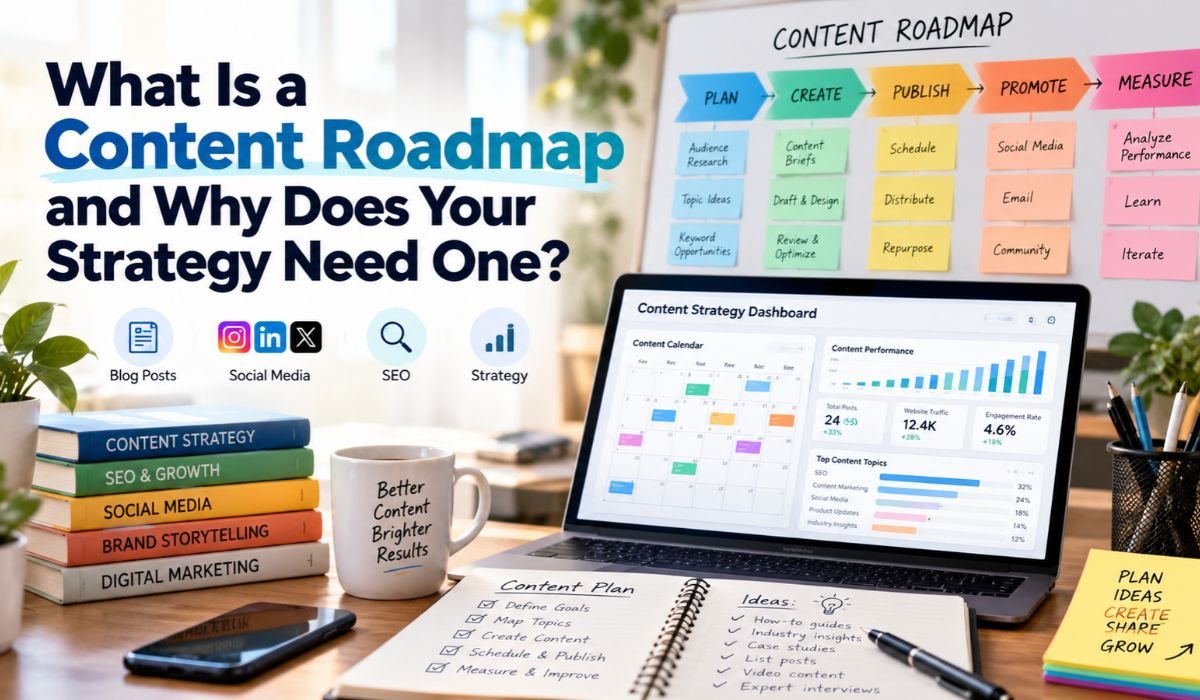
If you’re trying to understand What Is a Content Roadmap, think of it as the link between strategic thinking and the content work happening every day. It connects important content initiatives with audience needs, business objectives, priorities, responsibilities, resources, and expected outcomes.
That connection has become increasingly important. Modern Content Marketing isn’t limited to maintaining a company blog. Teams may be balancing SEO content, product education, video, email campaigns, social distribution, customer resources, sales materials, and major launches at the same time. Without a shared direction, even talented teams can end up producing plenty of material without building toward a meaningful result.
A well-designed Content Roadmap brings those moving parts together. It helps everyone see what deserves attention, what can wait, who owns each major initiative, why the work matters, and how success will eventually be judged.
Quick Bio Information
| Content Roadmap Fact | Key Information |
|---|---|
| Core Purpose | Connect Content Work With Strategic Goals |
| Planning Level | High-Level And Strategic |
| Main Focus | Priorities And Content Initiatives |
| Starting Point | Audience And Business Needs |
| Strategy Role | Turns Direction Into Planned Action |
| Main Users | Content And Marketing Teams |
| Small Business Use | Suitable For Lean Teams |
| Content Types | Articles, Video, Email, Social, Guides, And More |
| Audience Role | Helps Identify Useful Content Priorities |
| Ownership | Clarifies Responsibility |
| Timeline | Shows Broad Timing And Milestones |
| Collaboration | Supports Cross-Team Coordination |
| Resources | Helps Match Plans With Available Capacity |
| Measurement | Connects Initiatives With Relevant KPIs |
| Calendar Relationship | Guides Detailed Content Scheduling |
| Main Advantage | Better Prioritization |
| Flexibility | Can Change With New Evidence |
| Review Need | Should Be Revisited As Priorities Change |
What Is a Content Roadmap?
A Content Roadmap is a high-level strategic plan that organizes major content priorities over a defined period. Rather than tracking every small production task, it gives teams a broader view of where their content efforts are heading and which initiatives deserve the most attention.
In practical terms, it sits between Content Strategy and execution.
A Content Strategy establishes the bigger picture. It identifies the audience, explores what those people need, defines what the brand can credibly contribute, and connects content with wider organizational goals. The Content Roadmap takes that thinking and turns it into priorities that a team can actually act on.
Consider a software company preparing to introduce a new product. Its roadmap might prioritize customer education, beginner tutorials, product comparisons, onboarding resources, and customer stories. The individual articles, videos, and publication dates supporting those initiatives can later be organized through a Content Calendar or Editorial Calendar.
That distinction matters. A roadmap shouldn’t become another crowded task list. Its job is to help people make better strategic decisions and understand where the overall content program is going.
Why Your Content Strategy Needs a Roadmap
Coming up with content ideas is rarely the hardest part of Content Marketing. The real challenge is deciding which ideas deserve limited time, money, and expertise.
Without a roadmap, planning can quickly become reactive. Sales asks for a guide. The SEO team identifies a promising topic. Product wants educational material for a new feature. Someone suggests a video series, while another department needs content for an upcoming campaign.
Each request may be reasonable on its own. The problem appears when everything becomes urgent.
A Content Roadmap gives teams a shared framework for evaluating those requests. Before committing resources, they can ask whether an initiative addresses a genuine audience need, supports a meaningful business objective, fits the brand’s expertise, and deserves attention compared with other opportunities.
Unexpected requests won’t disappear, of course. What changes is the way they’re handled. Instead of allowing the newest idea to automatically become the highest priority, teams have context for deciding where it belongs.
That creates a more deliberate Content Strategy in which publishing decisions are driven by purpose rather than pressure.
How a Content Roadmap Works
An effective Content Roadmap starts with outcomes, not a long list of topics.
The first step is understanding what the organization is trying to accomplish. Perhaps the goal is to attract more qualified visitors, educate prospective customers, support a product launch, improve product adoption, generate leads, or establish stronger authority in a particular subject area.
Once the objective is clear, the next question becomes more useful: What does the audience need in order for content to contribute to that outcome?
Teams can then identify broader content initiatives and compare them according to audience value, strategic relevance, urgency, available resources, expected impact, and dependencies.
Imagine a software business trying to increase adoption of a complicated feature. Publishing unrelated articles simply because they have attractive search volume may not solve the underlying problem. A more useful roadmap could prioritize tutorials, demonstrations, use cases, onboarding material, FAQs, and customer education.
Starting with the desired outcome changes the conversation. Instead of asking, “What can we publish?” the team begins asking, “What should we create to solve this particular problem?”
That’s a far more strategic question.
Key Elements of an Effective Content Roadmap
A useful Content Roadmap should give stakeholders enough information to understand both the initiative and the reasoning behind it.
That generally means identifying the intended audience, business objective, major content initiative, priority level, owner, approximate timeframe, relevant channels, dependencies, resources, and suitable measures of success.
Context is especially important.
Imagine a roadmap containing an initiative called “Beginner Learning Hub.” The name tells the team what is being created, but not why. Add the insight that new customers repeatedly need introductory information before they can understand the company’s product, and the initiative suddenly has a clear strategic purpose.
At the same time, restraint matters. A roadmap becomes difficult to use when every draft deadline, image request, proofreading task, social post, and minor revision is added to it.
Those details are important, but they usually belong in an Editorial Calendar or Project Management system. The roadmap should remain clear enough that a stakeholder can review it and quickly understand the organization’s most important Content Priorities.
Content Roadmap Vs Content Strategy
Content Strategy and Content Roadmapping are closely connected, but they serve different purposes.
Content Strategy establishes the overall approach. It considers who the audience is, what the organization wants to achieve, which subjects matter, how the brand should communicate, where content will be distributed, and what standards should guide its creation and management.
The Content Roadmap moves one step closer to execution. It identifies which major initiatives should receive attention and how those priorities may unfold over time.
Suppose a financial software company decides that its Content Strategy should help small-business owners understand complicated accounting topics in plain language.
The roadmap could translate that goal into practical initiatives, such as a beginner accounting learning center, bookkeeping tutorials, tax-season education, and product-focused learning resources.
In that example, the strategy explains why the company is creating content and how it intends to provide value. The roadmap identifies the major projects that can bring that strategy to life.
The two work best together rather than as competing planning tools.
Content Roadmap Vs Content Calendar
A Content Roadmap and Content Calendar also perform different jobs.
The roadmap offers the strategic view. The Content Calendar handles individual publishing activity.
For example, a roadmap might identify beginner education as a major priority for the coming quarter. The calendar can then list the specific articles, videos, newsletters, or social posts that support that initiative, along with their production and publication dates.
Keeping those functions separate helps prevent a common problem in Content Marketing: mistaking activity for progress.
A full publishing calendar certainly looks busy. But publishing frequently doesn’t necessarily mean a business is creating the right content, reaching the right audience, or working toward worthwhile goals.
The roadmap establishes direction. The calendar helps the team follow that direction through day-to-day execution.
Content Roadmap Vs Editorial Calendar
An Editorial Calendar usually goes further into the production process. Depending on the organization, it may track topics, writers, editors, drafts, reviews, approvals, deadlines, publication dates, and distribution plans.
The Content Roadmap stays at a higher strategic level.
A growing organization might therefore use its Content Strategy to define the overall direction, a Content Roadmap to establish important initiatives, and an Editorial Calendar to manage the individual pieces needed to complete those initiatives.
Smaller businesses don’t necessarily need three separate systems. In many cases, a simple document or planning tool can handle several functions at once.
What’s important isn’t the number of documents a company maintains. It’s whether everyone involved understands the difference between strategic priorities and everyday production tasks.
Good planning should reduce complexity, not create more of it.
Benefits of a Content Roadmap
Perhaps the most immediate benefit of a Content Roadmap is better prioritization.
Most businesses can generate far more content ideas than they can realistically execute. Time, budgets, expertise, and production capacity are limited, which means choosing what not to create can be just as important as deciding what to publish.
A roadmap gives teams a structured way to make those choices.
It also creates visibility. Marketing leaders can see which initiatives are moving forward, while writers, editors, designers, SEO specialists, subject experts, and other contributors gain a clearer understanding of how their work supports larger goals.
Dependencies become easier to spot, and resource planning becomes more realistic.
There’s another benefit that’s easy to overlook: a roadmap gives teams a sensible way to say “not yet.”
A promising idea doesn’t always have to be approved or rejected immediately. It may simply be less important than another project at the moment. Moving it to a later planning period allows the team to preserve the idea without sacrificing current priorities.
Seen this way, a Content Roadmap isn’t only a planning document. It’s also a decision-making framework.
How a Content Roadmap Improves Collaboration
Content creation is often more collaborative than it appears from the outside.
A technically complex article may require input from a subject expert. A product launch could involve Product, Sales, Customer Support, Design, SEO, and Marketing. Certain topics may also require additional professional or legal review before publication.
Problems usually emerge when these dependencies are discovered too late.
A Content Roadmap gives teams earlier visibility into what’s coming. Stakeholders can identify the expertise, information, approvals, and resources an initiative will require before production reaches a critical stage.
Clear ownership matters just as much.
Several people may contribute to one initiative, but someone should remain accountable for moving the project forward. That doesn’t mean the owner performs every task. It simply means the team knows who is coordinating progress, resolving uncertainty, and raising issues when something becomes blocked.
That clarity can prevent a surprisingly common problem: projects stalling because everyone thought someone else was responsible.
How to Create a Content Roadmap
The best place to begin isn’t an empty brainstorming page. It’s evidence.
Review your Business Goals, existing Content Strategy, audience research, customer questions, current content performance, sales conversations, product priorities, support requests, search behavior, and known information gaps.
Then look for patterns.
Perhaps prospective customers repeatedly misunderstand one part of your service. Maybe several existing articles attract visitors but fail to answer the questions those readers ask next. A new product may require extensive education before customers can appreciate its value.
Patterns like these can become broader content opportunities.
From there, compare potential initiatives using practical criteria. Consider audience value, business relevance, expected impact, urgency, effort, available expertise, and dependencies.
The strongest opportunities can move onto the roadmap. Once priorities are established, assign ownership, determine broad timing, identify the required resources and channels, and decide how results will be evaluated.
Only after that strategic work is complete should large initiatives be broken into individual articles, videos, campaigns, and production tasks.
Goals, Audience, And Search Intent
Effective Content Planning starts with two questions: What are we trying to accomplish, and who are we trying to help?
The answers shape almost every decision that follows.
A company focused on awareness may need accessible educational resources that introduce people to unfamiliar topics or problems. A business trying to support conversions may benefit more from comparisons, demonstrations, case studies, and decision-focused resources. Existing customers could need tutorials, troubleshooting information, or more advanced education.
Search Intent offers another useful source of insight.
Someone searching What Is a Content Roadmap, for example, is likely looking for a clear explanation before they need advanced implementation advice. A strong article should satisfy that immediate need first and then guide the reader naturally toward deeper information.
Search data, however, shouldn’t make every decision.
Customer interviews, support conversations, sales feedback, internal search behavior, website analytics, and existing content performance can reveal needs that traditional keyword research doesn’t always capture.
A mature roadmap combines SEO opportunities with genuine knowledge of the people the business wants to serve.
Choosing Content Types And Distribution Channels
A useful content idea doesn’t automatically need to become a blog post.
Some subjects are easier to explain through video. A complicated process might benefit from a visual guide. Original research may deserve a detailed report, while customer outcomes could be presented through a case study. Recurring updates might make more sense in a newsletter.
The format should follow the purpose rather than habit.
Distribution deserves the same consideration.
One of the easiest mistakes in Content Marketing is spending most of the effort on production and only thinking about distribution after something has been published. A better roadmap considers how the intended audience is likely to discover or use the content from the beginning.
Depending on the audience and objective, discovery could happen through organic search, email, social platforms, video, communities, sales conversations, or direct visits to the company’s website.
In other words, a strong roadmap doesn’t stop at deciding what deserves to be created. It also considers how useful content will reach the people it was created for.
Building a Realistic Timeline And Clear Ownership
A roadmap can look impressive and still fail if the team doesn’t have the capacity to deliver it.
Realistic planning means accounting for available time, specialist expertise, review requirements, launches, seasonal priorities, dependencies, and unexpected work.
At the roadmap level, broad planning periods are often more useful than forcing every initiative into an exact deadline too early. Detailed dates can be introduced later through an Editorial Calendar or Project Management workflow.
Ownership should be equally clear.
When writers, designers, SEO specialists, product experts, and other contributors are involved, everyone needs to understand who is coordinating the initiative and where individual responsibilities begin and end.
Capacity also affects quality. Teams operating under constant deadline pressure naturally have less time for careful research, fact-checking, expert input, editing, and refinement.
Sometimes producing fewer pieces of genuinely useful content is a better strategic choice than maintaining a publishing schedule the team cannot realistically sustain.
Measuring Content Roadmap Success
There isn’t one universal KPI that can tell every organization whether its Content Roadmap is successful.
The right measurement depends on the original goal.
A search-focused initiative may examine relevant organic visibility and qualified website traffic. Lead-generation content could be judged through enquiries, sign-ups, or conversions. Customer education might require a different set of signals, including engagement with learning resources, successful product adoption, or changes in recurring support questions.
The important part is deciding what success means before judging the result.
Teams should also be cautious with vanity metrics.
A page attracting thousands of visits may look impressive in a report, but large traffic numbers aren’t automatically valuable. If visitors are the wrong audience or the content doesn’t achieve its intended purpose, those numbers can create a misleading picture of performance.
A better question is straightforward: Did this content initiative produce the audience or business outcome it was designed to support?
That keeps measurement connected to strategy.
Updating Your Content Roadmap
A good roadmap creates stability without becoming rigid.
Business priorities change. Products evolve. Customer questions shift. Resources can grow or disappear. Performance data may also reveal that an initiative isn’t working as expected.
That’s why a Content Roadmap should be reviewed rather than treated as a permanent plan.
During those reviews, teams can ask whether major initiatives still address relevant audience needs, support current goals, have sufficient resources, and remain justified by what the organization has learned.
That doesn’t mean changing direction every time a metric moves. Short-term performance can fluctuate for many reasons, and constantly rewriting the roadmap can create more confusion than clarity.
The goal is to respond to meaningful evidence.
When priorities genuinely change, the roadmap should be flexible enough to change with them.
Common Content Roadmap Mistakes
One of the quickest ways to weaken a roadmap is to put every possible idea on it.
When everything becomes a priority, nothing really is.
Another common mistake is using publishing volume as the main measure of progress. Producing more articles or videos shows activity, but activity alone doesn’t prove that content is useful or strategically valuable.
Unrealistic timelines can create similar problems. So can unclear ownership, weak audience research, poor resource planning, or an excessive focus on search volume without considering business relevance.
Credibility also matters. Organizations shouldn’t imply expertise or first-hand experience they don’t actually have. When a topic requires specialist knowledge, appropriate experts or credible reviewers should be involved rather than relying on unsupported claims.
Finally, teams shouldn’t keep pursuing an initiative simply because it appeared on the original roadmap.
Strategic planning isn’t about stubbornly following an old document. It’s about making informed choices as better evidence becomes available.
Content Roadmap Example
Consider an online accounting platform designed for small-business owners.
Through customer conversations and support data, the company discovers that many potential users struggle with basic bookkeeping concepts before they’re ready to understand the software itself.
That finding creates a clear audience problem.
Instead of immediately brainstorming dozens of unrelated article titles, the company establishes a strategic objective: improve beginner financial education.
Its Content Roadmap could then prioritize a Small Business Bookkeeping Learning Hub. The initiative might include foundational explanations, terminology guides, practical tutorials, common bookkeeping mistakes, expert-reviewed educational material, videos, and relevant product education.
The roadmap would identify who the initiative is intended to help, why it matters, who owns it, which expertise is required, how it will be distributed, the broad timeframe, major dependencies, and how success will be measured.
Specific articles and videos would move into the Editorial Calendar afterward.
The order is important. The company didn’t begin by asking what it should publish this week. It started with a genuine audience problem and designed a coordinated content initiative around solving it.
That is Content Roadmapping in practice.
Content Roadmap Best Practices
The best Content Roadmaps are usually easier to understand than people expect.
Keep priorities visible and give every major initiative a clear reason for existing. Ask which audience need it addresses, what objective it supports, why it deserves attention now, who owns it, and what meaningful success would look like.
Plans should also reflect real resources rather than an idealized publishing schedule.
Expertise deserves particular attention. When a subject requires specialist knowledge, involve people who genuinely understand it. That expertise may contribute through research, writing, interviews, fact-checking, or editorial review.
Clear authorship and review processes can also help readers understand where information comes from and who is responsible for its accuracy.
Above all, remember that a Content Roadmap should serve people before it serves a publishing schedule.
SEO can play an important role in helping useful information get discovered, but search visibility works best when it supports genuine reader value. The strongest Content Strategies don’t force a choice between SEO and user experience. They use both to help the right information reach the right audience.
Final Thoughts
Understanding What Is a Content Roadmap becomes easier once you stop thinking about it as another marketing document and start seeing it as a way to make better decisions.
Its purpose is to connect strategy with execution.
A useful roadmap gives teams a shared understanding of which initiatives deserve attention, who they’re intended to help, why they matter, who is responsible for moving them forward, and what evidence will show whether they succeeded.
That kind of clarity is increasingly valuable as producing content becomes faster and easier. Having the ability to publish more doesn’t necessarily mean that publishing more is the right decision.
Choosing wisely matters more.
A thoughtful Content Roadmap helps a business invest its time, resources, and expertise in content that has a genuine reason to exist. When those decisions are grounded in audience needs, credible knowledge, realistic capacity, and measurable objectives, the roadmap becomes more than a planning tool.
It becomes a practical framework for building a more focused, useful, and sustainable Content Marketing Strategy.
FAQs About Content Roadmaps
What Is a Content Roadmap?
A Content Roadmap is a high-level strategic plan that connects important content initiatives with audience needs, business objectives, priorities, ownership, resources, and broad timeframes. It helps a team understand which content work deserves attention and why that work matters.
Why Is a Content Roadmap Important?
A roadmap gives Content Marketing a clearer direction. It can improve prioritization, help teams allocate limited resources, clarify responsibilities, reveal dependencies, and reduce the amount of disconnected content being produced without a meaningful strategic purpose.
What Should a Content Roadmap Include?
The exact structure depends on the organization, but a useful roadmap generally identifies the audience, objective, major initiatives, priorities, owners, broad timing, dependencies, resources, distribution channels, and relevant success measures. It should provide enough detail to guide strategic decisions without becoming overloaded with everyday production tasks.
Is a Content Roadmap the Same as a Content Strategy?
No. Content Strategy defines the broader purpose, audience, direction, standards, and approach behind content. A Content Roadmap takes that strategic direction and turns it into prioritized initiatives that can be carried out over time.
What Is the Difference Between a Content Roadmap and Content Calendar?
A Content Roadmap focuses on strategic priorities and major initiatives. A Content Calendar typically organizes specific content pieces, production dates, and publishing schedules. The roadmap provides direction, while the calendar supports day-to-day execution.
Can a Small Business Use a Content Roadmap?
Yes. Small businesses may find a roadmap especially useful because they usually have limited time and resources. A simple roadmap can help them concentrate on a small number of initiatives that closely match customer needs and important business goals rather than trying to publish everywhere at once.
How Often Should a Content Roadmap Be Updated?
There isn’t a single schedule that works for every organization. The roadmap should be reviewed when meaningful changes in business priorities, audience needs, resources, products, or performance evidence could affect existing plans. Fast-moving organizations may need to review priorities more frequently than businesses operating in relatively stable environments.
What Tools Can Be Used to Create a Content Roadmap?
A Content Roadmap can be created in a spreadsheet, collaborative document, visual planning board, Project Management platform, or specialized roadmapping software. The best choice is usually the simplest system that gives the necessary people visibility and can be maintained consistently.
Learn more and explore exciting content on: Nemin.io Explained: Free Business Tools, Features, and Benefits
[…] Learn more and explore exciting content on: What Is a Content Roadmap and Why Does Your Strategy Need One? […]