
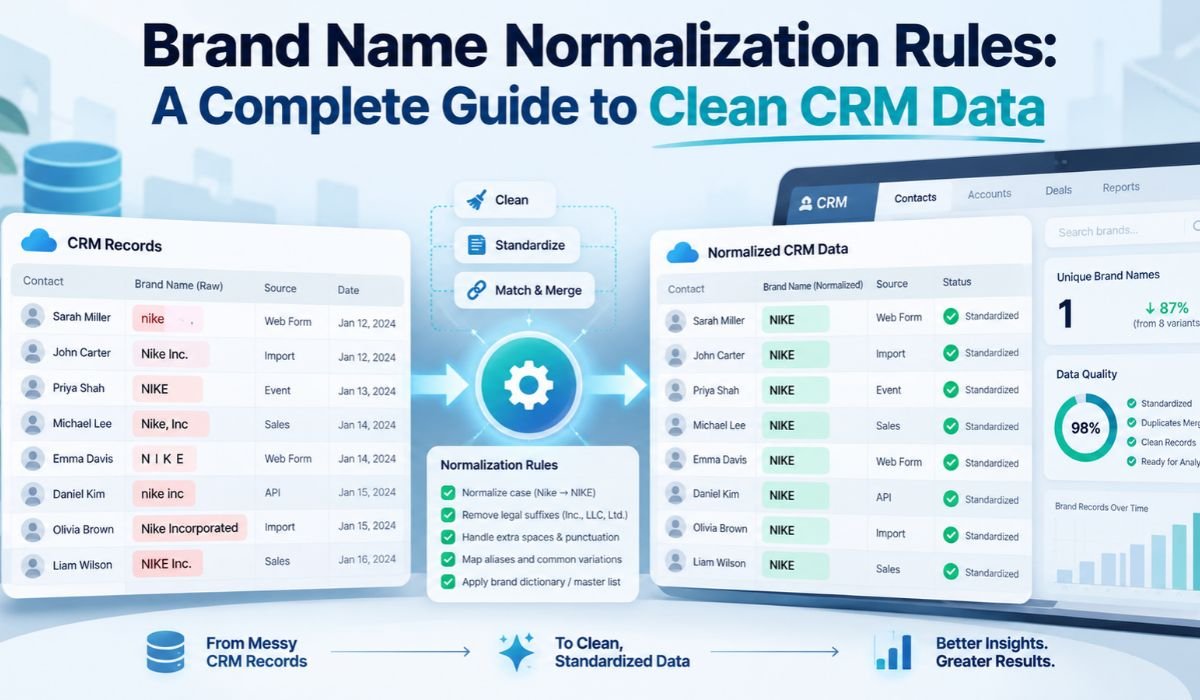
A CRM is only as useful as the information stored inside it. When company data is inconsistent, even routine tasks such as searching for an account, reviewing revenue, or building a marketing segment can become unnecessarily difficult.
Company names are a common source of trouble. The same business might appear as “Acme Corporation,” “ACME Corp,” “Acme, Inc.,” and simply “Acme.” A person can immediately see the connection between those names. A database may not.
That’s where Brand Name Normalization Rules come in. These rules create a consistent way to clean, format, compare, and manage company names across a CRM.
The purpose isn’t simply to make records look neater. Proper normalization can improve CRM Data Quality, support more accurate duplicate detection, strengthen reporting, and give sales and marketing teams a clearer view of the organizations they work with.
This matters even more in 2026. Company information now reaches CRM systems through web forms, spreadsheets, APIs, integrations, enrichment providers, sales tools, automated workflows, and AI-assisted processes. Each source can format a company name differently.
The challenge is to create consistency without throwing away useful information. Good normalization cleans what can safely be cleaned, preserves original and legal details when they matter, and uses stronger evidence before deciding that two records actually belong to the same business.
Quick Bio Information
| Information | Helpful Detail |
|---|---|
| Main Topic | Brand Name Normalization Rules |
| Primary Goal | Consistent Company Data |
| Main Environment | CRM Systems |
| Common Problem | Duplicate CRM Records |
| Preferred Name | Canonical Company Name |
| Original Name | Value Received From The Source |
| Legal Name | Registered Business Name |
| Display Name | User-Friendly Company Name |
| Matching Value | Standardized Comparison Value |
| Common Suffixes | Inc., LLC, Corp., Ltd. |
| Related Process | CRM Deduplication |
| Important First Step | CRM Data Audit |
| Useful Identity Signal | Company Domain |
| Key Safeguard | Preserve Original Data |
| Automation Strength | Predictable Transformations |
| Human Review Strength | Ambiguous Matches |
| International Requirement | Country-Aware Rules |
| Modern Approach | Rules Plus Assisted Matching |
| Key Risk | False-Positive Matches |
| Long-Term Goal | Trustworthy CRM Data |
What Are Brand Name Normalization Rules?
Brand Name Normalization Rules are documented standards used to convert different versions of company names into consistent formats.
Suppose a CRM contains “Salesforce, Inc.,” “SALESFORCE INC,” and “Salesforce.” These values are clearly related, but their formatting isn’t identical. A normalization process might use “Salesforce” as the preferred display or comparison value while preserving the company’s full Legal Name in another field.
Normalization can address capitalization, unnecessary spaces, punctuation, legal suffixes, abbreviations, aliases, and known spelling variations. The preferred standardized version is often described as a Canonical Company Name.
There is, however, an important boundary.
Normalization doesn’t automatically mean that records should be merged. Instead, it makes information easier to compare. Entity matching then evaluates whether records are likely to represent the same organization. Deduplication deals with confirmed or suspected duplicate records and determines what action should be taken.
Treating these as separate processes helps protect CRM data from incorrect merges.
Why Brand Name Normalization Matters For CRM Data
Inconsistent company names can create problems throughout an organization.
Imagine that one sales opportunity is stored under “Acme Inc.” while another appears under “ACME Corporation.” Marketing activity sits under “Acme,” and customer support conversations are attached to yet another variation. Individually, each record may look reasonable. Together, they create an incomplete picture of the customer.
This fragmentation can affect sales forecasting, customer history, segmentation, account management, personalization, and reporting.
Company Name Standardization gives those activities a more dependable foundation. Clean names make potential duplicates easier to spot and allow employees to find accounts more easily. They can also prevent awkward automated communication that uses a long legal entity name where a familiar brand name would sound more natural.
The real value, then, goes well beyond appearance. Brand Name Normalization contributes directly to CRM Data Quality by creating predictable company information that people and connected systems can use consistently.
Still, a standardized name isn’t proof that two records represent the same business. That distinction should remain central to any normalization strategy.
How Brand Name Normalization Works
A practical normalization workflow begins with the company name exactly as it arrived.
Rather than immediately replacing that value, a well-designed system can preserve the original and create a separate normalized version. That simple decision makes the process much safer because teams can standardize operational data without losing the source information.
From there, the system may remove unnecessary whitespace, clean accidental quotation marks, standardize selected punctuation, recognize legal suffixes, apply approved capitalization, and compare the result with an established Canonical Name or Alias Table.
For example, the original value “ACME CORPORATION” might remain untouched in one field while “Acme” becomes the company’s everyday Display Name.
Different fields can serve different purposes. The Legal Name may be needed for contracts and invoices. The Display Name may appear in sales dashboards and customer communications. A Matching Value can be more aggressively standardized because it exists primarily to help compare records.
Keeping these purposes separate provides consistency without sacrificing traceability.
Core Brand Name Normalization Rules
Strong Brand Name Normalization Rules should be predictable rather than improvised from one record to the next.
Basic cleanup often starts with straightforward issues such as leading or trailing spaces, repeated internal spaces, and accidental characters introduced through imports. The process can then move to punctuation, legal suffixes, capitalization, approved abbreviations, and brand-specific exceptions.
The sequence matters.
If punctuation is removed too early, for instance, it could change how another rule recognizes a suffix or abbreviation. For that reason, organizations should define the order in which transformations happen and test the complete sequence against real records.
It’s also useful to distinguish between Display Normalization and Matching Normalization.
A company name shown to a salesperson should respect recognizable branding. The internal value used to compare records can be more simplified. Separating those two functions allows a CRM to support stronger matching without presenting awkward or inaccurate names to users.
Removing Legal Company Suffixes Correctly
Legal suffixes are one of the most common causes of company-name variation.
Depending on the country and legal structure, names may include Inc., Incorporated, LLC, Corp., Corporation, Ltd., LLP, PLC, GmbH, AG, SA, SAS, SARL, BV, and many other designations.
For operational comparison, removing a recognized suffix can be useful. “Acme, Inc.” and “Acme Inc” might both produce “Acme” as their normalized Display Name.
That doesn’t mean the full legal identity should be deleted.
Registered company names can matter for contracts, invoicing, taxation, procurement, regulatory requirements, and compliance. A safer CRM model therefore preserves the Legal Name while creating a simpler value for everyday operational use.
International databases need additional care. A suffix library designed only around American businesses won’t adequately handle organizations from other jurisdictions. Where possible, normalization rules should consider the company’s country before interpreting legal terms.
Standardizing Capitalization, Punctuation, And Spacing
Formatting problems are generally easier to correct, although exceptions still matter.
“MICROSOFT,” “microsoft,” and “MicroSoft” can reasonably become “Microsoft.” Applying Title Case to every record, however, would create new mistakes. IBM shouldn’t become “Ibm,” just as eBay shouldn’t become “Ebay.”
The same principle applies to punctuation.
Unnecessary spaces, repeated spaces, or accidental quotation marks introduced through a CSV file can usually be cleaned without much risk. Apostrophes, ampersands, hyphens, and similar characters require more thought because they may be meaningful parts of an established brand.
Rather than forcing one field to do everything, businesses can maintain a polished Display Name alongside a simplified Matching Value.
That gives employees a natural-looking company name while allowing matching systems to work with a more standardized representation behind the scenes.
Handling Abbreviations, Acronyms, And Aliases
Abbreviations aren’t always as straightforward as they seem.
A business may choose to treat “Intl” and “International” as equivalent in a controlled matching process. But automatically expanding every abbreviation can quickly introduce errors. Recognized company names such as IBM, 3M, and AT&T shouldn’t be rewritten simply because part of the name resembles an abbreviation.
Aliases create another layer of complexity.
Companies rebrand. They may trade under names that differ from their registered entities, and customers sometimes continue using an old name long after a corporate change.
Deleting those historical variations isn’t always helpful. Instead, a CRM can maintain an Alias Table connecting approved alternative names to a Canonical Company Record. Someone searching with an older or alternate name can still reach the correct company without losing valuable historical context.
Even then, an alias should be treated carefully. A former company name, trade name, subsidiary, and parent company don’t necessarily describe the same type of relationship.
Managing Parent Companies And Subsidiaries
Corporate ownership is particularly easy to mishandle during CRM cleanup.
A subsidiary can belong to a much larger organization while still operating as a distinct legal or commercial entity. It may have its own employees, website domain, contracts, invoices, customer relationships, or sales opportunities.
Replacing every subsidiary with its parent’s name can therefore make the database less accurate.
In many cases, the better approach is to keep separate company records and document the relationship between them. A CRM might use Parent Company fields or another form of corporate hierarchy to connect related organizations.
That structure offers flexibility. Reports can roll information up to the corporate group when executives need a broader view, while sales teams can still see activity at the subsidiary level.
This is particularly valuable for Enterprise Sales, Account-Based Marketing, Procurement, and Global Account Management.
Good normalization should make corporate information clearer, not flatten meaningful relationships.
Handling Geographic And International Company Names
Global company data introduces challenges that a simple formatting rule can’t solve.
A multinational group may operate through separate registered entities in the United States, United Kingdom, Germany, Ireland, and other markets. Their names may share the same recognizable brand while referring to different legal businesses.
Removing every regional or legal distinction can consequently create false matches.
Geographic information should be retained whenever it affects contracts, billing, taxation, compliance, territory management, or account ownership.
Language presents another consideration. Modern CRM systems may contain accented characters as well as company names written in non-Latin scripts. Unicode-aware processing helps prevent those characters from becoming corrupted during normalization.
Alternate spellings or transliterated versions can sometimes make search and matching easier, but they shouldn’t automatically replace the authentic company name.
The broader lesson is that international normalization needs to be country-aware and language-aware. A single naming standard designed for one market won’t cover every business correctly.
Brand Name Normalization Vs. CRM Deduplication
This is one of the most important distinctions in the entire process.
Normalization makes data consistent. Deduplication determines whether records represent the same entity and how duplicates should be handled.
Suppose two records both normalize to “ABC.” That similarity alone tells us very little. Numerous unrelated companies can use the same short name.
A stronger duplicate-detection process considers additional information. Depending on what is available, that might include a Company Domain, Country, Address, Phone Number, verified company identifier, or another reliable business attribute.
Modern CRM duplicate-management workflows can use multiple properties or matching conditions rather than depending entirely on a company-name string.
That leads to a safer sequence: normalize the data first, evaluate the organization’s identity next, and merge records only when the available evidence provides enough confidence.
Using Domains And Identity Signals For Better Matching
Company domains are particularly useful because they can add context that a name alone can’t provide.
When two similarly named records share the same verified corporate domain, the likelihood of a relationship may increase. Even so, a domain shouldn’t automatically be treated as perfect proof.
Large corporate groups can own many domains. A subsidiary may share infrastructure with its parent, while acquisitions and rebranding can cause domains to change over time.
Reliable Entity Resolution works best when several independent signals support the same conclusion.
Depending on the CRM and available data, teams may compare domains, countries, addresses, telephone information, verified identifiers, and known corporate relationships.
This also makes confidence-based workflows possible. A deterministic match involving a reliable identifier can be handled differently from a fuzzy name match. When evidence conflicts or remains weak, the record should be reviewed rather than silently merged.
Building A Reliable Brand Name Normalization Ruleset
Before creating dozens of rules, look at the data you actually have.
A CRM audit can reveal repeated company-name variations, capitalization problems, unusual legal suffixes, known aliases, import artifacts, and patterns behind existing duplicates. These findings help teams solve genuine problems rather than designing rules around hypothetical ones.
The next question is what each company field should represent.
Organizations may decide to maintain an Original Name, Legal Name, Display Name, Canonical Name, Parent Company relationship, and one or more matching-related values. Clear definitions prevent different teams from using the same field for conflicting purposes.
Once the model is established, rules should be tested against a representative sample of records.
Testing needs to consider both sides of the problem. False negatives leave genuine variations disconnected. False positives incorrectly associate unrelated companies. Either outcome can damage CRM reliability.
Documentation matters as well. Recording exceptions, trusted sources, rule changes, and merge policies makes the process easier to understand and maintain as staff, systems, and company data change.
Automating Brand Name Normalization In A CRM
Automation is most useful when the transformation is predictable and low risk.
Removing unwanted spaces, applying approved formatting rules, handling known suffixes, and mapping established aliases can often be automated. Records arriving from web forms, spreadsheet imports, APIs, integrations, and enrichment workflows can pass through those rules before becoming part of the primary CRM dataset.
Potential duplicate decisions require greater caution.
A matching process can identify records that deserve attention without automatically deciding what should happen to them. Depending on the CRM and business rules, a potential duplicate might be flagged, blocked, reviewed, or eventually merged.
This separation between matching and action is valuable because it prevents a minor similarity from triggering a major data change.
Normalization should also happen continuously where practical. A large cleanup project may fix yesterday’s records, but it won’t stop tomorrow’s imports from introducing the same inconsistencies. Applying appropriate rules at ingestion helps prevent the problem from rebuilding itself.
AI, Human Review, And Data Governance
AI can make modern Company Name Standardization more efficient, particularly when variations are difficult to capture with simple rules.
It can help identify possible aliases, recognize unusual naming patterns, suggest likely Canonical Names, and prioritize records that may represent duplicates. Those capabilities are useful, but they don’t turn predictions into verified facts.
A short company name can belong to several businesses. A multinational group can contain many similar entities. Franchises, acquisitions, subsidiaries, and regional operations add further ambiguity.
That’s why human judgment still matters, particularly for high-value accounts and low-confidence matches.
Data governance is equally important. Organizations should establish a clear Source Of Truth policy that determines how conflicting information is handled. Verified company data, enrichment providers, manually confirmed account information, and user-submitted forms may not deserve equal levels of trust.
Defining those priorities helps prevent weaker information from silently overwriting data that has already been verified.
Measuring CRM Data Quality After Normalization
Deploying normalization rules isn’t the end of the project. Teams need to know whether those rules are actually improving the CRM.
Useful measurements include the percentage of company records that follow approved naming standards, the volume of suspected duplicates, the rate of false-positive matches, unresolved records, and the number of cases requiring manual review.
Business outcomes can be revealing too.
Salespeople should encounter fewer duplicate company records. Account histories should become easier to follow. Reporting should produce more consistent totals, and segmentation should become more dependable.
Changes in these measurements can also expose problems with the rules themselves. A sudden rise in potential duplicates may suggest that matching has become too aggressive. Persistent missed variations could mean that the rules are too narrow.
Regular monitoring turns Company Name Normalization into an ongoing Data Governance discipline rather than a one-off cleanup task.
Common Mistakes And Long-Term Best Practices
More normalization isn’t automatically better.
Overly aggressive cleanup can remove information that employees actually need. Fuzzy matching can connect unrelated businesses. Rolling every subsidiary into its parent can erase meaningful account relationships, while trusting every incoming source equally can allow poor-quality information to overwrite verified data.
A mature strategy takes a more measured approach.
Original Names should be preserved where useful. Legal Names should remain available for formal purposes. Canonical Names and approved aliases should be maintained deliberately, while parent and subsidiary relationships should be modeled rather than guessed.
Organizations should also think about reversibility. If a transformation or merge later proves incorrect, administrators need enough source information and change history to understand what happened and, where their systems permit it, correct the problem.
Ultimately, a healthy CRM isn’t simply one with attractive formatting. It’s a system in which users can understand what the data represents, where important information came from, and how confidently company identities have been matched.
Final Thoughts
Effective Brand Name Normalization Rules aren’t simply a way to make a CRM look cleaner. They create a more dependable foundation for Company Name Standardization, account reporting, duplicate detection, segmentation, enrichment, and long-term CRM Data Quality.
The most important principle is knowing where normalization ends.
A company may legitimately have several names, and two businesses with similar names can be entirely unrelated. Reliable CRM management therefore preserves Original and Legal Names, establishes carefully chosen Canonical Names, considers additional identity signals, records important relationships, and separates routine formatting changes from potentially risky record merges.
For organizations managing increasingly connected data in 2026, the strongest approach combines thoughtful rules with sensible automation, clear source priorities, measurable quality standards, and human judgment when the evidence isn’t conclusive.
Done well, normalization becomes something much more useful than a cleanup exercise. It becomes part of everyday Data Governance, helping turn a CRM from a collection of records into information that teams can genuinely trust.
FAQs About Brand Name Normalization Rules
What Are Brand Name Normalization Rules?
Brand Name Normalization Rules are documented standards for converting inconsistent company-name variations into consistent formats. They can address capitalization, spacing, punctuation, legal suffixes, abbreviations, aliases, and other predictable differences while preserving important source and legal information.
Why Should Company Names Be Standardized In A CRM?
Consistent company names make CRM information easier to search, compare, report on, segment, and maintain. Standardization can also improve duplicate detection and give sales, marketing, service, and operations teams a clearer view of account information.
Should LLC And Inc. Be Removed From Company Names?
They can often be removed from a normalized Display Name or Matching Value when that suits the organization’s operational needs. The full Legal Name should still be retained when it’s required for contracts, invoicing, compliance, taxation, procurement, or other official purposes.
Is Brand Name Normalization The Same As Deduplication?
No. Normalization creates more consistent values. Deduplication determines whether multiple records actually represent the same entity and what should happen to them. A normalized name can support duplicate detection, but name similarity by itself isn’t always enough evidence to merge records.
What Is A Canonical Company Name?
A Canonical Company Name is the preferred standardized name chosen to represent an organization within a particular data system. Alternative spellings, aliases, or formatting variations can be associated with that name while Legal Names and Original Names remain available separately.
Can Company Domains Help Identify Duplicates?
Yes. A verified Company Domain can provide useful supporting evidence when names are ambiguous. It isn’t foolproof, however. Subsidiaries can share domains, corporate groups may operate multiple domains, and domains can change after acquisitions or rebranding.
Can Brand Name Normalization Be Automated?
Many predictable transformations can be automated safely, including whitespace cleanup, approved formatting changes, known suffix handling, and established alias mappings. Ambiguous identity decisions and potentially damaging record merges deserve stronger validation or human review.
Can AI Improve Company Name Matching?
AI can help uncover possible name variations, aliases, and duplicate candidates that simple rules may miss. Its suggestions should still be evaluated alongside structured matching rules and other company information. Human review remains particularly valuable when evidence is uncertain or the consequences of an incorrect merge are significant.
Learn more and explore exciting content on: Safetrode.com Explained: Features, Content, Safety, and Reliability
[…] Learn more and explore exciting content on: Brand Name Normalization Rules: A Complete Guide to Clean CRM Data […]