
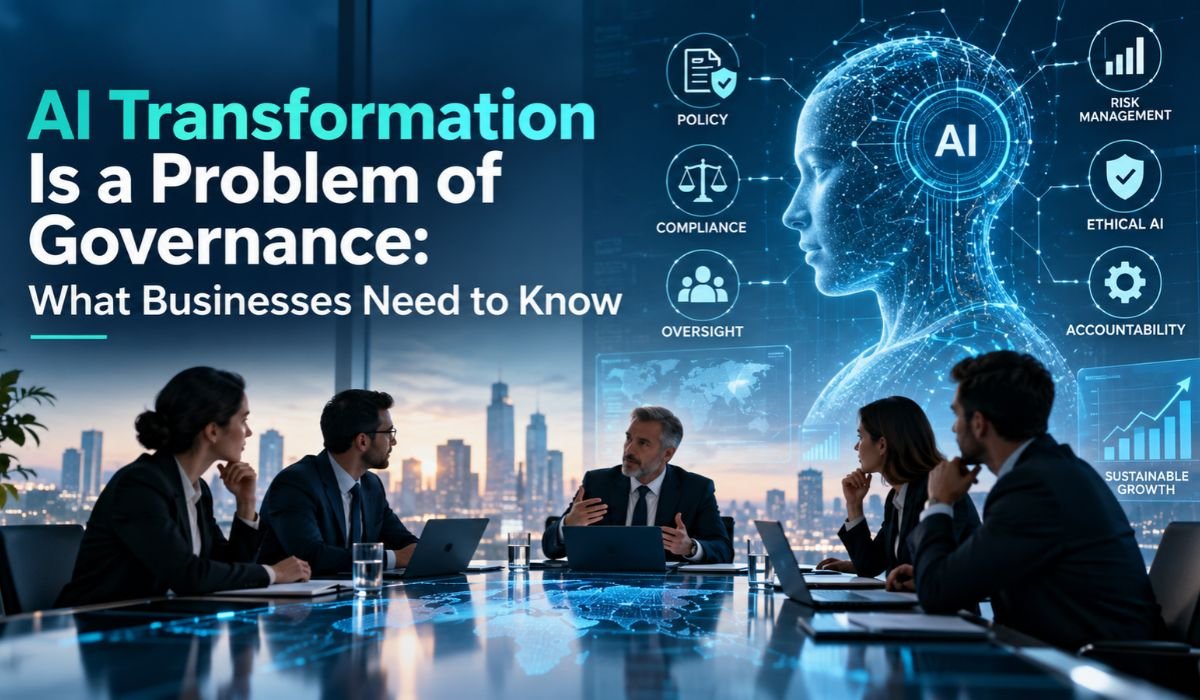
Artificial Intelligence often looks effortless in a demonstration. A chatbot answers a difficult question in seconds. An AI assistant turns raw notes into a polished report. An automated system works through information that might otherwise take employees hours to process. From the outside, the path to company-wide adoption can seem obvious: find what works and roll it out.
In practice, that’s where the difficult part begins.
Moving from an impressive pilot to AI that works reliably across a business introduces questions that computing power alone can’t answer. Who owns the system? What company information can it access? Which decisions can it influence? How much freedom should it have? Who checks its work, and who takes responsibility when something goes wrong?
Those questions explain why AI Transformation Is a Problem of Governance as much as a technology challenge.
That distinction is especially important in 2026. Generative AI is increasingly built into everyday business software, while AI agents are moving beyond producing content and toward completing tasks. At the same time, organizations face growing expectations around privacy, transparency, security, accountability, and regulatory compliance.
The businesses most likely to succeed won’t necessarily be those with the largest collection of AI tools. They’ll be the ones that know how to use those tools responsibly, consistently, and with a clear business purpose.
Quick Bio Information
| Information | Details |
|---|---|
| Main Topic | AI Transformation And Governance |
| Core Principle | AI Capability Requires Organizational Control |
| Primary Goal | Safe And Sustainable AI Adoption |
| Governance Focus | Accountability And Oversight |
| Major Data Concern | Privacy And Data Integrity |
| Key Organizational Risk | Shadow AI |
| Human Responsibility | Review, Judgment, And Intervention |
| Risk Approach | Proportional, Risk-Based Controls |
| International Standard | ISO/IEC 42001 |
| U.S. Reference Framework | NIST AI Risk Management Framework |
| Major EU Regulation | EU AI Act |
| Important Governance Area | Third-Party AI Vendors |
| Emerging Technology | Agentic AI |
| Security Principle | Least-Privilege Access |
| Management Priority | Clear AI Ownership |
| Operational Requirement | AI Incident Response |
| Monitoring Priority | Performance, Risk, And Incidents |
| Business Benefit | More Confident AI Scaling |
| Long-Term Objective | Responsible AI Transformation |
What Does AI Transformation Is A Problem Of Governance Mean?
AI transformation isn’t simply a software upgrade. It can change how information moves through an organization, how employees perform their jobs, how customers receive services, and how important decisions are made.
Governance establishes the boundaries around those changes.
A strong AI Governance Framework answers practical questions before they become expensive problems. It identifies who owns an AI application, why the business is using it, what information it may access, how much autonomy it should receive, what risks are acceptable, and who has authority to intervene.
That makes AI governance much broader than regulatory compliance.
It connects business strategy with cybersecurity, privacy, legal obligations, technical performance, data management, human judgment, and accountability. Done properly, governance gives leadership a clear picture of how AI fits into the organization rather than leaving individual departments to make those decisions independently.
Without that coordination, businesses can quickly end up with overlapping subscriptions, inconsistent security controls, fragmented data, duplicated spending, and AI risks that senior leaders can’t easily see.
Why AI Transformation Projects Struggle To Scale
A successful AI pilot answers one important question: can this technology perform a particular task under the conditions in which it was tested?
Enterprise deployment asks much harder questions.
A tool that works well for a small team may behave differently when hundreds or thousands of employees begin using it. Suddenly, the organization must think about user permissions, confidential information, integration with existing systems, monitoring, employee training, security, legal requirements, and support.
The underlying AI may still work perfectly well. The surrounding organization may not be ready for it.
Businesses also need to consider what happens after deployment. Who notices if performance declines? What happens if the AI provider changes its model? How are incorrect outputs reported? What should employees do when they’re unsure whether sensitive information can be entered into the system?
These aren’t primarily computing problems. They’re governance problems.
That’s why the number of AI pilots a company launches is a poor measure of transformation. A better measure is whether those systems create reliable, measurable business value once they become part of everyday operations.
AI Governance Vs Traditional IT Governance
Traditional IT governance remains essential, but Artificial Intelligence introduces forms of uncertainty that conventional software doesn’t always create.
Most traditional applications operate according to explicitly programmed rules. Modern AI, particularly generative AI, often produces probabilistic results. An answer can vary depending on the model, prompt, context, configuration, and information available to the system.
Generative models can also produce statements that sound authoritative while being inaccurate. That makes output validation and appropriate human judgment particularly important.
An effective AI Governance Framework therefore needs to address model limitations, testing, bias, security, data quality, third-party providers, transparency, monitoring, and human oversight alongside familiar IT controls.
There’s another misconception worth clearing up. Not every AI model continuously learns after deployment. Many production models remain fixed until their developers or providers intentionally update them. Their responses can still vary even though the underlying model hasn’t changed.
Businesses need to understand how each system actually works rather than building policies around broad assumptions about AI.
Why Strong AI Governance Matters
Governance sometimes gets treated as the part of the organization that tells everyone what they can’t do. That approach usually creates frustration rather than responsible innovation.
Good governance should provide a safe route forward.
When employees know which AI platforms are approved, what data they may use, which activities require additional review, and where to escalate questions, they can experiment with far more confidence.
Leadership benefits too.
A well-governed organization can see where AI is being used, which business processes depend on it, what the company is spending, what risks exist, and whether those investments are producing meaningful results.
This is where Responsible AI Implementation becomes practical. Instead of relying on vague principles about using AI safely, businesses translate those principles into decisions people can actually follow.
Core Pillars Of An AI Governance Framework
Accountability is the starting point. Important AI applications should have a clear business purpose and identifiable ownership. Someone needs to understand why the system exists and remain responsible for how it is used.
Reliable data practices come next. Organizations need appropriate controls around data quality, access, privacy, security, provenance, and retention.
Risk management helps determine how closely each AI application needs to be controlled. Documentation records important decisions, limitations, testing, approvals, and responsibilities. Continuous monitoring then helps identify declining performance, misuse, security problems, or unexpected behavior after deployment.
Established resources such as the NIST AI Risk Management Framework provide organizations with structured approaches for identifying and managing AI-related risks.
The broader lesson is straightforward: AI governance shouldn’t appear only at the final approval stage. It needs to follow a system throughout its lifecycle, from initial evaluation and development to deployment, monitoring, major updates, and eventual retirement.
Human Oversight Must Be Meaningful
Putting a person somewhere in an automated workflow doesn’t automatically make that workflow safe.
For Human Oversight In AI to be meaningful, the reviewer needs enough expertise, context, time, and authority to challenge what the system produces. If employees routinely approve AI recommendations without seriously examining them, human review becomes little more than a checkbox.
This is particularly important because people can develop excessive trust in automated recommendations, a tendency commonly associated with automation bias.
Consider software development. AI can help developers generate code quickly, but sensitive changes can still require testing, security checks, and appropriate authorization before reaching production.
The same principle applies when AI supports decisions involving employment, finance, legal matters, safety, customers, or other areas where an error could have serious consequences.
As the potential impact rises, meaningful oversight generally needs to become stronger.
Shadow AI Creates Hidden Business Risk
Employees don’t always wait for formal AI programs.
They may use a public chatbot to improve a document, install an AI browser extension, try an automated meeting service, experiment with a coding assistant, or upload information to another AI application because it helps them finish a task faster.
When that activity occurs outside approved company processes, it’s commonly described as Shadow AI.
The employee may have no harmful intention. In many cases, they’re simply trying to work more efficiently. The risk comes from the organization not knowing where its information is going, what an external provider does with that information, or whether appropriate security and privacy protections are in place.
Simply blocking every AI service isn’t a complete answer.
Businesses need approved alternatives that are genuinely useful. Employees also need understandable rules explaining what information can and cannot be shared, along with an easy process for requesting access to new AI capabilities.
The most sustainable approach is to make the safe option practical enough that employees actually want to use it.
Data Governance Is The Foundation Of Reliable AI
Powerful AI doesn’t make poor information disappear.
If the data surrounding a system is incomplete, inaccurate, outdated, biased, improperly obtained, or badly protected, even a sophisticated model can produce unreliable outcomes.
That’s why AI Data Governance belongs near the beginning of an AI transformation strategy rather than at the end.
Businesses should know where important data came from and whether they have the right to use it for the intended purpose. They should understand who can access it, how it’s protected, how long it’s retained, and whether it remains accurate enough for the decisions being made.
These questions become even more important when AI applications connect directly to customer records, internal documents, databases, knowledge systems, or other sensitive company resources.
Reliable AI ultimately depends on reliable information practices.
AI Risk Classification Prevents One-Size-Fits-All Governance
A chatbot summarizing non-sensitive internal text doesn’t create the same level of risk as an AI system influencing hiring, lending, healthcare, critical infrastructure, or another consequential activity.
Treating both systems identically would make little sense.
A practical AI Risk Management approach considers the possible consequences of failure, the sensitivity of the information involved, the number and type of people affected, the system’s autonomy, security exposure, regulatory requirements, and whether mistakes can easily be reversed.
That allows organizations to apply controls proportionately.
Lower-risk applications may move through a streamlined approval process. Higher-risk systems may require deeper testing, legal or compliance review, security assessment, detailed documentation, stronger human oversight, and continuous monitoring.
Risk-based governance protects the organization without turning every small experiment into a lengthy compliance project.
AI Regulations And The EU AI Act
AI regulation is no longer a distant concern for businesses operating internationally.
The European Union’s AI Act introduced a risk-based regulatory framework that distinguishes among different AI uses and establishes obligations according to factors including the system involved and an organization’s role.
One important point is often lost in simplified discussions of the law: implementation has followed a phased timetable rather than a single date on which every provision suddenly became applicable.
That distinction matters because businesses can otherwise misunderstand what they need to do and when they need to do it. Requirements can depend on the type of system, intended purpose, regulatory classification, and whether an organization is developing, providing, importing, distributing, or deploying the technology.
The practical starting point is an accurate AI inventory.
A company needs to know what AI it uses before it can determine which regulatory obligations may apply. Organizations with potentially regulated applications should then assess those systems individually and seek qualified legal guidance where necessary.
ISO IEC 42001 And AI Management
ISO/IEC 42001 gives organizations another structured way to think about responsible AI.
It is an international management system standard specifically focused on Artificial Intelligence. Its purpose is to help organizations establish, implement, maintain, and continually improve the systems they use to manage AI.
The idea of continual improvement is particularly relevant.
AI governance can’t be written once and considered finished. Models change, vendors update their products, businesses introduce new use cases, regulations develop, and previously unknown risks emerge.
A management-system approach encourages organizations to revisit those issues regularly rather than relying on policies created when their AI program first began.
Companies should also distinguish between using ISO/IEC 42001 principles to strengthen internal practices and pursuing formal independent certification. The two approaches can overlap, but they’re not the same thing.
Third-Party AI Vendors Need Governance Too
Many businesses won’t build their most widely used AI systems themselves.
They’ll purchase software containing AI, connect to external models through APIs, subscribe to cloud-based AI platforms, or adopt tools where AI operates quietly in the background.
That makes vendor governance a major part of enterprise AI governance.
Using an outside provider doesn’t make risk disappear. Before adopting an important service, businesses should understand what information the vendor receives, how that data is stored and processed, which security protections are in place, and whether customer information may be used to improve models or services.
Organizations should also consider how vendors communicate significant model changes, what contractual protections are available, how incidents are handled, and what happens to company data when a service ends.
An accurate AI inventory therefore needs to cover significant third-party systems as well as models developed internally.
AI Agents Create New Governance Questions
Generative AI initially captured attention because of what machines could produce. AI agents introduce a different issue: what should machines be allowed to do?
An agent may retrieve information, interact with applications, initiate workflows, communicate with other systems, or complete several connected tasks toward a larger objective.
That additional autonomy changes the risk picture.
Organizations need to decide which systems an agent can access, what information it can retrieve, which actions it can perform independently, and where human approval remains necessary.
Logging becomes important too. If an autonomous system takes an action, the organization should be able to understand what happened and investigate significant failures.
A useful security principle here is least privilege. An AI system should receive only the permissions it genuinely needs for its approved role, rather than broad access simply because granting that access is convenient.
AI Incident Response Should Be Planned Before Problems Occur
Businesses prepare for cybersecurity incidents before an attack occurs. Important AI systems deserve similar preparation.
An AI Incident Response plan can cover events such as sensitive information exposure, harmful or discriminatory outputs, unauthorized actions, serious model failures, security vulnerabilities, or unexpected behavior that affects customers or operations.
Waiting until something goes wrong to decide who is responsible wastes valuable time.
Organizations should know where employees report an AI incident, who investigates it, who can restrict or disable the affected system, and how significant issues are documented.
Where notification or remediation is required, responsibilities should already be clear.
Just as importantly, businesses should learn from incidents. Findings can reveal weaknesses in training, access controls, testing, vendor management, monitoring, or policies. Those lessons should feed back into the governance framework.
Operational Barriers To Effective AI Governance
The principles of AI governance are easier to describe than to implement.
Legacy technology is one common obstacle. Older systems may offer weak monitoring, incomplete data lineage, or limited integration with modern AI platforms.
Organizational silos create another problem. Technical teams may understand model architecture but lack detailed knowledge of regulatory obligations. Legal and compliance professionals may understand the rules without seeing exactly how an AI system behaves in production.
Then there’s culture.
If every AI proposal disappears into a slow and confusing approval process, employees will naturally begin to see governance as an obstacle.
Cross-functional collaboration can close these gaps. Technology, data, security, legal, compliance, risk, human resources, and business teams all bring useful expertise.
That doesn’t mean every decision should be made by a large committee. Effective governance still requires clear ownership and decision authority.
The objective is informed accountability, not bureaucracy.
Governance Can Improve Innovation And ROI
Governance and innovation are often presented as opposing forces. They don’t have to be.
An organization with approved AI platforms, defined risk categories, reusable assessments, established responsibilities, and predictable approval routes can often evaluate new ideas more efficiently.
Teams don’t have to reinvent the rules every time another AI use case appears.
Central visibility can also reveal financial waste.
Without coordination, marketing might purchase one AI platform while sales, human resources, engineering, and customer support buy separate products with overlapping capabilities. Costs rise, company information becomes fragmented, and security teams have more systems to oversee.
A coordinated AI Transformation Strategy gives leadership a clearer picture of spending, adoption, productivity gains, integration opportunities, risk, and return on investment.
The real goal isn’t to have more AI. It’s to get sustainable business value from the AI the organization chooses to use.
Building And Measuring AI Governance
Businesses can’t govern systems they don’t know exist, so visibility is the natural starting point.
Organizations need to understand which AI systems they develop, purchase, embed in existing products, or permit employees to use. Important applications should have an identifiable owner, defined purpose, appropriate risk classification, approved data access, testing expectations, documentation, monitoring, and an incident-response process.
From there, governance needs to become measurable.
Useful indicators can include how much of the organization’s AI environment is captured in its inventory, how consistently policies are followed, how often security or privacy incidents occur, and whether models continue to perform as expected.
Businesses can also monitor error frequency, human overrides, approval times, employee adoption of approved tools, operating costs, productivity improvements, and measurable return on investment.
The purpose of those measurements isn’t to prove that the governance department is busy.
It’s to show whether governance is helping the organization use AI more safely, efficiently, and effectively.
What Successful AI Transformation Looks Like
Successful AI transformation isn’t measured by how many models a business can deploy.
The stronger measure is whether those systems solve real problems while remaining reliable, manageable, secure, and aligned with the organization’s responsibilities.
Businesses that reach that point tend to connect AI projects to clearly defined needs. They establish ownership, understand their data, classify risks, monitor important systems, and maintain human accountability where it matters.
They also accept that governance must evolve.
New models appear. Vendors update existing products. Regulations change. Security threats develop. Business teams discover new use cases. AI agents gain additional capabilities.
A governance framework that never changes will eventually stop reflecting the technology it is supposed to govern.
As enterprise AI becomes more deeply integrated into daily operations, businesses with strong foundations will be better positioned to adopt new capabilities without having to rebuild their controls every time the technology moves forward.
Final Thoughts
The idea that AI Transformation Is a Problem of Governance doesn’t suggest that technology is secondary or unimportant. Without capable models, secure infrastructure, reliable software, and skilled technical teams, AI transformation can’t happen.
But technology gets an organization only part of the way.
The harder task is deciding how that technology should operate inside a real business, where sensitive information, customers, employees, regulations, budgets, security risks, and human judgment all intersect.
Businesses that want sustainable AI adoption need trustworthy data, clear ownership, proportionate risk controls, meaningful human oversight, strong vendor management, sensible security, incident readiness, regulatory awareness, and measurable business goals.
Those elements may not create the excitement of a new model demonstration, but they’re what allow an impressive demonstration to become a dependable business capability.
As AI becomes more autonomous and more deeply connected to everyday operations, the most important question will increasingly shift from “Can AI do this?” to something more demanding: “Should AI do this, under what conditions, and who remains responsible?”
Answering that question well is the heart of AI governance.
And for businesses trying to turn Artificial Intelligence from an experiment into lasting value, governance may ultimately be what separates AI adoption from genuine AI transformation.
FAQs About AI Transformation And Governance
Why Is AI Transformation A Governance Problem?
AI can affect data, employees, customers, security, compliance, decisions, and business processes. Technology supplies the capability, but governance determines how that capability may be used, who controls it, what risks are acceptable, and who remains accountable for the outcome. That is why successful AI transformation requires organizational rules and responsibilities alongside technical expertise.
What Is An AI Governance Framework?
An AI Governance Framework is a structured system for managing Artificial Intelligence throughout its lifecycle. It typically brings together ownership, policies, risk classification, data controls, testing, approval procedures, documentation, monitoring, human oversight, and incident management. The framework helps turn broad responsible-AI principles into practices employees and business teams can follow.
What Is The Difference Between AI Governance And IT Governance?
Traditional IT governance continues to play an important role in areas such as security, access management, procurement, and infrastructure. AI governance builds on those practices while addressing additional issues such as probabilistic outputs, model evaluation, bias, generative content, human oversight, AI-specific data use, model limitations, and increasingly autonomous behavior.
What Is Shadow AI?
Shadow AI refers to AI tools or services being used outside an organization’s approved processes. It may involve employees using public chatbots, AI extensions, coding assistants, transcription services, or other applications without formal approval. The main concerns include privacy, security, intellectual property, compliance, and loss of visibility over where company information is being processed.
Why Is Human Oversight Important In AI?
Human oversight provides judgment, context, challenge, and accountability when automated systems cannot reliably handle every situation. Its importance increases when AI can significantly affect individuals, finances, customers, security, employment, legal matters, or important business operations. Effective oversight requires more than simply asking someone to approve an AI recommendation.
Does AI Governance Slow Innovation?
Poorly designed governance certainly can. Effective governance can have the opposite effect. Approved tools, understandable policies, known risk categories, reusable assessments, and predictable approval routes reduce uncertainty. Employees can experiment more confidently because they understand where the boundaries are and when additional review is necessary.
What Is ISO IEC 42001?
ISO/IEC 42001 is an international management system standard for Artificial Intelligence. It provides a structured approach organizations can use to establish, implement, maintain, and continually improve their AI management practices. Businesses can use its principles to strengthen internal governance, while formal certification is a separate decision.
How Does The EU AI Act Affect Businesses?
The impact of the EU AI Act depends on factors such as the type of AI system, its intended purpose, risk classification, an organization’s role, and where the system is provided or used. Because implementation has followed a phased timetable, businesses potentially within scope should assess their systems individually and determine the obligations and dates relevant to their circumstances rather than assuming one requirement applies to every AI application.
Learn more and explore exciting content on: What Is File Content Conversion? A Simple Guide to How It Works
[…] Learn more and explore exciting content on: AI Transformation Is a Problem of Governance: What Businesses Need to Know […]