
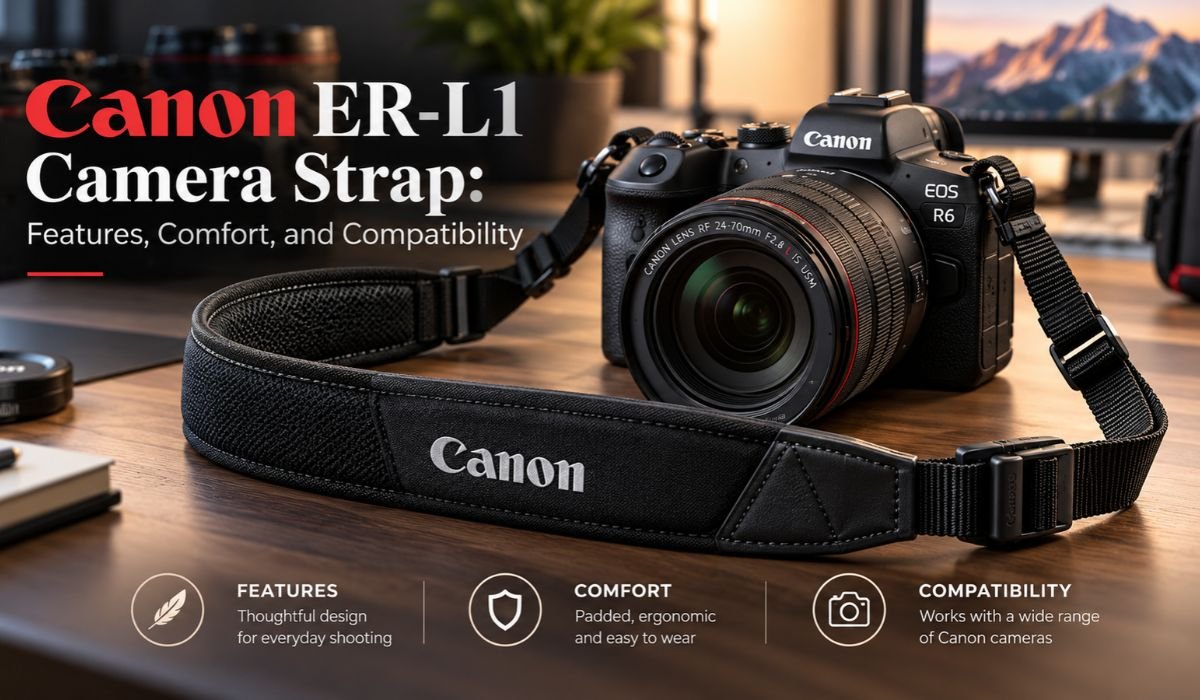
A Camera Strap probably isn’t the first accessory photographers think about when building a kit. Lenses, batteries, memory cards, and filters tend to get more attention. Yet the strap has a surprisingly important job. It supports the Camera between shots, provides another layer of security while you’re moving, and can influence how comfortable your equipment feels after you’ve been carrying it for a while.
The Canon ER-L1 Camera Strap keeps that job relatively simple. Instead of using a complex modular system or detachable quick-release anchors, it follows a more traditional design intended for compatible Canon EOS R Cameras. Canon specifies a width of 35 mm, and the strap can be wrapped around the hand or wrist to provide additional support.
For some photographers, that straightforward approach is exactly what they want. Others may prefer the extra padding, fast-release connections, or cross-body designs available from aftermarket manufacturers.
So where does the ER-L1 fit? The answer depends on more than the Canon name. Camera compatibility, lens weight, carrying time, shooting style, and personal comfort all matter. Looking at those factors gives a much clearer idea of whether this Original Canon Camera Strap is the right choice.
What Is The Canon ER-L1 Camera Strap?
The Canon ER-L1 Camera Strap is an Original Canon accessory made for compatible Cameras in the EOS R Series. Its Canon product number is 4898C001, and it has a particularly close association with the EOS R3.
Its purpose isn’t complicated. The ER-L1 provides a conventional way to carry and support a Camera without requiring photographers to adopt a separate system of detachable anchors or specialized connectors.
That simplicity has practical appeal. Not everyone wants additional pieces attached to a Camera, particularly when a traditional strap already fits the way they work. For those photographers, being able to attach the strap, adjust it, and get on with shooting can be preferable to having more features.
It’s worth keeping expectations realistic, though. The ER-L1 isn’t positioned as a specialized sling, heavily padded harness, or highly modular carrying system. Its appeal lies in its straightforward construction, Original Canon design, documented dimensions, and compatibility with selected EOS R Cameras.
Canon ER-L1 Quick Information
| Information | Canon ER-L1 Details |
|---|---|
| Product Name | Canon ER-L1 Wide Strap |
| Product Number | 4898C001 |
| Manufacturer | Canon |
| Accessory Type | Camera Strap |
| Product Category | Original Canon Accessory |
| Strap Width | 35 mm |
| Strap Length | 680 mm |
| Material | Synthetic Rubber |
| Adjustable | Yes |
| Main Camera Family | Canon EOS R Series |
| EOS R3 Compatibility | Listed |
| EOS R5 Compatibility | Listed |
| EOS R6 Compatibility | Listed |
| EOS R Compatibility | Listed |
| EOS RA Compatibility | Listed |
| EOS RP Compatibility | Listed |
| Traditional Quick Release | Not Listed |
| Primary Purpose | Camera Carrying And Support |
| Additional Use | Hand Or Wrist Support |
| Design Style | Wide, Simple, Factory-Style Strap |
Compatibility information isn’t something buyers should take for granted. Camera ranges change, regional product pages can differ, and accessory information may be updated over time. Before purchasing the ER-L1 for a particular Camera, it’s sensible to confirm that exact model against current Canon documentation.
Design And Build Quality
The Canon ER-L1 Camera Strap doesn’t try to reinvent the Camera Strap. Its design is deliberately functional, with Canon specifying a width of 35 mm and an overall length of 680 mm. Canon describes the material as hardwearing synthetic rubber.
Those specifications provide more useful information than simply calling the ER-L1 a standard factory strap. The relatively broad design gives the strap a larger contact area, while Canon specifically notes its usefulness when wrapped around the hand or wrist for support.
There’s also something to be said for a design that doesn’t add unnecessary complexity. Photographers who prefer to keep their Camera setup clean may appreciate not having extra detachable connectors or proprietary anchors attached to the body.
Still, simplicity shouldn’t be mistaken for evidence of superior performance. Without controlled comparisons, there’s no sound basis for saying the ER-L1 is automatically stronger, softer, or more comfortable than every aftermarket alternative. What can be said is that Canon has chosen a conventional, relatively wide design intended to perform a clearly defined job.
Canon ER-L1 Camera Strap Compatibility
Compatibility deserves careful attention because an EOS R badge alone doesn’t necessarily tell you whether a particular accessory is officially supported.
Canon information has listed the EOS R3, EOS R5, EOS R6, EOS R, EOS RA, and EOS RP as compatible with the ER-L1. Among those Cameras, the EOS R3 has the strongest connection with the strap, as the ER-L1 appears in Canon documentation associated with that model.
That’s useful for owners of the listed Cameras, but it shouldn’t be stretched into a claim that every EOS R Camera is automatically supported.
Canon’s Mirrorless Camera family has continued to expand, and newer bodies may not appear in older accessory listings. Product information can also differ by region. Anyone using an EOS R model that isn’t specifically named should therefore check current compatibility information before buying.
It’s a small step, but it can prevent the frustration of purchasing an accessory based on assumptions rather than documented support.
How To Attach The Canon ER-L1 Safely
The quality of a Camera Strap matters, but correct installation matters just as much. A strap can’t provide reliable support if it hasn’t been secured properly.
The ER-L1 follows a traditional attachment approach rather than relying on the removable anchor systems seen on some aftermarket straps. It should be connected through the Camera’s appropriate strap attachment areas and secured according to the instructions supplied for the Camera.
Once it’s installed, take a moment to examine both sides. The strap should remain secure when gentle tension is applied, and the adjustment hardware shouldn’t allow the ends to slip unexpectedly.
It’s also sensible to perform the first test somewhere safe. Instead of immediately letting an expensive Camera and lens hang freely, test the strap over a bed, padded surface, or low table.
Those checks shouldn’t end after installation. Travel, frequent adjustment, and regular use can all justify another inspection. Camera equipment is expensive enough that spending a few seconds checking the strap before a long shoot is a worthwhile habit.
Adjusting The Canon ER-L1 For A Better Fit
There isn’t a universal Camera Strap length that works for everyone.
A photographer’s height, clothing, Camera size, lens choice, and preferred shooting position all influence where the Camera feels most natural. One person may prefer the Camera close to the chest, while another may want more freedom to move it between carrying and shooting positions.
The ER-L1 is adjustable, which allows users to experiment until they find a practical position.
Its width also serves another purpose. Canon highlights the ability to wrap the strap around the hand or wrist, creating an additional point of support while handling the Camera.
The goal isn’t simply to make the strap as tight or loose as possible. A useful adjustment should keep the Camera controlled without restricting movement or leaving excessive material in the way.
Before heading out for several hours, spend some time trying different adjustments at home. What feels fine for a few minutes isn’t always what feels best after a longer photography session.
How Comfortable Is The Canon ER-L1?
Comfort is one of those qualities that can’t be judged from a specification sheet alone.
The ER-L1’s 35 mm width gives it a broader contact area than a very narrow Camera Strap, but that doesn’t mean every photographer will experience it in the same way.
Consider the equipment attached to it. A Mirrorless Camera fitted with a compact Prime Lens is one thing; a substantial Camera body paired with a large Professional Zoom is another. Clothing, temperature, body shape, carrying position, and the length of the shoot can all change how a strap feels.
For this reason, it would be inaccurate to describe the Canon ER-L1 Camera Strap as universally comfortable without comparative testing.
For ordinary outings and traditional Camera carrying, the wide design may provide all the support a photographer needs. Someone regularly carrying heavy equipment from morning until evening, however, may find it worthwhile to compare padded straps, slings, or harness systems that distribute weight differently.
Comfort is ultimately personal, and that’s especially true once heavier lenses enter the picture.
Camera And Lens Weight Matter
The Camera body gets most of the attention when people shop for a strap, but the lens can dramatically change the equation.
Pair an EOS R body with a small RF Prime Lens and the overall package may remain relatively compact. Add a large Telephoto or Professional Zoom Lens, and both the weight and balance can change substantially.
That matters with the EOS R3 in particular. It’s a professional-oriented Camera capable of being paired with sizeable RF lenses, so photographers should think about the entire setup rather than evaluating the strap in isolation.
Large lenses may also have their own support recommendations or dedicated mounting hardware. When that’s the case, those instructions should be followed rather than assuming the Camera Strap is meant to carry every possible combination in the same manner.
Canon’s published ER-L1 information doesn’t establish a universal maximum carrying load for every Camera and lens combination. Assigning it an unsupported weight limit would therefore create false precision.
The practical approach is simpler: consider the complete kit and follow the support guidance provided for both the Camera and lens.
Everyday And Travel Photography
The ER-L1’s uncomplicated design begins to make sense when you consider ordinary photography.
A family event, weekend walk, sightseeing trip, or afternoon taking photographs outdoors doesn’t necessarily require an elaborate Camera carrying system. Sometimes the photographer simply wants the Camera nearby and ready without adding more equipment to manage.
The Canon ER-L1 Camera Strap fits naturally into that type of use. Its conventional design keeps the Camera accessible, while the option to use the strap around the hand or wrist adds another way to support it.
Travel can place different demands on a strap, however. The Camera may stay out for much longer, photographers may move through crowded areas, and equipment can go in and out of a bag repeatedly throughout the day.
That makes it worth considering total kit weight, accessibility, and even how visible the Camera looks in public.
A strap can provide useful support and reduce the risk of an accidental drop during normal handling, but it shouldn’t create a false sense of security. Careful handling, appropriate storage, and awareness of the surroundings remain just as important.
Professional Photography Use
A traditional Camera Strap isn’t necessarily a beginner’s accessory. The ER-L1’s close association with the EOS R3, a Camera aimed at demanding users, is a good reminder of that.
What matters more is the photographer’s workflow.
A Sports Photographer working with long lenses has different requirements from a Wedding Photographer carrying two bodies for an entire event. A Wildlife Photographer may regularly switch between handheld shooting, a Monopod, and a Tripod. Someone working in a studio may have yet another set of priorities.
In some of those situations, the simplicity of the Canon ER-L1 Camera Strap can be an advantage. There are fewer specialized components involved, and photographers who rarely remove their strap may not need anything more complicated.
In other workflows, a quick-release system or specialized harness may save time and reduce inconvenience.
The better question, then, isn’t whether the ER-L1 is professional enough. It’s whether its design suits the way a particular photographer actually works.
Canon ER-L1 Vs Aftermarket Camera Straps
The aftermarket Camera Strap market offers far more variety than a traditional OEM strap.
Photographers can choose from padded Neck Straps, Wrist Straps, Cross-Body Slings, Dual-Camera Harnesses, and modular systems built around removable anchors. Each design addresses a slightly different problem.
A photographer who frequently moves a Camera onto a Gimbal might value a strap that comes off quickly. Someone walking all day with substantial equipment may prioritize padding or a different method of distributing weight. Street Photographers may prefer a low-profile design with minimal branding.
The Canon ER-L1 Camera Strap takes a different path. It offers an Original Canon design, adjustable construction, traditional attachment, and compatibility information for selected EOS R Cameras without trying to become a complete modular carrying system.
More features don’t automatically make an aftermarket strap better, just as Canon branding doesn’t automatically make the ER-L1 the better choice.
The strongest option is the one that solves the photographer’s actual carrying needs with the least unnecessary complication.
Benefits Of Choosing An Original Canon Strap
One useful advantage of choosing an Original Canon accessory is access to manufacturer-provided product information.
For the ER-L1, buyers can identify specific details including its 4898C001 product number, 35 mm width, 680 mm length, synthetic rubber construction, adjustable design, and documented compatibility with selected Canon Cameras.
That removes some of the uncertainty that can come with generic accessories whose descriptions are vague or inconsistent.
Appearance may matter as well. Some Canon owners prefer a factory-style accessory that visually belongs with the rest of their equipment.
Then there’s simplicity. Photographers who don’t want detachable anchors or additional connectors attached to the Camera may find the traditional design refreshing.
None of this means an Original Canon Strap will automatically outperform a high-quality third-party product. Manufacturer branding and documented compatibility are useful advantages, but comfort and workflow remain personal considerations.
Possible Limitations To Consider
The ER-L1’s restrained design won’t appeal to everyone.
Photographers accustomed to modern quick-release systems may find traditional attachment less convenient, especially if they frequently remove the strap for Tripod, Gimbal, or studio work.
Those carrying heavy equipment for long periods may also want more substantial padding or a carrying system designed to distribute weight across a larger area of the body.
Cross-Body Carrying is another consideration. Purpose-built slings are designed around a different style of movement and access than a conventional Camera Strap, which can matter for photographers who constantly raise and lower the Camera.
Brand visibility is more subjective. Some photographers like their Camera and strap to match. Others deliberately choose understated accessories when traveling or working on the street.
These aren’t reasons to label the Canon ER-L1 Camera Strap good or bad. They simply define its role more clearly. A product can be well suited to one photographer and unnecessarily restrictive for another.
Safety, Inspection, And Maintenance
Camera Straps don’t receive much attention until something goes wrong, which is exactly why occasional inspection makes sense.
The areas around attachment points deserve particular attention because they experience repeated tension and movement. Adjustment hardware and sections of the strap exposed to frequent friction should also be checked for visible wear or damage.
If something appears loose, badly worn, or insecure, don’t continue trusting expensive equipment to it simply because the strap hasn’t failed yet.
Cleaning deserves similar care. Canon identifies the ER-L1 as being made from synthetic rubber, and harsh household cleaners shouldn’t be applied without suitable manufacturer guidance. Different materials can react unpredictably to aggressive chemicals.
Moisture should also be dealt with before long-term storage. Keeping the Camera and its accessories clean and appropriately dry is a sensible part of general equipment care.
These habits aren’t complicated, but they support the main reason for using a Camera Strap in the first place: dependable everyday support.
Who Should Buy The Canon ER-L1?
The Canon ER-L1 Camera Strap is best suited to photographers who own a compatible EOS R Camera and want a straightforward Original Canon carrying solution.
Its 35 mm width, adjustable design, traditional attachment, and ability to provide hand or wrist support are likely to appeal most to users who value simplicity over modular features.
The EOS R3 connection makes the strap especially relevant to owners of that Camera, while Canon information has also listed compatibility with the EOS R5, EOS R6, EOS R, EOS RA, and EOS RP.
There are equally clear cases where another design may make more sense. Photographers who repeatedly remove their strap, spend entire days carrying substantial equipment, or strongly prefer Cross-Body Carrying should compare specialized alternatives.
Choosing a Camera Strap becomes much easier once the question changes from “Which strap has the most features?” to “Which features will I actually use?”
How To Decide Before Buying
Start with the equipment you already own.
Look at the Camera body, the lens you use most often, and the combined size of that setup. Then think about how you normally carry it. A Camera that’s used for a relaxed one-hour walk presents different demands from one carried through a full day of event photography.
Next, consider how frequently the strap needs to come off. Photographers who regularly use a Gimbal, Cage, Tripod, or another support system may place more value on quick removal than someone who leaves a strap attached permanently.
Compatibility should also be confirmed for the exact Camera model rather than assumed from the EOS R name.
Finally, separate useful features from attractive extras. A specialized aftermarket system is worthwhile when its padding, quick-release mechanism, or carrying position solves a genuine problem. When those features aren’t needed, the simpler Canon ER-L1 Camera Strap may be entirely sufficient.
That approach produces a more useful buying decision than choosing on brand reputation or feature count alone.
Is The Canon ER-L1 Camera Strap Worth It?
For the right user, the ER-L1 makes a strong case through simplicity rather than innovation.
Its key specifications are clearly defined. Canon identifies a 35 mm width, 680 mm length, adjustable construction, and synthetic rubber material, along with compatibility information covering selected EOS R Cameras.
What it doesn’t offer is equally important to understand. Photographers looking specifically for a modular anchor system, dedicated Cross-Body Sling, substantial additional padding, or rapid strap removal may need to look elsewhere.
That doesn’t make the ER-L1 outdated. Traditional Camera Straps continue to work because plenty of photographers don’t need their strap to do anything more complicated than support the Camera reliably and stay out of the way.
If that’s what you want, and your Camera is compatible, the Canon ER-L1 Camera Strap is a sensible option. If your photography demands more specialized carrying features, the aftermarket provides plenty of alternatives worth comparing.
Final Thoughts
The Canon ER-L1 Camera Strap is a reminder that Camera accessories don’t always need to become more complicated to remain useful.
Its specifications are straightforward. Canon identifies a 35 mm width, 680 mm length, adjustable construction, and synthetic rubber material. The strap is particularly associated with the EOS R3, while Canon information has also listed the EOS R5, EOS R6, EOS R, EOS RA, and EOS RP among compatible Cameras.
What stands out isn’t a long list of advanced features. It’s the ER-L1’s uncomplicated approach.
For photographers who want an Original Canon Camera Strap, prefer traditional attachment, and don’t need a modular quick-release ecosystem, that simplicity may be exactly the point. There are fewer decisions to make and fewer specialized features to manage.
Other photographers will reasonably want more. Long days with heavy equipment, frequent transitions between different support systems, or a preference for Cross-Body Carrying can make a specialized aftermarket strap the more practical choice.
Ultimately, the right Camera Strap isn’t determined by the logo or by how many features appear on the packaging. It comes down to compatibility, the weight of the equipment, how long it’s carried, and how the photographer actually works.
When those needs align with its traditional design, the Canon ER-L1 Camera Strap remains a practical and refreshingly straightforward option for compatible Canon EOS R users.
FAQs About The Canon ER-L1 Camera Strap
What Is The Canon ER-L1 Camera Strap?
The Canon ER-L1 is an Original Canon Wide Camera Strap designed for compatible EOS R Cameras. It provides conventional Camera carrying support and can also be wrapped around the hand or wrist to give the photographer an additional point of support while handling the Camera.
How Wide Is The Canon ER-L1?
Canon specifies the ER-L1 at 35 mm wide, or roughly 1.38 inches. That relatively broad design provides a larger contact area than a very narrow strap and supports Canon’s intended hand or wrist use.
How Long Is The Canon ER-L1?
The ER-L1 is specified at 680 mm long. It is also adjustable, so photographers can change its position according to their body size, Camera setup, and preferred way of carrying the equipment.
What Material Is The Canon ER-L1 Made From?
Canon describes the ER-L1 as being made from hardwearing synthetic rubber. Owners should follow appropriate care guidance and avoid using aggressive cleaning products that haven’t been recommended for the material.
Which Cameras Work With The Canon ER-L1?
Canon product information has listed the EOS R3, EOS R5, EOS R6, EOS R, EOS RA, and EOS RP as compatible. Because Camera and accessory ranges change, buyers should still confirm their exact model against current Canon information before purchasing.
Does The Canon ER-L1 Have A Quick-Release System?
The ER-L1 follows a traditional Camera Strap attachment approach rather than the detachable anchor-style quick-release systems offered by many aftermarket manufacturers. Photographers who frequently remove their strap should consider whether that difference matters to their workflow.
Can The Canon ER-L1 Be Used With Heavy Lenses?
That depends on the complete Camera-and-lens combination. Published ER-L1 specifications don’t establish one universal maximum load for every possible setup. Large professional lenses may also have their own carrying and support recommendations, which photographers should follow.
Is The Canon ER-L1 Better Than An Aftermarket Strap?
There isn’t a universal winner. The ER-L1 offers Original Canon construction, documented specifications, traditional attachment, and compatibility with selected EOS R Cameras. Aftermarket products may offer extra padding, Cross-Body Carrying, modular anchors, or quick-release systems. The better choice depends on which features genuinely improve the photographer’s workflow.
Learn more and explore exciting content on: Delta Fitness Authority: A Complete Guide to Fitness Equipment and Services
[…] Learn more and explore exciting content on: Canon ER-L1 Camera Strap: Features, Comfort, and Compatibility […]