
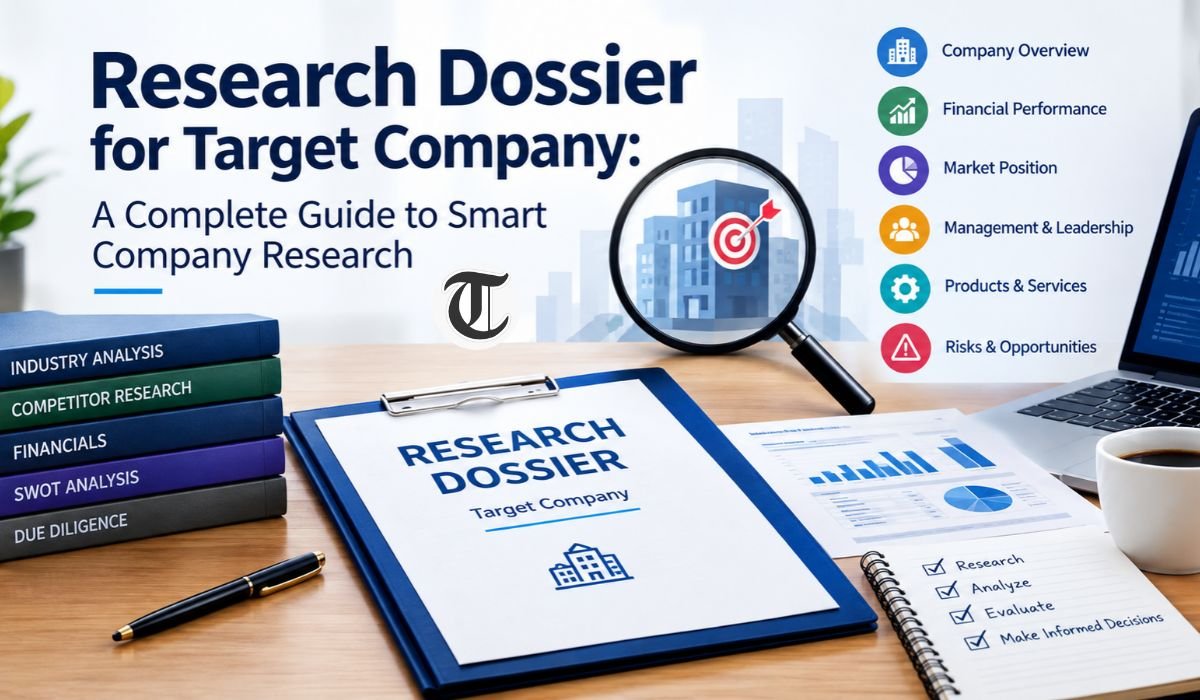
Introduction: Why Smart Company Research Matters
A Research Dossier For Target Company is much more than a document filled with business facts. Done properly, it brings together the information you need to understand a company, its background, operations, finances, market position, leadership, reputation, and potential risks.
Whether you’re researching a potential employer, business partner, investment opportunity, competitor, supplier, acquisition target, or prospective client, scattered information can quickly become difficult to manage. A research dossier solves that problem by putting important evidence into one organized record.
The goal isn’t simply to collect as much information as possible. Good company research is about finding relevant information, checking where it came from, separating confirmed facts from estimates, and explaining what the evidence actually means. That approach makes the final dossier more useful and easier to update.
What Is A Research Dossier For A Target Company?
A Research Dossier For A Target Company is a structured collection of verified information and analysis about a specific business. It can cover everything from the company’s legal identity and ownership to its products, customers, financial position, competitors, leadership, technology, reputation, and recent developments.
Think of it as a working research file rather than a simple company profile. A profile may give you a short overview of a business, while a dossier goes considerably deeper. It records the evidence behind important claims and highlights areas where information is incomplete or uncertain.
The depth of the dossier depends on the purpose of the research. A basic business review may require only public company information, while a more detailed Company Research Report could require financial records, regulatory filings, ownership information, competitor research, legal records, and industry data.
Why Create A Company Research Dossier?
The main advantage of a Company Research Dossier is that it turns disconnected information into something you can actually work with.
A company may have information spread across its official website, government databases, annual reports, interviews, news coverage, professional networks, industry publications, regulatory records, and other sources. Those sources don’t always tell the same story, and some may be outdated.
A structured dossier gives researchers a place to compare those sources and record what has been confirmed. It also makes future research faster because you don’t have to start from scratch every time the company changes its leadership, launches a product, receives funding, enters a new market, or faces a regulatory issue.
Define The Research Goal
Before opening dozens of websites and databases, decide exactly what you’re trying to learn.
The research goal determines what belongs in the dossier and what doesn’t. If you’re assessing a potential supplier, operational reliability, ownership, financial stability, legal history, and reputation may be particularly important. If you’re studying a competitor, products, pricing, customers, market strategy, technology, and recent expansion may deserve more attention.
Without a clear objective, Target Company Research can become an endless collection of facts. A focused research question gives the entire project direction and helps prevent unnecessary work.
It’s also useful to write the purpose at the beginning of the dossier. That simple step makes it easier for another person to understand why the research was conducted and how the information should be interpreted.
Confirm Company Identity And Ownership
Company identity should be established before deeper analysis begins. Similar business names can create confusion, especially when companies operate in different countries or industries.
Record the company’s legal name, trading name, registration information, headquarters, website, major operating locations, and corporate structure where those details are available. For larger organizations, identify parent companies, subsidiaries, acquisitions, and other important corporate relationships.
Ownership deserves particular attention. A company may appear independent while actually belonging to a larger corporate group. Private businesses can also have limited public ownership information, so researchers should clearly distinguish confirmed ownership details from assumptions or third-party estimates.
Research History, Products, And Customers
A company’s history provides useful context for understanding how it reached its current position. Look for its founding date, founders, major milestones, mergers, acquisitions, leadership changes, expansions, product launches, and other significant events.
From there, examine what the company actually sells. Record its main products and services, pricing information where publicly available, geographic availability, and the customers those offerings are designed to serve.
Customer research should go beyond simply identifying an audience. Consider whether the company serves consumers, businesses, government organizations, or several groups at once. Geographic markets also matter because a company’s strategy can differ significantly between domestic and international operations.
Business Model And Financial Position
Understanding How A Company Makes Money is central to meaningful company analysis. Revenue may come from direct product sales, subscriptions, advertising, licensing, commissions, consulting, marketplaces, enterprise contracts, or several sources at the same time.
The dossier should explain the company’s main revenue streams in straightforward language. It should also consider recurring versus one-time revenue, major customer groups, pricing structures, and any obvious dependence on a particular product or market.
Financial research requires extra care. Public companies may publish detailed financial statements, while private businesses often disclose much less. Reported figures should be distinguished from estimates, and estimates should always be identified as such.
Useful financial information can include revenue, profit or loss, assets, debt, cash position, valuation, funding, investment activity, and other figures relevant to the research objective. A number without a source and date isn’t strong evidence.
Leadership, Operations, And Technology
Leadership can reveal how a company is organized and how major decisions are made. Research founders, executives, directors, senior managers, and other publicly identified decision-makers. Where appropriate, record relevant professional backgrounds and leadership changes.
Operational research looks at how the company functions in practice. Depending on the business, that can include offices, manufacturing facilities, suppliers, logistics, distribution channels, customer support, partnerships, and geographic reach.
Technology can be equally important. A technology company might depend heavily on proprietary software, patents, cloud infrastructure, artificial intelligence systems, data, or intellectual property. For a traditional business, technology may still influence manufacturing, distribution, customer acquisition, or internal operations.
The key is to connect these details to the company’s business rather than simply listing technical terms.
Competitors And Industry Context
No company operates in isolation. Competitor Research helps explain the environment in which a business is trying to grow.
Start by identifying direct competitors offering similar products or services to similar customers. Then consider indirect competitors that solve the same customer problem in a different way.
Industry context adds another layer. Market size, growth trends, regulation, consumer behavior, technological change, economic conditions, and supply-chain developments can all affect a company’s position.
A useful dossier doesn’t merely name competitors. It explains where the target company overlaps with them, where the businesses differ, and which external developments could affect the market.
Research Methodology And Source Evaluation
A credible Company Research Process depends on source quality. Not every website deserves the same level of trust, and a search-engine result or AI-generated summary shouldn’t automatically be treated as original evidence.
Primary sources should generally receive close attention. These may include company filings, official corporate records, investor materials, regulatory documents, court records, official statements, patents, and company publications. Reputable journalism, industry research, academic material, and established business databases can provide valuable secondary context.
When a secondary source makes an important claim, trace it back to the original material whenever possible. This is particularly important for ownership, financial figures, legal matters, executive roles, and major corporate events.
The research record should also explain how important information was verified. Recording the source, publication date, access date, and relevant evidence creates a clearer trail for later review.
Recent Developments, Reputation, And Online Presence
Company research can become outdated surprisingly quickly. A dossier written several years ago may no longer accurately describe a company’s leadership, products, ownership, financial position, or strategy.
Check for recent product launches, acquisitions, partnerships, expansions, layoffs, funding announcements, executive changes, major contracts, restructuring, or other meaningful developments.
Reputation research should also be handled carefully. Look across reputable news coverage, industry publications, customer feedback, professional platforms, and the company’s own communications. Positive and negative claims should be distinguished from independently verified facts.
Online presence can provide useful clues, but social media posts and user comments aren’t automatically reliable evidence. They may help identify questions worth investigating rather than serving as proof on their own.
Legal And Regulatory Research
Legal and regulatory records can reveal issues that aren’t obvious from a company’s marketing materials.
Depending on the research purpose and jurisdiction, examine relevant court records, regulatory filings, enforcement actions, licenses, compliance information, intellectual-property disputes, and other publicly documented legal matters.
Not every lawsuit represents wrongdoing, and being named in a legal proceeding doesn’t by itself establish liability. The dossier should therefore describe what the record says and avoid turning an allegation into an established fact.
Dates and outcomes matter. A current legal matter, a resolved dispute from years ago, and an unverified online allegation shouldn’t be treated as equivalent pieces of evidence.
Reliable Sources And An Evidence Register
Strong Company Research Sources make a dossier easier to trust and easier to audit.
An evidence register can connect each significant claim to the source supporting it. For example, a statement about revenue should point to the relevant financial filing or clearly identified estimate. An executive appointment should be supported by an appropriate company announcement, filing, or reliable report.
The register doesn’t need to become complicated. Its purpose is simply to answer three basic questions: What is the claim? Where did the information come from? When was it checked?
That small discipline can dramatically improve the quality of a Business Research Dossier, especially when several people are contributing to the same project.
Facts, Estimates, Conflicts, And Analysis
One of the most important distinctions in company research is the difference between fact and interpretation.
A fact is something supported by credible evidence. An estimate is a calculated or externally reported figure that may not have been officially confirmed. Analysis is the researcher’s interpretation of what the available evidence could mean.
These categories shouldn’t be blended together.
Conflicting information also needs to be handled openly. If two reputable sources give different founding dates, employee counts, valuations, or revenue figures, don’t quietly choose whichever number looks more convenient. Check the dates, definitions, methodologies, and original sources. Then explain why the figures differ when that can be established.
This approach strengthens Trustworthiness because readers can see where certainty ends and interpretation begins.
Turn Raw Data Into Useful Analysis
Collecting information is only the first half of the job. The real value of a dossier comes from making sense of that information.
For example, a growing employee count may indicate expansion, but it doesn’t automatically prove that the business is becoming more profitable. A new market launch may create an opportunity while also increasing costs and regulatory exposure.
Good Target Company Analysis connects individual facts without overstating what they prove. Look for relationships between products, customers, financial performance, leadership decisions, market conditions, and recent developments.
The final analysis should remain grounded in the evidence. Readers should be able to distinguish what the sources establish from what the researcher is interpreting.
Risks, Opportunities, And Information Gaps
A useful dossier should make important uncertainties visible.
Potential risks might involve financial pressure, customer concentration, regulatory exposure, supply-chain dependence, competitive pressure, cybersecurity concerns, intellectual-property disputes, or dependence on a particular market. Potential opportunities could include expansion, new products, technological developments, partnerships, or growing demand.
These aren’t predictions. They’re research categories that help readers identify areas requiring closer attention.
Information gaps deserve their own place in the dossier. If ownership isn’t fully clear, financial data isn’t publicly available, customer concentration can’t be verified, or an important legal matter remains unresolved, say so.
A clearly identified gap is more useful than false certainty.
The Final Company Research Dossier
Once the research is complete, organize the material so someone unfamiliar with the project can understand it quickly.
Start with the research objective and a concise company overview. Follow with identity and ownership, history, products and customers, business model, financial information, leadership, operations, technology, competitors, industry context, recent developments, reputation, legal matters, sources, analysis, risks, opportunities, and unanswered questions.
The evidence register should remain connected to the relevant claims. Dates should also be visible because company information changes over time.
A Company Research Report is most useful when it can be revisited and updated rather than treated as a one-time document.
Common Mistakes In Company Research
One common mistake is relying too heavily on the company’s own marketing language. Official sources are important, but they naturally present the business from the company’s perspective. Independent and primary external records can provide necessary context.
Another problem is using outdated information without saying so. Employee numbers, valuations, leadership roles, product offerings, and market positions can change quickly.
Researchers should also avoid copying information from one secondary source into another without checking the original evidence. Search snippets, social media posts, AI summaries, and unsourced databases can be useful starting points, but important claims deserve stronger verification.
Finally, don’t confuse a large amount of information with high-quality research. A shorter, well-supported statement is more useful than a long paragraph built around uncertain claims.
Final Thoughts
A strong Research Dossier For Target Company brings structure to complex business research. It combines company facts, reliable sources, financial and market information, leadership details, legal records, competitive context, and careful analysis in one place.
The most valuable dossiers aren’t necessarily the longest. They’re the ones that make clear what is known, what is estimated, what remains uncertain, and where each important claim came from.
For researchers, analysts, journalists, business professionals, investors, and anyone evaluating a company, that distinction matters. Good research doesn’t simply collect information. It gives readers enough context and evidence to understand the business for themselves.
Frequently Asked Questions
What Is A Research Dossier For A Target Company?
It’s a structured research document containing verified information and analysis about a specific company. It can cover ownership, history, products, customers, finances, leadership, operations, competitors, legal matters, reputation, and recent developments.
How Is A Company Dossier Different From A Company Profile?
A company profile usually provides a concise overview. A dossier goes deeper by documenting evidence, examining multiple research areas, identifying uncertainties, and adding analysis based on the available information.
What Sources Should Be Used For Company Research?
Primary sources such as official filings, regulatory records, corporate documents, court records, patents, and official announcements are particularly valuable. Reputable journalism, industry publications, academic sources, and established databases can add independent context.
How Do You Research A Private Company?
Private companies often disclose less financial and ownership information than public companies. Researchers can examine corporate registries, official websites, regulatory records, court documents, credible news reports, professional information, industry databases, and other publicly available sources while clearly identifying estimates and information gaps.
Why Is An Evidence Register Important?
An evidence register creates a traceable connection between important claims and their sources. It helps readers verify information and makes it easier to update the dossier when new evidence becomes available.
How Often Should A Company Research Dossier Be Updated?
The update schedule depends on the purpose of the research and how quickly the company or industry changes. A dossier used for active business decisions may need frequent reviews, while a general background report may require less frequent updates. Significant developments should trigger a review regardless of the normal schedule.
What Should You Do When Two Sources Give Different Company Information?
Check the publication dates, definitions, methodologies, and original sources. Differences may result from timing or different ways of measuring the same subject. If the conflict can’t be resolved, record the disagreement rather than presenting one figure as unquestionably correct.
Can A Company Research Dossier Include Analysis?
Yes. Analysis is often one of the most useful parts of a dossier, provided it’s clearly separated from confirmed facts and estimates. The analysis should explain what the available evidence suggests without presenting unsupported assumptions as facts.
Learn more and explore exciting content on: Elleven Love: Biography, Age, Family and Life as Snoop Dogg’s Granddaughter
[…] Learn more and explore exciting content on: Research Dossier for Target Company: A Complete Guide to Smart Company Research […]