
Few fabric patterns are as instantly recognizable as Gingham. For many people, the first image that comes to mind is a red-and-white picnic tablecloth. Others might think of a blue checked shirt, a summer dress, or Dorothy’s famous blue-and-white dress from The Wizard of Oz. Gingham has become so familiar that it’s easy to overlook the interesting textile history behind those simple squares.
Traditionally, Gingham is a yarn-dyed, plain-weave fabric, most commonly made from cotton. Its familiar checks aren’t simply printed onto the finished material. Instead, they are created by arranging differently colored yarns during the weaving process. That detail gives traditional Gingham some of its most recognizable characteristics, including its similar appearance on both sides.
Over the years, Gingham has found a place far beyond casual clothing. You’ll see it in shirts and dresses, but also in accessories, beachwear, table linens, bedding, upholstery, and other home textiles. Fashion designers have repeatedly returned to the pattern, giving it new interpretations while preserving its classic identity.
So, what exactly is Gingham, where did the name come from, and why has this checked fabric remained popular for so long? Let’s take a closer look.
Quick Bio: Gingham At A Glance
Traditional Fabric: Yarn-Dyed Plain-Weave Textile
Most Traditional Fiber: Cotton
Modern Variations: Cotton Blends And Other Textile Fibers
Basic Weave: Plain Weave
Traditional Pattern: Checks Or Stripes
Most Recognizable Pattern: Repeated Checks
Common Color Arrangement: One Color With White
Familiar Colors: Blue And White, Red And White
Other Colors: Pink, Green, Black, Yellow, Brown, And More
Check Size: Small To Large
Pattern Formation: Created Through Yarn Arrangement
Traditional Construction: Dyed Yarn Woven Into The Fabric
Common Clothing Uses: Shirts And Dresses
Accessory Uses: Scarves, Headbands, And Pocket Squares
Home Uses: Table Linens, Bedding, Curtains, And Upholstery
Beach Uses: Towels And Swimwear Designs
French Fashion Term: Vichy
Famous Film Association: Dorothy’s Gingham Dress In The Wizard Of Oz
Main Advantage: Adaptable Across Fashion And Interiors
What Is Gingham?
Gingham is traditionally a cotton textile made using a plain weave and dyed yarns. The yarns running lengthwise and crosswise are arranged in carefully repeated sequences, creating stripes, checks, or related geometric designs. The checked version is by far the one most people recognize today.
A traditional Gingham design often combines one color with white. When the colored yarns cross, they create the familiar darker and lighter areas that form the checks. Blue and white is perhaps the most recognizable combination, followed closely by red and white, but there are plenty of other possibilities.
There’s also an important distinction between the fabric and the pattern. In everyday fashion and retail language, “Gingham” can refer to the familiar check itself. In a more precise textile sense, however, traditional Gingham describes a particular type of yarn-dyed, plain-weave fabric.
That difference is worth knowing, especially when you’re shopping for fabric. A material can have a Gingham-style check printed across its surface without actually being traditional woven Gingham.
What Does Gingham Look Like?
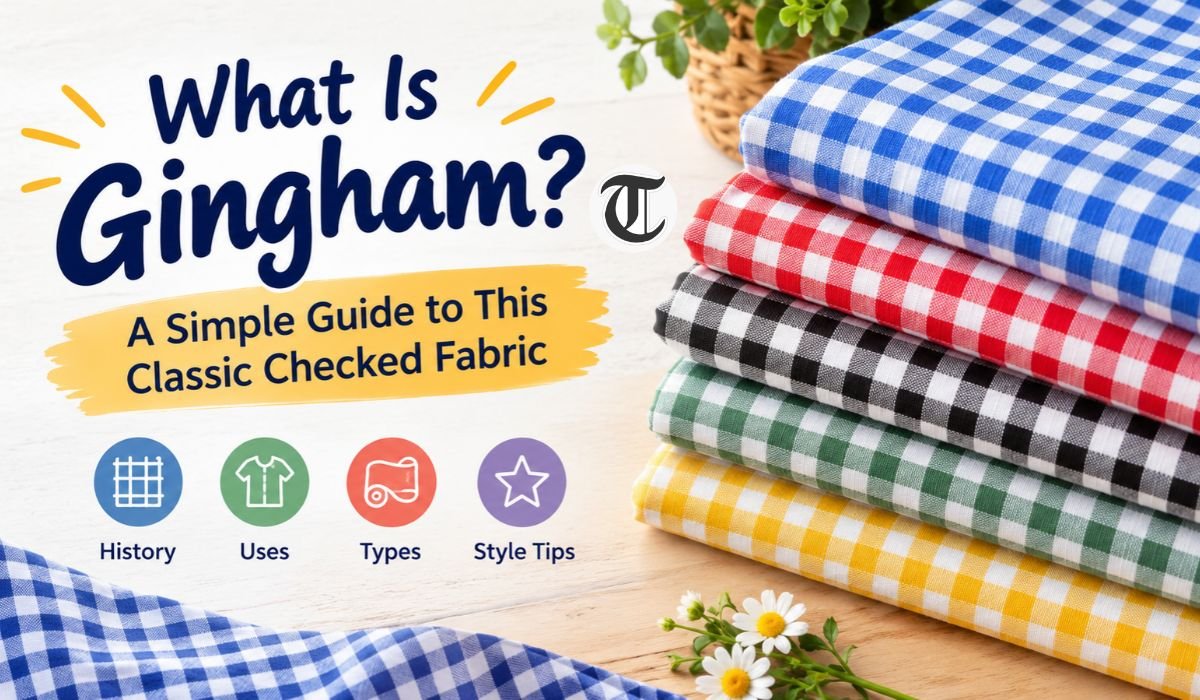
The defining visual feature of Gingham is its orderly arrangement of repeated checks. The squares can be tiny and understated or large enough to become the main feature of a garment or room.
Blue-and-white and red-and-white combinations are classic, but modern Gingham isn’t restricted to traditional colors. Pink, green, yellow, black, brown, and pastel shades are all used. Changing the color can give essentially the same pattern a completely different personality.
The size of the check matters, too. Smaller checks often create a neat and subtle appearance, which makes them easy to incorporate into everyday clothing. Larger checks are more noticeable and can make a bolder statement.
Traditional woven Gingham also has a characteristic visual depth. Because the pattern is produced by crossing differently colored yarns, the design isn’t simply a flat image sitting on the surface. The result is a balanced pattern that remains recognizable from both sides of the cloth.
How Is Gingham Fabric Made?
The traditional Gingham-making process begins with dyed yarn rather than an already finished piece of cloth. The yarns are colored before they’re woven, which is why Gingham is commonly described as a yarn-dyed fabric.
Those yarns are then woven using a plain-weave structure. In plain weave, the warp and weft yarns cross one another in a straightforward over-and-under arrangement. It’s one of the most basic and widely used textile constructions.
For Gingham, the color sequence is just as important as the weave itself. Colored yarns are arranged in the warp and weft so that their intersections create the familiar checks. The finished pattern is therefore built into the fabric rather than applied afterward as a surface decoration.
This is one of the clearest differences between traditional Gingham and a printed check. A printed fabric can reproduce almost the same appearance, but the design is added to the surface after the material has been woven.
That distinction doesn’t necessarily make one better than the other. It simply means they’re made differently. If you’re buying fabric for sewing or another textile project, understanding the construction can help you choose the right material.
Is Gingham Always Made Of Cotton?
Cotton is the fiber most closely associated with Gingham, and traditional definitions commonly describe it as a cotton fabric. Modern Gingham and Gingham-style textiles, however, may also be made with cotton blends or other textile fibers.
That matters because fiber content influences how a fabric feels and behaves. Cotton can offer the familiar characteristics associated with natural-fiber clothing, while blends may be chosen for different qualities such as durability, drape, or ease of care.
The pattern itself doesn’t tell you exactly what the fabric is made from. Two garments can have almost identical Gingham checks while feeling completely different because they’re made from different fibers.
For that reason, it’s better to check the fabric label or product specifications rather than assume that every Gingham item is pure cotton.
Why Is Gingham So Popular?
There’s a reason Gingham has never really disappeared from fashion. Its appeal starts with its simplicity. The pattern is distinctive enough to make an outfit or room interesting, yet orderly enough to avoid feeling visually overwhelming.
That balance makes Gingham remarkably versatile. The same basic check can appear on a casual shirt one day and a sophisticated dress the next. At home, it can work just as naturally on a traditional tablecloth as it does on contemporary bedding or a decorative cushion.
Gingham also carries strong emotional associations. Depending on the setting, it can suggest summer, outdoor gatherings, country style, vintage fashion, or childhood nostalgia. Yet designers can change the color, scale, fabric, and silhouette and make it feel completely modern.
Its relatively straightforward production has helped, too. Gingham has traditionally been accessible rather than reserved solely for luxury fashion. It can be practical, affordable, and stylish at the same time.
A Brief History Of Gingham
The history of Gingham is more complicated than its neat rows of checks might suggest. The English term has been traced through European languages, while the textile itself has a much broader history involving international trade and changing manufacturing traditions.
Historical accounts indicate that earlier textiles associated with the name included striped forms. The checked version that dominates our modern understanding of Gingham became increasingly established as the fabric developed within European textile production.
That evolution is important. Today’s familiar blue-and-white or red-and-white check shouldn’t automatically be assumed to represent every historical form of Gingham. The textile’s appearance and meaning have changed over time.
Gingham eventually became firmly associated with practical clothing and household textiles. Its relatively straightforward construction made it suitable for everyday use, while its distinctive appearance gave it an identity that could survive changes in fashion.
What began as a useful textile ultimately became something much broader: a recognizable design language that could move between clothing, interiors, and popular culture.
Where Does The Word “Gingham” Come From?
The exact history of the word Gingham has been debated, although the most widely supported dictionary explanation connects it with Dutch gingang and ultimately with a Malay term associated with stripes or separation.
The word appears to have traveled through different languages before taking its modern English form. That kind of linguistic journey isn’t unusual for textiles, which historically moved between regions through international trade.
There’s also an alternative theory linking the name with Guingamp, a town in Brittany, France. This explanation has appeared in historical discussions of the fabric, but it shouldn’t be presented as an established fact.
In France, the familiar checked textile is commonly associated with the term Vichy. The expression “Vichy check” is particularly familiar in French fashion and textile contexts.
The uncertainty surrounding the name’s origin is actually part of what makes Gingham’s history interesting. Rather than having one universally accepted story, the word reflects the complicated movement of textiles between cultures, languages, and markets.
Gingham In Popular Culture And Fashion
Gingham has managed to become more than a fabric. It’s now a visual shorthand for certain ideas of summer, nostalgia, innocence, and classic style.
One of its most famous appearances came in the 1939 film The Wizard of Oz, where Dorothy wears a blue-and-white Gingham dress. The costume became one of the most recognizable outfits in movie history and helped cement the pattern in popular culture.
But Gingham’s fashion history isn’t limited to nostalgic or casual clothing. Designers have used it for structured dresses, jackets, capes, gowns, and other garments that demonstrate how sophisticated the pattern can become.
Brigitte Bardot also played an important role in Gingham’s fashion image. Her association with pink Gingham helped connect the pattern with French-inspired style and mid-century fashion. Her Gingham wedding dress became another memorable example of the fabric being used for an occasion far removed from the traditional picnic table.
These examples reveal the unusual flexibility of Gingham. The pattern can look innocent and playful in one context, then elegant and fashion-forward in another.
What Are The Most Common Gingham Colors And Patterns?
Blue-and-white Gingham is arguably the pattern’s most recognizable combination. Red-and-white is another classic, particularly in table linens and country-inspired décor.
Modern Gingham offers a much wider palette. Pink, green, yellow, black, brown, and pastel combinations can all create different effects while retaining the basic checked structure.
Color isn’t the only variable. The scale of the check can dramatically change the appearance of the fabric. Small checks tend to feel more delicate and restrained, while large checks attract attention and create a stronger graphic effect.
This gives designers and shoppers plenty of flexibility. Someone looking for a subtle everyday shirt might choose a small check, while someone wanting a statement dress or interior feature might prefer a larger pattern.
There’s no single “correct” version of Gingham. Its character depends heavily on the combination of color, scale, material, and design.
Gingham Vs. Plaid Vs. Checkered Fabric
Gingham, Plaid, and Checkered Fabric can look similar at first glance, but the terms don’t mean exactly the same thing.
Traditional Gingham is associated with a relatively straightforward color arrangement and plain weave, commonly using one stronger color alongside white. Plaid, on the other hand, is generally built from intersecting stripes and can contain several colors and considerably more complex arrangements.
“Checkered” is a broader visual term. It can describe almost any surface containing repeated squares, regardless of how the material was constructed.
That’s why a printed fabric can look like Gingham without technically being traditional Gingham. Retailers and fashion brands sometimes use pattern names in a broader, less technical sense than textile specialists do.
If you’re simply choosing a shirt because you like the look, that distinction may not matter much. If you’re buying fabric for sewing, however, knowing the difference can help you understand exactly what you’re purchasing.
How To Wear Gingham Casually
Gingham has always been comfortable in casual wardrobes. Its balanced pattern adds visual interest without requiring a complicated outfit.
A Gingham shirt can be worn with jeans, trousers, shorts, or a simple skirt. A Gingham dress can also work on its own, particularly when the rest of the outfit is kept relatively understated.
One of the easiest styling approaches is to let the Gingham piece become the main pattern and surround it with solid colors. This keeps the look coordinated without making it feel overworked.
Check size can change the mood, too. Small checks tend to look neat and subtle, while larger squares create a more playful or statement-making effect.
That’s part of Gingham’s appeal for everyday clothing: you can make it as quiet or noticeable as you want.
How To Wear Gingham To Work
Gingham can also make sense in a professional wardrobe, particularly in workplaces where business-casual or smart-casual clothing is appropriate.
A Gingham button-down shirt can be paired with trousers for a polished look or with jeans in a more relaxed workplace. A well-cut Gingham dress can provide a professional appearance while still adding a little personality.
When you want the pattern to feel more understated, smaller checks and restrained color combinations are generally easier to work with. Tailoring makes a difference as well. A structured garment can look considerably more polished than a loose, casual piece made from the same patterned fabric.
Ultimately, Gingham isn’t inherently formal or informal. The setting, garment, fabric, fit, and styling all influence how the pattern comes across.
Can You Wear Gingham For A Dressy Look?
Gingham can absolutely be dressed up. Its association with picnic cloths and casual summer clothing doesn’t mean it has to stay in that category.
Fashion designers have used Gingham in gowns, capes, jackets, structured dresses, and other sophisticated garments. A carefully designed silhouette can completely change the character of the check.
Color plays a role, too. A softer or unexpected combination may feel more refined than a traditional high-contrast check. The material itself can also influence the final impression.
Accessories provide another way to elevate the pattern. A structured handbag, polished shoes, jewelry, or other carefully chosen details can make a Gingham garment feel appropriate for a more formal occasion.
The lesson is simple: don’t judge Gingham solely by its pattern. The way that pattern is cut, constructed, and styled can make all the difference.
How To Style Gingham Accessories
You don’t have to wear a full Gingham outfit to enjoy the pattern. Accessories are one of the easiest ways to introduce it into your wardrobe.
A Gingham scarf, headband, or pocket square can add a small amount of pattern while leaving the rest of the outfit relatively simple. This is especially useful if you like classic prints but don’t want them to dominate your look.
Because the pattern has such a regular structure, it can also work alongside other prints when the combination is carefully balanced. If you’re experimenting, pairing one Gingham accessory with mostly solid-colored clothing is an easy place to start.
The same idea works at home. A Gingham cushion, table runner, or other small textile can introduce the pattern without requiring a major change to the room.
Is Gingham Good For Summer And Beachwear?
Gingham has a natural connection with warm-weather style. Its checks regularly appear on summer dresses, lightweight shirts, swimwear, beach towels, and other seasonal products.
There is, however, a useful distinction between the appearance of Gingham and the construction of traditional Gingham. A swimsuit or beach towel may feature a printed Gingham-style check rather than being made from yarn-dyed woven Gingham.
That doesn’t make the product any less useful or attractive. It simply means that the visual design and the textile construction are different.
For summer wardrobes, Gingham works particularly well because it can feel fresh and relaxed without being overly complicated. Traditional colors can emphasize its nostalgic character, while brighter or softer shades can give it a more contemporary look.
How To Use Gingham In Home Décor
Gingham has been a familiar presence in home textiles for generations. The classic tablecloth remains one of its best-known uses, but the fabric can do much more than cover a dining table.
You’ll find Gingham-inspired designs in chair upholstery, curtains, window treatments, bedding, cushions, and other decorative textiles. Its orderly geometry can add pattern to a room without creating the visual complexity of a large floral or illustrated print.
The size of the check can determine how strongly the fabric affects a space. Small checks tend to blend more easily with other elements, while large checks can become an obvious focal point.
Color is equally important. Red-and-white and blue-and-white combinations can create a traditional or nostalgic atmosphere, whereas darker, softer, or less expected colors can give Gingham a more contemporary feel.
Used thoughtfully, the pattern can work in many different interiors without overwhelming the rest of the room.
How To Choose The Right Gingham For Your Style
Start by thinking about how much attention you want the pattern to attract. If you’re new to Gingham, a small-check scarf, shirt, headband, or other accessory can be an easy introduction.
For a stronger statement, a larger check or a higher-contrast color combination may be more appropriate. You can also choose an unexpected color to make the pattern feel less traditional.
The garment’s shape matters just as much. A tailored Gingham shirt or structured dress can look very different from a loose, relaxed piece, even when both use the same check.
For home décor, consider the colors and patterns that are already present. Gingham works best when it contributes to the overall design rather than competing with every other feature.
In both fashion and interiors, simplicity is often the key. Gingham already provides a clear visual pattern, so it doesn’t need much extra decoration to make an impression.
Why Gingham Continues To Be A Timeless Pattern
Gingham has survived changing trends because its basic design is simple enough to be reinvented without losing its identity.
Change the color and it feels different. Increase the check size and the mood changes again. Put the same pattern on a tailored dress, a casual shirt, or a tablecloth, and it takes on another personality altogether.
That adaptability is unusual. Many patterns become strongly associated with a particular era or style, while Gingham can move between decades with relatively little effort.
Its usefulness across different categories helps explain its longevity as well. The pattern works in fashion, accessories, beachwear, and interiors, making it much more than a passing clothing trend.
Gingham doesn’t necessarily need to follow fashion. It has lasted precisely because it can adapt to fashion while remaining recognizable.
Final Thoughts
Gingham may look simple, but there’s a surprisingly rich story behind its familiar checks. Traditionally, it’s a yarn-dyed, plain-weave textile associated most strongly with cotton. Its pattern is created through the arrangement of colored yarns during weaving rather than simply being printed onto the finished fabric.
Its history is equally layered. Earlier forms associated with Gingham included stripes, and the origin of the English name has been linked most strongly to a Malay-to-Dutch linguistic route, while an alternative French explanation has also been proposed.
Over time, Gingham became part of everyday clothing, home décor, popular culture, and high fashion. Dorothy’s famous dress and Brigitte Bardot’s association with pink Gingham are just two examples of how widely the pattern has traveled.
Perhaps the biggest reason Gingham remains relevant in 2026 is its flexibility. It can be casual without looking careless, traditional without feeling outdated, and sophisticated when given the right treatment.
Trends will continue to change, but Gingham’s straightforward check gives designers and everyday wearers something remarkably useful: a pattern that can keep changing while still feeling unmistakably familiar.
FAQs About Gingham
What Is Gingham Made Of?
Traditional Gingham is primarily a yarn-dyed cotton fabric made with a plain weave. Modern Gingham-style textiles can also contain cotton blends or other fibers. The fiber affects the fabric’s feel, drape, durability, and care requirements, while the yarn arrangement creates its familiar appearance.
Is Gingham A Fabric Or A Pattern?
It can refer to both. In the more precise textile sense, Gingham describes a yarn-dyed, plain-weave fabric, traditionally made from cotton, with its colors arranged to create stripes or checks. In everyday fashion and retail language, Gingham is also commonly used to describe the recognizable check pattern.
Is Gingham The Same As Plaid?
No. Traditional Gingham is associated with a relatively simple, balanced design and is commonly made using two colors. Plaid generally features intersecting stripes and may contain several colors and more complicated arrangements. “Checkered” is an even broader visual description that can apply to many different fabrics and surfaces.
Is Gingham Always Blue And White?
No. Blue and white is one of the best-known Gingham combinations, but it isn’t the only option. Red, pink, green, black, yellow, brown, pastel, and many other color combinations can be used. The checks can also range from very small to quite large.
Is Traditional Gingham Reversible?
Traditional woven Gingham generally has a similar appearance on both sides because its design comes from the arrangement of dyed yarns throughout the weave. This differs from many printed fabrics, where the design is primarily applied to one surface.
Where Is Gingham Used?
Gingham is used in clothing, accessories, and home textiles. Shirts and dresses are common fashion applications, while scarves, headbands, and pocket squares can introduce the pattern in smaller doses. In home décor, Gingham can be used for tablecloths, bedding, curtains, upholstery, cushions, and other decorative textiles.
What Is Vichy Gingham?
Vichy is the French term commonly associated with the familiar Gingham check. The expression “Vichy check” is therefore often used when discussing this pattern in French fashion and textile contexts.
Is Printed Gingham The Same As Woven Gingham?
No. Printed Gingham reproduces the familiar checked appearance on the surface of a fabric, while traditional Gingham creates its design through dyed yarns woven together. The two can look very similar, but their construction is different. If the manufacturing method matters to you, check the fabric’s fiber and construction details rather than relying on its appearance alone.
Learn more and explore exciting content on: What Is a Magnifying Glass Used For? Everyday Uses and Benefits
[…] Learn more and explore exciting content on: What Is Gingham? A Simple Guide To This Classic Checked Fabric […]