
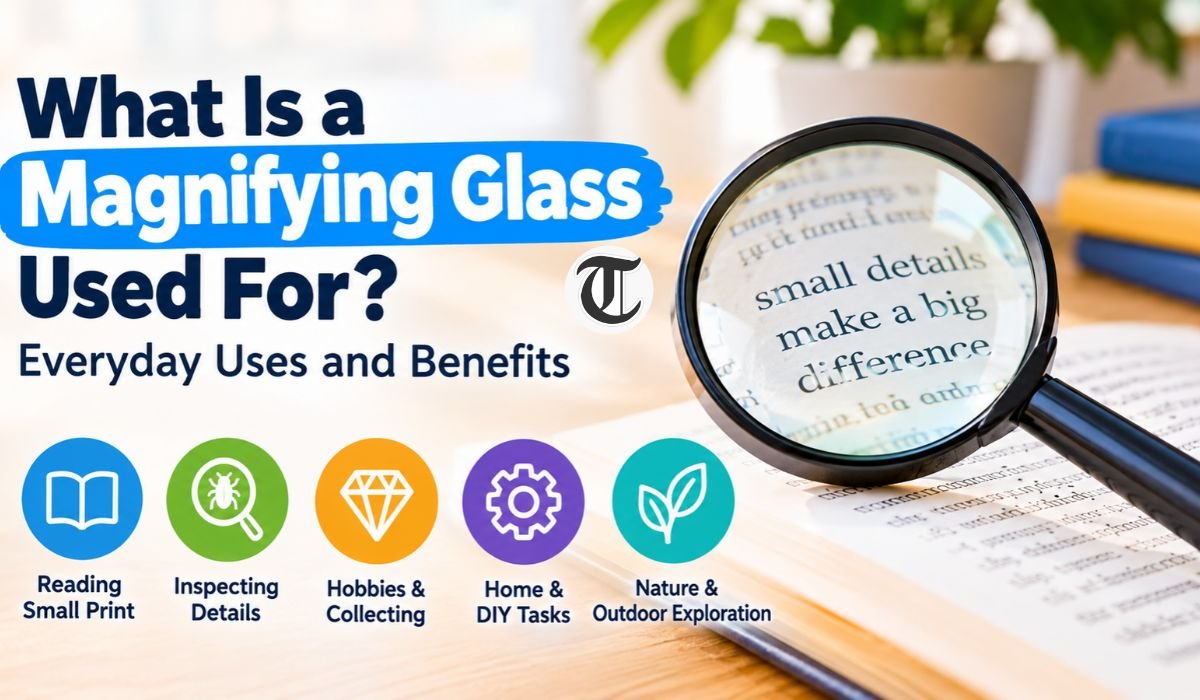
Sometimes, the smallest detail can tell you something important. A tiny marking on a coin, a line of unusually small print, or the delicate pattern on a leaf can be difficult to see with the naked eye. That’s where a Magnifying Glass comes in.
Most people recognize the classic handheld lens immediately. It’s often associated with detectives, science experiments, or childhood curiosity, but its usefulness goes much further. A Magnifying Glass can help with everyday reading, detailed crafts, collecting, nature observation, education, and many types of close-up inspection.
So, What Is a Magnifying Glass Used For? Put simply, it’s used to make nearby objects appear larger so their details are easier to see. The object itself doesn’t actually become bigger. Instead, the lens changes the way light reaches your eyes, creating the perception of a larger image.
Modern Magnifiers are available in many forms, too. Alongside the familiar handheld design, you’ll find Stand Magnifiers, Pocket Magnifiers, Magnifying Lamps, Head-Mounted Magnifiers, and electronic Video Magnifiers.
In this guide, we’ll look at how Magnifying Glasses work, where they’re useful, how different types compare, and what you should consider when choosing one.
Quick Bio Information
| Fact | Information |
|---|---|
| Optical Type | A traditional Magnifying Glass commonly uses a Convex or Converging Lens. |
| Main Purpose | It makes nearby objects appear larger for easier viewing. |
| Basic Principle | The lens refracts light and can create an enlarged virtual image. |
| Common Use | Reading small print and examining fine details. |
| Lens Shape | A Convex Lens curves outward and has a converging effect on light. |
| Reading Use | Magnifiers can enlarge small print on documents, labels, maps, and books. |
| Hobby Use | They can assist with crafts, models, coins, stamps, and collectibles. |
| Nature Use | They can reveal small details in plants, insects, rocks, and other natural objects. |
| Accessibility Use | Magnifiers can function as visual aids for some close-up tasks. |
| Hands-Free Option | Stand and Head-Mounted Magnifiers can allow hands-free viewing. |
| Lighting Option | Magnifying Lamps combine Magnification with illumination. |
| Portable Option | Pocket Magnifiers are designed for convenient carrying. |
| High Magnification | Greater Magnification can mean a smaller viewing area and shorter Working Distance. |
| Focusing | The distance between the lens and object affects image clarity. |
| Microscope Difference | A Microscope uses more complex optics and much greater Magnification. |
| Loupe Difference | A Loupe is generally a compact magnifier designed for close, detailed inspection. |
| Sunlight Risk | A Convex Lens can concentrate sunlight into a small, intense spot. |
| Lens Care | Keeping a lens clean helps preserve clear viewing. |
What Is a Magnifying Glass?
A Magnifying Glass is a simple optical device designed to make a nearby object appear larger. A traditional Magnifying Glass usually contains a Convex Lens, sometimes called a converging lens because of the way it bends light.
The lens doesn’t physically enlarge the object. Instead, it changes the path of light entering your eyes. When the object is positioned within the lens’s focal length, the lens can produce an upright, magnified virtual image. Your eyes then perceive that image as larger than the original object.
The basic design can be remarkably simple: a circular lens attached to a handle or held within a frame. Yet Magnifiers have evolved into many different forms for different situations. Some are designed for portability, others for hands-free use, and some combine Magnification with lighting or electronic displays.
It’s also worth separating a Magnifying Glass from other optical tools. A Loupe, for example, is generally a compact magnifier designed for very close inspection. A Microscope is considerably more sophisticated and is built to provide much greater Magnification for examining extremely small structures.
What Is a Magnifying Glass Used For?
A Magnifying Glass is primarily used for close-up viewing and detailed inspection. Reading small print is probably its most familiar application, but it’s far from the only one.
People use Magnifying Glasses to examine Jewelry, Coins, Stamps, Maps, Plants, Insects, Crafts, Labels, printed materials, and small components. They’re also useful for hobbies, classroom activities, nature observation, and some visual-aid applications.
The type of Magnifier that works best depends on the task. A Handheld Magnifier is convenient when you need to inspect something briefly or carry the tool around. A Stand Magnifier provides a more stable, hands-free view, while a Magnifying Lamp combines a lens with illumination.
That’s one reason Magnifiers remain useful. You don’t have to be a collector, scientist, or professional technician to benefit from one. Anyone who wants to see a small detail more clearly can find a practical use for a Magnifier.
How Does a Magnifying Glass Work?
The science behind a Magnifying Glass comes down to Refraction, which is the bending of light as it passes from one material into another.
A Convex Lens changes the direction of incoming light. When an object is placed within the lens’s focal length, the lens can create an enlarged, upright, virtual image. That’s the image your eyes perceive when you look through the Magnifier.
The Focal Length is the distance between the optical center of a lens and its focal point. It’s an important characteristic of a lens because it affects its optical power and how it forms images.
This also explains why positioning matters. Move the lens or object too far from the appropriate position and the image may become blurry or change its appearance. A small adjustment can often bring the view back into focus.
The underlying principles of optics are also found in more complex instruments. Microscopes, Telescopes, Cameras, and Binoculars all rely on lenses and the behavior of light, but their optical systems are much more sophisticated than that of a simple Magnifying Glass.
Magnifying Glass Uses for Reading Small Print
Reading is one of the most practical Magnifying Glass Uses. Small lettering can be surprisingly difficult to read, particularly when the print is tiny, the contrast is poor, or the surrounding light isn’t strong enough.
A Magnifying Glass can enlarge words and numbers on Books, Newspapers, Maps, Receipts, Packaging, Menus, Instructions, and Labels. For someone who only occasionally needs extra magnification, a Handheld Magnifier may be all that’s necessary.
Longer reading sessions can call for a different design. A Stand Magnifier, for instance, can remain in position above the page, reducing the need to hold the lens continuously. Some models also include built-in lighting, which can make printed material easier to see when additional illumination is useful.
Lens size matters as well. A large lens can provide a wider viewing area, while a smaller high-powered lens may reveal finer details but over a smaller section at a time.
Magnifying Glass Uses for Hobbies and Crafts
Many hobbies involve details that are simply easier to handle when they’re enlarged. Sewing, Embroidery, Model Building, Miniature Painting, Stamp Collecting, Coin Collecting, and Jewelry Making are just a few examples.
A Magnifying Glass can make tiny features easier to inspect and can help users work more comfortably on detailed projects. When the task requires both hands, a Handheld Magnifier isn’t always the most convenient option.
That’s where a Magnifying Lamp or Head-Mounted Magnifier can make a difference. A Magnifying Lamp provides a stable lens along with illumination, while a Head-Mounted or Binocular Magnifier stays in position as you work.
The best choice ultimately comes down to the project. Someone doing occasional crafts may prefer the simplicity of a handheld lens. A person who spends hours on detailed work may find a hands-free setup much more practical.
Magnifying Glass Uses for Jewelry, Coins, and Collectibles
Collectors often turn to Magnifiers when they want to inspect details that aren’t obvious at normal viewing distance.
For example, a Coin Collector may examine small lettering, markings, surface features, or signs of wear. Stamp collectors can use Magnification to look at printing details, perforations, textures, and other small characteristics.
Jewelry is another common application. A Magnifying Glass can help reveal details in settings, craftsmanship, surfaces, and gemstones that may be difficult to inspect without assistance.
There is an important distinction, though. A Magnifying Glass is a tool for visual inspection. It doesn’t automatically determine whether a collectible is authentic, establish its market value, or confirm the composition of a gemstone or precious metal. Those questions may require professional appraisal, authentication, or specialized testing.
Magnifying Glass Uses in Nature and Outdoor Exploration
Take a Magnifying Glass outside and familiar objects can suddenly become much more interesting. A leaf may reveal an intricate surface, a flower can show tiny structures, and the body of an insect contains details that are easy to miss at ordinary viewing distance.
That’s why Magnifiers can be useful for Nature Study, Gardening, collecting, and informal science activities. They’re also a simple way to encourage children to slow down and observe the world around them.
You don’t necessarily need to find something extremely unusual. Sometimes the most rewarding part is discovering how much detail is present in an ordinary object once you take a closer look.
Magnifying Glass Uses in Education and Science
A Magnifying Glass offers a straightforward introduction to basic Optical Science. Students can use one to examine Leaves, Seeds, Insects, Minerals, Textures, and other objects that are already visible but contain details that are difficult to see clearly.
It can also help demonstrate concepts such as Lenses, Light, Refraction, Focus, and Image Formation. Rather than simply reading about how a lens works, students can see the effect themselves.
A Magnifying Glass shouldn’t, however, be described as a replacement for a Microscope. A compound Microscope uses a more complex optical system and is designed for much greater Magnification and for examining extremely small specimens.
A simple Magnifier is better understood as an accessible introduction to the broader principles of optical imaging.
Magnifying Glasses for Low Vision
Magnifiers can also be useful as visual aids for people who have difficulty seeing small details. Depending on the person’s needs, a suitable Magnifier may help with reading labels, examining printed material, checking prices, or handling other close-up tasks.
There isn’t a single design that works equally well for everyone. Lens size, Magnification, Working Distance, lighting, and ease of handling can all influence how useful a Magnifier is.
Someone who needs a visual aid may therefore benefit from trying different options rather than automatically choosing the strongest Magnification available.
For ongoing or significant vision difficulties, professional eye-care advice remains important. A Magnifying Glass can be a useful aid, but it doesn’t replace an eye examination or appropriate vision care.
Magnifying Glass Uses for Detailed and Precision Work
Small components can be difficult to inspect comfortably, especially when a task requires careful visual attention. That’s where Magnification can become particularly useful.
Electronics, small mechanical parts, crafts, repairs, assembly work, and other precision tasks may benefit from a closer view. A Magnifying Lamp can be helpful because it brings Magnification and illumination together in one setup.
Head-Mounted Magnifiers offer another advantage: both hands remain available for tools and materials. This can be useful when working on intricate projects where holding a Magnifier would get in the way.
Even here, maximum Magnification isn’t necessarily the goal. A sharp image, appropriate Working Distance, adequate lighting, stability, and a useful viewing area can matter just as much.
Different Types of Magnifying Glasses
The phrase “Magnifying Glass” can describe several different designs.
Handheld Magnifiers are the familiar choice and are valued for their flexibility and portability. Stand Magnifiers provide hands-free viewing and can be particularly convenient for reading or other tasks where a steady lens is helpful.
Pocket Magnifiers are small and easy to carry, making them useful for quick inspections away from home. Magnifying Lamps combine a magnifying lens with built-in illumination and are popular for crafts and detailed work.
Binocular or Head-Mounted Magnifiers are worn around the head and leave the user’s hands free. Video Magnifiers take a different approach, using a camera and display to enlarge an image electronically.
These designs aren’t simply different versions of the same product. Each addresses a different need, whether that’s portability, stability, illumination, hands-free operation, or electronic enlargement.
What Do Magnification Levels Mean?
Magnification is commonly shown as 2×, 3×, 5×, or 10×. These numbers describe angular magnification under the relevant viewing conditions. They don’t mean that every physical dimension of an object has literally become two, five, or ten times larger.
It’s tempting to assume that more Magnification must be better, but that’s not necessarily the case. Higher Magnification can come with a smaller viewing area and can make positioning more sensitive. A lower-powered lens may offer a wider field of view and be more comfortable for general reading.
Working Distance matters, too. A stronger Magnifier may need to be positioned closer to the object to produce a useful image.
In practical terms, choose the Magnification that suits the job. The strongest lens isn’t automatically the most useful one.
How to Choose the Right Magnifying Glass
The easiest place to start is with the task itself. If you occasionally need to read a label or inspect something small, a lightweight Handheld Magnifier may be enough.
For extended reading, a Stand Magnifier can offer greater stability. If you’re working on crafts or repairs, an Illuminated Magnifier or Head-Mounted Magnifier may be more convenient. When portability is the priority, a Pocket Magnifier is easy to keep nearby.
Don’t judge a Magnifier by its Magnification number alone. Lens Size, Optical Clarity, Working Distance, Lighting, Weight, Handle Design, Portability, and Hands-Free Features can all affect how well it performs.
A comfortable Magnifier that produces a clear image at a practical distance is usually more useful than a very powerful model that’s awkward to hold or difficult to focus.
Benefits and Limitations of Magnifying Glasses
One of the greatest advantages of a Magnifying Glass is its simplicity. A basic model can make small details easier to see without complicated equipment, batteries, or specialized training.
They’re versatile, too. The same basic optical principle can be useful for reading, hobbies, education, nature observation, collecting, and close-up inspection.
Still, Magnifiers have limitations. A handheld model can be difficult to keep steady, particularly at higher Magnification. Strong Magnification can reduce the field of view, while lower-quality lenses may introduce distortion or color fringing.
There’s also a basic limit to what Magnification can accomplish. Making an image larger doesn’t automatically create more information. If the lens, lighting, or original detail isn’t sufficient, simply increasing Magnification won’t solve the problem.
Magnifying Glass vs. Loupe vs. Microscope
A Magnifying Glass is generally intended for convenient, general-purpose close-up viewing. A Loupe is typically smaller and designed for detailed inspection at very close range.
A Microscope, meanwhile, is a substantially more complex instrument. Compound Microscopes use multiple optical components and are designed to provide much greater Magnification for examining extremely small structures.
A Magnifying Lamp adds illumination to the viewing process, while a Video Magnifier uses a camera and screen to enlarge an image electronically.
There can be some overlap in how these tools are used, but they’re not interchangeable. The right choice depends on the size of the object, the detail you need to see, the required Working Distance, and whether you need lighting or hands-free operation.
How to Use a Magnifying Glass Correctly
Getting a clear image usually takes a little adjustment. Start with adequate lighting and position the object comfortably. Then move the Magnifier gradually until the image comes into focus.
If the view looks blurry, don’t assume that you need a stronger lens. First, try changing the distance between the Magnifier and the object. Keeping the lens steady can also make a noticeable difference, particularly when using higher Magnification.
Lens care matters, too. Dust, fingerprints, and scratches can interfere with image quality, so clean the lens using a method appropriate for its material and design.
With a little practice, most people quickly find the position that gives them the clearest and most comfortable view.
Magnifying Glass Safety Tips
A Convex Lens can concentrate sunlight into a very small area. For that reason, never look directly at the Sun through a Magnifying Glass. Concentrated sunlight can cause serious eye injury.
The same optical effect creates a potential fire hazard. Don’t leave a Magnifying Glass where sunlight can pass through the lens and become focused on paper, fabric, dry vegetation, or another combustible material.
Glass Magnifiers should also be handled with care. Cracked or broken lenses can cause injury. If you’re using an illuminated or electronic Magnifier, follow the manufacturer’s instructions for safe operation and maintenance.
Final Thoughts
A Magnifying Glass might be one of the simplest optical tools available, but that simplicity is part of its appeal. It doesn’t require complicated operation to make a meaningful difference. A single lens can bring small print into clearer view, reveal details on a coin, support a delicate craft project, or turn an ordinary leaf into something worth examining closely.
The answer to “What Is a Magnifying Glass Used For?” ultimately depends on what you need to see. A basic Handheld Magnifier may be perfect for everyday tasks, while a Stand Magnifier, Magnifying Lamp, Head-Mounted Magnifier, or Video Magnifier can be better suited to specialized situations.
It’s also worth remembering that Magnification isn’t simply a race toward the biggest number. Lens quality, viewing area, Working Distance, lighting, stability, and comfort all affect the experience.
A good Magnifier doesn’t actually make the world bigger. It helps you notice more of the detail that’s already there—and sometimes, that’s all you need to see something in a completely different way.
FAQs About Magnifying Glasses
What Is a Magnifying Glass Mainly Used For?
A Magnifying Glass is mainly used to make nearby objects appear larger so their details are easier to see. Common applications include reading small print, examining Jewelry and Collectibles, working on Crafts, observing Nature, and performing close-up inspection.
What Can You See With a Magnifying Glass?
You can examine many objects with a Magnifying Glass, including small text, Coins, Stamps, Jewelry, Plant Surfaces, Insects, Rocks, Craft Materials, and tiny markings. The amount of useful detail you can see depends on the lens, Magnification, lighting, and the object itself.
How Does a Magnifying Glass Make Things Look Bigger?
A traditional Magnifying Glass uses a Convex Lens to refract light. When an object is positioned within the lens’s focal length, the lens can produce an upright, enlarged virtual image that your eyes perceive as larger than the actual object.
What Magnification Is Best for Reading?
There isn’t one Magnification level that’s best for every reader. The appropriate choice depends on the size of the print, viewing distance, lens size, lighting, and the user’s individual needs. Higher Magnification can reveal smaller details but may reduce the viewing area.
Is a Magnifying Glass the Same as a Microscope?
No. A Magnifying Glass is a relatively simple optical device intended for general close-up viewing. A Microscope uses a more complex optical system and is designed to provide substantially greater Magnification for examining much smaller structures.
What Is the Difference Between a Magnifying Glass and a Loupe?
A Loupe is generally a compact magnifier designed for very close and detailed inspection, often positioned close to the eye. A traditional Magnifying Glass is usually larger and more convenient for general-purpose close-up viewing.
Is Higher Magnification Always Better?
No. Higher Magnification can reveal smaller details, but it can also reduce the viewing area and make positioning more sensitive. The most useful Magnification is the level that gives you a clear and comfortable view for the particular task.
Can a Magnifying Glass Help With Low Vision?
A Magnifying Glass can serve as a visual aid for some people who have difficulty seeing small details. The most suitable design depends on individual needs, including Magnification, lens size, lighting, and Working Distance. For ongoing vision problems, professional eye-care advice is appropriate.
Learn more and explore exciting content on: Wabi Sabi Explained: Finding Beauty in Imperfection and Change
[…] Learn more and explore exciting content on: What Is a Magnifying Glass Used For? Everyday Uses and Benefits […]