
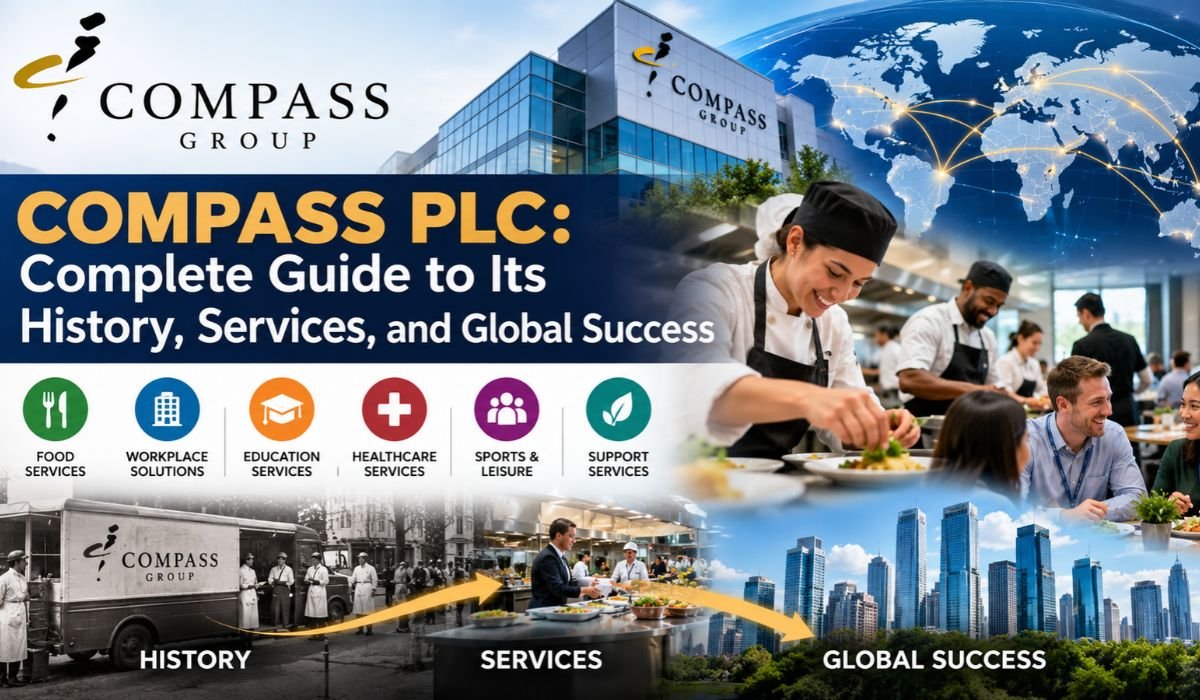
Food brings people together in ways that often go unnoticed. From a quick lunch at work to carefully prepared hospital meals and busy university dining halls, millions of people depend on reliable food services every day. Behind many of these everyday experiences are professional catering companies that handle everything from menu planning to kitchen operations. Compass PLC, officially known as Compass Group PLC, is one of the world’s largest names in this industry.
The British multinational has built an extensive international business, operating in more than 25 countries and employing approximately 590,000 people worldwide. For the 2025 financial year, Compass Group reported revenue of approximately $46 billion, highlighting the remarkable scale of its operations.
Yet the company’s story isn’t simply about impressive numbers. Its growth reflects decades of catering experience, carefully developed business relationships, and a strategy built around serving different industries.
Today, Compass Group provides food services to workplaces, hospitals, educational institutions, sports venues, and other organizations. Its operations influence how millions of people experience food outside their homes.
This guide takes a closer look at Compass PLC’s history, services, business model, financial performance, leadership, sustainability efforts, and future prospects in 2026.
Compass PLC Quick Bio Information
| Company Information | Details |
|---|---|
| Official Company Name | Compass Group PLC |
| Common Search Name | Compass PLC |
| Company Type | Public Limited Company |
| Industry | Contract Food Services |
| Headquarters | Chertsey, Surrey, United Kingdom |
| Country Of Origin | United Kingdom |
| Historical Origins | British Industrial Catering During The 1940s |
| Stock Exchange | London Stock Exchange |
| Stock Ticker | CPG |
| Market Index | FTSE 100 |
| FY2025 Revenue | Approximately $46 Billion |
| Global Workforce | Approximately 590,000 Employees |
| International Presence | More Than 25 Countries |
| Primary Business | Contract Catering And Food Services |
| Main Customer Sectors | Business, Healthcare, Education, And Hospitality |
| Business Strategy | Specialized Food Services Across Multiple Industries |
| Corporate Vision | Great People, Great Service, Great Results |
| Group Chief Executive | Dominic Blakemore |
| Board Chair | Ian Meakins |
| Latest Referenced Annual Report | 2025 |
The financial and workforce figures reflect information reported for fiscal year 2025. Company leadership, geographic coverage, and operating figures may change as new corporate reports become available.
What Is Compass PLC?
Compass PLC is a shortened name commonly used when referring to Compass Group PLC, a British multinational specializing in contract food services.
Unlike a traditional restaurant chain, Compass Group doesn’t primarily depend on customers visiting independently operated restaurants. Instead, it partners with organizations that need professional catering and dining management.
A large corporation, for example, might hire Compass Group to manage its employee dining facilities. A hospital may require specialized meals for patients, while a university needs dependable food services for thousands of students.
Depending on the agreement, Compass Group can handle menu development, food purchasing, kitchen operations, staffing, and daily service management.
This arrangement allows organizations to focus on their core responsibilities while experienced catering teams manage food-related operations.
It’s a business model that has helped Compass Group establish a strong position in the international catering industry.
The History And Origins Of Compass PLC
Compass Group’s story begins in Britain during the 1940s, when industrial catering played an important role in supporting wartime production.
Factories needed dependable meal services for employees working long shifts. Providing food efficiently wasn’t simply a convenience; it helped workplaces function during a demanding period in British history.
These early catering operations formed part of the heritage from which Compass Group eventually emerged.
As Britain’s economy developed, businesses increasingly recognized the benefits of hiring professional catering providers. Managing a workplace kitchen required more than preparing meals. Employers needed reliable purchasing arrangements, trained staff, food safety procedures, and consistent service.
Specialist catering companies were well placed to meet those demands.
Over the following decades, Compass Group’s predecessor businesses developed and expanded, eventually contributing to a much larger international organization.
Acquisitions and geographic expansion played important roles in that transformation.
What began as part of Britain’s industrial catering tradition gradually evolved into a global business serving customers across numerous sectors.
How Compass PLC Became A Global Food Service Leader
Compass Group didn’t achieve international success overnight. Its expansion developed through a combination of business experience, strategic acquisitions, customer relationships, and a clear understanding of how catering requirements differ between industries.
One of the company’s strengths has been its willingness to adapt services to individual customer environments.
A hospital kitchen operates under very different conditions from a stadium food outlet. Healthcare catering must consider medical diets, nutritional requirements, and strict hygiene standards. Stadium catering, meanwhile, often involves serving large crowds during short, intense periods.
Compass Group built its operations around these differences rather than treating every customer as though they needed the same service.
International expansion created further opportunities. Entering new markets allowed the company to reach additional customers while strengthening its purchasing capabilities and operational experience.
However, growing internationally also meant learning to work with different cultures, regulations, labor markets, and eating habits.
The company’s ability to combine global resources with locally adapted services became an important part of its business strategy.
Compass PLC Services And Catering Solutions
At the heart of Compass Group’s operations is a straightforward objective: helping organizations provide dependable, high-quality food services.
The company manages a broad range of catering activities, from menu planning and ingredient purchasing to meal preparation, staffing, and customer service.
In corporate workplaces, these services may include employee cafeterias, meeting refreshments, and hospitality arrangements. For many businesses, providing convenient dining options helps create a more comfortable working environment.
Healthcare facilities have different priorities. Meals must meet appropriate nutritional requirements, and kitchen operations need to follow strict hygiene and food safety procedures.
Educational institutions require dependable services that consider student preferences, dietary needs, and affordability.
Sports venues and entertainment facilities present another challenge. Catering teams may need to prepare for thousands of visitors arriving within a relatively short period.
Compass Group also provides selected support services in certain markets, although contract food services remain its central business.
The exact services offered depend on the customer, operating location, and contractual agreement.
Industries And Sectors Served By Compass PLC
One reason Compass Group has developed such a broad international presence is that food services are essential across many industries.
Corporate offices and industrial workplaces need reliable dining facilities for employees. Hospitals require carefully managed meals for patients, staff, and visitors. Schools and universities must serve large numbers of students while considering nutrition and dietary requirements.
Sports and entertainment venues bring their own operational demands. Food outlets must handle fluctuating crowds, limited service windows, and customer expectations for quick, convenient meals.
Remote workplaces may face additional difficulties involving transportation, food storage, and supply reliability.
Rather than relying on one catering approach, Compass Group organizes much of its business around individual customer sectors.
This structure allows teams to develop relevant expertise and understand the practical challenges faced by different organizations.
It also helps explain why Compass Group’s operations extend well beyond the traditional image of a catering company.
Understanding The Compass PLC Business Model
Compass PLC operates primarily through commercial agreements with organizations that outsource their food services.
Under these contracts, the company may take responsibility for managing kitchens, employing catering staff, purchasing ingredients, and delivering meals according to agreed standards.
Not every agreement works in the same way.
Some contracts involve management fees paid by the customer. Others depend more directly on food sales, service volumes, or a combination of commercial arrangements.
This flexibility allows Compass Group to serve organizations with different budgets and operating requirements.
However, contract catering is a demanding business. Profitability depends on controlling ingredient costs, managing staffing levels, reducing waste, and maintaining consistent service.
The company’s scale can support purchasing efficiency and supplier relationships, but individual operations still need careful management.
Customer retention is another important consideration. Long-term contracts can provide continuity, yet clients expect competitive pricing and reliable performance.
For Compass Group, winning new business matters, but maintaining the confidence of existing customers is equally important.
Compass PLC Global Presence And International Operations
Compass Group has established operations across North America and other international markets, creating a business with considerable geographic reach.
North America is especially significant to the company’s financial performance.
According to its fiscal year 2025 reporting, North America accounted for approximately 68% of underlying revenue, while international operations represented the remaining 32%.
These figures illustrate the importance of the North American market, although the company continues to operate across numerous other countries.
Managing such a widespread organization requires a balance between global standards and local decision-making.
Compass Group uses a decentralized operating structure that gives regional and local teams responsibility for many everyday business decisions.
This approach makes practical sense. Food preferences vary between countries, as do labor regulations, customer expectations, and supply chain conditions.
A dining program that works well in one market may need significant adjustments elsewhere.
At the same time, international operations expose the company to economic uncertainty, currency movements, and regulatory differences.
Managing these challenges remains essential to maintaining consistent performance.
Compass PLC Revenue And Financial Performance
Compass Group’s financial results provide a clearer picture of the scale and performance of its business.
For the financial year ending September 30, 2025, the company reported statutory revenue of approximately $46.07 billion.
Its underlying operating profit reached approximately $3.34 billion, while organic revenue growth was reported at 8.7%.
The company’s underlying operating margin stood at approximately 7.2%, and underlying free cash flow reached about $1.98 billion.
These figures measure different aspects of financial performance.
Revenue represents income generated through business activities. Operating profit provides insight into earnings after relevant operating expenses, while free cash flow helps show how much cash the business generates after specified adjustments.
Organic revenue growth is particularly useful because it measures business expansion while excluding certain effects, such as acquisitions and currency movements.
During 2026, Compass Group continued publishing financial information, including half-year results in May and a third-quarter trading update in July.
For shareholders and analysts, these announcements provide insight into contract activity, operating performance, and management expectations.
Nevertheless, strong historical results don’t guarantee future performance. Food prices, labor costs, customer demand, and broader economic conditions can all influence financial outcomes.
Compass PLC Leadership And Corporate Governance
Running a multinational company with hundreds of thousands of employees requires experienced leadership and clearly defined responsibilities.
Compass Group’s management structure includes executive leaders, regional operating teams, and a board of directors responsible for corporate oversight.
Dominic Blakemore has served as Group Chief Executive Officer, with responsibility for the company’s strategy and overall business performance.
Ian Meakins has served as Chair of the Board, overseeing board activities and supporting corporate governance.
These roles serve different purposes. Executive management is responsible for running the business, while the board provides oversight and holds leadership accountable.
Corporate governance also covers financial reporting, ethical conduct, risk management, regulatory compliance, and shareholder interests.
For an international company operating across different legal systems, these responsibilities are especially important.
Clear governance standards help establish accountability and support confidence among investors, employees, customers, and other stakeholders.
Compass PLC Mission, Vision, And Core Values
Compass Group’s corporate vision emphasizes becoming a world-class provider of food services, recognized for great people, great service, and great results.
Although the message is simple, it reflects the practical realities of the catering industry.
A successful dining operation depends on far more than the food being served. Employees must work together, maintain hygiene standards, respond to customer needs, and manage busy service periods efficiently.
Training and workplace culture therefore play an important role in service quality.
Compass Group also emphasizes building lasting customer relationships. Organizations that outsource catering want dependable services, predictable standards, and confidence that their employees, students, patients, or visitors will be properly served.
Meeting those expectations requires attention to everyday details.
The company’s values connect employee performance, customer satisfaction, and responsible business practices with its wider commercial objectives.
Compass PLC Sustainability And Environmental Responsibility
Large-scale food services have a significant relationship with environmental resources.
Food production requires energy, water, transportation, packaging, and agricultural supplies. When meals are prepared for large populations, even small improvements in efficiency can have meaningful effects.
Compass Group addresses environmental and social issues through sustainability initiatives and corporate reporting.
Its areas of focus include food waste reduction, responsible sourcing, supply chain management, and environmental performance.
According to its 2025 Annual Report, the company recorded a 4% year-on-year reduction in its greenhouse gas emissions intensity ratio, based on Scope 1 and Scope 2 emissions relative to revenue.
It’s important to understand what this means. Emissions intensity measures environmental impact relative to a business activity, such as revenue. A reduction in intensity doesn’t necessarily mean total emissions declined by the same percentage.
Beyond environmental performance, Compass Group also publishes a Modern Slavery Act Statement addressing ethical business practices and supply chain responsibilities.
These issues matter because responsible catering involves more than reducing waste. It also requires attention to workers, suppliers, communities, and the long-term sustainability of food systems.
Compass PLC Careers And Employment Opportunities
With approximately 590,000 employees reported worldwide, Compass Group is a significant employer within the international food service industry.
Its workforce includes chefs, kitchen assistants, catering managers, hospitality professionals, procurement specialists, logistics employees, and corporate teams.
The variety of roles reflects the complexity of its operations.
A catering employee working in a hospital may have responsibilities very different from someone managing hospitality services at a sporting event.
Likewise, corporate positions may involve finance, human resources, technology, supply chain management, or business development.
Training is especially important because employees must understand food safety, workplace procedures, customer service, and operational standards.
Career progression opportunities vary between countries and operating businesses.
People interested in Compass Group careers should review current opportunities through the company’s relevant regional recruitment channels and carefully check individual job requirements.
What Makes Compass PLC Different From Competitors?
Compass Group operates in a competitive industry that includes international companies such as Sodexo and Aramark, alongside numerous regional catering providers.
Its position in the market reflects several important strengths.
International scale gives Compass Group access to broad operational experience and established supplier relationships. Its sector-focused approach allows teams to develop specialized knowledge of different customer environments.
The company also benefits from long-standing relationships with organizations that require dependable food services.
Still, operating at scale doesn’t automatically guarantee customer satisfaction.
Clients continue to evaluate catering providers based on food quality, reliability, service standards, pricing, and the ability to respond to changing requirements.
Technology is becoming another important consideration.
Digital ordering platforms, operational data, improved menu planning, and purchasing systems can help catering businesses improve efficiency and customer convenience.
Compass Group’s challenge is to use these capabilities while preserving the personal service and local flexibility customers expect.
Compass PLC Growth Strategy And Future Outlook
Compass Group’s future growth depends on its ability to strengthen existing operations while identifying opportunities in the wider food service market.
The company’s strategy includes winning new contracts, retaining customers, improving efficiency, and expanding in attractive markets.
In its 2025 Annual Report, Compass Group estimated the global addressable food service market at approximately $360 billion, with its own market share below 15%.
This was a company estimate rather than an independently established valuation, but it illustrates the potential size of the market Compass Group believes it can serve.
Outsourcing may create further opportunities as organizations seek specialist catering providers capable of managing complex operations.
However, expansion also brings risks.
Rising labor costs, food inflation, competition, supply chain pressures, and economic uncertainty can affect profitability.
Compass Group PLC is publicly traded on the London Stock Exchange under the ticker CPG, making its financial performance relevant to shareholders and potential investors.
Anyone evaluating the company should consider revenue growth, operating margins, cash generation, dividend policy, acquisitions, and geographic exposure.
Its established market position provides a substantial foundation, but future growth and investment returns remain uncertain.
Final Thoughts
Compass PLC’s journey from its British industrial catering roots to a major international food service business reflects decades of adaptation, investment, and operational experience.
Today, Compass Group PLC serves organizations across healthcare, education, business, sports, and other industries. Its global workforce, financial scale, and specialized services demonstrate how important professional catering has become to modern institutions.
But the company’s story isn’t only about expansion.
Its long-term success depends on maintaining food quality, building customer trust, managing costs, supporting employees, and operating responsibly.
As expectations around nutrition, sustainability, convenience, and technology continue to change, Compass Group will need to keep adapting its services.
For readers interested in international business, contract catering, or corporate growth, Compass PLC offers a useful example of how a specialized service company can develop into a global enterprise.
Its future will ultimately depend not just on how many customers it serves, but on how consistently it delivers the quality, reliability, and value those customers expect.
FAQs About Compass PLC
What Is Compass PLC Known For?
Compass PLC is best known for providing contract catering and professional food services to organizations around the world. Its customers include businesses, hospitals, schools, universities, sports venues, and other institutions. The company manages dining operations that may involve food preparation, staffing, purchasing, menu development, and customer service.
Is Compass PLC The Same As Compass Group PLC?
Yes. Compass PLC is a shortened name frequently used in online searches, while Compass Group PLC is the company’s official corporate name. It is a British multinational business specializing in contract food services and related operations.
Where Is Compass PLC Headquartered?
Compass Group PLC is headquartered in Chertsey, Surrey, United Kingdom. Although the company has British origins, its operations extend across North America and numerous international markets. Regional and local management teams help oversee services in different countries.
Who Owns Compass Group PLC?
Compass Group PLC is a publicly listed company whose shares trade on the London Stock Exchange under the ticker CPG. Ownership is distributed among shareholders, including institutional investors and individuals. The ownership structure can change as shares are bought and sold.
How Many Employees Does Compass PLC Have?
Compass Group reported approximately 590,000 employees worldwide for fiscal year 2025. Its workforce includes catering staff, chefs, hospitality professionals, managers, logistics specialists, and corporate employees working across different industries and locations.
How Does Compass PLC Generate Revenue?
Compass Group earns revenue mainly by providing food services under contracts with organizations. Depending on the agreement, income may come from catering sales, management fees, or other service payments. The company’s profitability depends on contract performance, customer retention, operational efficiency, and cost management.
Is Compass PLC A Restaurant Chain?
Not in the traditional sense. Although Compass Group operates within the food service industry, its primary business involves managing catering and dining services for organizations. Unlike conventional restaurant chains, it doesn’t depend mainly on independently operated restaurants serving the general public.
What Is The Future Outlook For Compass PLC?
Compass Group has opportunities to expand through new contracts, existing customer relationships, and growing demand for outsourced food services. Technology and operational improvements may also support its development. However, competition, labor costs, food inflation, and economic conditions will continue to influence its performance.
Learn more and explore exciting content on: Averitt Express: Complete Guide to Shipping, Tracking, and Logistics Services
[…] Learn more and explore exciting content on: Compass PLC: Complete Guide to Its History, Services, and Global Success […]