
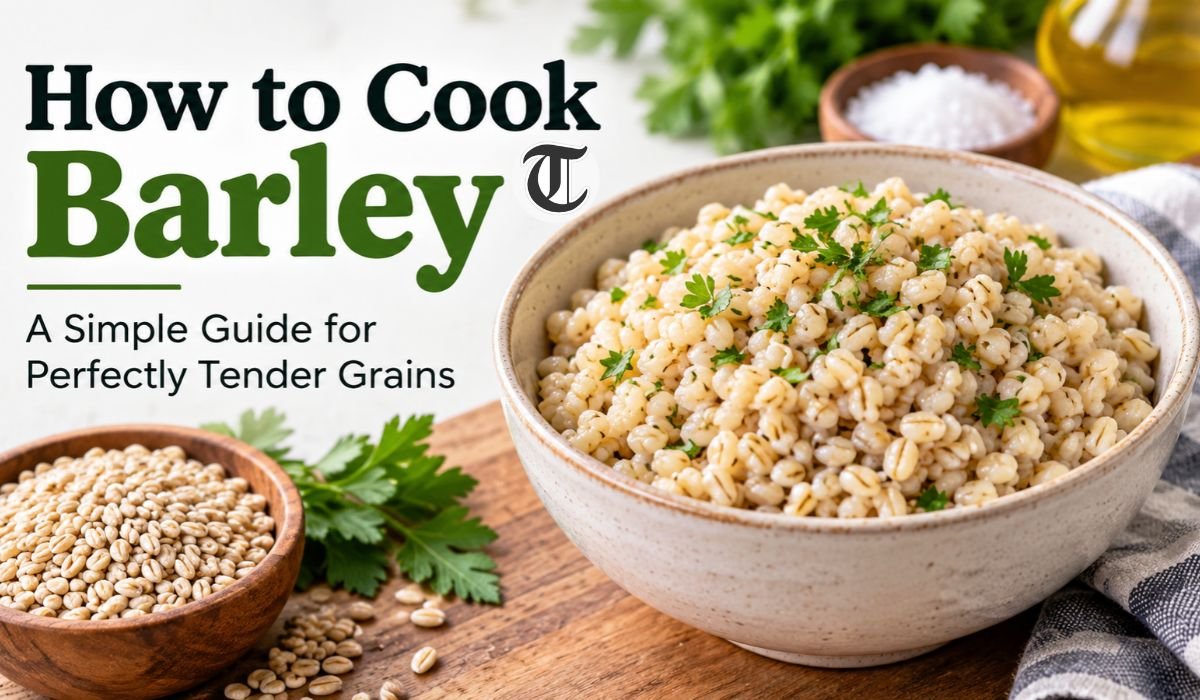
If you’ve ever wondered How To Cook Barley, the good news is that there’s nothing complicated about it. Barley is one of those humble pantry staples that can quietly transform a meal. It has a mild, slightly nutty flavor and a satisfying chew, making it a natural fit for everything from hearty soups and stews to fresh salads and grain bowls.
The one detail that can make a real difference is knowing which kind of barley you’re working with. Pearled Barley cooks relatively quickly and doesn’t normally need soaking. Hulled Barley takes longer because it retains more of the grain’s outer layers, and soaking it beforehand can help with preparation.
Once you know the difference, the rest is straightforward. In this guide, you’ll learn How To Cook Barley On The Stove, how much liquid to use, how long each type takes, how to recognize perfectly cooked grains, and what to do with the leftovers. We’ll also cover storage, reheating, common mistakes, gluten considerations, and easy ways to turn cooked barley into a complete meal.
What Is Barley?
Barley Is A Cereal Grain That Has Been Grown And Used As Food For Thousands Of Years. In Modern Kitchens, It remains popular because it’s inexpensive, versatile, and brings a distinctive texture to dishes. Its flavor is mild enough to work with bold ingredients, while its natural chew gives simple recipes more substance.
You’ll find barley in classic soups and stews, but that’s far from its only use. It can be tossed into salads, served as a side dish, used as a base for grain bowls, or substituted for rice in recipes where its firmer texture makes sense.
Barley also provides dietary fiber as well as a variety of vitamins and minerals. One particularly notable component is beta-glucan, a type of soluble fiber naturally found in barley. Research has linked barley’s beta-glucan with potential heart-health benefits, although the nutritional value of any individual food should always be considered as part of an overall balanced diet.
For cooking, however, the most important thing to understand is that not all barley is processed the same way. That difference affects both preparation and cooking time.
Pearled Barley Vs. Hulled Barley
The two forms most home cooks are likely to encounter are Pearled Barley and Hulled Barley. They come from the same grain, but processing changes their texture, cooking time, and whole-grain status.
Pearled Barley has been processed to remove the tough outer hull and much of the bran layer. It has a lighter appearance and cooks more quickly, which explains why it’s such a convenient choice for everyday meals. It’s particularly common in soups, salads, grain bowls, and side dishes. Because much of the bran has been removed, Pearled Barley isn’t generally classified as a whole grain.
Hulled Barley is processed less extensively. Its inedible outer hull is removed, but the bran remains largely intact. As a result, Hulled Barley is considered a whole grain and generally has a chewier texture and nuttier flavor. The trade-off is time: it takes longer to cook than Pearled Barley.
So, if you’re looking for a quicker option, Pearled Barley is usually the more practical choice. If retaining more of the grain’s natural structure is important to you, Hulled Barley is worth the extra cooking time.
Do You Need To Soak Barley?
Whether barley needs soaking depends largely on the variety.
Pearled Barley usually doesn’t need to be soaked. You can rinse it and put it straight into the cooking liquid. That’s one of the reasons it works so well for quick meals.
Hulled Barley is different. Soaking it for several hours or overnight can help water penetrate the grains before cooking. To do this, place the dry barley in a bowl, cover it generously with cold water, and leave it to soak. Drain the soaking water before cooking and use fresh water or broth in the pot.
Soaking isn’t an absolute requirement for Hulled Barley, but it can make the preparation process easier. If you’re cooking Pearled Barley on a busy evening, though, there’s generally no reason to add an unnecessary soaking step.
Barley Water Ratio
One of the easiest rules to remember when learning How To Cook Barley is the basic one-to-three ratio. Start with approximately one cup of dry barley and three cups of liquid.
Water works perfectly well and gives the grain a neutral flavor. If you want more savory depth, you can use vegetable, chicken, or another suitable broth instead. Salt can be added to the cooking liquid, too, allowing the grain to take on flavor as it cooks.
Barley absorbs a substantial amount of liquid and expands during cooking. While one cup of dry barley can produce roughly three cups or more of cooked grain, the exact yield depends on the variety and cooking method. It’s better to treat the yield as an estimate rather than an exact measurement.
The final texture matters, too. Barley intended for a salad may be better slightly firm, while grains destined for soup can be cooked until softer and more tender.
What You Need To Cook Barley
The beauty of this recipe is how little you actually need. For basic cooked barley, all you need is barley, water or broth, and salt. A saucepan or pot with a lid will handle the cooking, while a colander is useful if you need to drain excess liquid at the end.
Rinsing the barley under cool running water before cooking is a sensible preparation step. It helps remove loose dust and surface material from the grains.
From there, the recipe can remain as simple as you like. If you want more flavor, add ingredients such as garlic, onion, bay leaf, fresh herbs, or dried seasonings. None of them is essential, but they can give the finished barley much more character, especially if you plan to serve it as a side rather than mix it into another dish.
How To Cook Pearled Barley On The Stove
To Cook Pearled Barley, begin with one cup of rinsed barley and about three cups of water or broth. Bring the liquid to a boil in a saucepan, then add the barley and season with salt.
Once everything comes back to a simmer, lower the heat to medium-low. Cover the pot and let the grains cook gently for around 25 to 30 minutes.
That time is a useful guide, not a hard rule. Barley can vary, and your preferred texture may also be different from someone else’s. Start checking toward the end of the cooking period rather than relying solely on the timer.
The grains should be plump and tender while retaining their characteristic chew. If the barley is ready but there’s still a noticeable amount of liquid in the pot, simply drain it through a colander. If the pot has become dry while the grains are still firm, add a little more water or broth and continue cooking.
This simple stovetop method is an excellent starting point for anyone learning How To Prepare Barley for soups, salads, grain bowls, or side dishes.
How To Cook Hulled Barley
How To Cook Hulled Barley requires a little more patience, but the process itself remains simple.
If you choose to soak the barley, place one cup of dry Hulled Barley in a large bowl, cover it with water, and let it sit for several hours or overnight. Drain the soaking water before cooking.
Put the soaked barley in a pot with fresh water or broth. Bring the liquid to a boil, then reduce the heat to a gentle simmer and cover the pot.
Hulled Barley generally takes around 45 to 60 minutes to become tender, although the exact cooking time can vary depending on the grain and whether it was soaked beforehand.
Rather than waiting for a particular minute mark, taste the grains as they approach the end of the cooking time. You want the center to be cooked through without losing the pleasant chew that makes barley distinctive.
If the grains are still firm, keep simmering. Should the liquid disappear before the barley is tender, add a little more hot water or broth and continue cooking.
How Long Does Barley Take To Cook?
Barley Cooking Time depends mainly on the type of barley you’re using. Pearled Barley generally cooks faster, while Hulled Barley takes longer because it retains more of the grain’s outer structure.
As a practical guide, Pearled Barley often takes around 25 to 30 minutes, while Hulled Barley generally needs about 45 to 60 minutes.
Those figures shouldn’t be treated as guarantees. The exact timing can change depending on the particular product, how the grain was processed, whether it was soaked, the amount of heat used, and the texture you want.
For that reason, tasting the barley is more useful than watching the clock alone. Start checking toward the end of the expected cooking period and continue simmering until the grains reach the texture you prefer.
How To Tell When Barley Is Done
The simplest way to determine whether barley is ready is to taste it.
Properly cooked barley should be tender throughout but still pleasantly chewy. A grain that has a hard or chalky center needs more time. On the other hand, grains that have become extremely soft and are losing their shape may have cooked longer than necessary for the texture you wanted.
The ideal texture can also depend on the recipe. If you’re preparing a cold grain salad, slightly firmer barley can hold its shape nicely alongside vegetables and dressing. For a soup or stew, you might prefer a softer, more tender result.
In other words, cooking time tells you when to start checking. The grain itself tells you when it’s done.
How To Make Barley More Flavorful
Barley doesn’t need much help to taste good, but its mild flavor gives you plenty of room to experiment.
One of the easiest upgrades is to cook it in broth instead of water. Vegetable or chicken broth can give the grains a savory foundation before you add anything else. Garlic, onion, bay leaf, and dried herbs can also be introduced during cooking, while fresh parsley or other herbs work well once the barley is finished.
For a simple side dish, try tossing warm barley with olive oil, herbs, and seasoning. You can also mix it with roasted vegetables, chickpeas, lentils, beans, or a suitable protein to create a more substantial meal.
And barley isn’t limited to savory dishes. Pearled Barley can be cooked into a warm breakfast porridge and combined with milk, fruit, cinnamon, honey, or a little brown sugar. Its chewy texture makes it an interesting change from more familiar breakfast grains.
Common Barley Cooking Mistakes
One of the easiest mistakes to make is assuming that every type of barley cooks at the same speed. Pearled and Hulled Barley have different processing levels, so they naturally require different amounts of time.
Another common problem is taking the pot off the heat before tasting the grains. If the barley is still hard in the center, it simply needs more cooking. When the cooking liquid has disappeared too soon, add a little more rather than allowing the grains to scorch.
Too much liquid is generally easier to fix. If the barley is fully cooked but the pot still contains excess water, drain the grains through a colander.
Bland barley is another easy problem to solve. Season the cooking liquid, use broth instead of water, or add herbs and other ingredients after cooking.
Above all, don’t treat a cooking time as an absolute guarantee. The type of barley, soaking, heat level, cookware, and desired texture can all affect the result.
How Much Cooked Barley Does One Cup Make?
One cup of dry barley generally produces around three cups or more of cooked grain, although the final amount can vary according to the variety and cooking method.
That makes barley particularly useful for meal preparation. Instead of cooking a fresh batch every time you want a grain bowl or soup, you can prepare several portions at once and keep them ready for later meals.
If a recipe requires a precise amount of cooked barley, it’s best to prepare the grain first and then measure the finished amount. This avoids relying too heavily on an estimated yield.
The amount of liquid absorbed also varies, so two batches made with different types of barley may not produce exactly the same volume. Think of the three-cup figure as a practical planning estimate rather than a fixed rule.
How To Store Cooked Barley
Cooked Barley can be prepared ahead, which makes it a useful meal-prep ingredient. Once cooked, transfer it to a clean, covered container and refrigerate it promptly rather than leaving it at room temperature for an extended period.
For everyday use, refrigerated cooked barley is best used within several days when handled and stored properly. If you don’t expect to use it within that period, freezing is a convenient alternative.
When freezing, divide the barley into useful portions before placing it in freezer-safe containers or packaging. Smaller portions are easier to thaw and mean you won’t have to defrost an entire batch for one meal.
Good storage is about more than convenience. Keeping cooked grains properly chilled and handling them carefully helps reduce the risk of foodborne illness.
How To Reheat Cooked Or Frozen Barley
Reheating barley is straightforward, particularly when you’ve stored it in individual portions.
If the barley is frozen, thaw it in the refrigerator before reheating. Place the thawed grain in a saucepan and add a few tablespoons of water or broth. Cover the pan and warm it gently until the barley is heated through, stirring or tossing occasionally.
That small amount of additional liquid matters. Refrigeration and freezing can make cooked grains seem firmer or drier, and a little moisture helps bring back a more pleasant texture.
You can also add cooked or frozen barley to soups and stews when the dish contains enough liquid and cooking time to heat the grain thoroughly. This can be an especially convenient way to use leftovers without preparing another meal from scratch.
Is Barley Gluten-Free?
No. Barley Is Not Gluten-Free. Both Pearled Barley and Hulled Barley contain gluten, so changing the way barley is processed does not make it suitable for a strict gluten-free diet.
This is especially important for people with Celiac Disease or other conditions requiring strict gluten avoidance. Barley is one of the grains that should be avoided on a gluten-free diet.
Fortunately, there are several alternatives. Rice and Quinoa are common choices, while Buckwheat, Millet, and Sorghum can also work in appropriate recipes. The best substitute depends on what you’re making because each grain has a different texture and cooking behavior.
If gluten avoidance is medically necessary, it’s also important to pay attention to labels and preparation practices because cross-contact can matter.
Easy Ways To Use Cooked Barley
Once you know How To Cook Barley, you’ll quickly find that there are plenty of ways to use it.
In soups, barley adds body and a satisfying chew. It works particularly well in hearty vegetable, chicken, and bean-based soups. In salads, the grains hold up nicely alongside chopped vegetables, herbs, beans, and flavorful dressings.
Barley is also an excellent foundation for grain bowls. Add roasted vegetables, chickpeas, lentils, chicken, fish, or another protein, then finish the bowl with a dressing or sauce.
You can use barley in place of rice in many dishes when its firmer texture suits the recipe. It pairs naturally with hearty stews, roasted vegetables, savory sauces, and legumes.
For breakfast, take the recipe in an entirely different direction. Warm cooked Pearled Barley with milk, fruit, cinnamon, honey, or other favorite toppings can make a filling alternative to traditional breakfast grains.
Tips For Perfectly Tender Barley Every Time
Getting consistently good results starts with choosing the right type of barley. Pearled Barley is generally the faster, more convenient option, while Hulled Barley takes longer and retains more of its natural grain structure.
Rinse the grains before cooking, use roughly three cups of liquid for each cup of dry barley as a starting point, and keep the heat at a gentle simmer. If you’re using Hulled Barley, soaking it beforehand can make preparation easier.
Most importantly, don’t stop cooking simply because the timer says you should. Taste the grains. You’re looking for tenderness with enough chew to give the barley its characteristic texture.
If you regularly eat barley, consider making a larger batch and storing portions for later. Once cooked barley is already waiting in the refrigerator or freezer, adding it to soup, salad, or a grain bowl becomes much easier.
Final Thoughts
How To Cook Barley becomes much easier once you understand the grain you’re working with. Pearled Barley is a convenient option when you want a relatively quick cooking time, while Hulled Barley takes longer and retains more of the grain’s natural structure.
A ratio of roughly three cups of liquid to one cup of dry barley is a useful place to begin, but texture should ultimately guide the cooking process. Keep the grains at a gentle simmer, give them enough time to become tender, and taste them before deciding they’re finished.
Once you’ve mastered the basic method, there’s no need to stop at one recipe. Barley can add substance to soups, freshness to salads, heartiness to grain bowls, and an interesting twist to breakfast. It’s a simple grain, but its versatility makes it surprisingly useful in an everyday kitchen.
FAQs About How To Cook Barley
How Much Water Do I Need For One Cup Of Barley?
About three cups of water or broth is a useful starting point for one cup of dry barley. The exact amount can vary depending on the barley variety and cooking method. If the grains are tender but excess liquid remains, simply drain it before serving.
How Long Does Pearled Barley Take To Cook?
Pearled Barley commonly takes around 25 to 30 minutes in a basic stovetop preparation. Start checking the grains toward the end of that range and continue cooking until they’re tender but still pleasantly chewy.
How Long Does Hulled Barley Take To Cook?
Hulled Barley generally takes about 45 to 60 minutes. Soaking it for several hours or overnight can help with hydration, but the actual cooking time still depends on the grain and the texture you want.
Does Barley Need To Be Soaked?
Pearled Barley generally doesn’t need soaking. Hulled Barley can be soaked for several hours or overnight before cooking. If you’re using Pearled Barley, rinsing and cooking it directly is usually sufficient.
Can I Cook Barley In Broth?
Yes. Cooking barley in broth instead of water is an easy way to give it more savory flavor. Vegetable, chicken, or another suitable broth can be chosen according to the dish you’re preparing.
Can I Freeze Cooked Barley?
Yes. Cooked barley can be frozen in suitable containers or portions. For best results, thaw it in the refrigerator and reheat it with a small amount of water or broth to help restore moisture.
How Do I Know When Barley Is Done?
Taste a few grains. Properly cooked barley should be tender throughout while retaining a pleasant chew. If the center is hard, continue cooking. Your preferred texture can also depend on whether you’re using the barley in soup, salad, or another dish.
Is Barley Gluten-Free?
No. Barley contains gluten and isn’t suitable for a strict gluten-free diet. Rice, Quinoa, Buckwheat, Millet, and other naturally gluten-free grains can be used as alternatives, depending on the recipe.
Learn more and explore exciting content on: MegaPersonals Explained: What You Need to Know About the Online Platform
[…] Learn more and explore exciting content on: How To Cook Barley: A Simple Guide For Perfectly Tender Grains […]