
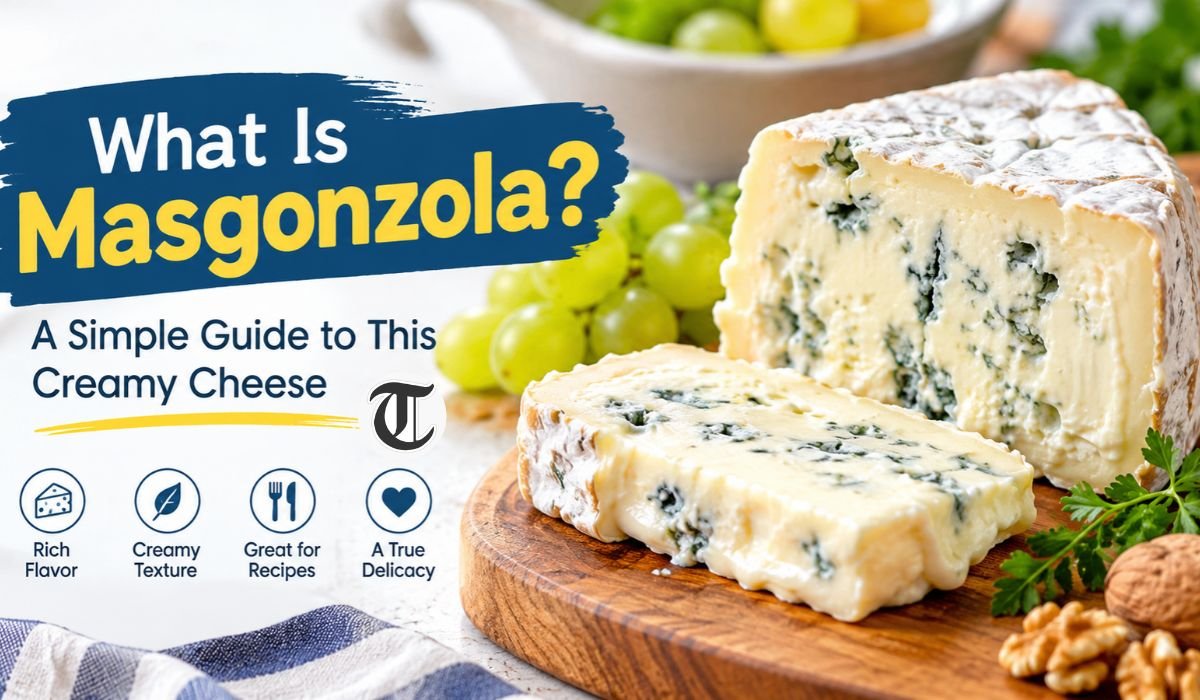
Introduction: What Is Masgonzola?
If You Like Blue Cheese But Sometimes Find Its Flavor A Little Too Strong, Masgonzola May Be Worth Getting To Know. The Name generally refers to a creamy combination of Gorgonzola And Mascarpone, bringing together the distinctive character of a Blue Cheese with the soft, rich texture of a creamy dairy product.
Gorgonzola is responsible for the salty, tangy, earthy flavor that gives the cheese its personality. Mascarpone, on the other hand, brings a smooth, buttery richness that can make the overall experience softer and more approachable. Together, the two create a cheese preparation that can be spread, melted, or used in a wide range of dishes.
The name Masgonzola appears to combine “Mas” from Mascarpone with “Gonzola” from Gorgonzola. It’s important, though, not to mistake the name for a separate Protected Designation of Origin cheese. Gorgonzola itself has official PDO status in the European Union, while documented commercial products are sold as Gorgonzola And Mascarpone preparations.
So, What Is Masgonzola? In simple terms, it’s best understood as a Gorgonzola-And-Mascarpone cheese preparation. The exact recipe can vary, which means the taste, texture, nutritional values, and even appearance may differ from one product to another.
What Exactly Is Masgonzola?
Masgonzola doesn’t have one universal recipe that every producer follows. Instead, the name is generally associated with products that bring Gorgonzola and Mascarpone together.
That distinction explains why you may come across versions that look quite different. One product may combine the two cheeses into a more uniform mixture, while another may deliberately keep them in separate layers.
Italian producer CasArrigoni, for example, makes a documented Gorgonzola And Mascarpone product using alternating layers of Mascarpone and Mild Gorgonzola. The Mascarpone appears as a smooth, dense white or pale-yellow cream, while the Gorgonzola is creamy and blue-veined.
This layered format creates more than an attractive appearance. It can also affect the eating experience, since one bite may contain more Mascarpone while another has a stronger Gorgonzola presence.
The proportions matter, too. A product containing more Mascarpone will generally have a softer, creamier profile, while a higher proportion of Gorgonzola can make the Blue Cheese character more noticeable. That’s why it’s useful to check the label instead of assuming that every product called Gorgonzola And Mascarpone will taste exactly the same.
Is Masgonzola A Traditional Italian Cheese?
This is where a little clarification goes a long way.
Gorgonzola is an officially protected Italian cheese. Under the European Union’s PDO specification, Gorgonzola is a blue-veined cheese made from pasteurized whole cow’s milk, with defined production requirements and characteristics.
Masgonzola is different. The available product evidence supports describing it as a Gorgonzola-And-Mascarpone preparation, rather than as a separate PDO cheese with its own protected production specification.
That distinction is important because unfamiliar food names can sometimes attract exaggerated descriptions online. There’s no need to attribute an ancient history, a single inventor, or one officially established recipe to Masgonzola without reliable evidence.
What can be documented is much simpler: commercial producers combine Gorgonzola and Mascarpone to create a softer, richer cheese preparation. That straightforward explanation is also the most useful one for someone encountering the term for the first time.
What Is Masgonzola Made Of?
At Its Core, Masgonzola Brings Together Two Components: Gorgonzola And Mascarpone. Each one contributes something very different to the finished product.
Gorgonzola supplies the Blue Cheese character. According to the EU PDO specification, Gorgonzola is made from pasteurized whole cow’s milk and develops its characteristic blue-green or grey-blue veining during production and maturation. Depending on the type and maturation, its flavor can range from relatively mild to distinctly tangy.
Mascarpone plays the opposite role. It has a soft, rich consistency and a delicate, buttery dairy flavor. Rather than competing with Gorgonzola, it helps balance the stronger cheese notes and gives the mixture its characteristic creaminess.
There’s no reason to assume that every product uses the same ratio. A technical sheet for one documented CasArrigoni Gorgonzola And Mascarpone product lists 60% Mascarpone and 40% Gorgonzola PDO.
That example is particularly useful because it demonstrates how much formulations can differ. If you’re trying to predict how strong a particular Masgonzola-style product will taste, the ingredient list can tell you more than the name alone.
How Is Masgonzola Made?
There isn’t one universal manufacturing method for Masgonzola. Instead, the two dairy components are prepared according to their respective processes and then brought together in the finished product.
One documented approach is layering. CasArrigoni produces Gorgonzola And Mascarpone by placing alternating layers of Mascarpone and Mild Gorgonzola together. The contrasting colors and textures remain visible in the finished cheese.
A layered product offers a slightly different experience from a thoroughly blended mixture. Because the ingredients remain distinct, the balance can change from bite to bite. One mouthful might be especially creamy, while the next may emphasize the tangy Gorgonzola.
A blended version, by contrast, can provide a more even distribution of flavor throughout the cheese.
Neither approach should automatically be treated as the one “correct” way to make Masgonzola. Since there’s no single universal formula, the producer’s description is the best way to understand how a particular product was made.
What Does Masgonzola Taste Like?
The Flavor Of Masgonzola Comes Down To Balance. Gorgonzola brings the salty, tangy, earthy qualities associated with Blue Cheese, while Mascarpone rounds out those sharper notes with a rich and buttery creaminess.
Gorgonzola itself can have different levels of intensity. The European Union specification recognizes variations associated with maturation, and the cheese can range from mild to more pronounced and tangy.
Mascarpone changes how those flavors are experienced. When a product contains a larger share of Mascarpone, the result can feel gentler and richer. More Gorgonzola, meanwhile, allows the Blue Cheese flavor to take center stage.
A documented CasArrigoni product describes the combination as bringing together the delicate, sweet and buttery character of Mascarpone with the more pronounced flavor of veined Gorgonzola.
That balance may appeal particularly to people who are interested in Blue Cheese but don’t want an especially aggressive flavor. Masgonzola still has a recognizable Blue Cheese identity, but the creamy component can make it feel less intense.
What Is The Texture Of Masgonzola?
Texture Is One Of The First Things You’ll Notice About Masgonzola. The Mascarpone contributes a smooth, dense creaminess, while the Gorgonzola provides a softer but more structured, blue-veined component.
In the layered CasArrigoni product, the contrast is especially easy to see. The Mascarpone sections are smooth and dense, while the Gorgonzola sections are creamy and veined.
That softness gives Masgonzola plenty of flexibility in the kitchen. It can be spread over bread or crackers, but it can also be incorporated into warm dishes where a creamy cheese is useful.
The texture can vary depending on the product. A blended version is likely to feel more consistent, while a layered cheese gives you more obvious differences between the two components.
Masgonzola Nutrition: Calories, Fat, And Protein
There’s No Single Nutrition Profile For Masgonzola Because There’s No Single Standard Recipe. The amount of Gorgonzola, the amount of Mascarpone, and the specific formulation all influence the final nutritional values.
For one documented Gorgonzola And Mascarpone product, CasArrigoni lists 394 calories, 38 grams of fat, 26 grams of saturated fat, 12 grams of protein, 1.2 grams of carbohydrates, and 0.6 grams of salt per 100 grams.
Those figures shouldn’t be presented as universal Masgonzola nutrition facts. They describe one specific commercial product.
They do, however, illustrate an important point: this is a rich cheese preparation, particularly in terms of fat and saturated fat. That doesn’t mean it can’t be enjoyed. Because it has a strong and creamy flavor, relatively small portions can add plenty of character to a dish.
If you’re keeping track of calories, saturated fat, salt, or another nutrient, the nutrition panel on the product you actually buy is the most reliable guide.
Is Masgonzola Lactose-Free?
It’s Best Not To Assume That Masgonzola Is Lactose-Free.
The final product contains both Gorgonzola and Mascarpone, and its lactose content can depend on the exact formulation and manufacturing process. Information about Gorgonzola on its own shouldn’t automatically be applied to every Gorgonzola-And-Mascarpone product.
A technical sheet for one documented CasArrigoni product specifically identifies lactose in its allergen information. That product contains 60% Mascarpone and 40% Gorgonzola PDO.
For anyone who needs to avoid lactose, the safest approach is to check the exact packaging or manufacturer’s product information before eating it.
There’s another important consideration for people with food allergies. Masgonzola contains milk, so it shouldn’t be considered suitable for someone with a milk allergy.
How To Use Masgonzola In Cooking
One Of The Best Things About Masgonzola Is Its Versatility. Its soft consistency means it works just as naturally in cold preparations as it does in cooked dishes.
For pasta, small pieces can be stirred into hot noodles until they soften and melt into a creamy sauce. A little pasta cooking water can help loosen the cheese and create a smoother consistency.
Masgonzola also fits nicely into risotto. Adding it toward the end of cooking allows the cheese to melt into the rice while bringing both creaminess and Blue Cheese flavor.
Pizza and flatbread offer another easy option. Small pieces can melt during baking and work especially well with ingredients such as mushrooms, onions, pumpkin, pear, and walnuts.
You don’t have to cook it, either. Masgonzola can be spread onto crostini, crackers, toasted bread, or baguette. It can also be used in mashed potatoes, savory fillings, salads, and appetizers.
What Foods Pair Well With Masgonzola?
Good Masgonzola Pairings are largely about contrast. The cheese is rich, salty, tangy, and creamy, so ingredients with sweetness, freshness, crunch, or earthy flavors can create a more balanced bite.
Pears, figs, apples, grapes, and dates are particularly useful because their natural sweetness works against the salty and tangy side of Gorgonzola. Honey offers another simple way to introduce sweetness.
Nuts bring a completely different element. Walnuts and hazelnuts provide crunch along with earthy flavors that naturally complement the cheese.
For savory pairings, mushrooms, onions, pumpkin, leafy greens, pasta, and fresh bread all work well.
For a simple cheese-board serving, try Masgonzola with slices of ripe pear, a few walnuts, toasted bread, and a small drizzle of honey. It’s an uncomplicated combination, but it highlights the contrast that makes the cheese interesting.
Masgonzola Vs. Gorgonzola
Masgonzola And Gorgonzola Are Related, But They Aren’t The Same Product.
Gorgonzola is the protected Italian Blue Cheese covered by the European Union’s PDO specification. That specification establishes requirements for the cheese, including its production, ingredients, characteristics, and maturation categories.
Masgonzola, in contrast, combines Gorgonzola with Mascarpone. The added Mascarpone changes both the texture and the overall flavor profile.
Gorgonzola can itself range from mild to stronger varieties. Gorgonzola Dolce is generally associated with a softer, sweeter and milder style, while Gorgonzola Piccante has a more pronounced and sharper character.
For someone who wants the direct flavor of a traditional Blue Cheese, straight Gorgonzola provides that experience. Masgonzola offers something different: the recognizable Gorgonzola character combined with the softer richness of Mascarpone.
That difference is worth remembering when shopping. A product labeled simply Gorgonzola isn’t automatically the same as one described as Gorgonzola And Mascarpone.
Can You Make Masgonzola At Home?
Making A Simple Gorgonzola-And-Mascarpone Mixture At Home Is Quite Straightforward. There’s no need to follow a supposedly official ratio, because commercial products can vary in their proportions.
A practical starting point is to use equal amounts of softened Gorgonzola and Mascarpone. From there, you can adjust the balance according to your preference.
If you want a gentler, creamier spread, increase the Mascarpone. If you prefer a stronger Blue Cheese presence, add more Gorgonzola.
You can mix the two thoroughly for a smooth spread or combine them more lightly to create a marbled appearance. Honey, black pepper, and chopped walnuts can also be added if you want to turn the mixture into a more distinctive appetizer.
Just remember that a homemade mixture is a simple preparation of two cheeses. It isn’t an officially standardized Masgonzola recipe.
How To Store Masgonzola
Because Masgonzola Is A Soft Dairy Product, Refrigeration Is Essential. The exact storage temperature and shelf life, however, depend on the individual product, so the manufacturer’s instructions should always take priority.
For example, a technical sheet for one commercial Gorgonzola And Mascarpone product specifies storage between 1°C and 6°C and gives a packaged shelf life of 25 days.
Those figures apply to that particular product. They shouldn’t be turned into a universal storage rule for every Gorgonzola-And-Mascarpone cheese.
After opening, keep the cheese properly covered and refrigerated. Follow the use-by date and the instructions on the package. If the product develops unexpected changes in smell, appearance, or texture, it’s safer not to eat it.
Where To Buy Masgonzola
If You Search For Masgonzola And Can’t Find It, Try Searching Under A More Descriptive Product Name. Similar cheeses may be sold as Gorgonzola And Mascarpone, Gorgonzola E Mascarpone, Gorgonzola-Mascarpone, Or Gorgonzola With Mascarpone.
Specialty cheese stores and Italian food shops are natural places to look. Some supermarkets and online cheese retailers may also carry products in this category.
Once you find one, don’t stop at the front label. Look at the ingredient list to see how much Gorgonzola and Mascarpone the product contains, if the percentages are provided. The nutrition panel and allergen information are equally important.
It’s also worth checking whether the cheese is layered or blended. That small detail can give you a good idea of what kind of texture and flavor distribution to expect.
Final Thoughts
Masgonzola Is Best Understood As A Creamy Gorgonzola-And-Mascarpone Preparation, Rather Than As A Separate Traditional PDO Cheese. Its appeal lies in the contrast between its two main components: Gorgonzola brings the salty, tangy, Blue Cheese character, while Mascarpone contributes softness, richness, and a buttery quality.
That combination gives Masgonzola plenty of room in the kitchen. It can be spread over bread, melted into pasta, folded into risotto, added to pizza, served with fruit and nuts, or included on a cheese board.
The biggest takeaway is that Masgonzola does not have one universal formulation. Documented commercial products can use specific ratios, such as 60% Mascarpone and 40% Gorgonzola PDO, and their nutritional information, lactose content, texture, and storage requirements can differ.
For that reason, the product label remains your best source of information when buying Masgonzola. Check the ingredients, nutrition panel, allergen information, and storage instructions before serving it.
For anyone discovering Masgonzola for the first time, it offers an appealing meeting point between the distinctive personality of Blue Cheese and the smooth richness of Mascarpone. It’s familiar enough to understand at a glance, yet versatile enough to inspire plenty of new ways to enjoy it.
FAQs About Masgonzola
Is Masgonzola A Real Cheese?
Masgonzola Refers To Real Commercial Preparations That Combine Gorgonzola And Mascarpone. It’s more accurate, however, to describe it as a cheese preparation or combination rather than a separately protected PDO cheese. Gorgonzola itself has official PDO recognition in the European Union.
What Is Masgonzola Made From?
Masgonzola Is Made From Gorgonzola And Mascarpone, although the exact proportions can differ. One documented commercial example contains 60% Mascarpone and 40% Gorgonzola PDO, demonstrating why it’s useful to check the label instead of assuming a fixed ratio.
Does Masgonzola Taste Strong?
Masgonzola Can Have A Noticeable Blue Cheese Flavor, but its intensity depends on the formulation. A higher proportion of Mascarpone can create a softer, creamier profile, while more Gorgonzola can make the Blue Cheese character more pronounced.
Is Masgonzola The Same As Gorgonzola?
No. Gorgonzola is a protected Italian Blue Cheese with defined production requirements. Masgonzola refers to a combination involving Gorgonzola and Mascarpone, so the addition of Mascarpone changes the texture and overall eating experience.
Is Masgonzola Lactose-Free?
You Shouldn’t Assume That It Is Lactose-Free. A documented commercial Gorgonzola And Mascarpone product specifically lists lactose in its allergen information. If lactose avoidance is important, check the exact product label or manufacturer’s information.
Can You Cook With Masgonzola?
Yes. Its creamy texture makes it suitable for pasta, risotto, pizza, flatbread, sauces, mashed potatoes, and other savory dishes. It can also be spread onto bread, crackers, and crostini.
Can You Make Masgonzola At Home?
Yes. You Can Combine Gorgonzola And Mascarpone At Home To Create A Simple Creamy Mixture. Starting with equal amounts is an easy way to experiment, after which you can add more Mascarpone for a milder taste or more Gorgonzola for a stronger Blue Cheese flavor.
How Should Masgonzola Be Stored?
Keep Masgonzola Refrigerated And Follow The Manufacturer’s Instructions. Storage requirements vary by product. One documented commercial example specifies 1°C to 6°C storage and a 25-day packaged shelf life, but those figures shouldn’t be applied automatically to every Masgonzola-style product.
Learn more and explore exciting content on: Incfidelibus: A Complete Guide to Its Meaning, History, and Significance
[…] Learn more and explore exciting content on: What Is Masgonzola? A Simple Guide to This Creamy Cheese […]