
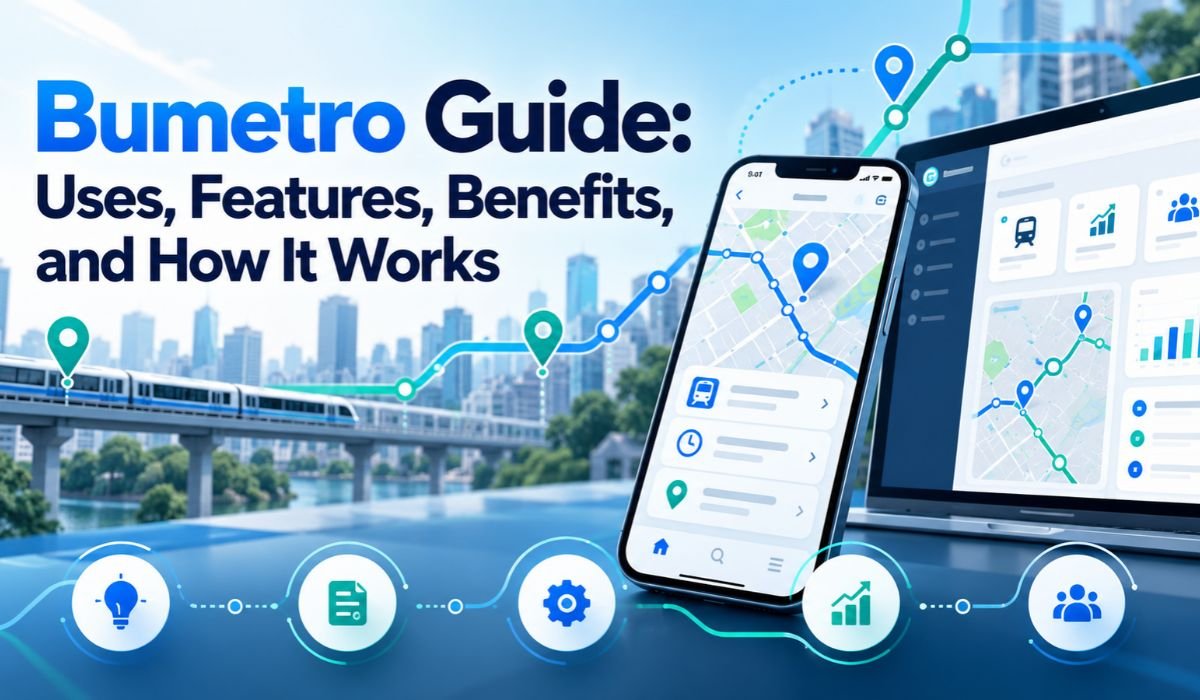
Bumetro is one of those terms that can become confusing surprisingly quickly. Search for it online and you may find references to Smart Mobility, Urban Transportation, digital journey planning, and even electronics. Those subjects aren’t all connected, which makes understanding the context especially important.
Much of the newer discussion around Bumetro places it within the world of Smart Mobility. In this context, the idea is closely related to Mobility as a Service, better known as MaaS. The basic goal of MaaS is simple: make it easier for people to plan journeys involving different forms of transportation through a connected digital experience. Instead of treating buses, trains, cycling, walking, and shared transport as separate systems, MaaS tries to bring them together from the traveler’s point of view.
That doesn’t mean every feature associated with MaaS can automatically be attributed to Bumetro. Publicly available information doesn’t clearly establish Bumetro as a widely documented transport operator or mature commercial MaaS platform with a confirmed list of cities, prices, partnerships, and services.
For that reason, this guide takes a careful approach. It explains what Bumetro means, how Bumetro-style mobility could work, its possible uses and benefits, and what users should check before trusting a service operating under the name. It also explores another, completely separate use of the term that appears in older electronics discussions.
Quick Information About Bumetro
| Information | Details |
|---|---|
| Name | Bumetro |
| Common Recent Context | Smart Mobility |
| Related Technology | Urban Transportation Technology |
| Closely Related Concept | Mobility as a Service |
| MaaS Meaning | Mobility as a Service |
| Basic Idea | Connected Multimodal Travel |
| Relevant Transport Modes | Bus, Train, Metro, Cycling, Walking, Shared Mobility |
| Potential Purpose | Simplifying Journey Planning |
| Digital Focus | Integrated Transport Information |
| Official Operator | Not Clearly Established |
| Confirmed Official App | Not Clearly Established |
| Confirmed Cities | Not Clearly Established |
| Verified Pricing | Not Established |
| Likely Audience | Commuters And Urban Travelers |
| Important Requirement | Accurate Transport Data |
| Important User Concern | Privacy And Security |
| Alternative Meaning | VU Meter-Related Electronics Usage |
| Best Current Description | Ambiguous Term Associated With Smart Mobility |
What Is Bumetro?
Bumetro is best described as an ambiguous term with several online uses. In recent content, one of the most noticeable interpretations connects the name with Smart Urban Mobility and digital transportation.
The idea behind that interpretation is easy to understand. Most city journeys aren’t as simple as moving from one station to another. A passenger might walk from home to a bus stop, take a bus to a railway station, travel by train, and then walk or cycle the final part of the journey.
When each stage belongs to a different system, finding the right information can become frustrating. A connected mobility platform attempts to make the entire trip easier to understand by bringing relevant travel information into one place.
The important distinction is between the Bumetro name and the established technology surrounding Smart Mobility. Features such as Real-Time Tracking, Integrated Ticketing, Mobile Payments, and Personalized Route Planning are entirely plausible within modern MaaS systems. They shouldn’t, however, be presented as confirmed Bumetro features without reliable first-party documentation.
Keeping that distinction clear gives readers a more accurate picture of what is known and what remains uncertain.
Why Bumetro Is Getting Attention
Interest in Bumetro makes more sense when viewed as part of a larger shift in transportation.
People have grown accustomed to using digital tools for banking, shopping, communication, entertainment, and travel. Naturally, they also expect technology to remove some of the inconvenience involved in getting around a city.
Urban transportation remains fragmented in many places. A commuter may check one source for bus times, another for railway information, and another for a bicycle or shared ride. Even when every individual service works well, the overall journey can still feel disconnected.
Smart Mobility attempts to bridge those gaps.
That broader trend helps explain why descriptions linking Bumetro with Connected Transportation sound convincing. They address a genuine problem: travelers want to understand an entire journey rather than research every individual stage separately.
What isn’t yet clear is how far Bumetro itself has progressed beyond that broader concept. Interest in the idea shouldn’t be mistaken for evidence of large-scale adoption or a fully established service.
How Bumetro-Style Technology Works
The easiest way to understand Bumetro-style technology is to look at Mobility as a Service.
A MaaS platform essentially creates a digital connection between travelers and different transportation providers. It doesn’t need to own buses, trains, bicycles, or taxis. Instead, it can collect and organize information from participating services so travelers can view their options through a single interface.
Imagine entering a starting point and destination. A connected system could analyze available transportation data and present several possible journeys. Depending on the platform and the information available, recommendations might consider travel time, transfers, walking distance, availability, or cost.
More advanced systems can go beyond route planning. Booking, ticketing, subscriptions, and payments may also be integrated, allowing travelers to handle more of the journey without constantly switching between different services.
The technology behind that apparently simple experience is considerably more complicated.
Transport operators need to provide reliable schedules and data. Different systems must communicate properly. Real-Time Information needs to remain accurate, while payment and ticketing arrangements may require agreements between several organizations.
So, while an attractive interface matters, the real strength of a mobility platform lies in the quality of the network and data behind it.
Features Associated With The Bumetro Concept
Many features mentioned alongside Bumetro are familiar within the wider Smart Mobility industry.
One of the most important is Multimodal Journey Planning. Rather than examining buses, trains, bicycles, and walking routes independently, multimodal planning considers how several options can work together to complete one journey.
Route comparisons can make that information more useful. A traveler might prefer the quickest journey on one occasion but choose a route involving less walking or fewer transfers on another.
Mobile accessibility is equally important. Transportation decisions often happen while people are already traveling, so useful information needs to be easy to access on a phone as well as on other devices.
More advanced mobility systems can include Real-Time Travel Information, booking, ticketing, and payment. Live information is particularly valuable when a delay or cancellation affects a connection later in the journey.
These capabilities help explain the appeal of the Bumetro concept. Still, they represent features associated with MaaS and Smart Mobility generally unless reliable documentation confirms that a particular Bumetro product provides them.
Common Uses Of Bumetro-Style Mobility
Connected Mobility is most valuable when a journey becomes complicated.
Consider a commuter trying to find the most practical route to work. Driving might be familiar, but a combination of rail and walking could be faster during rush hour. A Multimodal Journey Planner can make that alternative easier to discover.
Visitors face a different problem. Someone arriving in an unfamiliar city may recognize a train station but have no idea which bus, bicycle service, or walking route provides the easiest connection to a hotel or attraction.
There is also the familiar first-mile and last-mile challenge. Public transportation may cover most of a journey efficiently while leaving a smaller gap between the station and the final destination. Walking, cycling, shared mobility, or another local service may fill that gap.
A connected system can make these separate choices feel like parts of the same journey.
Those examples illustrate genuine uses of Multimodal Mobility technology. They shouldn’t be interpreted as proof that every scenario is currently supported by Bumetro.
Bumetro And Smart Urban Mobility
Smart Urban Mobility is sometimes reduced to maps and mobile applications, but the idea is much broader.
At its best, it connects transportation infrastructure, digital information, service providers, and passengers in ways that make moving through a city simpler and more efficient.
Public transportation often provides the backbone. Trains, Metro Systems, and buses can move large numbers of people, while walking and cycling handle shorter distances. Shared Mobility and other transport services may then fill gaps that fixed public transportation can’t easily serve.
Digital technology sits above those options and helps travelers understand how they fit together.
Instead of seeing a train journey, a bus ride, and a short walk as three separate problems, the passenger can view them as three stages of one trip.
This broader Smart Mobility framework is the most useful context for understanding modern descriptions of Bumetro. It reflects a real direction in transportation technology without requiring unsupported assumptions about a particular product.
Benefits Of A Bumetro-Style System
Convenience is perhaps the clearest benefit of Connected Mobility.
Planning an urban journey can require comparing schedules, routes, operators, prices, and ticketing rules. If useful information is presented together, travelers spend less time searching and more time making an informed decision.
Better visibility is another advantage.
People naturally rely on transportation methods they already understand. A commuter may drive every day without realizing that another practical option exists. Multimodal Journey Planning can expose alternatives that might otherwise remain hidden.
There can also be environmental advantages when better travel information makes public transportation, walking, cycling, or shared options easier to use. Still, a digital platform can’t create sustainable travel on its own. Local infrastructure, reliability, affordability, safety, and service availability all influence how people actually travel.
Accessibility matters too. Clear information presented on different devices can make complicated transportation systems easier to navigate, particularly for visitors or people using a route for the first time.
Ultimately, the best mobility technology isn’t necessarily the one with the longest feature list. It’s the one that removes friction from a real journey.
What Makes A Good Mobility Experience?
Picture someone stepping off a train in an unfamiliar part of a city. They don’t need a complicated technical dashboard. They need straightforward answers.
Where should they go next? How long will the next stage take? Is there a transfer? Has a service been delayed? Is walking the final distance realistic?
A good mobility platform should answer questions like these quickly.
That requires thoughtful design. Maps should be readable, routes should be easy to compare, travel times should make sense, and transfers should be clearly identified. If information may be outdated or uncertain, the service should communicate that rather than giving users false confidence.
Accessibility also goes beyond screen size. Text needs to be readable, instructions understandable, and important information easy to locate.
These practical standards offer a useful way to evaluate Bumetro if a clearly identifiable working platform becomes available. Real user value matters more than impressive promotional language.
Is Bumetro Easy To Use?
At present, there isn’t enough independently verifiable product evidence to give Bumetro a meaningful usability rating.
Ease of use can’t be established from descriptions alone. A functioning service needs to be tested to determine whether routes are accurate, navigation makes sense, pages load reliably, and accessibility features perform as expected.
In general, a good Smart Mobility service shouldn’t make basic tasks difficult. Entering a destination, comparing routes, recognizing transfers, and understanding disruptions should feel intuitive.
Registration deserves attention as well. If an account is required, users should know why. Creating a profile may make sense for saving trips, managing tickets, or processing payments, but requesting personal information without a clear purpose should raise questions.
Until an official Bumetro product can be confidently identified and evaluated, claims about exceptional ease of use should be treated cautiously.
Is Bumetro Safe And Reliable?
Safety is another area where evidence matters more than appearance.
A polished website doesn’t automatically mean the organization behind it is trustworthy. A legitimate digital transport service should clearly explain who operates it, how users can contact the organization, what information is collected, and how that information is handled.
Location data is particularly relevant to Journey Planning services. Knowing where someone is can help suggest nearby stations or routes, but users should understand when location access is being requested and why.
Payment information creates another layer of responsibility when a service offers tickets, subscriptions, or other purchases.
Before providing sensitive information, users should look for a clear Privacy Policy, understandable Terms Of Service, reliable contact information, and transparent payment arrangements.
HTTPS encryption is important because it helps protect information exchanged between a browser and a website. It isn’t, however, proof that the company operating a website is legitimate.
Reliability presents a separate challenge. Even a genuine travel service becomes frustrating if its timetable, disruption notices, or route information is consistently wrong. For mobility technology, trustworthy data is just as important as cybersecurity.
How To Verify Bumetro Before Using It
The most useful place to start isn’t with a feature list. It’s with identity.
Who operates Bumetro?
A legitimate service should make that answer reasonably easy to find. Look for a clearly named organization, consistent company information, genuine contact details, a Privacy Policy, Terms Of Service, and an understandable description of what the platform actually provides.
If Bumetro is presented as an application, verify the developer through a recognized app marketplace. Downloading an unknown installation file from an unfamiliar website introduces unnecessary risk.
Transport partnerships can provide another useful verification point. If a service says it integrates information from a specific Railway, Metro System, Bus Network, or other Mobility Provider, check whether the relevant operator recognizes that integration.
Financial terms deserve the same care. Users should know what they’re paying for, whether charges recur, how cancellations work, what refund rules apply, and which organization processes the payment.
Taking a few minutes to verify these basics is far more useful than trusting claims simply because several websites repeat them.
Limitations And Challenges
Even established MaaS platforms face significant obstacles.
Transportation networks aren’t usually controlled by one organization. A single city can contain public agencies, railway operators, bus companies, bicycle providers, taxi businesses, and private Mobility Services. Each may have its own technology, pricing structure, data standards, and operational rules.
Making all of those systems communicate reliably isn’t easy.
Data presents another challenge. A Journey Planner may look excellent, but its usefulness quickly declines if the information underneath it is outdated. Real-Time Travel Information only works when participating operators provide timely, dependable data.
Ticketing and payments add further complexity. Different operators may use incompatible fare structures, passes, discounts, or refund policies.
Then there is privacy. A mobility platform may potentially process location information, travel history, account details, and payment data. Those capabilities create responsibilities around data protection and transparency.
For Bumetro specifically, another limitation comes before any of these technical questions: its exact identity as an operating Smart Mobility platform remains insufficiently documented.
That uncertainty doesn’t undermine the wider MaaS concept. It simply means Bumetro-specific claims need stronger evidence.
Another Meaning Of Bumetro
There is another side to this keyword that newer discussions can easily miss.
Older Spanish-language electronics conversations use the spelling Bumetro in connection with a Vúmetro, or VU Meter. A VU Meter is an instrument used to display audio signal levels.
For example, electronics hobbyists may build LED-based meters that react to an audio signal. This has nothing to do with Metro Transportation, Urban Mobility, or Journey Planning.
The distinction may seem minor, but it’s useful for understanding search results. Someone researching Bumetro can encounter pages about Smart Transportation alongside older electronics discussions and assume there must be a connection.
There isn’t.
This alternative usage is one reason a precise definition of Bumetro should always consider context.
Bumetro Compared With Established Mobility Services
Comparing Bumetro directly with established Journey Planning applications isn’t particularly useful until its own feature set, coverage, and operator can be verified.
A better comparison begins with standards.
Geographic coverage is one of the first things to examine. A useful mobility service should tell users exactly where it works rather than relying on vague claims about global or urban availability.
Data sources matter just as much. Which transport networks provide information? Are schedules static or updated in real time? How quickly are disruptions reflected?
The level of integration is another key distinction. A basic Journey Planner that displays routes is different from a full MaaS platform that also handles booking, ticketing, subscriptions, or payments.
Privacy, accessibility, support, pricing, account controls, and reliability should also be considered.
Using these criteria allows readers to compare actual functionality rather than marketing language.
The Future Of Bumetro And Connected Mobility
Predicting Bumetro’s future would require something that isn’t yet sufficiently clear: an identifiable operator, product roadmap, and documented development plan.
The future of Connected Mobility itself is less uncertain.
Cities and transportation providers continue to explore ways of linking public transport with walking, cycling, shared services, and better digital information. Improved data exchange can help Journey Planners respond more effectively to disruptions, while integrated ticketing can reduce the inconvenience of dealing with several separate payment systems.
Artificial Intelligence may also play a larger role. It could help improve route recommendations, analyze transportation demand, or identify patterns that allow operators to manage networks more efficiently. At the same time, more personalized systems can create additional privacy questions, especially when location and travel behavior are involved.
Technology also has clear limits.
No application, however sophisticated, can compensate entirely for unreliable trains, inadequate bus coverage, unsafe walking routes, inaccessible stations, or poor infrastructure.
If Bumetro eventually becomes a clearly documented Smart Mobility product, its success will depend less on how futuristic it sounds and more on whether it solves these everyday problems.
Final Thoughts
Bumetro is an interesting subject precisely because the name isn’t as straightforward as it first appears.
On one side is a genuine and increasingly important transportation idea. Smart Mobility and Mobility as a Service aim to make buses, trains, cycling, walking, shared transportation, and digital information work together more naturally from the passenger’s perspective. Done well, that approach can make complicated urban journeys much easier to understand.
On the other side is the question of what Bumetro itself actually represents.
As of 2026, there isn’t enough clearly established first-party information to confidently describe Bumetro as a mature global transportation platform with confirmed cities, partnerships, prices, applications, and a complete feature set. That doesn’t mean every description associated with the name is wrong. It means those claims need evidence before being presented as fact.
The distinction is important for readers and publishers alike.
Rather than repeating attractive claims about Real-Time Tracking, AI Route Planning, Integrated Payments, or worldwide availability, a trustworthy Bumetro guide should explain which ideas belong to Smart Mobility generally and which capabilities can actually be tied to Bumetro.
The older electronics meaning adds another layer. In some discussions, Bumetro has been used where Vúmetro or VU Meter is intended, referring to audio signal measurement rather than transportation. Context therefore matters from the very beginning.
If Bumetro develops into a clearly documented Smart Mobility service, evaluating it won’t require complicated criteria. Readers will need answers to practical questions. Who operates it? Where does it work? Which transportation networks does it connect? How accurate is its information? What personal data does it collect? Does it handle payments? How much does it cost? And does it genuinely make travel easier?
Until those details are firmly established, Bumetro is best approached with informed curiosity rather than assumptions. The Smart Mobility concept behind many descriptions is credible and useful. The next step is making sure claims about the Bumetro name itself are equally well supported.
FAQs About Bumetro
What Is Bumetro?
Bumetro is an ambiguous term with more than one online use. Recent content often associates it with Smart Mobility, Connected Transportation, and Multimodal Journey Planning. However, its status as a widely documented and established MaaS platform hasn’t been clearly confirmed.
What Is Bumetro Used For?
In the Smart Mobility context, Bumetro is associated with ideas such as Connected Transportation and Multimodal Journey Planning. These uses closely resemble established MaaS technology. Specific Bumetro capabilities should still be verified before they’re treated as confirmed features.
How Does Bumetro Work?
A Bumetro-style system could bring transportation information from different providers into a single digital environment. A more advanced MaaS service may also integrate booking, ticketing, subscriptions, or payments. Whether Bumetro itself currently provides each of these functions isn’t clearly established.
What Are The Main Bumetro Features?
Features frequently associated with the concept include Multimodal Route Planning, transportation information, route comparison, mobile accessibility, and potentially Real-Time Travel Information. These are established Smart Mobility capabilities, but they shouldn’t automatically be described as verified Bumetro features.
Is Bumetro Safe?
There isn’t enough verified evidence to make a universal statement about Bumetro’s safety. Before using any service under this name, check the operator, application developer, Privacy Policy, requested permissions, payment arrangements, and claimed transportation partnerships.
Is Bumetro Free?
A verified universal pricing structure for Bumetro hasn’t been established. Claims that the service is completely free, subscription-based, or offers paid premium features should be confirmed through reliable first-party information.
Is Bumetro Related To A VU Meter?
In a separate context, yes. The spelling Bumetro appears in older electronics discussions where Vúmetro or VU Meter terminology is intended. A VU Meter displays audio signal level and has no connection with Smart Urban Transportation.
What Does MaaS Mean?
MaaS stands for Mobility as a Service. It describes an approach in which different transportation services are connected through a digital interface. Depending on the system, this may include Journey Planning, booking, ticketing, subscriptions, and payments.
Learn more and explore exciting content on: Peitner Explained: Features, Benefits, Uses, and Future
[…] Learn more and explore exciting content on: Bumetro Guide: Uses, Features, Benefits, and How It Works […]