
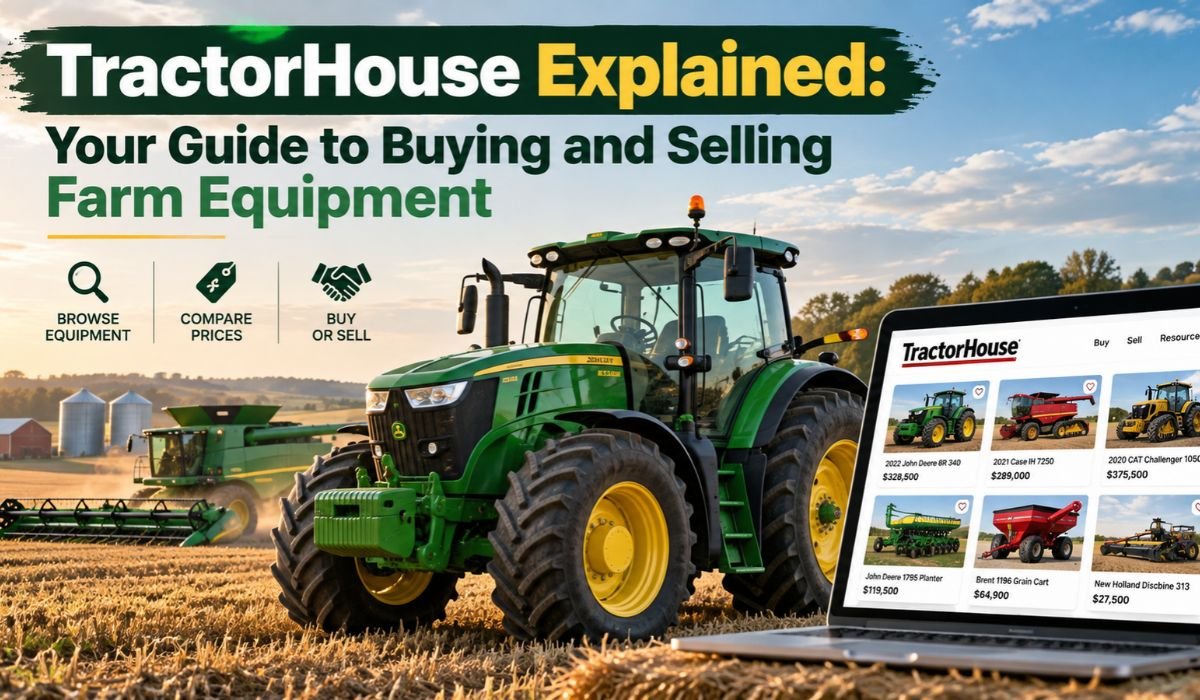
Buying farm equipment isn’t an everyday purchase. A tractor, combine, planter, sprayer, baler, or specialized attachment can represent a serious investment, and the machine you choose may affect productivity, operating costs, and day-to-day farm work for years. Having reliable information before making that decision matters.
That’s where TractorHouse comes in. TractorHouse is an agricultural equipment marketplace that brings buyers and sellers together. Its listings cover new and used tractors, harvesting machinery, planting equipment, hay and forage machines, tillage equipment, attachments, parts, and a wide variety of other agricultural products.
For buyers, the platform offers a practical way to discover machinery, compare specifications, study photos, and contact sellers. Dealers and other sellers, meanwhile, can use TractorHouse to advertise equipment to people already searching within the agricultural market.
There’s still more to buying machinery than finding an appealing listing. Equipment condition, maintenance history, transportation, financing, seller credibility, and the true cost of ownership all deserve attention. This guide looks at TractorHouse from that broader perspective, explaining how the marketplace works while also covering the practical details buyers and sellers should consider before moving forward.
Quick Bio Information
| Information | Details |
|---|---|
| Platform Name | TractorHouse |
| Main Purpose | Buying And Selling Agricultural Equipment |
| Parent Company | Sandhills Global |
| Headquarters | Lincoln, Nebraska, U.S.A. |
| Primary Industry | Agriculture And Farm Equipment |
| Equipment Condition | New And Used |
| Tractor Listings | Available |
| Harvesting Equipment | Available |
| Planting Equipment | Available |
| Hay And Forage Equipment | Available |
| Tillage Equipment | Available |
| Attachments And Implements | Available |
| Parts | Available |
| Precision Agriculture Components | Available |
| Listing Photos | Available Where Provided |
| Listing Videos | Available On Some Listings |
| Seller Contact Options | Available |
| Mobile Access | Available |
| Print Publication | TractorHouse Magazine |
| International Visibility | Available Through Its Broader Marketplace Presence |
What Is TractorHouse?
TractorHouse is a specialized marketplace built around agricultural equipment. It allows people to search for new and used farm machinery offered by equipment dealers and other sellers.
The name might suggest a website devoted entirely to tractors, but the marketplace is much broader. Alongside tractors, users can find harvesting machinery, chemical applicators, hay and forage equipment, livestock equipment, planting machinery, tillage equipment, implements, attachments, parts, and precision agriculture components.
That agricultural focus is one of the platform’s defining characteristics. Buying a piece of farm machinery usually requires more information than someone would expect from a basic classified advertisement. Horsepower, operating hours, configuration, model year, condition, attachments, specifications, and location can all influence whether a particular machine is right for the job.
By organizing listings around agricultural equipment and its relevant specifications, TractorHouse provides a more focused environment for farmers, ranchers, contractors, dealers, and agricultural businesses searching for machinery.
Who Owns TractorHouse?
TractorHouse is a service of Sandhills Global, a company headquartered in Lincoln, Nebraska.
Sandhills Global operates marketplaces and related services across several equipment-centered industries. Its other brands include Machinery Trader, Truck Paper, and AuctionTime, among additional specialized platforms.
That connection provides useful context. TractorHouse isn’t simply an isolated website hosting farm equipment advertisements. It belongs to a larger organization involved in equipment marketplaces, auctions, publications, advertising, and related technology.
Even so, buyers shouldn’t mistake an established marketplace for a guarantee attached to every individual listing. The condition of a machine, the accuracy of transaction details, and the reliability of a particular seller still need to be assessed on their own merits. Due diligence remains important regardless of where equipment is advertised.
How TractorHouse Works
Using TractorHouse begins much like any equipment search: with a clear idea of what you need.
Buyers can search by equipment type and narrow the available inventory using relevant criteria. Someone looking for a tractor, for instance, may want to compare manufacturer, model, year, price, horsepower, operating hours, drive configuration, transmission, condition, and location when those details and filters are available.
Opening a listing provides a closer look at the machine. Depending on what the seller has supplied, a listing may contain specifications, written descriptions, photographs, videos, location information, seller details, and options for making contact.
For people who don’t find the right machine immediately, TractorHouse also offers features intended to make ongoing searches easier. These include Watch Lists, saved searches, listing alerts, and equipment discovery tools.
The important distinction is that TractorHouse functions primarily as a marketplace connecting interested buyers with available equipment and sellers. The exact steps involved in completing a purchase can vary according to the seller, payment method, financing arrangement, transportation needs, and terms of the individual transaction.
Farm Equipment Available On TractorHouse
Tractors are a major part of TractorHouse, but they’re only one part of the marketplace.
Buyers may encounter combines and other harvesting machines, planters and seeders, tillage machinery, sprayers and chemical applicators, hay and forage equipment, livestock equipment, loaders, attachments, implements, replacement parts, and precision agriculture components.
The marketplace also carries listings associated with many familiar agricultural manufacturers. John Deere, Case IH, CLAAS, Massey Ferguson, and New Holland are among the well-known brands buyers may see, alongside machinery from many other manufacturers.
Of course, online inventory never stands still. Equipment is added and removed as sellers advertise machines and purchases are made. A particular model, configuration, year, or price range may be well represented one week and harder to find later.
For that reason, buyers searching for something highly specific may benefit from checking the marketplace regularly rather than assuming current results represent everything that will become available.
How To Find The Right Farm Equipment
The smartest equipment search often starts away from the marketplace itself. Before looking at individual machines, buyers should define exactly what the equipment needs to accomplish.
For a tractor, that might mean establishing minimum horsepower, hydraulic capacity, PTO requirements, transmission preference, drive configuration, implement compatibility, cab features, and physical dimensions. A machine that’s attractive on price but unable to handle the intended implements isn’t a bargain.
The same principle applies to specialized equipment. When considering planting, harvesting, or hay machinery, capacity and compatibility with the rest of the farm’s equipment can be especially important.
Once those requirements are clear, TractorHouse’s search tools can help narrow the field. Rather than scrolling through machines that don’t fit the operation, buyers can focus their attention on realistic candidates.
Price matters, naturally, but it shouldn’t dominate the decision. A less expensive tractor that immediately needs tires, hydraulic repairs, transportation, or extensive servicing could end up costing more than a well-maintained machine with a higher asking price.
The better question isn’t simply, “Which machine is cheapest?” It’s, “Which machine offers the right combination of capability, condition, price, and likely ownership cost?”
How To Evaluate A TractorHouse Listing
Finding a promising TractorHouse listing should be treated as the start of the investigation, not the conclusion.
Begin with the basic information. Check the manufacturer, model, year, operating hours where applicable, specifications, condition, location, attachments, photographs, and seller description. Then compare those details with other examples of the same or similar machinery.
Photos can tell you quite a bit when you know what to look for. Excessive tire or track wear, corrosion, damaged body panels, poor cab condition, visible leaks, worn attachments, and other signs of heavy use may all be apparent.
Still, photographs only go so far.
A clean exterior won’t tell you whether the transmission shifts correctly under load. Images may not reveal weak hydraulics, intermittent electrical faults, internal engine wear, unusual noises, or other mechanical problems.
That’s why important claims made in a listing should be confirmed directly. For higher-value equipment, an appropriate physical or professional inspection can provide a much clearer picture of what you’re actually buying.
Inspecting Used Tractors And Farm Machinery
Operating hours are often one of the first figures buyers notice on a used tractor, but hours don’t tell the whole story.
Two machines with similar hours can have dramatically different histories. One may have received regular servicing, proper storage, and careful operation. Another may have worked in demanding conditions with inconsistent maintenance. Looking at the hour meter without considering the machine’s broader history can therefore be misleading.
For a used tractor, areas worth examining may include the engine, transmission, hydraulic system, PTO, three-point hitch, steering, brakes, electrical components, tires or tracks, cooling system, cab controls, and structural components. Signs of fluid leakage, unusual wear, poorly executed repairs, or damage deserve closer attention.
Service and maintenance records are valuable when they’re available because they provide context that the machine itself can’t always reveal. Serial numbers and ownership documentation may also need to be verified as part of the transaction.
When substantial money is involved, bringing in a qualified technician can be worthwhile. An experienced inspection may identify mechanical concerns that aren’t obvious during a quick walk-around or visible in an online advertisement.
New Versus Used Farm Equipment
New and used farm equipment each have advantages, and neither is automatically the better choice.
A new machine gives the buyer an unused operating history and may come with manufacturer warranty protection. It may also include newer technology, updated controls, improved precision agriculture capabilities, or other features that matter to a modern operation.
Those advantages usually come at a higher purchase price.
Used equipment can make financial sense for buyers who want to reduce the initial investment or obtain a larger, better-equipped machine without paying the price of an equivalent new model. Well-maintained used machinery can continue working productively for years.
The trade-off is greater uncertainty. Previous use, maintenance practices, hidden wear, and upcoming repairs can all affect the true value of a used machine.
A meaningful comparison should therefore extend beyond the sticker price. Depreciation, financing, expected maintenance, parts availability, fuel consumption, insurance, downtime risk, technology needs, and eventual resale value can all influence which option makes more sense.
Understanding Farm Equipment Prices
Age is important when valuing farm machinery, but it’s far from the only factor.
Manufacturer, model, configuration, horsepower, operating hours, condition, maintenance history, attachments, technology packages, regional demand, inventory levels, and seasonal buying patterns can all influence an asking price.
That’s why comparing similar machines is so useful.
Consider two tractors built in the same year. One has relatively low hours, desirable options, documented maintenance, and good tires. The other has worked considerably harder and needs several expensive wear items replaced. Their age may be identical, but their practical value isn’t.
Buyers can use comparable TractorHouse listings to develop a better understanding of asking prices. However, an advertised price shouldn’t automatically be treated as an independent appraisal or the amount at which a machine will ultimately sell.
Sellers can apply the same reasoning. Looking at comparable machinery can help them set a price that reflects the equipment’s condition and market position rather than relying on guesswork.
Questions To Ask A Seller
A good conversation with the seller can reveal information that never made it into the listing.
Ask how the equipment was used and why it’s being sold. Find out whether there are known mechanical problems, what major repairs have been performed recently, and whether maintenance or service records are available.
Buyers should also establish exactly what’s included in the sale. A photograph may show dual wheels, weights, monitors, guidance equipment, headers, or attachments, but their presence in an image doesn’t necessarily mean they’re part of the deal.
Ownership documentation, inspection arrangements, transportation, payment expectations, and any warranty or sale conditions should also be discussed before money changes hands.
For important details, written confirmation is preferable to assumptions. When a purchase involves a substantial investment, clarity at the beginning can prevent expensive misunderstandings later.
Selling Farm Equipment On TractorHouse
For sellers, a strong listing is built on accuracy rather than hype.
Potential buyers want enough information to decide whether a machine deserves a closer look. A useful listing should therefore identify the manufacturer, model, year, hours where relevant, major specifications, condition, attachments, maintenance information, and any known issues.
Good photography matters too. Exterior photographs provide an overall impression, but serious buyers are likely to appreciate closer views of the cab, controls, tires or tracks, engine area, hydraulic connections, hitch, attachments, and visible areas of wear.
Honesty can also save everyone time. If a machine has a known problem, clearly explaining it may reduce unnecessary inquiries and help attract buyers who understand what they’re considering.
Pricing deserves similar care. Sellers should study comparable equipment before setting an asking price. A figure that’s far above comparable machines may discourage interest, while a suspiciously low price can raise questions or leave value on the table.
Financing And The True Cost Of Ownership
The amount shown in an advertisement isn’t necessarily the amount a buyer will ultimately spend.
Depending on the equipment and transaction, additional costs may include financing, taxes, transportation, insurance, servicing, repairs, replacement tires, attachments, registration requirements, and technology upgrades.
TractorHouse provides access to equipment-financing resources through its marketplace. As with any financing arrangement, approval, rates, costs, and terms depend on the provider and the applicant’s circumstances.
Buyers considering finance should look beyond the monthly payment. The total repayment amount, interest cost, loan term, and impact on farm cash flow deserve attention.
This is particularly important with used machinery. A tractor that appears affordable at purchase can become considerably more expensive if a major component fails soon afterward. Building a reasonable maintenance and repair allowance into the buying decision can provide a more realistic picture of affordability.
Transportation And Delivery Considerations
Transport costs can change the economics of an equipment purchase surprisingly quickly.
A smaller tractor located close to the buyer may be relatively straightforward to move. A large combine, wide planter, or oversized implement can be another matter entirely.
Distance, dimensions, weight, loading facilities, specialized trailers, permits, route restrictions, insurance, and delivery timing may all influence the final transportation bill.
This becomes even more important when buyers search outside their region to find a better machine or price. A distant listing may initially look like the better deal, but the advantage can disappear once hauling costs are included.
International purchases add another layer of complexity. Depending on the countries involved, buyers may need to consider shipping, customs procedures, import duties, taxes, local regulations, and equipment compliance requirements.
Transportation should therefore be calculated before the purchase decision, not treated as an afterthought once the machine has already been bought.
Buying Farm Equipment Safely
Online marketplaces have made farm equipment easier to find, but convenience doesn’t eliminate the need for caution.
Before sending money, buyers should verify the seller, equipment identity, ownership documentation, payment instructions, and important transaction terms. Information provided in different parts of the transaction should make sense and remain consistent.
Certain situations deserve extra scrutiny. A seller who creates unusual pressure to pay immediately, refuses reasonable requests for additional information, provides conflicting details, or unexpectedly changes payment instructions may give a buyer reason to investigate further.
An unusually low price should also encourage more verification, not less.
High-value equipment can involve additional financial considerations, including whether an asset is subject to an existing lien or other financial interest. The appropriate checks depend on the location and transaction, and professional legal or financial assistance may be appropriate when substantial money is involved.
Most importantly, seeing a machine advertised on an established marketplace shouldn’t be treated as proof that every detail of an individual transaction has been independently verified. Buyers remain responsible for performing appropriate due diligence.
TractorHouse Magazine And Mobile Access
TractorHouse isn’t limited to people sitting at a desktop computer.
Its mobile presence gives users another way to search for agricultural equipment, view machinery information, and continue researching while away from the office. That can be useful when comparing a listing with a machine at a dealership, auction, workshop, or farm.
The TractorHouse brand also maintains a print presence through TractorHouse magazine, which features agricultural machinery and attachments advertised for sale.
That mix of web, mobile, and print reflects the way agricultural equipment marketing has evolved. Digital search makes it easier to filter and compare large amounts of inventory quickly, while print continues to offer another channel for dealers and sellers trying to reach equipment buyers.
For users, the result is a marketplace experience that isn’t tied to a single format.
Benefits And Limitations Of TractorHouse
Specialization is one of TractorHouse’s clearest advantages.
A general online marketplace may contain almost every imaginable product. TractorHouse concentrates on agricultural machinery, allowing buyers to focus on relevant equipment categories, manufacturers, specifications, dealers, and sellers.
Comparing several listings can also help buyers become more familiar with available configurations and current asking prices. Even someone who doesn’t purchase immediately can use that information to better understand the market.
There are limitations, though.
The quality and completeness of individual listings can vary. Machinery condition isn’t uniform, inventory changes constantly, and costs such as transportation, repairs, inspections, financing, and taxes may not be obvious from the advertised price.
TractorHouse is therefore most useful when viewed as a discovery, research, comparison, and seller-contact resource. It can make the equipment search considerably easier, but it can’t replace a buyer’s own judgment or due diligence.
Who Should Use TractorHouse?
TractorHouse serves a broad range of people within agriculture.
A farmer replacing an aging field tractor can use it to compare alternatives from different sellers. Ranchers may search for livestock-related machinery, while agricultural contractors can look for specialized or higher-capacity equipment suited to commercial workloads.
Dealers can use the marketplace to expose inventory to buyers beyond their immediate area. Smaller landowners may find compact and utility tractors, while larger operations can search for high-horsepower tractors, combines, planting machinery, and other substantial equipment.
The usefulness of TractorHouse ultimately depends on what the buyer needs, where the equipment is located, how much they’re prepared to spend, and what’s currently available.
For someone prepared to research carefully rather than simply choose the first attractive listing, the marketplace can provide a useful starting point.
Final Thoughts
TractorHouse can make one of the more difficult parts of purchasing agricultural machinery considerably easier: finding suitable equipment and comparing what’s available.
Its agricultural focus gives farmers, ranchers, contractors, dealers, landowners, and other buyers a place to explore new and used tractors, harvesting equipment, planting machinery, attachments, parts, and many other farm-related products without sorting through an unrelated general marketplace.
But finding the machine is only the first part of a successful purchase.
A thoughtful buyer looks beyond photographs and asking prices. Equipment condition, operating history, maintenance records, specifications, seller credibility, financing, transportation, potential repairs, and long-term ownership costs all deserve consideration.
The same principle applies to sellers. Accurate descriptions, useful photographs, realistic pricing, and straightforward communication make it easier for serious buyers to understand what they’re considering.
Ultimately, TractorHouse works best as a research and discovery tool combined with careful real-world judgment. Use the marketplace to find possibilities, compare similar equipment, and connect with sellers. Then verify the details that matter before committing to a purchase.
Farm machinery is too important and too expensive for shortcuts. A little more research before the sale can make the difference between simply buying a machine and buying the right machine.
FAQs About TractorHouse
What Is TractorHouse?
TractorHouse is an agricultural equipment marketplace where buyers can search for new and used farm machinery. Listings may include tractors, harvesting machinery, planting equipment, tillage machines, hay and forage equipment, livestock machinery, attachments, parts, and other agricultural products.
Who Owns TractorHouse?
TractorHouse is a service of Sandhills Global, a company headquartered in Lincoln, Nebraska. Sandhills Global operates marketplaces and related services serving several equipment-focused industries.
Can You Buy Used Tractors On TractorHouse?
Yes. Used tractors are an important part of the TractorHouse marketplace. Depending on current inventory, buyers may find machinery from manufacturers such as John Deere, Case IH, Massey Ferguson, New Holland, CLAAS, and many other brands.
Does TractorHouse Only Have Tractors?
No. Despite its name, TractorHouse covers a much wider range of agricultural equipment. Listings can include harvesting, planting, tillage, hay and forage, livestock and chemical application equipment, along with implements, attachments, parts, and precision agriculture components.
Can You Sell Farm Equipment On TractorHouse?
Yes. TractorHouse provides marketplace and advertising services for agricultural equipment sellers and dealers. Available services, advertising options, requirements, and pricing can change, so sellers should review the current terms before creating a listing.
Is TractorHouse Safe To Use?
TractorHouse is an established agricultural equipment marketplace operated by Sandhills Global. That doesn’t remove the need to assess each individual transaction carefully. Buyers should verify seller information, machinery condition, ownership, payment instructions, and sale terms before committing funds.
Should You Inspect Equipment Before Buying?
An inspection is generally a sensible precaution when purchasing valuable used farm equipment. Photographs and descriptions are useful for initial research, but a physical inspection or assessment by a qualified technician may uncover wear, mechanical problems, or maintenance needs that aren’t obvious online.
How Do You Find A Good Deal On TractorHouse?
Start by deciding exactly what specifications you need and then compare several similar machines. Look beyond the asking price to operating hours, condition, maintenance history, included attachments, transportation expenses, immediate repair needs, and likely ownership costs. A good deal is a machine that fits the job and offers reasonable overall value, not necessarily the listing with the lowest price.
Learn more and explore exciting content on: Windstrebe Explained: What It Is, How It Works, and Why It Matters
[…] Learn more and explore exciting content on: TractorHouse Explained: Your Guide to Buying and Selling Farm Equipment […]