
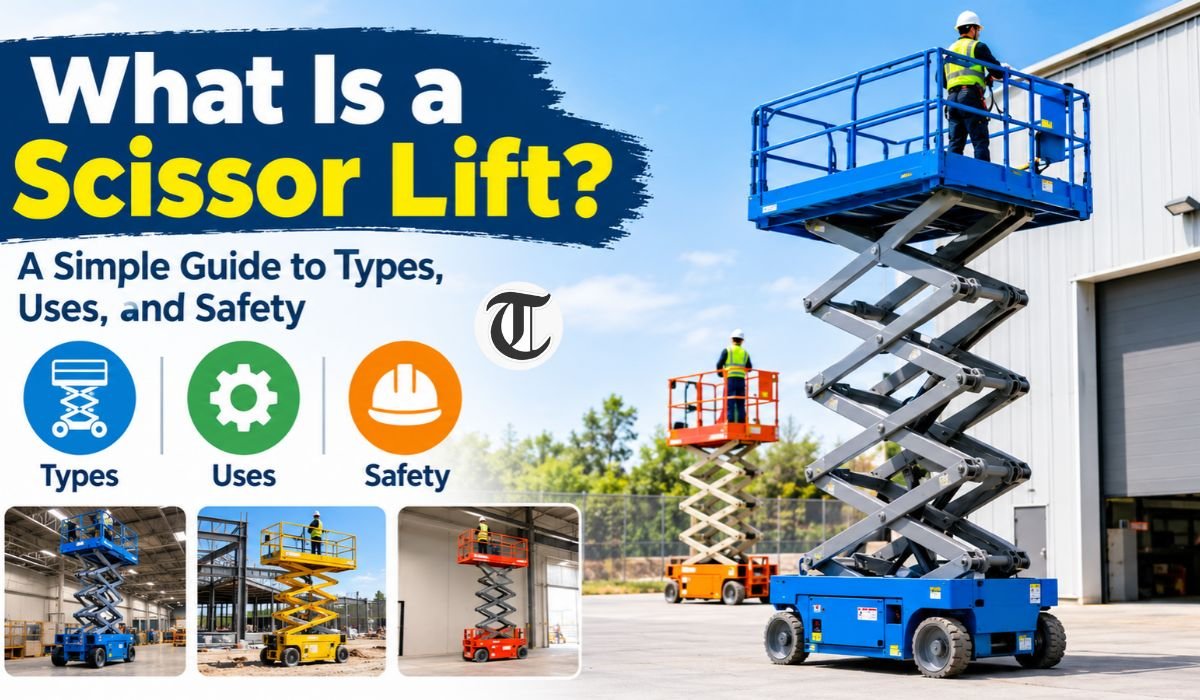
Getting work done at height isn’t always as simple as bringing out a ladder. When workers need more space to move around, carry tools, or stay elevated for an extended period, a Scissor Lift can offer a much more practical solution. This powered elevated work platform is designed mainly to raise workers, tools, and permitted materials vertically to a higher working position.
You’ll see Scissor Lifts in a wide range of settings, from construction sites and warehouses to manufacturing plants, retail stores, commercial buildings, and maintenance facilities. They’re useful for jobs such as installation, painting, inspection, equipment servicing, lighting work, inventory operations, and general building maintenance.
The name comes from the machine’s distinctive crossed support arms. As the lifting system extends these arms, the platform moves upward. When the arms contract, the platform comes back down. Although the basic idea is straightforward, Scissor Lifts come in many configurations, and each is designed for particular working conditions.
That distinction matters. A compact electric model intended for an indoor warehouse isn’t automatically suitable for a construction site or uneven outdoor ground. Working height, rated capacity, platform dimensions, terrain, power source, mobility, and manufacturer requirements all have to be considered before choosing equipment.
What Is A Scissor Lift?
A Scissor Lift is an elevated work platform that raises and lowers a working platform using a folding, crossed-arm mechanism. The platform gives operators a dedicated place to work, along with room for permitted tools and materials, while the base or chassis supports the lifting structure.
Its primary movement is vertical. That’s one of the easiest ways to distinguish a Scissor Lift from a Boom Lift, which can provide additional horizontal outreach and positioning around obstacles.
There isn’t just one type of Scissor Lift. Compact electric models are commonly used on smooth indoor floors, while Rough-Terrain Scissor Lifts are designed for appropriate outdoor applications. Stationary Scissor Lift Tables use a similar scissor mechanism but are generally intended for lifting goods or equipment rather than providing mobile access for workers.
Every machine has its own specifications and limitations. Before use, operators and buyers should check the manufacturer’s information for rated capacity, platform height, working height, terrain suitability, travel limitations, and other operating requirements.
How Does A Scissor Lift Work?
The basic Working Principle Of A Scissor Lift is fairly simple. A lifting actuator or hydraulic system applies force to a set of crossed support arms. As the arms extend, they push the platform upward. When the mechanism contracts, the platform moves downward.
Hydraulics are widely used in lifting equipment because hydraulic systems can deliver substantial force in a controlled way. Some Scissor Lifts are electrically powered and use batteries to operate hydraulic components. In other words, “electric” and “hydraulic” don’t necessarily describe two completely separate machine categories. Electric can refer to the machine’s power source, while hydraulic can describe the way lifting force is produced.
The operator uses dedicated controls to operate the machine. Depending on its design, the control system may handle platform lifting and lowering, driving, steering, braking, emergency lowering, and other functions.
Modern equipment can also include alarms, limit switches, interlocks, emergency controls, and other safety systems. These features are valuable, but they don’t eliminate the need for proper training, inspections, maintenance, appropriate equipment selection, and compliance with the manufacturer’s instructions.
Main Parts Of A Scissor Lift
A Scissor Lift may look relatively simple from a distance, but several systems work together to make it function safely.
The Working Platform is where operators perform their tasks. It also provides space for permitted tools, equipment, and materials. Guardrails and an access gate help protect people working on the elevated platform.
Below the platform are the Scissor Arms, the crossed structural members that give the machine its name. They extend and contract to change the platform’s height. A hydraulic cylinder or another type of lifting actuator supplies the force needed to move this structure.
The Base Frame Or Chassis supports the lifting assembly. On mobile machines, this section also works with the wheels, steering, brakes, and drive system. Depending on the model, the Power System may use batteries, an electric motor, an internal-combustion engine, or a combination of technologies.
The Control System gives the operator control over the machine’s functions. Other equipment can include platform extensions, emergency-lowering systems, alarms, safety switches, and machine-specific interlocks.
Understanding these parts isn’t just useful for technical knowledge. It also helps explain why an apparently small problem can matter. Damage to a guardrail, brake, control, structural component, or other critical system can affect safe operation and needs appropriate attention before the lift is used.
Types Of Scissor Lifts
Different jobs call for different machines, so choosing the right Type Of Scissor Lift is an important part of planning elevated work.
Electric Scissor Lifts are commonly used indoors. They generally operate quietly and produce no direct exhaust emissions while running, which makes them a good fit for warehouses, factories, commercial buildings, and other enclosed spaces.
Compact or slab models are generally intended for relatively smooth, firm surfaces. Their smaller dimensions can be particularly useful where maneuvering room is limited.
For appropriate outdoor applications, Rough-Terrain Scissor Lifts are designed to handle surfaces that may be less uniform than finished indoor floors. Depending on the model, they can feature larger tires, increased ground clearance, and other terrain-oriented features. Even so, they must be operated within the conditions and limits specified by the manufacturer.
Another option is an Extension-Platform Scissor Lift. Its platform can extend outward to provide additional working reach. This can be useful when a worker needs limited access beyond the main platform without moving the entire machine.
Then there are Stationary Hydraulic Scissor Lift Tables. They use the same general scissor-lifting concept but are commonly used for material handling rather than mobile personnel access. Factories, warehouses, loading areas, and production environments may use them to raise goods or equipment between different working levels.
What Is A Scissor Lift Used For?
The Uses Of A Scissor Lift are broad because many industries have tasks that require workers to reach elevated areas safely and efficiently.
On construction sites, suitable Scissor Lifts can be used for ceiling installation, painting, maintenance, finishing work, and other jobs where workers need a stable elevated position.
In Warehousing And Logistics, they can support inventory work, access to elevated shelving, equipment installation, and maintenance. Manufacturing facilities may use them for machine servicing, assembly support, production-line maintenance, and overhead equipment work.
They’re also common in building and facility maintenance. Depending on the machine and site, workers can use suitable Scissor Lifts to reach lighting systems, HVAC equipment, electrical installations, fire-system components, and other elevated building systems.
Retail stores, shopping centers, exhibition venues, airports, and transportation facilities have similar needs. Scissor Lifts can assist with signage, lighting, inspections, repairs, and maintenance when the selected equipment is appropriate for the task.
The common thread is straightforward: the work requires elevation, and the task can generally be performed from a position above the machine.
Benefits Of A Scissor Lift
One of the biggest advantages of a Scissor Lift is the working platform itself. Compared with standing on a ladder, workers can have a larger dedicated area in which to perform suitable tasks and organize permitted tools and materials.
The machine’s vertical lifting design is another major benefit. If the work is directly above the equipment, there’s often no need for the horizontal outreach provided by a Boom Lift. That can make a Scissor Lift an efficient option for many installation, inspection, and maintenance jobs.
There’s also considerable variety within the category. Compact electric models can work well indoors, while suitable Rough-Terrain models are available for certain outdoor applications. Different platform sizes and rated capacities allow equipment to be matched more closely to the job.
Built-in features such as guardrails, access gates, brakes, alarms, and emergency controls can provide important safety support. Still, these features shouldn’t be viewed as a substitute for trained operators, inspections, correct loading, suitable ground conditions, or compliance with operating instructions.
Limitations Of A Scissor Lift
A Scissor Lift is useful, but it’s not a universal answer to every elevated-work problem.
Its main limitation is its movement. The machine is primarily designed for vertical access. If workers need substantial horizontal outreach or have to reach around an obstacle, a Boom Lift or another type of access equipment may be better suited to the job.
Ground conditions also deserve careful attention. A compact indoor machine shouldn’t simply be taken outside and used on rough or unstable ground. The machine must be designed and rated for the environment in which it’s being operated.
Load capacity presents another clear limit. The combined weight of workers, tools, equipment, and permitted materials must remain within the manufacturer’s rated capacity. Outdoor machines can also have restrictions related to wind and other environmental conditions.
Training, inspection, and maintenance are equally important. OSHA guidance emphasizes inspecting controls and components, maintaining guardrails and brakes, understanding load limits, following manufacturer instructions, and training workers about the hazards associated with Scissor Lift operation.
Scissor Lift Vs. Boom Lift
The biggest difference between a Scissor Lift And Boom Lift is how each machine positions the worker.
A Scissor Lift primarily raises and lowers its platform vertically. A Boom Lift uses a boom to position a work platform or basket, providing vertical movement and, depending on its configuration, horizontal outreach.
That makes a Scissor Lift particularly useful when workers need a relatively spacious platform and the work is located directly above the machine. A Boom Lift becomes more valuable when the job requires reaching over, around, or beyond an obstacle.
Consider a ceiling installation inside a large building. A Scissor Lift may provide exactly the type of vertical access needed. On the other hand, reaching an exterior section of a building from a position away from the structure may call for the outreach capabilities of a Boom Lift.
The important point is that one isn’t automatically better than the other. The task, required height, horizontal reach, platform requirements, terrain, and load should determine the choice.
Scissor Lift Vs. Ladder And Scaffolding
Ladders are still useful for many straightforward tasks, particularly where the work is brief and the conditions are appropriate. Their main drawback is that they provide relatively little standing and working space.
A Scissor Lift can offer a larger elevated platform and powered positioning, which may make it more practical for suitable tasks that require workers to remain at height.
Scaffolding offers another alternative. It can provide a substantial working area and may be appropriate for longer projects, but it can require assembly, dismantling, and modification as the work progresses. A mobile Scissor Lift can allow quicker repositioning for suitable jobs, provided the machine is operated within its design limitations.
Convenience shouldn’t be the only deciding factor. The height, duration, number of workers, materials, surface conditions, hazards, mobility needs, and applicable safety requirements all deserve consideration.
In U.S. construction, OSHA treats Scissor Lifts under its scaffold requirements rather than the specific aerial-lift requirements. That distinction is important when discussing training and regulatory compliance in the United States.
Scissor Lift Safety
Scissor Lift Safety starts before the machine moves. Selecting the right equipment and identifying hazards at the worksite are both essential.
Potential hazards include falls, tip-overs, electrical contact, falling objects, crushing hazards, unstable surfaces, collisions, and other site-specific dangers.
Before operating the equipment, workers should understand the manufacturer’s instructions and know how to use the controls. They should also understand load limitations, inspection procedures, emergency controls, and hazards specific to the work area.
Workers should remain on the platform floor. Guardrails shouldn’t be treated as steps, and ladders, boxes, planks, or other makeshift devices shouldn’t be used to gain additional height. OSHA guidance specifically addresses these unsafe practices.
Ground conditions require equal attention. Operators should consider holes, uneven surfaces, overhead obstructions, electrical hazards, traffic, nearby structures, and weather. The machine must remain within its stated operating limits.
Fall-protection requirements can vary according to the equipment, jurisdiction, workplace, and circumstances. It’s therefore inaccurate to claim that every Scissor Lift operator must always wear a harness. In U.S. construction settings, OSHA guidance explains the role of guardrail systems and notes that additional fall protection may be required in certain situations.
Scissor Lift Pre-Operation Inspection
A Pre-Operation Inspection is one of the simplest ways to identify potential equipment problems before work begins. The inspection should always follow the manufacturer’s instructions and the procedures established for the workplace.
The operator should examine the platform, guardrails, access gate, controls, wheels or tires, brakes, power system, and visible structural components. On machines that use hydraulic systems, visible leaks or damage should be checked as part of the applicable inspection process. Safety devices and emergency controls should also be checked according to the manufacturer’s procedures.
The area surrounding the lift needs attention, too. Look for holes, unstable surfaces, overhead obstacles, electrical hazards, vehicle traffic, and other conditions that could interfere with safe operation.
OSHA recommends inspecting and testing controls and components before use and ensuring that guardrail systems and brakes remain in safe working condition. If a defect or maintenance issue is identified, it shouldn’t simply be ignored or worked around.
Working Height And Load Capacity
When comparing Scissor Lifts, it’s easy to confuse Platform Height with Working Height.
Platform height refers to the height the platform itself can reach. Working height is a manufacturer-defined specification that generally accounts for a worker’s reach from the elevated platform. Because manufacturers may present these specifications differently, buyers should check the exact definitions used for the machine they’re considering.
Load capacity is just as important as height. The permitted load can include everyone on the platform as well as tools, equipment, and materials. Exceeding the manufacturer’s rated capacity isn’t acceptable.
It’s also worth checking whether the permitted load changes when a platform extension is deployed or when the machine is being used in a particular configuration. The manufacturer’s labels, manual, and load information should always take precedence over general assumptions.
How To Choose The Right Scissor Lift
Choosing the right Scissor Lift starts with understanding the job itself.
First, determine the required working height and platform height. Consider whether the task can be completed directly above the machine or whether the workers need additional horizontal reach.
Next, calculate the total expected load. Include operators, tools, equipment, and materials. Then look at the surface. Smooth indoor floors may be suitable for compact electric models, while an appropriate outdoor construction environment may call for a Rough-Terrain Scissor Lift.
Platform size matters as well. A larger platform can provide more workspace, but it may also require more room to maneuver. Power source, operating duration, charging access, noise, emissions, transportation, storage, and mobility requirements should also be considered.
The goal isn’t to buy or rent the biggest machine available. It’s to choose equipment that meets the job’s requirements while remaining within its operating limits. Manufacturer specifications should be used to confirm working height, capacity, platform dimensions, terrain suitability, and other limitations.
Electric Vs. Fuel-Powered Scissor Lifts
Electric Scissor Lifts are often a practical choice for indoor work. They generally operate quietly and don’t produce direct exhaust emissions while operating, which can be particularly useful in warehouses, factories, retail spaces, and enclosed commercial buildings.
Fuel-powered models can be useful when outdoor operating conditions, runtime, terrain capability, or other job requirements make them appropriate. Some Rough-Terrain Scissor Lifts use combustion engines, while electric rough-terrain configurations are also available.
There isn’t a single answer for every project. Charging access, expected runtime, terrain, noise restrictions, emissions considerations, maintenance, and site requirements all play a role in the decision.
Do You Need Training Or Certification?
Anyone operating a Scissor Lift should receive appropriate training before using the equipment. However, the exact legal requirements differ depending on the country, jurisdiction, workplace, and equipment.
There isn’t one universal worldwide Scissor Lift license. In the United States, for example, OSHA treats Scissor Lifts used in construction under its scaffold requirements rather than the specific aerial-lift rules. OSHA requires training for employees working with scaffolds, including instruction about hazards, protective measures, and load-related requirements.
Training should cover the machine’s controls, operating limitations, load requirements, site hazards, inspection procedures, emergency procedures, and safe movement. Operators should also understand the manufacturer’s instructions for the specific equipment they’re using.
Employers should determine what training, evaluation, certification, or authorization is required under the rules that apply to their workplace. Retraining may also be necessary when equipment or workplace conditions change or when new hazards are identified.
Common Mistakes To Avoid
One of the easiest mistakes is choosing equipment based solely on maximum height. A lift might reach the required elevation and still be wrong for the job because its platform capacity, dimensions, terrain rating, or maneuverability don’t match the worksite.
Overloading the platform is another serious mistake. The weight of workers, tools, equipment, and materials all counts toward the permitted load. The manufacturer’s rated capacity should always be respected.
Workers should also never climb onto guardrails or use ladders, boxes, planks, or similar makeshift arrangements to gain extra height. These practices can create fall and stability hazards.
Skipping inspections is another preventable problem. A machine that worked properly the previous day isn’t automatically safe today. Controls, structural components, guardrails, brakes, tires or wheels, and other relevant systems need to be checked according to the manufacturer’s procedures.
When something appears damaged or doesn’t operate as expected, the safer approach is to stop and follow the workplace’s reporting and maintenance procedure rather than attempting to work around the problem.
Final Thoughts
A Scissor Lift can be an extremely useful piece of equipment when a job calls for controlled vertical access and a dedicated working platform. Its crossed-arm mechanism provides the lifting movement, while different configurations allow the equipment to serve a variety of indoor, outdoor, mobile, and material-handling applications.
The key is matching the machine to the work. A compact Electric Scissor Lift may make sense for indoor maintenance, while a Rough-Terrain model may be appropriate for certain outdoor jobs. A Stationary Scissor Lift Table can be a better fit when the goal is moving goods rather than personnel. And when the work requires significant horizontal outreach, a Boom Lift may be the more suitable option.
Safety should be part of that decision from the start, not an afterthought. Operator training, pre-use inspection, load control, suitable ground conditions, awareness of overhead and electrical hazards, and compliance with manufacturer instructions and applicable regulations all contribute to safer work.
Ultimately, the best Scissor Lift isn’t necessarily the biggest, tallest, or most powerful one. It’s the machine that fits the required height, capacity, platform, terrain, mobility, and working environment and allows the job to be completed safely and efficiently.
FAQs About Scissor Lifts
What Is A Scissor Lift Used For?
A Scissor Lift provides elevated access for workers and permitted tools or materials. Common uses include construction, building maintenance, warehousing, manufacturing, lighting installation, equipment servicing, inventory work, and commercial facility maintenance. The appropriate application depends on the machine’s rated capacity, working height, platform design, terrain suitability, and operating limitations.
How Does A Scissor Lift Work?
A Scissor Lift uses crossed support arms that extend and contract to raise and lower its platform. The lifting force may come through hydraulic components, electric systems, or a combination of technologies. When the lifting mechanism extends the scissor structure, the platform rises. As the structure contracts, the platform lowers.
How High Can A Scissor Lift Go?
There isn’t one maximum height that applies to every Scissor Lift. Compact models are designed for lower-level work, while larger machines can reach substantially higher working positions. The manufacturer’s platform-height and working-height specifications should always be checked when selecting equipment.
How Much Weight Can A Scissor Lift Carry?
Rated capacity varies by machine and configuration. It can include workers, tools, equipment, and materials placed on the platform. The manufacturer’s rated capacity must never be exceeded. Users should also check whether an extension platform or particular machine configuration changes the permitted load.
Are Scissor Lifts Safe?
A Scissor Lift can be operated safely when the appropriate machine is selected and properly inspected, maintained, and operated by trained workers. Safe use involves following manufacturer instructions, staying within rated capacity, assessing ground conditions, using the platform’s protective systems correctly, and recognizing hazards such as overhead obstructions and electrical sources.
Is A Scissor Lift Better Than A Boom Lift?
Neither machine is universally better. A Scissor Lift is generally suited to vertical access where workers need a relatively spacious platform. A Boom Lift is more useful when the job requires horizontal outreach or positioning around obstacles. The required height, reach, terrain, load, and workspace should guide the decision.
Can Scissor Lifts Be Used Outdoors?
Yes, some Scissor Lifts are specifically designed for outdoor applications. Rough-Terrain models can be configured for appropriate outdoor surfaces and may include features intended to improve terrain performance. However, an indoor or slab model shouldn’t automatically be used outdoors. Always follow the manufacturer’s specifications for the machine and the work environment.
Do You Need A License Or Certification To Operate A Scissor Lift?
Appropriate operator training is important, but the exact licensing, certification, or authorization requirements vary by location, workplace, and type of equipment. There isn’t a universal worldwide Scissor Lift license. Employers and operators should check applicable local regulations, workplace requirements, and manufacturer instructions before operating the equipment.
Learn more and explore exciting content on: What Causes Dry Eyes? Common Reasons, Risk Factors, and Relief Tips
[…] Learn more and explore exciting content on: What Is A Scissor Lift? A Simple Guide To Types, Uses, And Safety […]