
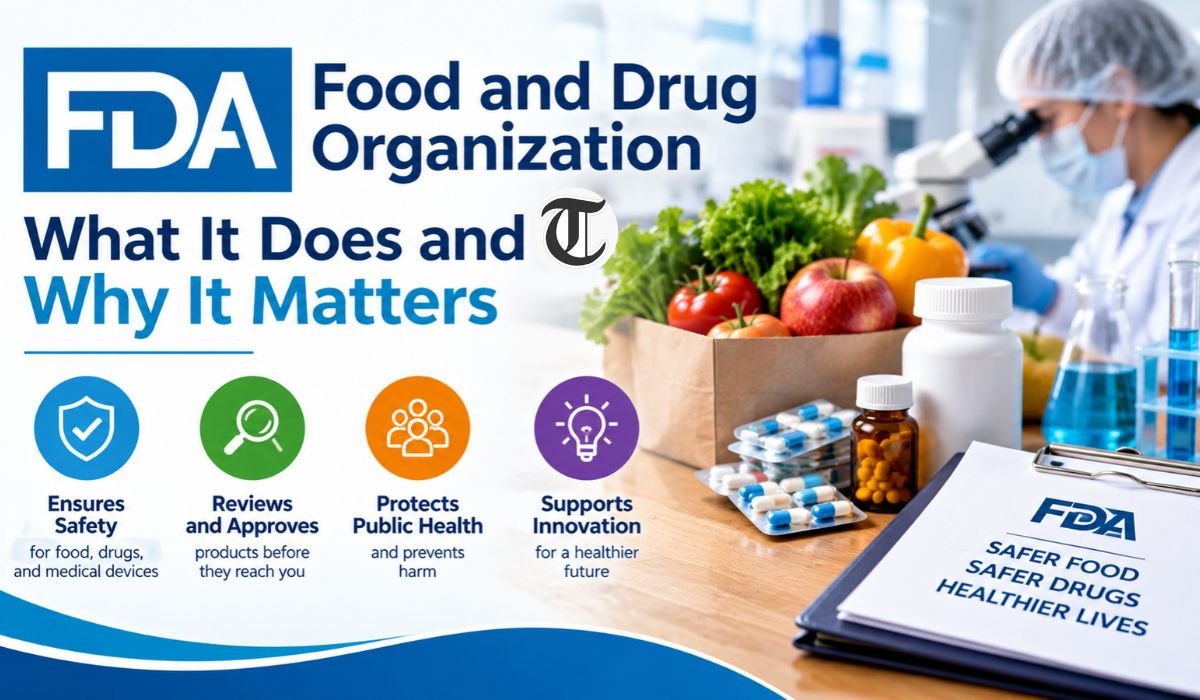
The safety of the food we eat, the medicines we take, and the medical devices used in hospitals affects everyone. In the United States, the Food And Drug Administration (FDA) plays a central role in overseeing these products and protecting public health. Its work reaches far beyond checking labels or reviewing medicines. The agency evaluates scientific evidence, monitors potential risks, inspects facilities, and takes action when products fail to meet applicable legal requirements.
Although the term Food And Drug Organization is sometimes used when discussing the agency, its official name is the Food And Drug Administration. As part of the U.S. Department Of Health And Human Services, the FDA works to ensure that products under its authority meet the standards required by law. Understanding how the agency operates can help consumers make informed decisions and give businesses a clearer picture of what it takes to bring products to the American market.
Quick Bio Information About The FDA
| Fact | Information |
|---|---|
| Official Name | Food And Drug Administration |
| Common Abbreviation | FDA |
| Government Department | U.S. Department Of Health And Human Services |
| Primary Mission | Protecting Public Health |
| Main Regulatory Scope | Foods, Drugs, Medical Devices, Biologics, Cosmetics, Tobacco, And Certain Other Products |
| Drug Regulatory Center | Center For Drug Evaluation And Research |
| Medical Device Center | Center For Devices And Radiological Health |
| Biological Products Center | Center For Biologics Evaluation And Research |
| Veterinary Products Center | Center For Veterinary Medicine |
| Tobacco Regulatory Center | Center For Tobacco Products |
| Food Oversight | FDA Human Foods Program |
| Research Organization | National Center For Toxicological Research |
| Medical Device Submission | 510(k) Premarket Notification, When Applicable |
| High-Risk Device Pathway | Premarket Approval |
| Certain Novel Device Pathway | De Novo Classification |
| Cosmetic Law Update | Modernization Of Cosmetics Regulation Act Of 2022 |
| Drug Safety Evaluation | Depends On The Applicable Regulatory Pathway |
| Postmarket Responsibilities | Vary By Product And Applicable Law |
| Consumer Safety Resources | FDA Warnings, Recall Information, And Reporting Resources |
| Regulatory Status | Approval, Clearance, Authorization, Registration, And Listing Have Different Meanings |
What Is The Food And Drug Administration?
The Food And Drug Administration is a federal regulatory agency responsible for protecting public health through oversight of specific products. Its responsibilities cover human and animal drugs, biological products, medical devices, much of the U.S. food supply, cosmetics, tobacco products, and certain radiation-emitting electronic products.
However, the FDA doesn’t handle every product in the same way. Some medicines and medical devices must undergo extensive evaluation before they can be marketed, while other products follow different regulatory requirements. The agency also continues monitoring products after they reach consumers, investigates reported safety concerns, issues warnings when necessary, and enforces applicable laws.
This combination of premarket evaluation and ongoing oversight helps reduce risks while allowing products that meet the relevant requirements to reach the people who need them. For consumers and businesses alike, understanding the FDA’s role makes it easier to distinguish between regulatory requirements and claims made by manufacturers.
Why Was The FDA Established?
The FDA’s history began with growing concerns about unsafe foods, dangerous medicines, and misleading product claims. During the late nineteenth and early twentieth centuries, consumers had limited protection against adulterated products and inaccurate health claims. These concerns helped build support for stronger federal oversight.
The Pure Food And Drugs Act Of 1906 established an important foundation by addressing adulterated and misbranded foods and drugs. A major turning point came in 1938, when deaths associated with Elixir Sulfanilamide exposed serious weaknesses in existing drug safety protections. The product contained a toxic solvent, and the resulting tragedy helped drive the passage of the Federal Food, Drug, And Cosmetic Act Of 1938.
That law strengthened federal oversight and established important requirements for drug safety before marketing. Subsequent legislation expanded the FDA’s responsibilities involving drug effectiveness, medical devices, and other regulated products. Today, the agency continues adapting its approach as scientific knowledge advances, new technologies emerge, and public health concerns change.
What Does The FDA Regulate?
The FDA oversees a broad range of products, although its authority has specific boundaries. In the food sector, it regulates much of the domestic and imported food supply, including many food additives, food labeling requirements, and measures designed to prevent contamination. Most conventional meat and poultry products are primarily regulated by the U.S. Department Of Agriculture, although certain products fall under different regulatory arrangements.
The agency also oversees prescription and over-the-counter medicines, vaccines and other biological products, medical devices, cosmetics, tobacco products, and many veterinary products. The requirements for each category depend on applicable laws, product classification, and intended use.
Consider a skincare product as an example. A moisturizer marketed to improve the skin’s appearance is generally regulated as a cosmetic. If the same product is promoted to treat a disease, it may also fall under drug regulations. That difference can affect the evidence, labeling, and regulatory steps required before the product can be marketed. For manufacturers, identifying the correct category early can prevent confusion and costly compliance mistakes.
How Is The FDA Organized?
The FDA relies on specialized centers and offices to manage its many regulatory responsibilities. Each organization focuses on particular products, scientific questions, or public health concerns. This arrangement allows experts to evaluate the specific risks associated with medicines, medical devices, biological products, foods, and other regulated categories.
The agency brings together professionals from a range of fields, including medicine, engineering, toxicology, statistics, chemistry, and regulatory affairs. Their combined expertise helps inform decisions about product safety, quality, and effectiveness where applicable.
Major FDA organizations include the Center For Drug Evaluation And Research, Center For Devices And Radiological Health, Center For Biologics Evaluation And Research, Center For Veterinary Medicine, and Center For Tobacco Products. The Human Foods Program oversees important food-related responsibilities, while research organizations and other offices support scientific evaluation and regulatory operations. Although their duties differ, these organizations share the broader goal of protecting public health through science-based regulation.
Major FDA Centers And Their Responsibilities
Each major FDA center has a defined area of responsibility. The Center For Drug Evaluation And Research evaluates many prescription and over-the-counter medicines, including the evidence supporting their safety, effectiveness, quality, and labeling. Its work helps determine whether drugs meet the applicable requirements for marketing and supports continued monitoring after they become available.
The Center For Devices And Radiological Health oversees medical devices and certain radiation-emitting electronic products. Its responsibilities include products such as surgical instruments, implants, and diagnostic equipment. The Center For Biologics Evaluation And Research regulates many vaccines, blood products, and other biological products.
Other organizations address different public health needs. The Human Foods Program manages major food safety and nutrition responsibilities within the FDA’s jurisdiction. The Center For Tobacco Products administers federal tobacco product regulation, while the Center For Veterinary Medicine oversees animal drugs and related products within its authority.
The National Center For Toxicological Research conducts research that supports regulatory science. Meanwhile, the Oncology Center Of Excellence coordinates expertise across FDA centers to support the development and evaluation of cancer-related products. Together, these organizations allow the FDA to apply specialized knowledge to a wide range of regulatory decisions.
How Does The FDA Ensure Product Safety?
The FDA uses several approaches to evaluate products and monitor their safety. Depending on the product category, these may include reviewing scientific evidence before marketing, inspecting manufacturing facilities, examining product quality, assessing labeling, and monitoring reports of adverse events. Food safety programs also address contamination prevention and applicable manufacturing controls.
The agency’s work doesn’t end once a product reaches consumers. Reports of unexpected reactions, manufacturing defects, contamination, or medical device failures may lead to further investigation. When necessary, the FDA can issue safety communications, pursue legally authorized corrective action, oversee certain recall activities, or take enforcement measures.
It’s important to understand that FDA oversight doesn’t mean every possible risk has been eliminated. No evaluation can anticipate every problem that might emerge during widespread use. Continued monitoring allows the agency and manufacturers to respond when new evidence raises concerns about a product’s safety or quality.
FDA Approval, Clearance, And Authorization
The terms FDA approval, clearance, authorization, registration, and listing are often confused, but they have different meanings. Understanding these distinctions helps consumers interpret product claims and allows businesses to identify the regulatory steps relevant to their products.
Drugs that require approval undergo an evaluation of evidence supporting their safety and effectiveness for the proposed use. Certain higher-risk medical devices require Premarket Approval, commonly known as PMA, which involves a detailed review of scientific evidence.
Other eligible medical devices may qualify for the 510(k) pathway, in which manufacturers demonstrate substantial equivalence to an appropriate legally marketed predicate device. Certain novel devices may qualify for the De Novo pathway when they meet the applicable criteria.
Emergency Use Authorization is different from these standard pathways. Under specific legal conditions, it may allow certain unapproved products or unapproved uses of approved products to be used during qualifying emergencies.
Registration and listing don’t automatically mean that the FDA has approved or cleared a product. A company should therefore describe its regulatory status accurately rather than suggesting that every interaction with the agency represents formal approval.
Understanding The FDA 510(k) Process
The FDA 510(k) process is a Premarket Notification pathway available for eligible medical devices. To qualify, a manufacturer generally must demonstrate that its device is substantially equivalent to a legally marketed predicate device that isn’t subject to Premarket Approval. The FDA examines the intended use, relevant technological characteristics, and supporting evidence to determine whether the legal criteria for substantial equivalence have been met.
For example, a company developing a new surgical instrument may investigate whether an appropriate predicate device exists. It must then explain how its proposed product compares with that device and address any differences that could affect safety or effectiveness. A similar appearance alone isn’t enough to establish substantial equivalence.
Depending on the device, a submission may include performance testing, materials information, software documentation, labeling, and clinical evidence when needed. The amount and type of evidence required vary according to the product’s design, intended use, and applicable regulatory requirements.
Not every medical device qualifies for the 510(k) pathway. Some products may require a De Novo request, Premarket Approval, or another applicable regulatory route. Identifying the correct pathway early can help manufacturers plan development, testing, and documentation more effectively.
Documents Needed For An FDA 510(k) Submission
Preparing an FDA 510(k) submission involves more than completing forms. Manufacturers must provide a clear explanation of what their device does, how it operates, and how it compares with the selected predicate. The documentation typically includes a device description, intended-use statement, technical specifications, predicate comparison, and relevant performance evidence.
Testing requirements depend on the product. Some devices need evidence covering mechanical performance or electrical safety, while others may require software validation, biocompatibility testing, sterilization validation, packaging evaluations, or shelf-life studies. Clinical data may also be necessary when laboratory testing and other nonclinical evidence cannot adequately resolve important questions about safety or performance.
Labeling is another essential part of the submission. Instructions for use, warnings, precautions, and other product information must support the proposed intended use and meet applicable requirements. Any differences between the proposed device and its predicate should be explained clearly and supported by appropriate evidence.
Because no single checklist covers every device, manufacturers should consult current FDA guidance and the requirements that apply to their particular product. Planning documentation and testing early can help identify gaps before a submission reaches the review stage.
Why Businesses Work With FDA Regulatory Consultants
Navigating FDA requirements can be challenging, particularly for companies without an experienced regulatory affairs team. An FDA regulatory consultant can help determine the appropriate pathway, interpret relevant guidance, plan testing, organize technical documentation, and identify potential weaknesses before a submission is filed.
For medical device manufacturers, this support may include evaluating predicate-device options and reviewing the substantial-equivalence argument. Consultants may also help prepare FDA submissions, organize technical evidence, and respond to requests for additional information.
Their work can extend beyond initial market entry. Depending on the company’s needs, consultants may advise on quality systems, labeling, manufacturing controls, regulatory communications, and postmarket obligations. This broader perspective can help businesses understand that regulatory compliance is an ongoing responsibility rather than a single approval milestone.
However, hiring a consultant doesn’t guarantee FDA approval, clearance, or a particular review timeline. Outcomes depend on the device, the strength of the supporting evidence, and the applicable legal requirements. Companies should prioritize professionals with relevant experience in their product category instead of relying on promises of rapid market access.
What Happens After A Product Reaches The Market?
The FDA’s responsibilities continue after products become legally available. Depending on the product category, manufacturers may have ongoing obligations involving quality controls, adverse-event reporting, safety updates, recordkeeping, labeling, and corrective actions.
Medical device manufacturers, for example, may need to report certain device-related deaths, serious injuries, and malfunctions. Drug manufacturers and other regulated businesses also have applicable safety-monitoring and reporting responsibilities.
Postmarket monitoring is especially important because some problems only become apparent after a product has been used by a larger population. If new evidence reveals a serious concern, the FDA may investigate, communicate risks, inspect facilities, or pursue appropriate regulatory action.
Recalls may be initiated by companies or carried out through other legally authorized processes, depending on the circumstances. Manufacturers that maintain effective monitoring and response procedures are better prepared to investigate problems and take appropriate action when product safety or quality is questioned.
How Does The FDA Protect Consumers?
The FDA helps consumers by enforcing applicable standards, evaluating products when required, and sharing information about potential safety concerns. Its public communications include recall announcements, warnings, product updates, and information about newly identified risks. These resources help people understand when a product may require extra caution or further investigation.
Consumers can consult official FDA information to check relevant regulatory details, review safety announcements, and learn how to report suspected adverse events. Such reports contribute to safety monitoring, although a report alone doesn’t prove that a particular product caused a health problem.
The agency’s role also has limits. It doesn’t replace individual medical advice or determine the right treatment for every person. Anyone with questions about symptoms, medication changes, or treatment decisions should consult a qualified healthcare professional. Using reliable safety information alongside professional guidance provides a more informed approach to health decisions.
Common Misconceptions About The FDA
One common misconception is that every product sold in the United States must receive FDA approval before it can be marketed. In reality, premarket requirements vary by product category, and some products don’t undergo individual premarket approval. Another misunderstanding is that FDA registration or listing automatically confirms that a product has been approved or cleared. These administrative steps aren’t equivalent to a formal regulatory decision.
Cosmetics are another source of confusion. Most cosmetics don’t require FDA premarket approval, although certain color additives do. Companies must still comply with applicable safety, labeling, and other legal requirements.
Medical devices also follow different regulatory pathways according to their classification, intended use, risk, and other characteristics. A device cleared through the 510(k) process hasn’t necessarily undergone the same review as a device approved through PMA. Understanding these differences helps consumers evaluate marketing claims more carefully and allows businesses to communicate their regulatory status accurately.
Challenges Facing The FDA In 2026
Scientific advances continue to create new questions for regulators. Artificial intelligence in healthcare, increasingly complex medical devices, advanced biological products, emerging food technologies, and international supply chains all present challenges that may require specialized scientific evaluation.
The FDA must assess available evidence while balancing timely access to useful innovations with appropriate safeguards against potential harm. This work depends on scientific research, clear communication, and cooperation with other government organizations. As technologies develop and new evidence emerges, regulatory guidance and oversight practices may also change.
For manufacturers, these developments reinforce the importance of treating compliance as an ongoing process. Monitoring current requirements, maintaining accurate documentation, and considering safety throughout product development can help companies adapt to changing expectations. Businesses that plan ahead are better positioned to identify regulatory concerns before they become expensive obstacles.
Final Thoughts
The Food And Drug Administration plays a major role in protecting public health, but its work involves much more than approving medicines and regulating food. The agency evaluates scientific evidence, oversees specific product categories, inspects facilities, monitors safety, and enforces applicable regulations. Understanding the differences between approval, clearance, authorization, registration, and listing is particularly important when assessing product claims.
For manufacturers, early regulatory planning can clarify the evidence and documentation needed to enter the U.S. market. For consumers, understanding FDA oversight provides a stronger foundation for interpreting product information and responding to safety announcements.
Ultimately, effective regulation depends on sound scientific evidence, clear legal standards, and continued attention to product safety. By bringing these elements together, the FDA helps consumers make informed decisions while supporting responsible innovation across the United States.
Frequently Asked Questions About The FDA
What Does The Food And Drug Administration Do?
The FDA protects public health by regulating products within its authority, including medicines, medical devices, much of the food supply, biological products, cosmetics, tobacco products, and veterinary products. Its responsibilities include reviewing products when required, inspecting facilities, monitoring safety, communicating risks, and enforcing applicable laws.
Is The FDA Part Of The U.S. Government?
Yes. The FDA is a federal agency within the U.S. Department Of Health And Human Services. It carries out responsibilities established by federal law and works with other government organizations when regulatory duties overlap.
Does The FDA Approve Every Product Before Sale?
No. Premarket requirements vary by product category. Certain medicines and medical devices require formal review before marketing, while other products follow different regulatory requirements. Registration and listing alone don’t mean that a product has received FDA approval.
What Is FDA 510(k) Clearance?
A 510(k) is a premarket submission used for eligible medical devices. Manufacturers generally must demonstrate substantial equivalence to a legally marketed predicate device. The FDA evaluates the submission and determines whether the legal criteria for clearance have been met.
Does The FDA Approve Cosmetics?
Most cosmetics don’t require FDA premarket approval, although certain color additives do. Companies remain responsible for product safety and appropriate labeling. The Modernization Of Cosmetics Regulation Act Of 2022 introduced additional requirements involving cosmetic facility registration, product listing, safety substantiation, and serious adverse-event reporting, subject to applicable exemptions and conditions.
Why Do Medical Device Companies Hire FDA Consultants?
Companies may hire consultants to assess regulatory pathways, organize technical documentation, plan testing, review submissions, and prepare responses to FDA questions. Experienced consultants can help identify regulatory gaps and improve submission readiness, but they can’t guarantee clearance or approval.
What Happens If The FDA Finds A Safety Problem?
The agency may investigate, issue safety communications, inspect facilities, or pursue appropriate corrective or enforcement measures. Depending on the product and circumstances, a recall or other action may be necessary to reduce risks to consumers.
Where Can I Find Reliable FDA Information?
The FDA’s official website provides regulatory guidance, product information, safety announcements, recall notices, and other public resources. Manufacturers should consult current guidance relevant to their products, while consumers can use official safety communications to learn about potential risks and product concerns.
Learn more and explore exciting content on: Mobile Interactive Group: The Story Behind Its Rise in Mobile Technology
[…] Learn more and explore exciting content on: Food And Drug Organization: What It Does And Why It Matters […]