
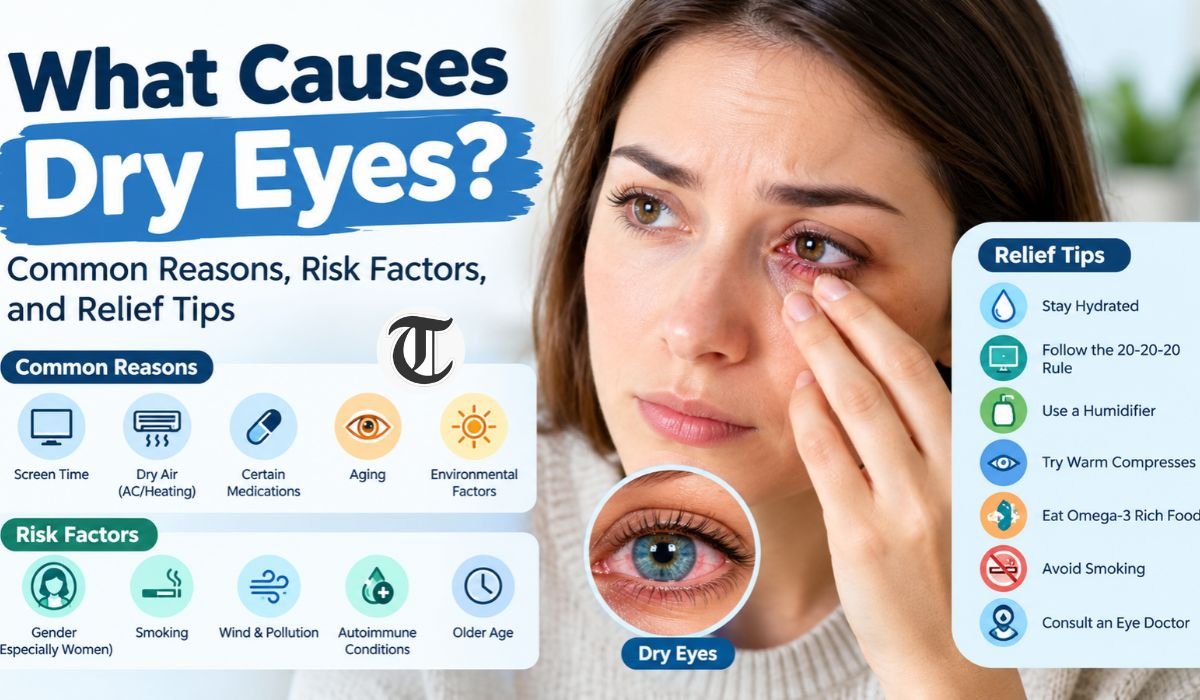
Dry, irritated eyes can be surprisingly distracting. Maybe your eyes feel gritty after a long day at the computer, or perhaps they burn, water, or seem as though there’s a tiny speck stuck in them. If that sounds familiar, you may be experiencing Dry Eye Disease. But What Causes Dry Eyes? There isn’t always one straightforward answer.
Dry Eye can develop when the eyes don’t produce enough tears, when tears evaporate too quickly, or when the Tear Film itself isn’t working properly. In many people, several factors are involved at once. Age, screen use, contact lenses, medications, environmental conditions, eye surgery, eyelid problems, and certain medical conditions can all play a role.
Your eyes rely on a thin Tear Film every time you blink. It helps keep the surface of the eye smooth, comfortable, and protected while also supporting clear vision. When that film becomes unstable, symptoms can range from mild irritation to Blurry Vision and ongoing discomfort. Finding out why the problem is happening is often the first step toward meaningful Dry Eye Relief.
Quick Bio Information
| Fact | Information |
|---|---|
| Condition | Dry Eye Disease |
| Main Problem | Loss Of Healthy Tear Film Function |
| Major Mechanisms | Low Tear Production, Rapid Evaporation, Or Abnormal Tear Function |
| Common Sensation | Gritty, Sandy, Or Scratchy Eyes |
| Vision Effect | Blurry Or Fluctuating Vision Can Occur |
| Can It Cause Watering? | Yes, Reflex Tearing Can Occur |
| Important Glands | Lacrimal Glands And Meibomian Glands |
| Common Trigger | Prolonged Screen Use |
| Environmental Triggers | Wind, Smoke, And Dry Air |
| Contact Lenses | Can Worsen Symptoms In Some People |
| Age | Risk Generally Increases With Age |
| Associated Condition | Sjögren’s Syndrome Can Cause Dry Eye |
| Common Tear Test | Schirmer’s Test |
| Tear Stability Test | Tear Breakup Time |
| Common First-Line Option | Artificial Tears |
| Nighttime Option | Lubricating Gel Or Ointment |
| Long-Term Outlook | Often Chronic But Manageable |
| Specialist | Ophthalmologist Or Optometrist |
| Important Warning | Persistent Or Worsening Symptoms Need Evaluation |
What Are Dry Eyes?
Dry Eye Disease is a condition in which the tears don’t adequately lubricate and protect the surface of the eye. Tears aren’t just plain water. They contain different components that work together to maintain a healthy eye surface. The outer oily layer helps slow evaporation, the watery layer supplies moisture, and the inner mucus layer helps spread tears evenly across the eye.
That means Dry Eye isn’t necessarily a matter of simply having too few tears. Some people don’t produce enough tears in the first place. Others make enough tears but lose them too quickly. In some cases, the composition or stability of the Tear Film is affected even when the amount of tears appears normal.
The result can be uncomfortable and, in some people, disruptive to everyday life. Because the Tear Film also contributes to the eye’s optical surface, instability can cause vision to become blurry or fluctuate throughout the day.
What Causes Dry Eyes?
When looking at What Causes Dry Eyes, doctors generally consider three major mechanisms: insufficient tear production, excessive Tear Evaporation, and problems with normal Tear Film function. These can occur separately or overlap.
Insufficient tear production happens when the Lacrimal Glands don’t make enough of the watery component of tears. The risk tends to increase with age, while hormonal changes and certain autoimmune conditions can also affect tear production.
Evaporative Dry Eye is different. In this case, tears disappear from the surface of the eye too quickly. Meibomian Gland Dysfunction is a major contributor because the Meibomian Glands produce oils that help keep the watery part of the Tear Film from evaporating too rapidly.
Everyday habits can make either problem more noticeable. Spending hours looking at a screen may reduce blinking, while wind, smoke, heating, air conditioning, and dry air can increase evaporation or irritate the eye surface.
The Three Types Of Dry Eye
Dry Eye is often discussed in terms of the main problem affecting the Tear Film. Aqueous-Deficient Dry Eye occurs when the eyes don’t produce enough of the watery part of tears. Problems involving the Lacrimal Glands can contribute to this form.
Evaporative Dry Eye occurs when tears evaporate too quickly. One of the most common contributors is Meibomian Gland Dysfunction. When these glands don’t provide enough of the oily component of tears, the protective barrier against evaporation can be weakened.
Then there’s Mixed Dry Eye, in which both inadequate tear production and excessive evaporation are present. This overlap is important because the same treatment won’t necessarily work for everyone. Two people can have similar symptoms while the underlying causes are quite different.
Dry Eye Symptoms
Dry Eye Symptoms aren’t always limited to a simple feeling of dryness. Many people describe a gritty, sandy, scratchy sensation, almost as if dust or a tiny particle has become trapped in the eye. Burning and stinging are also common.
Vision may become blurry or fluctuate, particularly during activities that require sustained concentration. Reading, computer work, and other visually demanding tasks can make symptoms more noticeable. Some people also experience redness, light sensitivity, mucus around the eyes, or discomfort when wearing contact lenses.
Then there’s the seemingly contradictory symptom of Watery Eyes. It may sound strange to have watery eyes and Dry Eye at the same time, but it happens frequently. Irritation caused by an unstable Tear Film can trigger reflex tearing. The resulting watery tears may overflow without solving the underlying problem.
Why Do Dry Eyes Cause Watery Eyes?
Watery Eyes can be the body’s attempt to protect an irritated eye. When the surface becomes uncomfortable, nerves send signals that can cause the Lacrimal Glands to produce additional tears.
Those reflex tears are mainly watery and aren’t necessarily the same as the stable Tear Film the eye needs for ongoing protection and lubrication. That’s why someone can have tears running down their cheeks while still feeling burning, grittiness, or dryness.
It’s also important to remember that excessive tearing isn’t always caused by Dry Eye. Problems involving tear drainage or the position of the eyelids can also cause persistent watering. If your eyes water frequently without an obvious explanation, an eye examination can help identify the real cause.
Everyday Causes And Triggers
Modern routines can be tough on the eye surface. Screen use is a good example. When people concentrate on a computer, phone, or tablet, they often blink less frequently or don’t complete their blinks. As a result, the Tear Film can break up more easily.
Your surroundings matter, too. Wind can speed up tear evaporation, while heating and air conditioning can make indoor air drier. Fans and vents aimed directly at the face may aggravate symptoms. Smoke and allergens can further irritate already sensitive eyes.
Contact lenses are another possible contributor. Some people develop more noticeable dryness during prolonged lens wear, especially if they already have an unstable Tear Film. If contact lenses repeatedly cause discomfort, redness, or dryness, an eye-care professional can help determine whether the lenses or wearing routine need to be changed.
Medical Conditions That Can Cause Dry Eyes
Dry Eye sometimes appears alongside another medical or eye condition. Blepharitis, for example, causes inflammation around the eyelids and can interfere with normal eyelid and Meibomian Gland function.
Sjögren’s Syndrome is another important condition to know about. This autoimmune disorder can affect glands that produce tears and saliva, so Dry Eyes may occur together with Dry Mouth. Other autoimmune diseases, including lupus and rheumatoid arthritis, can also be associated with Dry Eye. Thyroid disease and diabetes may increase the risk as well.
That doesn’t mean persistent Dry Eye automatically points to a serious illness. Most people with Dry Eye don’t necessarily have an underlying systemic disease. Still, when eye dryness occurs alongside other unexplained symptoms, a healthcare professional may decide that further evaluation is appropriate.
Medications And Dry Eye Risk
Certain medications can contribute to Dry Eye or make existing symptoms more noticeable. Drugs associated with dryness include some medicines used for allergies, depression and anxiety, high blood pressure, sleep problems, pain, and other health conditions. Some medications used for glaucoma and other eye conditions may also affect symptoms.
The connection isn’t always obvious. If your eyes became noticeably drier after starting a new medication or following a change in dosage, tell your healthcare provider when the symptoms began. That timing can provide a useful clue.
Don’t stop taking a prescribed medicine on your own. Instead, discuss the problem with the clinician who prescribed it. They can determine whether the medication may be contributing to Dry Eye and decide whether another treatment strategy is appropriate.
Who Is More Likely To Develop Dry Eyes?
Dry Eye can affect people of any age, but certain factors make it more likely. Age is one of the clearest risk factors, with Dry Eye becoming more common as people get older. Hormonal changes, including those associated with pregnancy and menopause, may also influence tear production and eye comfort.
Lifestyle and environmental factors matter as well. Contact lens use, extended screen time, smoking, allergies, wind, and dry environments can increase the likelihood of symptoms. Certain medications, medical conditions, and previous eye surgery can add to the risk.
Some of these factors can’t be changed. Age, for instance, is unavoidable. Others can be addressed through practical changes, such as reducing smoke exposure, avoiding direct airflow, taking breaks during screen work, and maintaining appropriate contact-lens habits.
Dry Eyes After Eye Surgery
Dry Eye Symptoms can develop after certain eye procedures. LASIK is particularly associated with postoperative dryness because surgery can temporarily affect corneal nerves and the normal communication between the cornea and the tear-producing system.
Cataract surgery and other procedures involving the cornea may also be followed by Dry Eye symptoms. Recovery isn’t identical for everyone, so patients should follow their surgeon’s postoperative instructions and attend recommended follow-up appointments.
Some discomfort can occur during recovery, but worsening symptoms, significant pain, or changes in vision shouldn’t simply be dismissed as part of the healing process. Those symptoms should be reported to the eye-care professional responsible for the patient’s care.
How Are Dry Eyes Diagnosed?
A Dry Eye diagnosis starts with more than simply asking whether the eyes feel dry. An eye professional will usually want to understand the complete picture, including symptoms, medications, contact-lens use, previous eye surgery, medical conditions, and environmental triggers.
During the examination, the provider may assess the eyelids, blinking pattern, Cornea, Conjunctiva, eye surface, and Tear Film. A detailed medical history can be particularly helpful because Dry Eye symptoms don’t always correspond perfectly with what can be seen during an examination.
Doctors may also look for signs that suggest another condition could be contributing. Dry Mouth, joint symptoms, fatigue, or other systemic complaints may be relevant when an autoimmune condition such as Sjögren’s Syndrome is being considered.
Tests Used For Dry Eye
There’s no single test that explains every case of Dry Eye. Instead, doctors may combine several tests to examine tear production, Tear Film stability, and the condition of the eye surface.
A Slit-Lamp Examination provides a magnified view of the eyelids, Conjunctiva, Cornea, and Tear Film. Special dyes may also be used to highlight areas of damage or irritation on the eye surface.
Schirmer’s Test uses a small strip of paper to estimate how much tear fluid the eye produces. Tear Breakup Time, commonly called TBUT, looks at how long the Tear Film remains stable after a blink.
Depending on the situation, an eye specialist may use additional tests to evaluate tear concentration, inflammation, or Meibomian Gland structure. These tests can help determine not only whether Dry Eye is present, but also what may be driving it.
How Are Dry Eyes Treated?
Dry Eye Treatment depends on the cause, severity, and condition of the eye surface. Artificial Tears are commonly used to provide temporary lubrication and relief. For people who need frequent drops, preservative-free Artificial Tears may be a better option because preservatives can irritate some eyes when used repeatedly.
Some people benefit from moisturizing gels or thicker Ointments, particularly when dryness is worse at night. If inadequate tear retention is part of the problem, Punctal Plugs can help keep natural tears on the eye surface for longer.
Treatment may also focus on inflammation, eyelid health, or Meibomian Gland Dysfunction. Prescription medicines can sometimes reduce inflammation or encourage the eyes to produce more tears. In selected cases, Scleral Lenses can provide a protective, fluid-filled surface while also correcting vision.
For more severe or persistent disease, specialized procedures may be considered. The key is to treat the underlying problem rather than relying solely on short-term symptom relief.
How To Relieve Dry Eyes At Home
For mild symptoms, a few everyday changes may make a meaningful difference. Start by limiting exposure to things that irritate or dry the eyes, including cigarette smoke, strong wind, allergens, and air blowing directly toward your face. Wraparound glasses can provide an extra layer of protection outdoors, particularly on windy days.
Indoor humidity can also affect comfort. A Humidifier may help when the air inside your home is especially dry. Warm compresses and appropriate eyelid care can be useful as well, particularly when Meibomian Gland Dysfunction or eyelid inflammation is contributing to symptoms.
Don’t overlook your screen habits. Take regular breaks during extended computer or phone use, and make a conscious effort to blink fully and frequently. These steps won’t cure chronic Dry Eye, but they can reduce some of the everyday triggers that make symptoms worse.
Can Omega-3 Supplements Help?
Omega-3 Fatty Acids have received attention as a possible way to manage Dry Eye. Research has explored whether supplementation can improve symptoms, but the results have been mixed. There isn’t enough evidence to describe omega-3 supplements as a guaranteed treatment for everyone with Dry Eye.
It’s better to think of supplements as one possible topic to discuss with a healthcare professional rather than a replacement for established Dry Eye Treatment. This is especially important for people who take other medications or have an underlying medical condition.
What Happens If Dry Eyes Aren’t Treated?
Mild Dry Eye may cause little more than occasional discomfort. Severe or persistent disease, however, can affect the surface of the eye and, in some cases, contribute to Corneal damage.
Possible complications include Corneal Ulcers, Corneal Scarring, infection, and vision problems. These complications aren’t inevitable, and many people with Dry Eye never develop them. Even so, persistent symptoms deserve attention rather than being ignored.
Effective treatment isn’t only about making the eyes feel comfortable for a few hours. Long-term management aims to improve Tear Film function, reduce irritation and inflammation when present, address contributing conditions, and protect the health of the eye surface.
When Should You See An Eye Doctor?
Consider seeing an Ophthalmologist or Optometrist if Dry Eye Symptoms continue, become worse, interfere with daily activities, or don’t improve with appropriate self-care. Significant redness, eye pain, or changes in vision also warrant professional evaluation because these symptoms can have causes other than ordinary Dry Eye.
An eye examination is particularly worthwhile when dryness occurs alongside symptoms such as Dry Mouth, joint problems, eyelid inflammation, or other unexplained health concerns. These details may help a healthcare professional identify an underlying condition.
If you’re already receiving treatment, report new symptoms or treatment side effects to your provider. Chronic Dry Eye often requires follow-up because the condition and its triggers can change over time.
Can Dry Eyes Go Away On Their Own?
Not every episode of eye dryness means you have chronic Dry Eye Disease. Temporary irritation caused by wind, smoke, very dry air, or another short-term trigger may improve once the exposure ends.
Chronic Dry Eye is different. It tends to be a long-term condition that requires ongoing management rather than a single permanent cure. Treatment can make a substantial difference, even when the underlying tendency toward Dry Eye remains.
That’s why identifying the cause is so useful. Someone whose main problem is Meibomian Gland Dysfunction may need a very different management plan from someone whose eyes don’t produce enough tears or whose dryness is linked to an autoimmune condition.
How Can You Prevent Dry Eyes?
Not every case of Dry Eye can be prevented, but many common triggers can be reduced. Protect your eyes from excessive wind and smoke, avoid directing fans or air vents toward your face, and take regular breaks during prolonged screen use. Remembering to blink fully and regularly can also help maintain the Tear Film.
If you wear Contact Lenses, follow the recommended wearing and replacement schedule and pay attention to persistent discomfort. Routine eye examinations can also help identify problems before they become more troublesome.
Prevention is ultimately about recognizing your own triggers. Some people notice symptoms mainly during screen-heavy days, while others struggle more in dry weather, air-conditioned rooms, or during allergy season. Paying attention to those patterns can give you and your eye-care professional useful information.
Final Thoughts
Understanding What Causes Dry Eyes can make it much easier to find the right kind of relief. Dry Eye isn’t simply a consequence of not drinking enough water or producing too few tears. It can involve Tear Film instability, rapid evaporation, Meibomian Gland function, inflammation, environmental exposure, medications, eye surgery, or another medical condition.
For mild symptoms, everyday adjustments can sometimes make a noticeable difference. Taking breaks from screens, blinking regularly, avoiding smoke and direct airflow, protecting the eyes from wind, and maintaining comfortable indoor humidity are all practical steps worth considering.
When symptoms continue despite these measures, it’s important to look deeper. An Ophthalmologist or Optometrist can assess the eye surface, evaluate tear production and stability, and look for factors that may be keeping the problem going.
Dry Eye is often chronic, but that doesn’t mean you have to live with constant discomfort. With an accurate diagnosis and a management plan tailored to the underlying cause, many people can improve their symptoms, protect their eye surface, and get back to enjoying everyday activities with greater comfort.
FAQs About Dry Eyes
What Is The Main Cause Of Dry Eyes?
There isn’t one universal cause. Dry Eye usually develops because the eyes don’t produce enough tears, tears evaporate too quickly, or the Tear Film doesn’t function normally. Aging, hormonal changes, Meibomian Gland Dysfunction, medications, screen use, environmental conditions, eye surgery, and certain medical conditions can all contribute.
Why Are My Eyes Dry But Watery?
Dry Eye can cause reflex tearing. When the surface of the eye becomes irritated, nerves can signal the Lacrimal Glands to produce additional watery tears. These tears may overflow from the eyes even though the underlying Tear Film remains unstable.
Can Screen Time Cause Dry Eyes?
Yes. Long periods of screen use can contribute to Dry Eye because people often blink less while concentrating on a screen. Less frequent blinking can allow tears to evaporate and the Tear Film to become unstable. Regular breaks and deliberate blinking may help.
Can Dry Eyes Cause Blurry Vision?
Yes. The Tear Film contributes to the eye’s optical surface, so instability can cause Blurry Vision or vision that fluctuates. If vision changes are persistent, substantial, or unexplained, they shouldn’t automatically be blamed on Dry Eye and should be assessed by an eye professional.
Can Dry Eyes Be Cured Permanently?
Chronic Dry Eye doesn’t have one universal permanent cure. However, it can often be managed effectively. Depending on the cause, treatment may include Artificial Tears, prescription therapies, eyelid care, environmental changes, Punctal Plugs, or specialized treatments.
Does Drinking Water Help Dry Eyes?
Staying adequately hydrated is important for normal body function, but drinking extra water alone doesn’t treat most cases of Dry Eye. The condition can involve Tear Film instability, rapid evaporation, inflammation, Meibomian Gland Dysfunction, or inadequate tear production. These problems may require more targeted treatment.
When Should I Worry About Dry Eyes?
It’s worth seeking professional advice when symptoms persist, become worse, interfere with everyday activities, or don’t improve with appropriate self-care. Significant eye pain, marked redness, or vision changes should also be evaluated promptly because they can indicate conditions other than routine Dry Eye.
Are Dry Eyes A Sign Of Another Health Problem?
Sometimes they can be. Dry Eye may occur with autoimmune conditions such as Sjögren’s Syndrome and lupus, as well as thyroid disease, diabetes, eyelid disorders, and other health problems. Having Dry Eye doesn’t automatically mean there’s another disease, but persistent symptoms combined with other unexplained symptoms should be discussed with a healthcare professional.
Learn more and explore exciting content on: Bladder Infection Explained: Symptoms, Causes, Treatment, and Prevention
[…] Learn more and explore exciting content on: What Causes Dry Eyes? Common Reasons, Risk Factors, and Relief Tips […]