
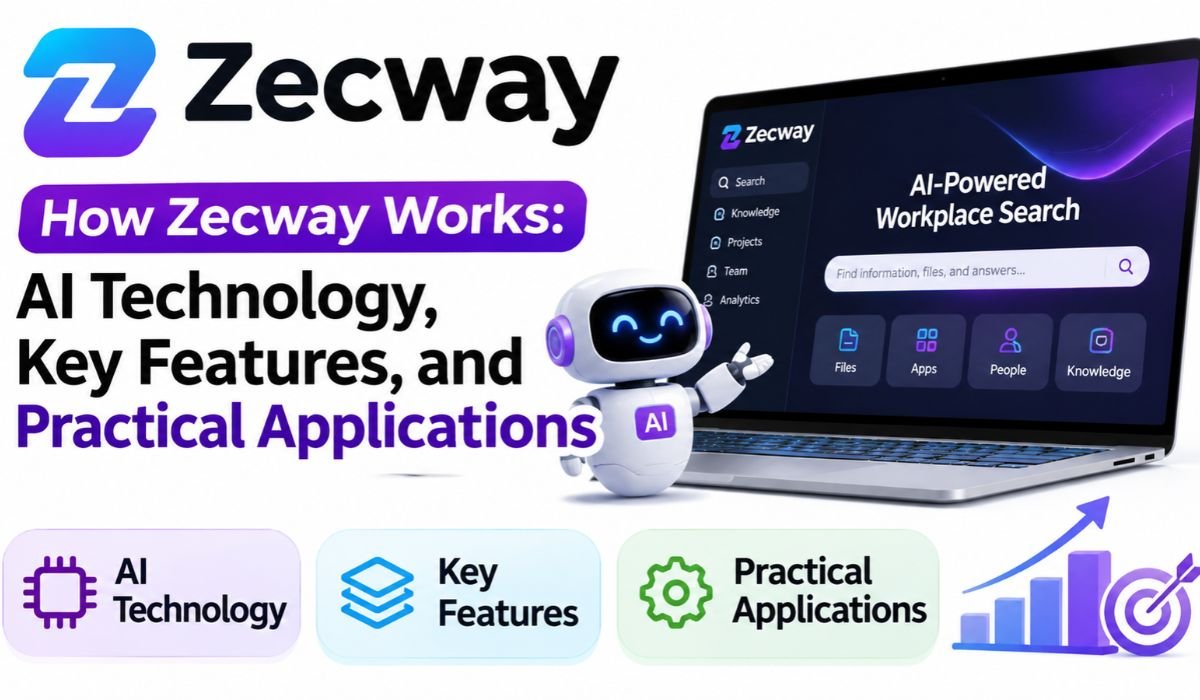
Finding information at work sounds simple until you actually need something important. A presentation might be buried in a shared folder, a project update could be hidden in a long email thread, and the explanation behind a business decision may exist only in a messaging conversation. For many organizations, this scattered information has become an everyday frustration.
That’s the problem Zecway aims to solve.
Zecway is an emerging AI-powered workplace knowledge platform designed to help businesses find, understand, and use information stored across different applications. By combining intelligent search, AI assistance, and workflow automation, the platform aims to make company knowledge easier to access without forcing employees to jump between multiple tools.
As artificial intelligence becomes a bigger part of business operations in 2026, platforms like Zecway are attracting interest for their potential to simplify everyday work. But how does the technology actually work, and what should businesses know before trying it?
This guide explores Zecway’s main features, technology, practical applications, benefits, security considerations, pricing, and future potential.
Zecway Quick Information
| Information | Details |
|---|---|
| Platform Name | Zecway |
| Platform Category | AI Workplace Knowledge Platform |
| Main Purpose | Centralized Workplace Information Search |
| Core Technology | Artificial Intelligence |
| Primary Function | Unified Workplace Search |
| AI Assistant | Advertised Product Capability |
| AI Agents | Proposed Workflow Automation |
| Search Experience | Natural-Language Questions |
| Knowledge Management | Connected Business Information |
| Source References | Source-Backed AI Responses |
| Security Approach | Permission-Aware Information Retrieval |
| Workplace Applications | Google Drive, Slack, and Other Referenced Tools |
| Target Audience | Growing Businesses and Professional Teams |
| Target Organization Size | Approximately 30–500 Employees |
| Main Applications | Search, Research, Summaries, and Drafting |
| Product Availability | Limited Early Access Reported in 2026 |
| Registration Method | Work Email Request |
| Credit Card Requirement | Not Required for Reported Early-Access Registration |
| Subscription Pricing | Not Publicly Confirmed |
| Main Consideration | Verify Features, Security, and Integrations |
These details reflect the platform’s publicly described positioning. Specific features, integrations, and commercial arrangements should be confirmed directly with the provider.
What Is Zecway?
Zecway is presented as an AI-powered workplace search and knowledge management platform. Its main purpose is to help employees discover information from different business applications through a more centralized experience.
Think about how a typical company operates. Documents are stored in cloud drives, conversations happen through messaging applications, and important updates arrive by email. Each tool serves a purpose, but information doesn’t always move smoothly between them.
As a result, employees may know that a document exists without knowing where to find it.
Zecway aims to make that process easier by connecting workplace knowledge and allowing employees to search for information using everyday language.
Its public product description highlights three main areas: unified workplace search, AI-powered assistance, and automated agents.
The platform is primarily positioned toward growing organizations with approximately 30 to 500 employees. Rather than replacing existing business applications, Zecway aims to help teams get more value from information they already have.
How Does Zecway Work?
At its simplest, Zecway aims to bring workplace information into one searchable environment.
Instead of opening several applications to locate a document or understand a project update, employees could ask a question through a centralized search interface.
Imagine a sales manager preparing for an important customer meeting. The latest product presentation might be stored in Google Drive, while recent pricing discussions are scattered across Slack conversations.
Finding everything manually could take time, particularly when several employees have contributed to the project.
A connected workplace search system could potentially identify the relevant information and present useful results in one place.
Zecway’s AI assistant is intended to take this process further. Rather than simply locating documents, it could help employees summarize information, understand previous discussions, or prepare an initial draft.
The platform also describes AI agents that could support recurring research and workflow preparation.
Of course, the quality of these results depends on the applications connected, the accuracy of available information, and the features actually supported by the platform.
Understanding the AI Technology Behind Zecway
Artificial intelligence is at the center of Zecway’s proposed approach, but understanding the technology doesn’t require a technical background.
One important concept is natural language processing. This allows AI systems to interpret questions written in ordinary language.
For example, an employee might ask, “Where can I find the latest customer onboarding policy?” instead of searching through folders using exact document titles.
Enterprise search technology provides another important piece of the process. It helps identify relevant information across connected sources, making documents and conversations easier to discover.
A related technology is retrieval-augmented generation, often called RAG.
RAG is commonly used in enterprise AI systems to retrieve relevant information before generating a response. This approach can help connect AI-generated answers with supporting documents.
However, the available public description doesn’t establish whether Zecway uses a specific RAG architecture or language model.
It’s also important to understand that AI-generated answers aren’t automatically accurate. Even when information comes from company documents, the system may misunderstand context or rely on outdated material.
That’s why human review remains essential.
Key Features of Zecway
Zecway’s advertised features focus on helping employees find information, understand it, and use it more efficiently.
One of its main capabilities is unified workplace search. Instead of searching separate applications, employees could potentially access relevant company knowledge through a central interface.
The AI assistant is another major part of the platform’s positioning. It is intended to support everyday activities such as preparing summaries, answering workplace questions, and drafting business materials.
Source-backed responses are particularly important.
When an AI assistant provides information, employees need to know where that information came from. References to original documents can make responses easier to check and help users identify outdated or incomplete material.
Zecway also emphasizes permission-aware retrieval. This approach is intended to respect existing access restrictions so employees don’t receive information they aren’t authorized to view.
Beyond search and assistance, the platform describes AI agents that could help with recurring research and automated workflows.
However, businesses should verify which features are currently available rather than assuming every advertised capability is fully operational.
Practical Applications of Zecway in Business
The potential usefulness of Zecway becomes clearer when looking at everyday workplace situations.
Sales teams, for example, regularly need access to product information, approved presentations, pricing documents, and customer-related materials. A centralized search experience could help employees find the latest information before meetings.
Marketing departments face a different challenge. Campaign plans, research reports, brand guidelines, and creative documents often exist across several systems.
An AI assistant could potentially help marketing employees review previous campaigns, summarize research, or prepare initial content drafts.
Human resources teams may also benefit from easier access to approved employee policies, onboarding guides, and internal documentation. However, confidential personnel records would require particularly careful access controls.
For project managers, the challenge often involves understanding what happened previously. Meeting notes, project updates, and important decisions may be spread across different conversations.
Zecway’s proposed search capabilities could make that information easier to locate.
These examples illustrate practical possibilities for workplace AI. They shouldn’t be mistaken for independently verified Zecway customer success stories.
Benefits of Zecway for Workplace Productivity
One of the biggest potential advantages of Zecway is reducing the time employees spend searching for information.
In many workplaces, finding the right document can involve opening several applications, checking old conversations, and asking colleagues for help.
A centralized knowledge platform could simplify that process.
Another possible benefit is better collaboration. When employees can access relevant information more easily, they may spend less time repeating questions or recreating work that has already been completed.
Zecway’s AI assistant could also help with repetitive activities such as summarizing documents, organizing research, and preparing first drafts.
That doesn’t mean artificial intelligence should replace human judgment.
Employees still need to check important information, particularly when it affects customers, financial decisions, or company policies.
Businesses should also measure productivity improvements instead of assuming they will happen automatically.
A useful evaluation might compare how long employees take to complete common tasks before and after introducing the platform.
Zecway Integrations and Workplace Compatibility
A workplace knowledge platform is only as useful as the information it can access.
That’s why integrations are an important consideration when evaluating Zecway.
Modern businesses commonly rely on tools such as Google Drive, Slack, Notion, and email platforms. These applications contain valuable information, but they don’t always provide a single place to search everything.
Zecway’s public presentation discusses connecting workplace knowledge across applications.
However, references to particular services shouldn’t be treated as confirmation that every integration is currently available.
Before adopting the platform, businesses should ask which applications are supported and how information is synchronized.
They should also understand what happens when documents are updated, permissions change, or information is deleted.
Poorly maintained data can create problems even when the underlying AI technology is sophisticated.
For this reason, integration quality and information accuracy deserve as much attention as the platform’s AI features.
Is Zecway Secure for Business Information?
Security is one of the first questions businesses should ask before connecting internal documents to an AI system.
Zecway emphasizes permission-aware information retrieval, an approach intended to respect the access restrictions already established within an organization.
For example, a marketing employee shouldn’t automatically gain access to confidential financial records simply because those documents are connected to the same search platform.
This distinction matters because businesses manage sensitive information, including customer records, employee details, contracts, and financial documents.
However, an advertised security feature isn’t the same as independently verified protection.
Organizations should request information about encryption, access management, data retention, and third-party processing.
It’s also important to understand whether company information is used for AI model training and how stored data can be deleted when a business stops using the service.
A careful security review can help organizations identify potential risks before connecting sensitive systems.
Zecway vs Traditional Workplace Search
Traditional workplace search tools are designed to locate information through keywords, document names, and filters.
They’re often effective when employees already know what they’re looking for.
AI-powered workplace search takes a different approach.
Instead of requiring an exact keyword, employees can ask questions in natural language and potentially receive responses based on relevant documents.
Imagine someone searching for information about a delayed project.
A traditional search system might return several files containing the project name. An AI assistant could attempt to explain the delay by reviewing relevant documents and discussions.
That additional context may be helpful, particularly when information is spread across multiple sources.
Still, traditional search has advantages. It can be more predictable when employees need a specific document or exact wording.
AI-powered search works best as a complementary tool rather than an automatic replacement for conventional methods.
How to Get Started With Zecway
Businesses interested in Zecway should begin by checking its current availability and registration requirements.
The platform’s public information described a limited early-access program in 2026, with interested organizations able to request access using a work email address.
The reported registration process didn’t require a credit card.
However, businesses should confirm current onboarding conditions before making plans.
Once access is available, the next step is identifying which workplace information sources would provide the most value.
A small pilot project is often more useful than immediately connecting every department.
For example, a business could select common employee questions and compare the platform’s answers with verified company documents.
This helps reveal whether search results are accurate, sources are relevant, and employees can use the system comfortably.
A successful pilot should demonstrate practical improvements rather than simply show that the technology works.
Zecway Pricing and Availability in 2026
Pricing is an important consideration for any organization exploring new workplace software.
According to the available product description, Zecway promoted limited early access in 2026. Interested businesses could request access without providing a credit card.
However, this doesn’t establish that Zecway offers a permanent free subscription.
Detailed public information about monthly pricing, enterprise plans, usage limits, and additional service charges remains unconfirmed.
Businesses should therefore contact the provider for current commercial arrangements.
It’s worth asking about onboarding fees, supported integrations, customer support, and whether AI-related features carry separate costs.
Organizations should also understand what happens after early access ends.
Clear pricing and contract terms make it easier to compare Zecway with other workplace knowledge platforms and estimate its long-term value.
Limitations and Challenges of Zecway
Zecway presents an interesting approach to workplace knowledge management, but businesses should approach emerging technology with realistic expectations.
One challenge is the limited independently verified information about its technical infrastructure, customer adoption, and real-world performance.
Another concern involves AI accuracy.
An AI assistant may produce a convincing summary while overlooking important details or misunderstanding the original information.
Even source-backed responses require verification because the supporting documents themselves may be outdated or incomplete.
Integration quality can create additional challenges. If important applications aren’t supported or information isn’t synchronized correctly, employees may receive incomplete results.
Security reviews, employee training, and implementation costs also deserve consideration.
These limitations don’t necessarily mean Zecway is unsuitable. They simply reinforce the importance of testing the platform before depending on it for critical business activities.
Is Zecway Worth Considering for Your Business?
Whether Zecway is worth exploring depends largely on how a business manages information.
Organizations with growing teams, extensive documentation, and multiple workplace applications may have a stronger reason to consider centralized AI search.
For these businesses, even modest improvements in information discovery could make everyday tasks easier.
However, companies with simple workflows may already have everything they need through existing document storage and search tools.
The most practical approach is to identify a specific problem before choosing a solution.
Does the team struggle to locate approved documents? Are employees repeatedly asking the same questions? Do project managers spend too much time gathering updates?
If those problems are significant, Zecway’s proposed capabilities may be worth testing.
The final decision should depend on demonstrated accuracy, security, usability, integration coverage, and overall cost.
The Future of Zecway and AI Workplace Technology
Artificial intelligence is changing how businesses interact with information.
Earlier workplace software largely focused on storing documents, managing communication, and organizing tasks. Newer AI systems increasingly aim to help employees understand information and take useful action.
Zecway reflects this broader shift.
Its combination of unified search, AI assistance, and proposed automated agents points toward a workplace experience where employees can move more easily from finding information to preparing work.
Looking ahead, enterprise AI systems may become better at coordinating research, generating reports, and supporting recurring processes.
However, Zecway’s future will depend on more than technological ambition.
Reliable integrations, strong security practices, accurate responses, customer trust, and measurable business results will all influence its success.
Competition from established workplace software providers will also shape the market.
For now, Zecway represents a developing approach to a familiar problem: making organizational knowledge easier to find and use.
Final Thoughts
Workplace information is only valuable when employees can find it, understand it, and put it to use. That’s the challenge Zecway aims to address.
By bringing together unified search, AI-powered assistance, and workflow automation, the platform presents a potentially useful approach to managing company knowledge.
Its emphasis on source-backed responses and permission-aware retrieval also reflects important concerns about accuracy and security in workplace AI.
Still, businesses shouldn’t confuse promising technology with proven results. Integration quality, information reliability, security documentation, pricing, and actual product availability all deserve careful attention.
For organizations exploring AI workplace tools in 2026, Zecway offers an idea worth investigating. Whether it becomes a valuable part of everyday operations will depend on how effectively it delivers reliable information and measurable improvements.
Ultimately, the future of workplace AI isn’t simply about finding information faster. It’s about helping people make better use of the knowledge their organizations already possess.
FAQs About Zecway
What Is Zecway?
Zecway is an emerging AI-powered workplace knowledge platform designed to help businesses find and use information across connected applications. Its advertised capabilities include centralized search, AI assistance, and automated workflows. The platform aims to simplify information discovery and reduce repetitive knowledge-related tasks.
How Does Zecway Work?
Zecway aims to connect workplace information sources and allow employees to search them using everyday language. Its AI assistant is intended to help summarize relevant documents, answer questions, and prepare initial drafts. Actual functionality depends on available integrations and product features.
What Are the Main Features of Zecway?
Zecway’s advertised features include unified workplace search, source-backed AI responses, permission-aware information retrieval, intelligent assistance, and AI agents for recurring tasks. Businesses should verify which capabilities are currently available before adopting the platform.
Is Zecway Free to Use?
Zecway’s reported early-access registration process doesn’t require a credit card. However, that doesn’t confirm a permanent free plan. Detailed subscription pricing and commercial terms should be requested directly from the provider.
Is Zecway Safe for Confidential Business Information?
Zecway emphasizes permission-aware access, but organizations should independently evaluate its security arrangements. Important considerations include encryption, access controls, data retention, third-party processing, and whether connected information is used for AI training.
Does Zecway Support Google Drive and Slack?
Google Drive and Slack are mentioned in discussions of Zecway’s workplace search concept. However, businesses should confirm whether these integrations are currently supported, what information can be accessed, and whether any limitations apply.
Can Zecway Improve Workplace Productivity?
Zecway could potentially reduce the time employees spend searching for information, preparing summaries, and organizing routine research. However, actual productivity improvements depend on data quality, integration coverage, employee adoption, and the reliability of AI-generated results.
Who Should Consider Using Zecway?
Zecway may be relevant to growing businesses that manage information across several workplace applications. Its reported target audience includes organizations with approximately 30 to 500 employees, particularly those seeking better knowledge management and more efficient information discovery.
Learn more and explore exciting content on: CJMonsoon Explained: Brand History, Wave Caps, Durags, Trademark, and Community
 Backlinks Hub
 Apex
 Echo Linkers
[…] Learn more and explore exciting content on: How Zecway Works: AI Technology, Key Features, and Practical Applications […]