
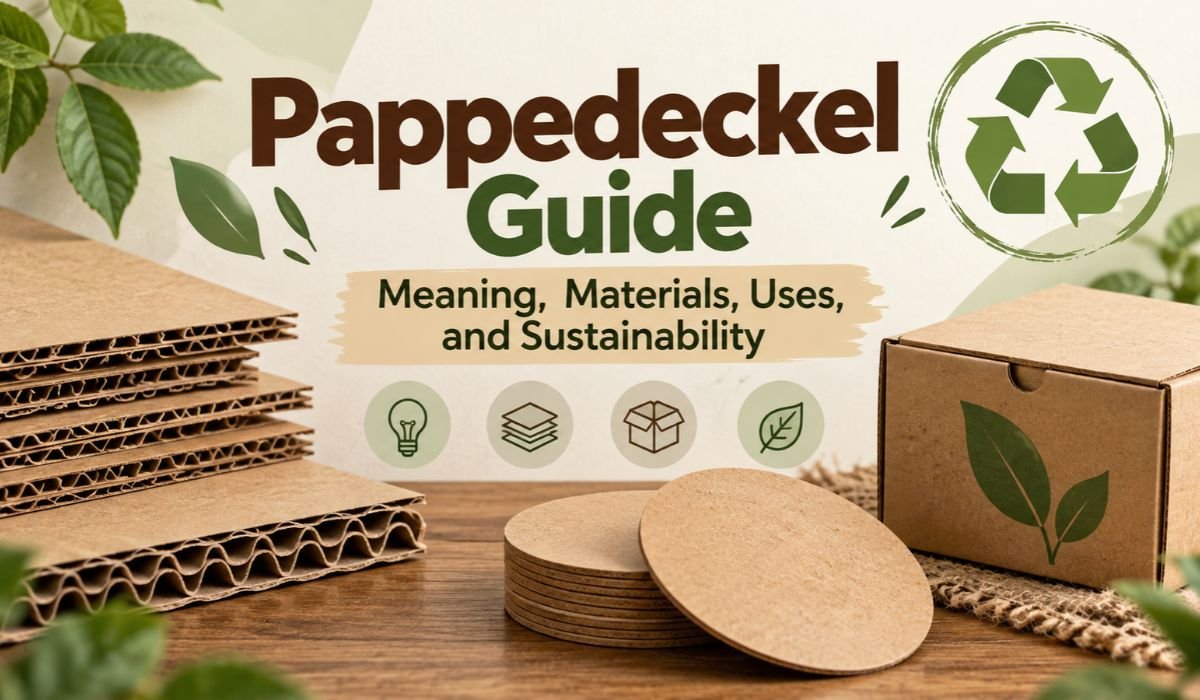
Pappedeckel might look like a simple German word at first glance, but its meaning becomes more interesting once context enters the picture. Depending on where the term appears, it may be associated with cardboard, a stiff piece of board, a cover, or an everyday object made from paper-based material.
That distinction is worth understanding, particularly for anyone who encounters Pappedeckel while translating German text or researching cardboard and paperboard packaging. A literal reading might suggest that it always means “cardboard lid,” but established German usage surrounding related words is broader than that.
There’s also a practical side to the subject. Paperboard and cardboard are everywhere. They protect products in transit, hold food, provide surfaces for retail branding, form the covers of books, and appear in countless craft and household applications. Yet not all cardboard is alike. Fiber composition, thickness, structure, coatings, moisture exposure, and manufacturing methods can dramatically change how a material performs.
This guide takes a closer look at the Pappedeckel Meaning, related German terminology, common materials, manufacturing, practical uses, recycling, and sustainability. It also explains what buyers and consumers should know about paper-based packaging in 2026.
What Is Pappedeckel?
Pappedeckel is associated with German vocabulary used for cardboard and objects made from stiff paper-based materials. To understand the term more accurately, it helps to consider two established German forms: Pappdeckel and Pappendeckel.
The connection is fairly easy to see. The German word Pappe refers to cardboard or pasteboard, while Deckel commonly means a lid or cover. Still, compound words don’t always translate neatly by combining the dictionary meanings of their individual parts.
In actual usage, related terms can refer more generally to a piece of cardboard rather than exclusively to a lid. That makes context especially important.
For this reason, Pappedeckel shouldn’t be treated as the formal name of one particular type of packaging. If you encounter the word in a sentence, look at the object being described and the way it’s being used before settling on an English translation.
Pappedeckel Meaning In English
There isn’t one English translation of Pappedeckel that works perfectly in every situation.
Depending on context, reasonable interpretations can include cardboard, a piece of cardboard, cardboard cover, or, in some situations, cardboard lid.
The difference between material and function is important here. Cardboard tells us what an object is made from. A lid tells us what that object does. A flat piece of cardboard placed beneath another object clearly isn’t functioning as a lid, even though essentially the same type of board could be cut and shaped into one.
For someone looking for a quick translation, “piece of cardboard” is a useful general interpretation. For an accurate translation, however, the surrounding sentence should always have the final say.
Pappedeckel, Pappdeckel, And Pappendeckel
The spelling can cause almost as much confusion as the meaning.
Readers searching online may encounter Pappedeckel, Pappdeckel, and Pappendeckel. They’re closely related, but they shouldn’t automatically be presented as three equally standard dictionary forms.
Pappdeckel and Pappendeckel are established German terms documented in major German-language references. Pappedeckel appears in searches and informal online usage, but it isn’t the principal standard form recorded by major dictionaries.
That distinction matters for both language accuracy and search intent. Someone who searches for Pappedeckel may actually be trying to understand Pappdeckel or Pappendeckel, so a useful guide should acknowledge the search term while explaining the established terminology.
Regional and everyday language can add another wrinkle. Cardboard-related words may refer to simple pieces of board and, depending on context, items such as coasters. The familiar German word Bierdeckel, for instance, refers to the coaster commonly placed beneath a beer glass.
The safest rule is straightforward: don’t translate Pappedeckel solely by breaking the word into parts. Context provides the clearer answer.
Quick Information About Pappedeckel
| Information | Details |
|---|---|
| Main Keyword | Pappedeckel |
| Language Connection | German |
| Related Base Word | Pappe |
| Established Related Forms | Pappdeckel, Pappendeckel |
| General English Interpretation | Piece Of Cardboard |
| Contextual Interpretation | Cardboard Cover Or Lid |
| Material Family | Paper-Based Materials |
| Common Material | Paperboard |
| Protective Material | Corrugated Board |
| Main Fiber | Cellulose Fiber |
| Common Fiber Sources | Wood Pulp And Recovered Paper |
| Production Stages | Pulping, Forming, Pressing And Drying |
| Common Applications | Packaging, Covers, Crafts And Inserts |
| Food Packaging | Requires Suitable Materials And Construction |
| Major Advantage | Lightweight And Versatile |
| Major Limitation | Sensitivity To Moisture |
| Recycling Potential | Depends On Construction And Local Systems |
| Sustainability Factors | Sourcing, Design, Production And End Of Life |
| Useful Specifications | Grammage, Thickness And Stiffness |
| Buying Best Practice | Test Samples Under Real Conditions |
What Materials Are Used For Pappedeckel?
There’s no single material specification for every Pappedeckel-related product. The right board depends on the job it needs to perform.
A carton holding a lightweight cosmetic product, for example, doesn’t face the same demands as a shipping box or takeaway food container. Strength, print quality, moisture resistance, appearance, and cost can all influence material selection.
Paperboard is relatively thin, flat, and smooth. Its surface makes it well suited to printing, which is why it’s commonly used for folding cartons, product sleeves, backing cards, and lightweight covers.
Corrugated Board is built differently. A fluted paper layer is positioned between liner layers, creating a structure that provides cushioning and improved resistance to compression. That’s why corrugated cardboard is such a familiar choice for shipping boxes and protective packaging.
Coated Paperboard receives a surface treatment to achieve particular properties. Depending on the coating and construction, this can improve printing performance or provide additional resistance to grease and moisture.
Laminated Paperboard combines board with another layer or layers to deliver specific functional or visual characteristics. Lamination can be useful, but the additional materials may influence how easily the finished package can be recycled.
Fiber choice also varies. Manufacturers may use virgin fibers, recovered fibers, or a mixture of both. Neither option is automatically right for every product. Performance requirements, manufacturing specifications, intended use, and applicable safety standards all matter.
Understanding GSM, Thickness, And Strength
Packaging specifications can look deceptively simple. One of the most common misunderstandings is assuming that a higher GSM always means stronger cardboard.
GSM stands for grams per square meter. It measures how much a square meter of paper or board weighs. Thickness, by contrast, measures the physical distance between the two surfaces of the sheet. Although these properties can be related, they aren’t interchangeable.
Strength and stiffness are more complicated still. Fiber properties, board construction, manufacturing techniques, and moisture conditions can all affect how a sheet behaves.
Imagine two very different packaging jobs. A premium folding carton may need a smooth surface, clean folds, attractive printing, and enough stiffness to keep its shape on a shelf. A shipping container, meanwhile, may need far greater compression strength and protection against knocks during transport.
Simply comparing GSM won’t tell you which material will perform better in those situations.
When choosing Pappedeckel or paperboard packaging, buyers should ask suppliers for specifications that actually relate to the intended use rather than making a decision based on grammage alone.
How Is Pappedeckel Made?
The journey from raw fiber to finished cardboard involves several stages, and each one can influence the properties of the final product.
Paperboard production starts with cellulose fibers. Depending on the grade being manufactured, those fibers may come from wood, recovered paper, or a combination of sources.
The fibers are dispersed in water to produce pulp. When recovered paper is part of the raw material, additional processing may be necessary to remove contaminants and unwanted components.
Next comes sheet formation. The diluted pulp moves across a forming section, allowing much of the water to drain away. Pressing removes additional moisture, while controlled drying turns the wet fiber web into a stable sheet or board.
Some paperboards contain multiple layers engineered to provide different surface or structural characteristics. This helps explain why boards that appear similar from the outside can behave quite differently.
Once the board itself is finished, converting begins. Die-cutting creates precise shapes, while creasing prepares areas that need to fold cleanly. Printing can add logos, instructions, colors, and product information. Depending on the application, manufacturers may also use coatings, embossing, or other finishing techniques.
By the time a Pappedeckel-related product reaches the customer, it may have gone through far more engineering than its simple appearance suggests.
Common Uses Of Pappedeckel
One reason paperboard remains so widely used is its adaptability. The same broad material family can serve very different purposes when its structure and specifications are changed.
In retail, paperboard is used for folding cartons, sleeves, backing cards, and display packaging. These formats do more than contain products. They also provide valuable space for branding, instructions, ingredients, and other information.
Corrugated cardboard performs a different role. Its fluted construction makes it useful for shipping boxes, dividers, and protective inserts designed to keep products stable while they’re transported.
Food businesses also rely on suitable paperboard constructions for bakery boxes, trays, takeaway containers, and related applications. These uses can require additional attention to grease, moisture, temperature, and food-contact requirements.
Away from commercial packaging, stiff board appears in hardcover books, stationery, artwork backing, educational projects, models, storage dividers, and crafts. Related cardboard pieces can also serve as coasters or simple protective surfaces.
The range of applications highlights an important point: Pappedeckel isn’t one universal cardboard product. The correct material depends on what the finished object needs to accomplish.
Pappedeckel In Food Packaging
Food packaging is one area where choosing a material by appearance alone simply isn’t enough.
A box holding dry biscuits faces relatively mild conditions. Packaging for an oily takeaway meal, frozen product, or hot food may encounter grease, condensation, steam, moisture, or elevated temperatures. Each situation places different demands on the board.
Untreated paper fibers can lose stiffness when they absorb moisture. Grease can also penetrate certain materials. Manufacturers may use barrier treatments or specially designed constructions to improve performance.
Even then, a moisture or grease barrier doesn’t by itself prove that packaging is suitable for food contact.
The whole package needs to be considered. That can include the paperboard, coatings, printing inks, adhesives, and other components that could affect the intended use.
Within the European Union, food-contact materials are governed by requirements designed to prevent the transfer of substances to food at levels that could endanger human health or cause unacceptable changes to the food.
For businesses, the practical approach is to obtain relevant compliance information from the manufacturer or supplier. Packaging should be confirmed as suitable for the particular food, temperature, contact duration, and conditions in which it will actually be used.
Benefits Of Pappedeckel Packaging
Cardboard and paperboard have remained important packaging materials because they combine several useful qualities in one relatively simple format.
Weight is one advantage. Many paperboard packages are light and easy to handle, and folding cartons can often be transported and stored flat before assembly. That can make warehouse and packing operations more efficient.
Printability is another strength. Suitable paperboard surfaces can carry detailed graphics, instructions, product descriptions, barcodes, and branding without requiring a separate label across the entire package.
Then there’s design flexibility. Paperboard can be cut, creased, folded, embossed, and shaped into a wide range of structures. A thoughtfully designed fold or insert can sometimes add considerable strength without requiring large amounts of extra material.
Cost can also be attractive, although purchase price tells only part of the story.
A cheap carton isn’t much of a bargain if it collapses during transport and damages the product inside. A realistic cost calculation should consider the board itself alongside printing, assembly, storage, transportation, packing efficiency, damaged goods, and disposal requirements.
Is Pappedeckel Sustainable?
The sustainability discussion around paper packaging needs more nuance than phrases such as “green” or “eco-friendly” usually provide.
Paper fibers come from renewable biological resources, and recovered paper can be used as raw material for new paper products. Responsible forestry practices and recognized certification systems can also provide information about fiber sourcing.
Those are meaningful advantages, but they don’t tell the entire environmental story.
Manufacturing requires resources. Transportation creates impacts. Packaging that fails to protect a product can also create additional waste if the damaged goods need to be replaced.
Coatings, package weight, recycled content, manufacturing efficiency, and end-of-life treatment all influence the overall picture.
Design therefore matters almost as much as material choice. Right-sized packaging can reduce unnecessary material and empty shipping space. Removing a redundant layer may sometimes provide a straightforward reduction in waste without affecting product protection.
Environmental claims should also be precise. Specific information about recycled content, responsible sourcing, or recycling compatibility is more useful than vague claims that a package is completely “green.”
Is Pappedeckel Recyclable?
Paperboard and corrugated cardboard are widely associated with recycling, and many products made from these materials can enter established paper recovery systems.
In a typical recycling process, recovered paper products are collected, sorted, and repulped. Usable fibers can then become raw material for new paper-based products.
The process sounds straightforward, but real packaging can be more complicated.
Clean packaging made predominantly from paper fibers is generally easier to process than a structure containing several tightly bonded materials. Food residue can introduce contamination, while films, windows, adhesives, and certain coatings may create additional challenges.
That doesn’t mean every coated or printed paperboard package is automatically unsuitable for recycling. Processing technology and acceptance requirements differ between recycling facilities.
Location matters too. A package accepted by one local collection system may be handled differently elsewhere.
For that reason, consumers should follow current local waste and recycling instructions rather than assuming every cardboard-looking item belongs in the same recycling stream.
Recyclable, Biodegradable, And Compostable Are Different
Packaging language can easily become confusing because several environmental terms are often used as though they mean the same thing. They don’t.
Recyclable generally describes a material that can potentially be collected and processed into material for another product through an appropriate recycling system.
Biodegradable refers to the ability of a material to break down through biological activity under particular conditions. Calling something biodegradable doesn’t, by itself, tell a consumer how quickly it will break down, under what conditions that process happens, or how it should be disposed of.
Compostable is more specific and is normally tied to defined composting conditions and relevant standards.
Renewable is different again. A material can originate from a renewable resource without necessarily being recyclable or compostable in its finished form.
These distinctions matter when assessing Pappedeckel sustainability. The real disposal route available to the consumer is often just as important as the material’s theoretical properties.
Pappedeckel Compared With Other Packaging Materials
Packaging debates often turn into simple paper-versus-plastic arguments, but real-world decisions are rarely that straightforward.
Paperboard performs particularly well in folding cartons, sleeves, dry-goods packaging, and retail presentation. It offers a printable surface and can often be formed into useful structures without much weight.
Corrugated board adds cushioning and structural performance, which makes it better suited to many shipping applications.
Plastic brings a different set of advantages. Certain plastic structures provide strong moisture barriers, low weight, flexible seals, and reliable containment. Those qualities can be essential for particular foods, liquids, and sensitive products.
Reusable packaging creates yet another set of trade-offs. A reusable container may avoid repeated single-use packaging, but its performance depends on how many times it’s actually reused and what is required to collect, transport, wash, and redistribute it.
Rather than asking whether cardboard is always better than plastic, it makes more sense to ask which packaging system protects the specific product effectively while using materials efficiently and fitting realistic reuse, recycling, or disposal systems.
Challenges And How To Choose The Right Pappedeckel
For all its versatility, paperboard has clear limitations.
Moisture is one of the biggest. Water and high humidity can reduce stiffness and cause deformation. In severe conditions, structural performance may decline enough for packaging to fail.
Weight presents another challenge. Thin paperboard may be ideal for a small retail carton but unsuitable for a heavy product that needs substantial stacking strength. Corrugated structures or another material may be more appropriate.
Coatings can improve resistance to moisture, grease, or abrasion, but those improvements may come with trade-offs involving cost, complexity, and recycling.
A sensible selection process begins with the product itself.
Think about its weight, dimensions, fragility, temperature, moisture exposure, storage conditions, and likely journey from manufacturer to customer. From there, compare board thickness, grammage, stiffness, printing requirements, barrier properties, fiber composition, and end-of-life options.
And don’t skip physical testing.
Ask for samples, place the real product inside, stack the packages, store them under realistic conditions, and reproduce likely transport stresses where practical. A specification sheet provides valuable information, but it can’t fully replace testing under real conditions.
Common Pappedeckel Packaging Mistakes
Many packaging problems aren’t caused by bad materials. They’re caused by choosing the wrong material for the job.
Selecting paperboard solely because it’s inexpensive is one example. If the package bends, leaks, or fails during transport, the apparent saving can quickly disappear.
Another mistake is assuming that thicker board automatically means better performance. Structure, fiber properties, and intended use matter too.
Unnecessary lamination can also create complications. A decorative layer may improve appearance, but if it serves little practical purpose, it may add cost and material complexity without providing enough value.
Environmental assumptions create problems as well. A recycling symbol doesn’t guarantee that every local system will accept the package, and paper-based construction doesn’t automatically make a product sustainable.
Perhaps the most avoidable error is placing a large order before testing the finished design.
A prototype can expose weak folds, poor fit, moisture problems, awkward opening, or insufficient stacking strength before those issues become expensive.
The Future Of Pappedeckel And Paper-Based Packaging
Paper-based packaging is evolving as manufacturers look for ways to improve performance while using materials more efficiently.
Areas of development include fiber-based barrier technologies, lighter board constructions, improved processing of recovered fibers, and package designs intended to simplify material separation or recycling.
Regulation is shaping this direction as well.
The European Union’s Packaging and Packaging Waste Regulation entered into force in 2025 and generally applies from August 2026, while various individual requirements have their own implementation timelines.
The broader direction is clear: greater attention is being placed on packaging waste prevention, recyclability, material efficiency, and circular use of resources.
That means businesses increasingly have to look beyond appearance and unit price. Compliance, material efficiency, recoverability, functionality, and the quality of environmental claims are becoming more important parts of packaging decisions.
Innovation won’t make every paper-based product the right answer. What it can do is give manufacturers and packaging designers more ways to balance product protection with responsible material use.
Final Thoughts
Pappedeckel may begin as a translation question, but the subject quickly becomes broader. Understanding the term requires both linguistic context and an appreciation of the paper-based materials it can describe.
For readers primarily interested in language, the most important point is that Pappedeckel shouldn’t automatically be translated as “cardboard lid.” Established related forms such as Pappdeckel and Pappendeckel can have broader meanings connected with cardboard or pieces made from it.
For businesses and packaging buyers, there’s another lesson. Cardboard isn’t a single, uniform material. Paperboard performance changes with fiber composition, structure, grammage, thickness, coatings, moisture, and package design. A material that works beautifully for a retail carton may be completely unsuitable for a wet food product or a heavy shipping load.
Sustainability requires the same level of care. A paper-based package can offer genuine advantages, particularly when material is used efficiently and compatible recovery systems exist. But responsible packaging decisions can’t be reduced to choosing paper over plastic or printing a recycling symbol on a box.
In 2026, a better approach is to look at the whole job. Understand what the package needs to protect. Check reliable specifications. Verify food-contact or environmental claims where necessary. Test the finished design with the real product. Finally, consider what will realistically happen to the packaging once its useful life ends.
That broader view makes Pappedeckel more than an unfamiliar German term. It offers a useful window into how everyday paper-based materials can balance practical performance, cost, design, and sustainability when they’re chosen with care.
FAQs About Pappedeckel
What Does Pappedeckel Mean?
Pappedeckel is associated with German terminology for cardboard and objects made from stiff paper material. Depending on the context, it may be interpreted as cardboard, a piece of cardboard, or a cardboard cover. Pappdeckel and Pappendeckel are established related German forms.
Is Pappedeckel The Same As Cardboard?
Not exactly. Cardboard is a broad English term for several types of stiff paper-based material. Pappedeckel and its related German expressions may describe a piece or object made from such material. The surrounding context determines the most appropriate translation.
What Is Pappedeckel Used For?
Related cardboard and paperboard materials have many uses, including folding cartons, packaging covers, protective inserts, retail displays, book covers, backing sheets, crafts, and other everyday products. The correct board grade depends on the strength, appearance, and environmental conditions required.
Can Pappedeckel Be Used For Food Packaging?
Suitable paperboard can be used for food packaging, but the complete package needs to be appropriate for its intended food-contact conditions. Businesses should verify relevant compliance information, barrier requirements, and intended temperature and contact conditions with the manufacturer or supplier.
Is Pappedeckel Recyclable?
Many paperboard and corrugated cardboard products can be recycled where suitable collection and processing systems exist. Food contamination, laminates, coatings, and other materials can affect recyclability, however. Local recycling guidance should therefore determine how a particular package is discarded.
Is Pappedeckel Biodegradable?
Cellulose-based paperboard can biodegrade under appropriate conditions. The finished product may also contain inks, coatings, adhesives, or other materials, however, and those additions can change its behavior. Claims about biodegradability should therefore consider the complete product rather than the paper fibers alone.
Is Pappedeckel Better Than Plastic?
Neither material is universally better. Paperboard can offer advantages in printability, renewable fiber use, and compatibility with established paper recycling systems. Plastic may provide stronger moisture barriers or other useful properties with relatively little material. The better choice depends on the product, packaging design, transportation, reuse possibilities, and available end-of-life infrastructure.
How Do You Choose The Right Pappedeckel Material?
Start with the product’s actual requirements. Consider weight, size, fragility, temperature, moisture exposure, storage, transportation, printing, and disposal. Compare relevant supplier specifications and, whenever possible, test samples under realistic conditions before placing a large order.
Learn more and explore exciting content on: Inbredward Explained: Meaning, Origin, and the Squidward Meme
[…] Learn more and explore exciting content on: Pappedeckel Guide: Meaning, Materials, Uses, and Sustainability […]