
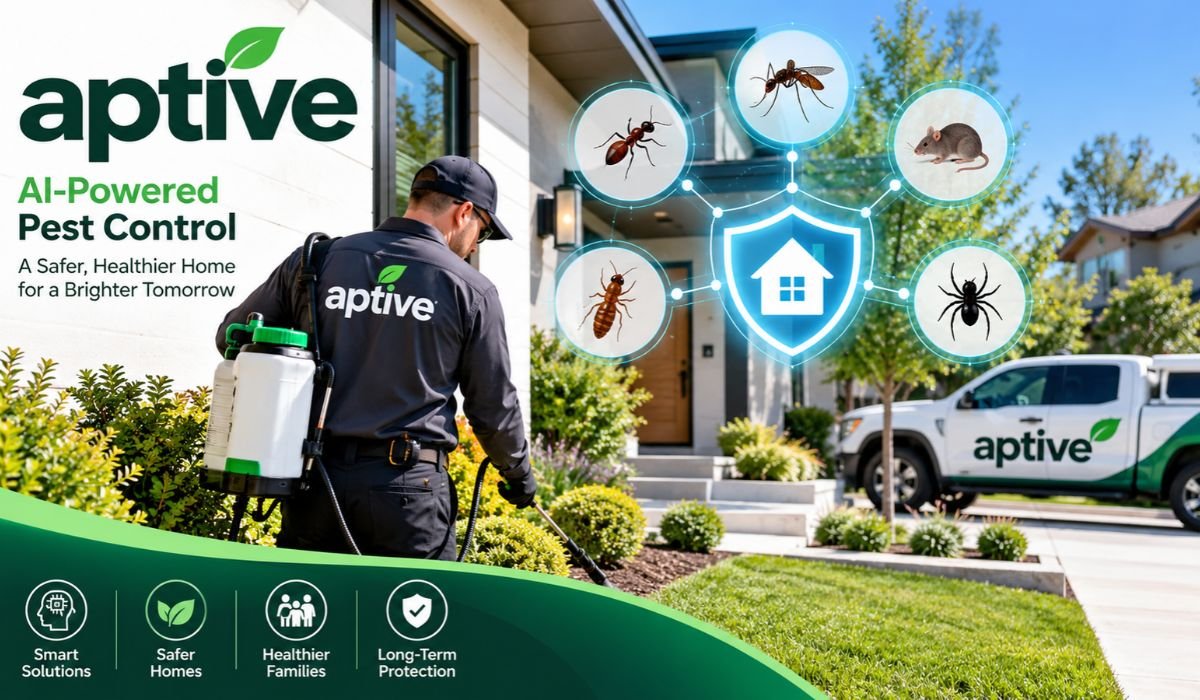
Introduction to Aptive and the Future of Pest Control
Imagine knowing that pest activity in your neighborhood is likely to increase before you spot a single insect inside your home. Instead of waiting for an infestation, you could take preventive steps early. That’s the idea behind Aptive, a residential pest control company bringing artificial intelligence and predictive analytics into everyday home protection.
In 2026, Aptive introduced Intelligent Pest Control™, a new brand initiative powered by its proprietary Pest Intelligence Center™. The technology examines millions of data points, including weather conditions, historical pest patterns, and observations from professional technicians, to identify where pest activity may increase.
The company hopes to move pest management beyond the familiar cycle of discovering a problem, scheduling treatment, and waiting for the next infestation.
It’s an ambitious approach, but one that raises an important question: Can artificial intelligence genuinely help homeowners stay ahead of pests?
While predictive technology can’t promise a completely pest-free home, Aptive’s strategy offers an interesting example of how modern data analysis and professional pest management could work together.
Quick Bio Information About Aptive
| Company Information | Details |
|---|---|
| Company Name | Aptive |
| Common Name | Aptive Pest Control |
| Founded | 2015 |
| Founders | David Royce and Vess Pearson |
| Headquarters | Provo, Utah |
| Country | United States |
| Industry | Residential Pest Management |
| Primary Services | Pest Treatment and Prevention |
| Current Reported Coverage | 37 U.S. States |
| New Brand Initiative | Intelligent Pest Control™ |
| Proprietary Technology | Pest Intelligence Center™ |
| Forecasting Platform | Aptive Pest Activity Index™ |
| Technology Focus | Artificial Intelligence and Predictive Analytics |
| Reported Data Volume | More Than 500 Million Data Points |
| Markets Analyzed | 76 U.S. Markets |
| Data Update Frequency | Daily |
| Marketing Executive | April Anslinger |
| Creative Agency Partner | Said Differently |
| Environmental Participation | EPA Pesticide Environmental Stewardship Program |
| Community Partnership | United to Beat Malaria |
What Is Aptive Pest Control?
Aptive is an American residential pest control company founded in 2015 by David Royce and Vess Pearson in Provo, Utah. The company provides professional pest management services designed to treat existing infestations while helping homeowners reduce the chances of future problems.
Its services cover a range of common household pests, including ants, cockroaches, spiders, fleas, rodents, and stinging insects. Treatment availability can vary depending on the location and service agreement.
Since its founding, Aptive has expanded its presence across the United States. Its 2026 Intelligent Pest Control announcement reported operations in 36 states, while newer company service information lists coverage in 37 states.
What distinguishes Aptive’s latest direction is its growing emphasis on information-driven prevention. Rather than treating every pest concern as an isolated problem, the company wants to understand broader patterns that may influence pest activity.
That doesn’t eliminate the need for inspections or conventional treatments. Instead, Aptive aims to give technicians and homeowners additional information that could make prevention more timely and effective.
Why Aptive Introduced Intelligent Pest Control
For many homeowners, pest control begins with an unpleasant discovery. Ants suddenly appear along a kitchen counter, wasps build a nest near an entrance, or cockroaches emerge from hidden spaces.
By the time these problems become visible, pest activity may already be established.
Aptive believes homeowners could benefit from receiving information earlier. Its Intelligent Pest Control initiative uses historical records, environmental conditions, and local observations to identify patterns that may signal increased pest activity.
The goal isn’t to abandon traditional pest management. Prevention, monitoring, sanitation, and sealing entry points have been important practices for years.
Instead, Aptive wants to strengthen these methods with predictive information that helps homeowners understand when certain risks may become more relevant.
This approach also reflects a change in how the company communicates with customers. Rather than relying primarily on the urgency of an existing infestation, Aptive wants to emphasize preparation and ongoing protection.
How Aptive’s AI-Powered Pest Control Technology Works
Artificial intelligence may sound complicated, but the basic idea behind Aptive’s technology is relatively straightforward.
The company gathers information from customer reports, technician observations, historical pest activity, and environmental conditions. Its analytical models then examine these records for patterns that could indicate changes in pest activity.
Weather plays an important role in this process.
Temperature, rainfall, humidity, and seasonal changes can influence how insects reproduce, move, and survive. Some pests become more active during warmer periods, while others are strongly influenced by moisture or available shelter.
By comparing current conditions with historical observations, Aptive attempts to estimate where pest activity might increase.
Still, a regional forecast doesn’t tell the whole story.
Two houses on the same street can face very different pest risks. One may have damaged screens, moisture problems, or accessible food sources, while another may be properly maintained.
That’s why predictive technology is most useful when paired with inspections and practical preventive measures.
Inside Aptive’s Pest Intelligence Center
At the heart of Aptive’s technology strategy is the Pest Intelligence Center™, a proprietary analytics platform designed to identify changing pest patterns.
According to the company’s 2026 announcement, the system examines more than 500 million data points across 76 U.S. markets.
These records include customer information, observations collected by field technicians, historical activity, and environmental signals.
Aptive says the platform updates its insights daily, allowing the company to monitor changing conditions rather than relying exclusively on older seasonal assumptions.
Localized information is particularly valuable because pest activity isn’t uniform across the country. A city experiencing unusually warm conditions may face different challenges from another dealing with cooler temperatures or persistent moisture.
However, the company hasn’t publicly disclosed every technical detail behind its predictive models.
Independent accuracy measurements and comprehensive comparisons with traditional pest management methods were not included in the launch announcement.
Those details will matter when evaluating how effectively the technology performs over time.
Understanding the Aptive Pest Activity Index
The Aptive Pest Activity Index™ is another important part of the company’s data-driven approach.
It uses proprietary models to identify pest activity trends and estimate how those patterns may change in particular locations.
For homeowners, understanding the difference between an observed trend and a forecast is essential.
An observed increase reflects activity identified in existing information. A prediction, on the other hand, estimates what could happen based on available data and expected conditions.
Neither guarantees that a specific property will experience an infestation.
A forecast showing increased flea activity, for example, doesn’t mean every household in that area will develop a flea problem.
Instead, it suggests that homeowners may have a reason to pay closer attention to preventive measures.
Aptive acknowledges that its forecasts are estimates based on environmental information, customer reports, field observations, and historical patterns.
Real Pest Activity Trends Reported by Aptive
Aptive has shared several examples to demonstrate the kinds of information its predictive technology can produce.
In its 2026 announcement, the company reported that fly activity had increased 53% year over year in Orlando, Florida. It also identified a 68% year-over-year increase in wasp activity in Dallas, Texas.
Looking ahead, its models projected a 76% seasonal increase in flea activity in Corona, California.
The company also forecast elevated silverfish activity in Boston during the week referenced in its announcement.
These figures illustrate how pest conditions can vary considerably between locations.
However, the numbers come from Aptive’s proprietary reporting and shouldn’t be treated as independently verified estimates of pest populations.
Likewise, the Boston forecast referred to the original announcement period rather than an ongoing prediction for the current week.
The broader takeaway is that local conditions matter. Homeowners may benefit from understanding regional patterns, but property-specific prevention remains equally important.
How Aptive Intelligent Pest Control Could Benefit Homeowners
One of the most appealing aspects of Aptive Intelligent Pest Control is the possibility of receiving useful information before pest activity becomes difficult to manage.
Consider a household in an area where flea activity is expected to rise. That information could encourage pet owners to review veterinarian-recommended flea prevention and inspect places where their animals regularly rest.
Similarly, a forecast suggesting increased wasp activity might prompt homeowners to watch for developing nests around outdoor structures.
For silverfish, homeowners could focus on reducing indoor humidity, repairing leaks, and inspecting damp storage areas.
These preventive measures aren’t new. What’s different is the possibility of using predictive information to decide when additional attention may be worthwhile.
Of course, early warnings are only valuable if they lead to sensible action.
Aptive’s announcement doesn’t establish that its forecasts consistently reduce infestations or lower treatment costs. Those outcomes would need to be demonstrated through reliable performance data.
Aptive vs. Traditional Pest Control
Traditional pest control and Aptive’s newer approach aren’t as different as they might initially appear.
Both aim to reduce unwanted pest activity through inspections, treatment, monitoring, and preventive measures.
Established integrated pest management practices already emphasize sanitation, exclusion, monitoring, and carefully selected treatments.
Aptive’s approach builds on these principles by introducing large-scale predictive analytics.
Rather than relying entirely on visible pest activity or routine seasonal assumptions, the company can examine broader patterns that may indicate changing risks.
The potential advantage is better timing and more informed preparation.
However, technology doesn’t automatically make a pest control service more effective.
The real test is whether predictive insights help technicians make better decisions and enable homeowners to avoid problems that might otherwise have developed.
What Types of Pests Does Aptive Treat?
Aptive provides treatment services for several common household pests, although coverage depends on the location and service plan.
Its published service information includes ants, cockroaches, spiders, rodents, fleas, mosquitoes, silverfish, ticks, flies, wasps, and other pests.
Each requires a different approach.
Ants may enter homes while searching for food or moisture. Cockroaches often thrive where shelter, warmth, and food are available. Rodents can exploit small structural openings, while silverfish are frequently associated with humid indoor environments.
Understanding these behaviors is essential for effective prevention.
It’s also important to distinguish Aptive’s general treatment services from the pests specifically highlighted in its predictive reporting.
The company’s Intelligent Pest Control announcement featured flies, wasps, fleas, and silverfish.
Homeowners should confirm that their particular pest problem is covered before purchasing a treatment plan.
How Aptive Combines AI With Professional Technicians
Even sophisticated technology has limitations when it comes to managing pests inside a real home.
Artificial intelligence can examine patterns across thousands of observations, but it can’t independently inspect damaged foundations, identify hidden nesting areas, or apply treatments.
That’s where professional technicians remain essential.
Aptive’s service approach includes property inspections, treatment planning, and communication with homeowners.
Its ProAct Inspection™ process emphasizes examining property conditions and identifying potential pest concerns during service visits.
Technicians also contribute field observations that support the company’s broader data analysis.
This creates a connection between regional information and conditions at individual properties.
A forecast might suggest increased pest activity in a particular area, but a technician must still determine whether the property has relevant vulnerabilities.
Ultimately, effective pest management depends on both reliable information and practical professional judgment.
Aptive’s National Marketing Campaign and Business Strategy
Aptive’s Intelligent Pest Control initiative isn’t limited to technology. It also represents a significant change in the company’s marketing strategy.
To introduce the concept nationally, Aptive partnered with creative agency Said Differently.
The campaign emphasizes the value of anticipating pest problems instead of waiting until they become visible.
Advertising was planned across connected television, YouTube, digital platforms, and social media.
The company also experimented with a creative approach during the NCAA March Madness basketball tournament.
Using pest-related information in entertaining basketball content, Aptive reported more than 2.7 million impressions and approximately 849,000 accounts reached.
Its leading post reportedly performed 10,000% above the company’s average.
Aptive also announced a multimillion-dollar marketing investment for 2026, representing a 70% increase over the previous year.
These figures demonstrate the company’s commitment to promoting its new positioning. However, successful advertising doesn’t independently establish the effectiveness of its forecasting technology.
Aptive’s Environmental Responsibility and Community Initiatives
Environmental responsibility is another important consideration in professional pest management.
Treating pests effectively requires more than selecting a pesticide. It also involves understanding the pest, identifying the conditions supporting its activity, and choosing appropriate control methods.
Aptive reports participation in the Environmental Protection Agency’s Pesticide Environmental Stewardship Program.
The company has also described its partnership with the United Nations Foundation’s United to Beat Malaria initiative, which supports efforts to address malaria transmitted through mosquito bites.
These activities provide additional context about Aptive’s stated environmental and community commitments.
However, participation in such programs doesn’t automatically prove that every treatment is safer or more environmentally responsible than competing services.
Homeowners should ask which products will be used, what precautions are necessary, and whether nonchemical prevention methods can help address their specific concerns.
Aptive Pest Control Pricing and Service Considerations
Cost is naturally one of the first questions homeowners ask when considering a pest control company.
Aptive doesn’t provide a universal price for Intelligent Pest Control in its launch announcement.
Actual service costs can vary depending on property size, location, pest type, infestation severity, and the treatment plan selected.
Some properties may need recurring preventive visits, while others require more specialized treatment.
Before signing an agreement, homeowners should request a written quote explaining what the service includes.
It’s worth reviewing treatment frequency, covered pests, follow-up visits, cancellation terms, and any additional charges.
Customers interested in Aptive’s predictive technology should also ask whether these features are included in their plan and how the information influences service recommendations.
A clear understanding of the agreement is more useful than choosing a provider based on marketing claims alone.
Is Aptive Intelligent Pest Control Reliable?
Aptive’s predictive technology is an interesting development, but evaluating its reliability requires looking beyond the amount of information it processes.
Large datasets can help identify patterns, yet prediction quality also depends on the accuracy of the underlying records and the methods used to analyze them.
Environmental conditions can change unexpectedly. Pest activity may also vary between individual properties, even within the same neighborhood.
Aptive hasn’t provided independently verified prediction accuracy rates in its Intelligent Pest Control launch announcement.
The announcement also doesn’t establish that its technology consistently reduces infestations more effectively than established preventive pest management practices.
That doesn’t mean the approach lacks value.
It simply means the technology’s potential benefits should be distinguished from results that have been demonstrated through independent testing.
For homeowners, professional inspections, sensible prevention, and appropriate treatment remain the foundations of reliable pest control.
The Future of Aptive and AI-Powered Home Protection
Aptive’s new direction reflects a wider opportunity for data analysis in residential services.
Just as weather forecasting helps people prepare for changing conditions, predictive pest information could eventually help homeowners understand when certain risks are increasing.
More localized alerts, improved seasonal planning, and personalized preventive recommendations are possible areas for development.
Aptive has also described an interest in applying machine learning to operational decisions and service planning.
However, future possibilities shouldn’t be confused with features already available to every customer.
The long-term success of AI-powered pest control will depend on how effectively technology supports real-world decisions.
If predictive information helps technicians identify risks earlier and enables homeowners to take useful preventive action, it could become a valuable addition to established pest management practices.
Final Thoughts
Pest control has always involved a combination of observation, prevention, and treatment. What Aptive is attempting to change is how early useful information becomes available.
Through its Intelligent Pest Control initiative, the company is bringing artificial intelligence, environmental analysis, and professional field observations together to identify changing pest risks.
For homeowners, the potential benefit is straightforward: better information could make it easier to prepare before unwanted pests become a larger problem.
Still, no forecasting system can eliminate every risk. Keeping a home protected requires routine maintenance, attention to moisture and entry points, appropriate inspections, and professional treatment when necessary.
Aptive’s approach represents a meaningful attempt to make residential pest management more proactive and data-informed. Whether it ultimately delivers better results will depend on the accuracy of its predictions, the quality of its services, and the practical value homeowners receive.
As AI continues to influence everyday services, Aptive offers an example of how technology may support an industry built on hands-on expertise. The most promising future isn’t one where algorithms replace pest control professionals, but one where better information helps them protect homes more effectively.
FAQs About Aptive Intelligent Pest Control
What Is Aptive Pest Control?
Aptive is an American residential pest control company founded in 2015 in Provo, Utah. It provides professional services designed to treat common household pests and reduce future activity. Its newer Intelligent Pest Control initiative introduces predictive analytics to support home protection.
How Does Aptive Use Artificial Intelligence?
Aptive uses artificial intelligence and analytical models to examine historical pest activity, customer reports, technician observations, and environmental conditions. The system identifies patterns that may indicate increased pest activity in particular locations.
What Is the Aptive Pest Intelligence Center?
The Pest Intelligence Center is Aptive’s proprietary analytics platform. According to the company, it analyzes more than 500 million data points across 76 U.S. markets, with insights updated daily to identify changing pest activity patterns.
Can Aptive Predict Pest Infestations?
Aptive’s technology forecasts potential changes in regional pest activity. However, it cannot guarantee that a particular property will experience an infestation. Its predictions are estimates that homeowners can use alongside practical prevention and professional advice.
Which Pests Does Aptive Treat?
Aptive offers services for common pests such as ants, cockroaches, spiders, rodents, fleas, mosquitoes, silverfish, and stinging insects. Specific coverage depends on the customer’s location and treatment agreement.
How Much Does Aptive Pest Control Cost?
Aptive’s pricing varies according to property size, location, pest concerns, and service requirements. Homeowners should request a written quote and confirm the treatment schedule, included services, and contract terms before making a decision.
Is Aptive Better Than Traditional Pest Control?
Aptive adds predictive analytics to established pest management methods, potentially improving awareness and preparation. However, independent comparative evidence is still needed to determine whether its technology consistently produces better treatment outcomes.
Learn more and explore exciting content on: Selene Finance Explained: Mortgage Payments, Services, and Borrower Support
[…] Learn more and explore exciting content on: Aptive: How AI-Powered Pest Control Is Changing Home Protection […]