
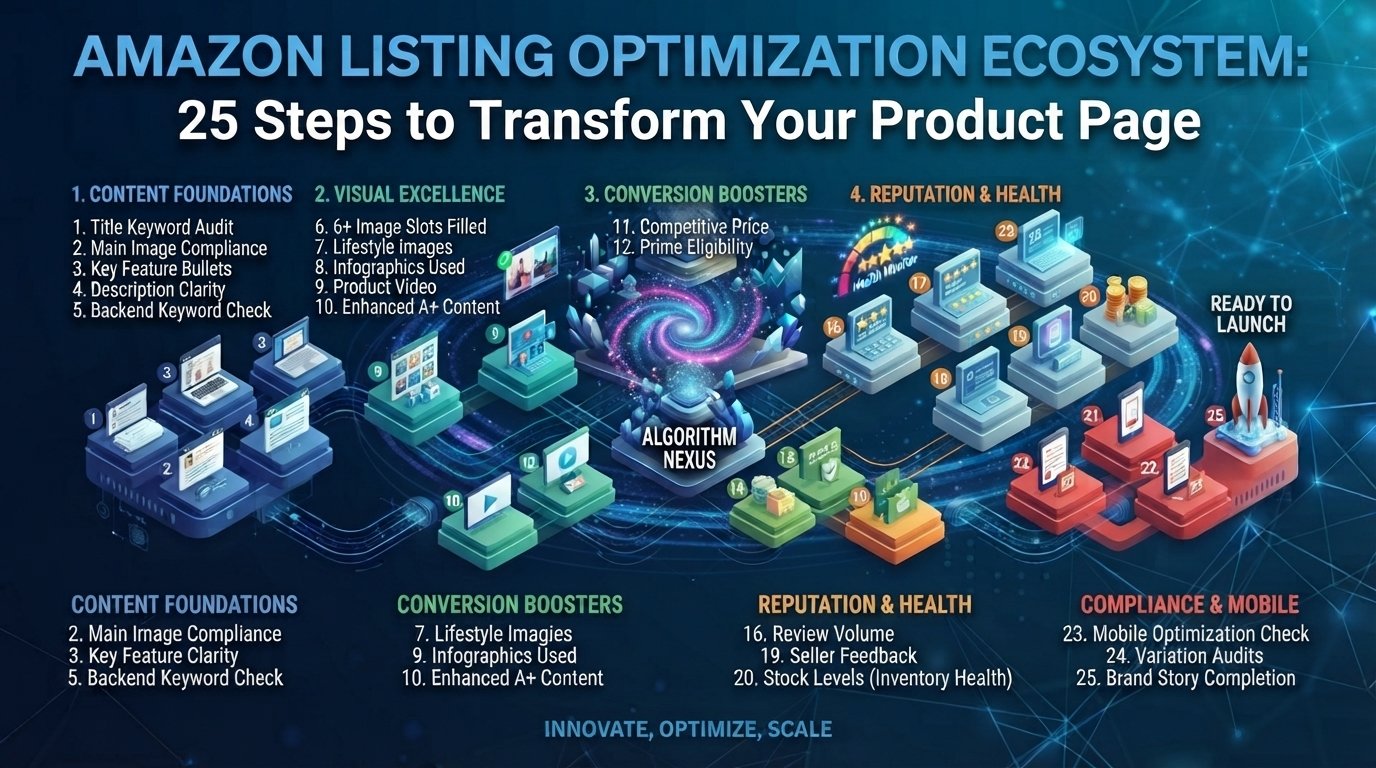
Amazon Advertising campaigns can bring benefits to brands in terms of attracting potential customers, increasing visibility and making sales. Nevertheless, advertising campaigns launched before the product listing optimization might become a waste of the budget. If customers click on your ad but see the lack of relevant information about the product, poor quality of images, unappealing description and non-competitive prices, they will probably go away from the page and not make any purchases.
When it comes to e-commerce businesses, Amazon advertising becomes possible when the product listing is properly prepared. Prior to investing in Sponsored Products or any other types of ads, sellers have to make sure that the listings are relevant, informative, attractive and able to convert visitors into customers. And here is where the professional Amazon SEO Services can help. Whether it is keyword research, product title optimization or other aspects of the optimization process, it is a good way to build a strong product page.
In this article, we will discuss 25 things to fix before starting Amazon advertising campaigns.
Why Should You Optimise Amazon Listings Before Running Ads?
Amazon advertising will take potential buyers straight to your products, but advertisements alone will not guarantee sales. Your product listing should offer sufficient details and reassurance for purchases to be made.
- An optimized product listing can help:
- Boost relevancy for search terms.
- Attract more qualified buyers.
- Communicate the benefits of the product effectively.
- Create a better shopping experience.
- Answer commonly asked buyer questions.
- Enhance conversion performance.
- Increase efficiency of advertising campaigns.
- Before you invest in additional advertising, consider all the important aspects of your product listing.
A. Keyword Research
1. Identify Main Keywords
Within each listing you should optimize for relevant keywords that accurately describe your product. Identify the main keyword that your customers will most likely search for.
- For example if you are selling stainless steel water bottles you might want to target:
- Insulated Water Bottle
- Stainless Steel Bottle
- Reusable Water Bottle
- Use Amazon Brand Analytics, Product Opportunity Explorer and keyword research tools to identify keywords.
- 2. Identify Secondary and Long Tail Keywords
- Don’t rely solely on using main keywords, using long tail keywords can help you target customers with more specific needs.
- Examples could be:
- Insulated Water Bottle for Office
- Leak Proof Stainless Steel Bottle
- Reusable Water Bottle for Travelling
- Make sure you include these keywords in your listing where relevant.
- 3. Research Competitors
Research your competitors to see how others are optimising their product. Look at their title, images, bullet points, pricing, reviews and features.
Identify any information that your customers would expect to see but isn’t included in your listing. Use this research to help you improve your listing rather than copying another brands content.
4. Optimise Backend Keywords
Backend Keywords help Amazon to understand what other relevant keywords relate to your product.
Use this section to include relevant keywords that aren’t well covered in your listing. Make sure you follow Amazon’s current policies on bytes and keywords. Don’t include duplicate words, other brands or irrelevant keywords.
5. Accurate Keywords
Keywords should accurately describe your product. If you have the wrong keywords this can cause poor engagement with people visiting your listing.
Focus on having relevant keywords.
B. Title and Description Optimisation
- 1. Clear Title with Keywords
- Your title should clearly state what the product is and its main features.
- Include relevant information such as:
- Brand Name
- Product Type
- Key Features
- Size/Quantity
- Colour/Material (if relevant)
- Make sure you follow Amazon’s policies for titles within your category. Don’t include too many duplicate keywords.
- 2. Optimise Bullet Points
Your bullet points should explain why customers should buy your product. Don’t just list the features but link them to benefits. Rather than Leak Proof Lid explain how this lid will help stop spillages due to it being leak proof. (As long as this is accurate).
3. Avoid Generic Descriptions
Avoid generic descriptions. Explain what the product does, who it is suitable for, how it works and why it is useful. Keep it clear and customer focused.
- 4. Include Key Specifications
- Customers often look at multiple listings so it’s important to include key information. If you don’t include this it can cause confusion.
- Make sure you include accurate information on:
- Size/Weight
- Materials/Ingredients
- Compatibility
- What’s in the pack
- How to use
- Care/Maintenance
- 5. Avoid Duplicate and Misleading Information
Avoid using too many duplicate keywords, over the top claims, unproven claims and out of date information. All statements should accurately describe your product and follow Amazon’s policies.
C. Product Image and Visual Optimisation
1. Improve your main image
Your main image is usually the first thing your customers will see. Use a high quality image. This should show your product clearly, and should meet Amazon standards. Most will have a white background and no extra marketing graphics. Show the actual product.
2. Lifestyle Images
These images show customers how they can use your product. For example, a storage brand would show the containers in a tidy kitchen. Or a fitness accessories brand would show them being used whilst working out. This helps customers know what they can do with the product.
- 3. Infographics
- These are great to use on secondary images to show key features of your product. These can include:
- Product size
- Material
- Unique features
- How to use
- What’s in the packaging
- Benefits
- Make sure all the information is correct and easy to understand.
- 4. Demonstration Images/Videos
If possible, use demonstration videos to show how your product works. This is great for items such as electronics, appliances, beauty products, furniture and anything that has a range of functions. This can help to answer questions that you may not have been able to answer with images.
5. Consistency
Your images should be consistent. Using your brand colours, fonts and keeping it professional. This will help to build your brand and make it look like you have a range.
D. A+ Content & Branding
1. Use A+ Content
If you are an eligible brand owner, you should use A+ Content. This helps you show your information using enhanced images, text, comparison charts and brand modules. Using professional Amazon A+ Content Services can help you create structured content to show your product benefits.
2. Comparison Charts
If you have a range of related products, you can use comparison charts. For example, a skincare brand can compare different types, uses, textures and key ingredients. As long as all the information is correct. This will help customers to find the best option for them.
3. Brand Story
Customers may want to know more about your brand. If possible use Amazon’s Brand Story feature to tell your customers about your brand, values, product ethos and related products. Having good branding can help to build brand recognition.
4. Mobile Optimised
Many Amazon customers will look at products on their phone. Make sure your images, text and content are easy to read on smaller screens. Don’t over complicate the images with too much text and complex designs.
5. Check for errors
Check all of the modules for spelling errors, old product information, misleading statements and incorrect specifications. Your enhanced content should match the information provided elsewhere.
E. Pricing, Reviews & Ready for Conversion
1. Check your pricing
Compare your pricing to similar products within the category. Think about the quality of your product, features, brand and delivery costs. You want to offer value for money but not necessarily the cheapest.
2. Customer Reviews
Customer reviews can impact customers greatly. Look at the reviews to see if there are any common issues. This could be packaging, quality, instructions or functionality. Use real customer feedback to improve your product and information. Never pay for fake reviews.
- 3. Check Stock
- If you launch your campaigns and you don’t have enough stock, this can cause issues. Before spending any money on advertising:
- Check how much stock you have.
- How long it will take to restock.
- Fulfillment.
- Are your products available?
- Delivery times.
- Having a good stock plan will help to avoid any unnecessary issues.
- 4. Test your product page
Imagine you are a potential customer and test your product page. Check if the information is clear, images are loading, variations are working and key information is available. Make sure there is no confusion that would stop customers from purchasing.
5. Set up tracking
Before starting your campaigns, set up some tracking. Track important metrics such as:
| Metric | Purpose |
|---|---|
| Impressions | Measures product exposure |
| Click-through rate (CTR) | Measures how effectively impressions generate clicks |
| Conversion rate | Measures how effectively visits generate purchases |
| ACoS | Measures advertising spend against attributed sales |
| TACoS | Measures advertising spend against total sales |
| Organic keyword ranking | Tracks organic search visibility |
| Total sales | Measures overall sales performance |
These metrics help sellers understand what is working and where improvements are needed.
What Should You Do After Completing the Checklist?
Once your listing has been optimised, you can start to plan your advertising. Start with a small advertising budget and focus on using keywords that are highly relevant to your product. Use automatic campaigns to identify what search terms are relevant to your product and manual campaigns to target your best chosen keywords.
Use the search terms report to see what is working well. Bid accordingly for your best-performing keywords. Don’t increase your spend just because you are getting more impressions and clicks. Focus on getting real results such as conversions and profitability. If you offer more than one product, focus on optimising your listings that have enough stock, competitive pricing and good customer-facing content.
Professional Amazon SEO Services
Optimising your Amazon listing requires more than just adding keywords into your product titles. Businesses will need to consider how relevant the content is to search terms, the quality of the content, how well competitors are positioned, product images and customer buying habits.
- Professional Amazon SEO Services can help sellers to plan their optimisation strategy by:
- Keyword research and competitor analysis
- Optimising product titles and bullet points
- Improving backend search terms
- Creating product descriptions
- Recommendations for images and infographics
- Analysing listing performance
- Keyword research for advertising
- Recommendations for ongoing optimisation
Professional Amazon A+ Content Services can help brands create engaging product detail pages. Working with an experienced agency can help businesses to identify any issues with their listings, improve how their products are presented and prepare their catalogue for advertising.
Final Thoughts
Advertising on Amazon can help ecommerce brands to gain some great opportunities. However, if you don’t optimize your product listing you may not get the best out of your campaign. Take time to look at your keywords, product titles, descriptions, images, A+ Content, pricing, reviews and stock. Use the 25-point checklist as a starting point. Remember that you will need to keep optimising your listings as customer expectations, competition and marketplace requirements will change. By using the right combination of Amazon SEO Services and Amazon A+ Content Services, brands can create more informative listings which will improve the shopping experience and set them up for long-term growth.
FAQs
1. Why should I optimize my Amazon listing?
Optimising your listing will ensure that customers have clear information about your product once they click on your ad. Having quality content, images, pricing and relevant products can help improve your conversion rates.
2. What is the most important part of optimising my Amazon listing?
Having the right keywords, product titles, images, bullet points, pricing and customer-facing content are all important. Which part you should focus on will depend on what issues you have with your listing.
3. What are Amazon SEO Services?
Amazon SEO Services are services that will help you to improve your product listings by using keyword research, competitor analysis, optimising content, backend search terms and analysing performance.
4. How do Amazon A+ Content Services help sellers?
Amazon A+ Content Services will help brands to create visually appealing product pages using images, text modules, comparison charts and branded storytelling.
5. Can I advertise on Amazon without A+ Content?
Yes, you can advertise on Amazon without A+ Content. However, if you are eligible you can use A+ Content to improve how your products are presented.
6. How often should I optimize my Amazon product listings?
You should regularly review your listings. If there have been any major changes to your product performance, customer feedback, competition or marketplace requirements then you should update your listings. Use the performance data to decide what changes to make.
7. Will optimising my listing guarantee me sales on Amazon?
No. Whilst optimising your listing can help improve product relevance and shopping experience, there are many factors that can affect sales such as demand, competition, pricing, reviews, stock, quality and advertising.
8. How do I know my Amazon listing is ready to advertise?
Your listing should have relevant keywords, clear product information, professional images, competitive pricing, accurate specifications, stock available and a reliable fulfilment plan. You should also have a way to track your advertising performance.
 Sky Bloom IT
 Qamer Javed