
Anyone who has spent time learning another language eventually runs into the same frustrating problem: a translation can be technically correct and still sound completely wrong.
That happens because language isn’t a simple exchange of one word for another. Meaning depends on the sentence around a word, the speaker’s intention, the audience, the level of formality, and sometimes the culture behind the expression. A phrase that works perfectly between friends may sound awkward in a business email. An idiom translated word for word may lose its meaning altogether.
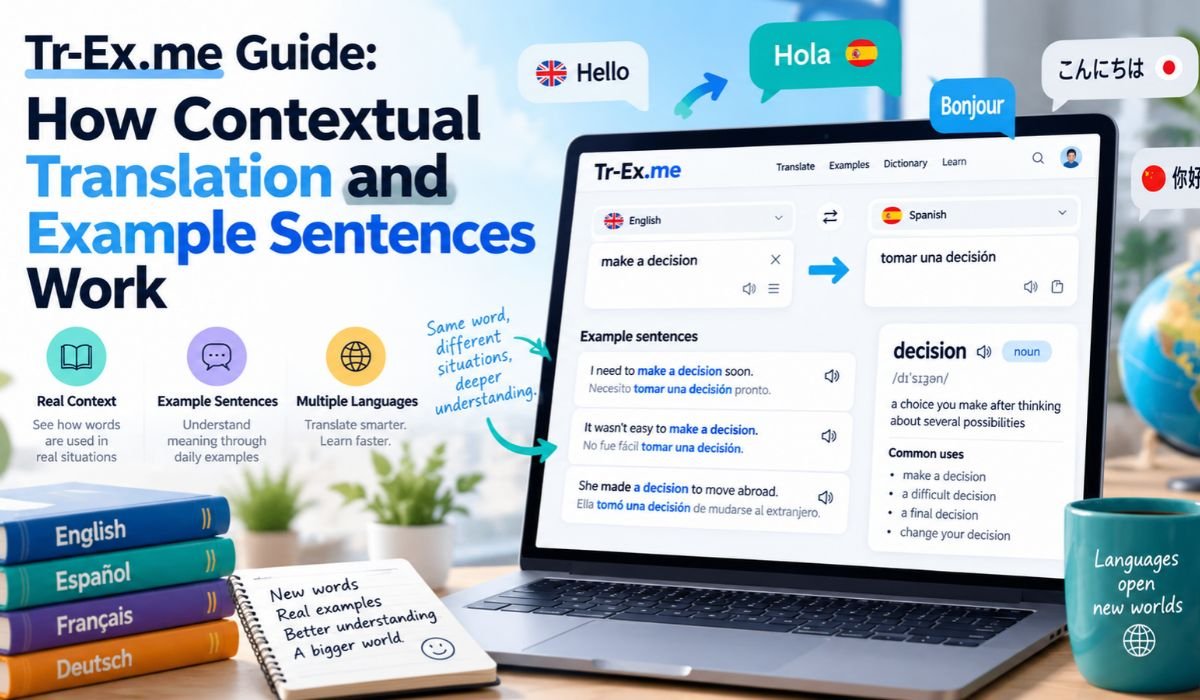
Tr-Ex.me approached this problem through context. Rather than limiting users to direct word equivalents, the service presented possible translations alongside example sentences. That gave readers a chance to see how a word or expression had been used before deciding whether it belonged in their own sentence.
The idea was especially useful for idioms, conversational phrases, and words with several meanings. It also came with an important limitation: seeing a translation in an example doesn’t automatically make it correct for every situation.
This guide takes a closer look at how Tr-Ex.me worked, what contextual translation actually means, how example sentences can improve translation decisions, and what readers should know about the site’s reported accessibility problems in 2026. It also explores alternatives for anyone looking for similar translation help.
What Is Tr-Ex.me?
Tr-Ex.me is best described as a contextual translation resource. Its main purpose was to show possible translations of words and phrases within complete bilingual sentences.
That distinction matters.
A standard dictionary might give you several meanings for a word, but you still have to decide which one fits your sentence. Tr-Ex.me tried to make that decision easier by putting translations into context.
Take the English word “light.” It can refer to illumination, describe something that doesn’t weigh much, indicate a pale color, or describe a small amount. Looking at the word alone doesn’t tell you which meaning is intended. The sentence surrounding it usually does.
Tr-Ex.me applied this principle to individual words as well as longer phrases and expressions. Instead of treating vocabulary as a collection of isolated definitions, it allowed readers to examine how language worked inside complete thoughts.
That made the service useful for more than simply finding a translation. It could also help someone study usage, compare wording, and recognize how meaning changes from one situation to another.
Still, Tr-Ex.me was better treated as a research aid than a final authority. Example sentences provide useful clues, but users need to decide whether those examples genuinely match the meaning and tone they’re trying to communicate.
Tr-Ex.me Quick Information
| Information | Details |
|---|---|
| Platform Name | Tr-Ex.me |
| Service Type | Contextual Translation Resource |
| Main Purpose | Showing Translations In Context |
| Core Feature | Bilingual Example Sentences |
| Search Material | Words And Phrases |
| Main Benefit | Comparing Meaning Through Context |
| Useful For | Idioms And Multi-Meaning Words |
| Typical Users | Learners, Writers, Students, And Translators |
| Learning Value | Vocabulary And Usage Research |
| Translation Approach | Examples From Previously Translated Material |
| Dictionary Replacement | No |
| Human Translator Replacement | No |
| Example Accuracy | Requires Evaluation |
| Important Consideration | Context And Tone |
| Reported 2026 Issue | Website Access Problems |
| Reported Error | 403 Forbidden |
| Permanent Closure | Not Confirmed In The Available Evidence |
| Similar Resource | Reverso Context |
| Another Alternative | Linguee |
| Best Practice | Cross-Check Important Translations |
How Tr-Ex.me Contextual Translation Works
The basic idea behind Tr-Ex.me was simple: connect a search term with translated sentences that show how it can be used.
That becomes particularly valuable when dealing with phrases whose meaning isn’t obvious from the individual words.
Consider “give me a hand.” Someone translating give, me, and hand separately could end up with a sentence about physically handing something over. In everyday English, however, the expression often means “help me.”
Context makes the difference clear.
Instead of asking users to trust a single translation in isolation, a contextual resource gives them material to compare. If several translations are available, readers can look at the sentences around them and decide which meaning comes closest to their own situation.
This is also where good judgment becomes important. The aim isn’t to find an example and copy it immediately. A better approach is to look for patterns.
If the same translation repeatedly appears in situations similar to the one you’re dealing with, that’s useful evidence. If examples point in several directions, the word or expression may have multiple meanings that need closer examination.
In other words, Tr-Ex.me could help narrow the possibilities, but the reader still had to make the final decision.
Why Context Matters In Translation
Context is what turns vocabulary into meaning.
A single word can carry several ideas, and those meanings may have little in common once the word appears in a sentence. English offers countless examples.
Take “run.” Someone can run down a street, run a company, run a software program, run an event, or leave a machine running. The spelling doesn’t change, but the meaning certainly does.
A translation based only on the isolated word would have no reliable way of knowing which interpretation was intended. The surrounding sentence supplies that information.
Tone introduces another layer.
“Can you help me?” and “Would you be able to assist me?” express broadly similar requests. Yet they don’t sound the same. The first feels ordinary and conversational. The second can sound more formal, depending on the setting.
Neither is automatically better. What matters is where and how it’s being used.
Good translation therefore requires more than finding matching vocabulary. The translator has to consider meaning, audience, tone, purpose, and grammatical structure. Contextual examples are valuable because they give readers a way to examine several of those factors at once.
How Example Sentences Improve Translation Decisions
A dictionary definition tells you what a word can mean. An example sentence shows what that meaning looks like in practice.
That’s a small distinction with a big effect.
Consider the phrase “piece of cake.” A literal interpretation leads directly to food. In everyday English, however, someone who says a task was “a piece of cake” usually means it was easy.
A useful example sentence makes that meaning immediately obvious.
Examples can reveal more than idioms. They can show which prepositions commonly follow a word, where adjectives naturally appear, how verbs interact with particular nouns, and whether an expression tends to belong to formal or casual language.
They’re also useful for spotting differences between translations that initially look interchangeable.
One example, however, shouldn’t be treated as proof. A sentence may come from an unusual context, contain awkward wording, or use a meaning that doesn’t fit the reader’s situation.
That’s why comparison matters. Reading several relevant examples gives a much clearer picture than copying the first translation that appears.
Tr-Ex.me And Traditional Bilingual Dictionaries
Traditional dictionaries and contextual translation services overlap, but they don’t do exactly the same job.
An established bilingual dictionary is usually the stronger starting point when you need a clear definition, spelling, grammatical information, or a list of standard meanings. Good dictionaries may also include pronunciation information and carefully selected examples.
A service such as Tr-Ex.me becomes particularly interesting when the question changes.
Instead of asking, “What does this word mean?” you may be asking, “Which version sounds appropriate in this sentence?”
Consider “help” and “assistance.” Their meanings are closely related, but their tone can differ. “Can I get some help?” sounds perfectly ordinary in many everyday situations. Replacing “help” with “assistance” can make the sentence feel more formal.
A dictionary helps establish what the words mean. Contextual examples help demonstrate where they sound natural.
For that reason, there’s little value in treating dictionaries and contextual translation resources as rivals. Used together, they can answer different parts of the same translation question.
Establish the meaning first. Then examine how that meaning is expressed in context.
Tr-Ex.me And Machine Translation Tools
Tr-Ex.me should also be distinguished from conventional machine translation services.
Machine translation systems take text supplied by a user and generate a translation. They’re convenient when someone needs to translate an entire sentence, paragraph, email, or document.
A contextual translation resource takes a different route. Instead of primarily generating a new translation, it allows readers to examine examples and compare how particular expressions have appeared in translated material.
The difference affects when each type of tool is most useful.
If you’re trying to understand an unfamiliar idiom or decide between several possible expressions, contextual examples can be extremely helpful. If you need a quick working translation of several paragraphs, machine translation is usually more practical.
Modern machine translation can produce impressively fluent text, but fluent language isn’t necessarily accurate language. Ambiguous wording, technical terminology, names, humor, slang, and culturally specific expressions can still cause trouble.
For important work, relying on a single automated result isn’t ideal. Dictionaries, contextual examples, subject-specific references, and human review can all play a role in checking the final translation.
Who Can Benefit From Tr-Ex.me?
The approach used by Tr-Ex.me can benefit anyone interested in understanding how translated language works beyond basic definitions.
For language learners, complete sentences put vocabulary into a meaningful setting. Instead of memorizing disconnected word pairs, learners can see which words commonly appear together and how sentence patterns work.
Students may find the same approach useful when they encounter unfamiliar expressions in articles, books, assignments, or other foreign-language material.
Writers and editors working across languages have a different need. They may already know the basic translation but want to determine whether a particular expression carries the right tone.
Professional translators can also consult contextual resources while researching terminology and usage. In professional work, though, those examples are normally just one part of a much broader verification process involving dictionaries, specialist references, linguistic knowledge, and sometimes consultation with subject experts.
The common benefit is context. Instead of stopping at “What does this mean?” readers can investigate the more useful question: “How is this normally used?”
How To Evaluate A Translation Example
Finding an example sentence is easy. Deciding whether it’s a good example for your situation takes more care.
Start by understanding the original sentence before worrying about its translation. What is the speaker actually trying to say? Is the message friendly, formal, humorous, annoyed, polite, or technical? Who is going to read it?
Those details shape the translation.
Whenever possible, search for the complete expression rather than breaking it into individual words. Once examples appear, read the entire sentence instead of looking only at the highlighted phrase.
Then compare several examples.
If the same wording consistently appears in situations similar to yours, that’s encouraging. If it appears mainly in legal documents while you’re writing to a friend, it probably isn’t the best model.
A dependable dictionary can then help confirm the core meaning and grammatical details.
Finally, read the finished translation as a complete sentence. Does it communicate what the original actually meant? Does the tone suit the audience?
For everyday language learning, that process is often enough. For legal, medical, technical, financial, or otherwise high-stakes material, contextual examples shouldn’t replace appropriate professional review.
Common Contextual Translation Mistakes
Many translation mistakes begin with an understandable assumption: if two words are listed as equivalents, they must be interchangeable.
Often, they aren’t.
A word may have several translations depending on the sentence. Choosing the wrong one can produce language that is grammatically possible but semantically incorrect.
Idioms make the problem even clearer. “Break the ice,” “under the weather,” and “piece of cake” all mean something beyond the literal definitions of their individual words. Translating them word for word can destroy the intended meaning.
Tone causes subtler problems.
A phrase may communicate the right information but sound unexpectedly rude, overly formal, old-fashioned, or too casual. That can matter just as much as vocabulary, particularly in professional communication.
Regional differences deserve attention as well. A perfectly normal expression in one country may sound unfamiliar or carry a different meaning somewhere else.
Finally, don’t assume that one example establishes normal usage. It could come from specialist writing, fictional dialogue, an unusual translation, or a context very different from your own.
The best defense against these problems is comparison. Check the meaning, read multiple examples, and verify important wording independently.
How Reliable Are Tr-Ex.me Examples?
Contextual translation databases can be useful precisely because they expose readers to a wide range of language. That variety can also be a weakness.
An example appearing in a translation database isn’t automatically authoritative.
The original translated material may contain an error. A sentence might be understandable but awkward. Some wording may be highly specialized, regional, dated, or appropriate only to the original situation.
Even a completely accurate sentence can become misleading once its context disappears.
Film and television dialogue provides a good illustration. Characters may speak sarcastically, use slang, deliberately break grammatical rules, or choose unusual language for comic or dramatic effect. Copying such wording into a formal email could produce an entirely different impression.
For that reason, Tr-Ex.me and similar resources are best treated as sources of evidence rather than sources of final answers.
Look for agreement across several examples. Check uncertain words against a respected dictionary. Think about the audience and setting. Where mistakes could have serious consequences, seek qualified human review.
That approach preserves what is useful about contextual examples without giving them more authority than they deserve.
Tr-Ex.me Not Loading In 2026
For readers trying to use Tr-Ex.me in 2026, translation isn’t the only question. Website accessibility has also become an issue.
Reports have described repeated difficulty reaching the service, including instances of a 403 Forbidden response.
The meaning of that error is narrower than it may first appear. In general, a 403 response indicates that the server understood the request but refused to fulfill it.
It doesn’t tell the visitor exactly why access was refused.
That distinction matters because an error message shouldn’t be turned into evidence for a claim it doesn’t support. A 403 response, even when it persists, doesn’t by itself prove that Tr-Ex.me has permanently shut down.
Likewise, extended periods of inaccessibility don’t reveal the operator’s intentions.
Without reliable confirmation from the service’s operators or another authoritative source, specific explanations for the problem remain uncertain.
The responsible conclusion is therefore limited: Tr-Ex.me has had reported accessibility problems in 2026, while the available evidence doesn’t establish a confirmed permanent closure or explain the exact reason for those problems.
What To Do When Tr-Ex.me Is Unavailable
If Tr-Ex.me isn’t opening, a few basic checks can help determine whether the problem is local.
Start by confirming that the address has been entered correctly. Trying another browser or internet connection may also reveal whether the issue is limited to one device, browser, or network.
Extensions, cached browser information, and security settings can occasionally interfere with website access.
Persistent server-side errors are different. If a 403 response continues across browsers or devices, repeatedly changing local settings may not solve anything because the refusal is coming from the server.
At that point, moving to another established translation resource is usually more useful than repeatedly refreshing the page, particularly if the translation is needed immediately.
There is also a security consideration. When a familiar website becomes inaccessible, unfamiliar services sometimes appear promising to act as mirrors, replacements, or restored versions. A similar name or design doesn’t prove that such a site has any connection with the original service.
It’s safer to use established translation resources whose identity and purpose are clear.
Best Tr-Ex.me Alternatives
There isn’t necessarily one perfect replacement for Tr-Ex.me because different translation tools solve different problems.
Reverso Context is among the closest alternatives for readers primarily interested in contextual examples. Its emphasis on translations shown alongside sentences makes it useful when comparing expressions, idioms, and possible wording choices.
Linguee takes a related approach, combining dictionary information with bilingual examples. It can be particularly helpful when researching terminology and expressions found in written material.
For readers who first need to establish exactly what a word means, Cambridge Dictionary serves a different purpose. Its definitions, grammatical information, pronunciation guidance, and examples can provide a useful foundation before comparing translations elsewhere.
Google Translate is better suited to quickly generating translations for user-provided words, sentences, and longer passages. It isn’t the same type of resource as a contextual example database, but it can be convenient for producing a first draft.
DeepL similarly focuses on machine translation and can be useful for translating longer passages or comparing alternative wording.
The most effective solution may involve using more than one service. A dictionary can establish meaning, contextual examples can clarify usage, and machine translation can provide a starting point for longer text.
Each tool answers a slightly different question.
How To Tell Whether A Translation Sounds Natural
Accuracy is essential, but natural language requires something more.
A translation can be grammatically valid and still sound as though no fluent speaker would normally say it. Recognizing that difference is one of the main reasons contextual examples are valuable.
Begin by comparing the expression across several relevant sentences. Look for patterns in the way it is used and pay attention to the situations surrounding it.
Then consider register, meaning the level and style of language. An expression that sounds natural between close friends may be inappropriate in an academic paper. Business communication may require different wording again.
Collocations are another useful clue. These are combinations of words that speakers commonly use together. Two words can have similar dictionary meanings while appearing in very different combinations in natural speech.
Frequency helps, but it shouldn’t be treated as proof. A phrase appearing many times online isn’t necessarily correct for your particular sentence.
The real test is whether the translation preserves the intended meaning while sounding appropriate for its audience and setting.
Benefits And Limitations Of Contextual Translation Tools
Contextual translation tools have a clear strength: they show language doing real work inside sentences.
That gives readers access to several layers of information at once. They can study vocabulary, sentence structure, tone, idiomatic meaning, and common patterns rather than learning words in isolation.
For language learners, this can make vocabulary easier to understand and remember. For translators and writers, examples can reveal distinctions that aren’t immediately obvious from dictionary definitions.
Contextual examples are also good at exposing ambiguity. They remind readers that one source word may require different translations in different situations.
But the same tools have limitations.
Examples can contain translation errors or awkward wording. Some may be outdated, regional, highly technical, or intentionally unusual. Others may be perfectly correct but irrelevant to the situation the reader is dealing with.
There is also the risk of misunderstanding the original context.
That’s why contextual translation works best as part of a broader process. A reliable dictionary, several relevant examples, careful reading, and human judgment provide a stronger foundation than any one tool on its own.
Final Thoughts
Tr-Ex.me highlights a simple but important principle of translation: meaning lives in context.
Knowing what a word means is only the beginning. The harder question is deciding which meaning belongs in a particular sentence and how that idea should be expressed for a particular audience.
That’s where contextual example sentences become valuable. They allow readers to move beyond dictionary definitions and observe language inside complete thoughts. They can reveal idiomatic meaning, grammatical patterns, tone, and differences between translations that initially appear interchangeable.
They aren’t perfect, though.
Examples need to be read critically, compared with other evidence, and checked against reliable language references when necessary. A sentence that worked in one document, conversation, or subtitle won’t automatically work in another.
The reported accessibility problems surrounding Tr-Ex.me in 2026 may lead users toward other resources, but the method behind the service remains useful. Contextual dictionaries, established language references, and modern machine translation tools can all contribute to better translation when they’re used for the right purpose.
Ultimately, the strongest question isn’t simply, “Can this word be translated this way?”
It’s “Does this translation communicate the right meaning, in the right tone, for this particular context?”
That distinction is what turns a possible translation into a useful one.
FAQs About Tr-Ex.me
What Is Tr-Ex.me Used For?
Tr-Ex.me was used to explore translations through bilingual example sentences. Instead of presenting only isolated equivalents, its contextual approach allowed readers to compare possible meanings and examine how words or phrases appeared inside complete sentences. This could be particularly helpful for idioms, ambiguous words, and expressions whose meaning changes according to context.
How Is Tr-Ex.me Different From A Dictionary?
A traditional dictionary is primarily designed to establish meanings and provide linguistic information such as spelling, grammatical categories, and sometimes pronunciation and examples. Tr-Ex.me placed greater emphasis on contextual translation examples. The two approaches can work well together: a dictionary establishes what a word means, while contextual examples help show how a particular meaning is used.
Why Are Example Sentences Useful For Translation?
Example sentences reveal details that an isolated word often cannot. They can clarify meaning, demonstrate grammar, expose common word combinations, and show whether an expression is formal, conversational, technical, or informal. Comparing several examples also helps readers distinguish between different meanings of the same word.
Is Tr-Ex.me Still Working?
Tr-Ex.me has had reported accessibility problems in 2026, including difficulties reaching the website. Website availability can change, however, and the available evidence doesn’t support presenting permanent closure as a confirmed fact without authoritative confirmation.
What Does Tr-Ex.me 403 Forbidden Mean?
A 403 Forbidden response generally means that the server understood a request but refused to fulfill it. The error doesn’t reveal the exact reason access was denied. More importantly, seeing a 403 message doesn’t by itself prove that Tr-Ex.me has permanently shut down.
What Is A Good Alternative To Tr-Ex.me?
Reverso Context is a relevant choice for readers who want contextual translation examples, while Linguee can be useful for bilingual examples and terminology research. Traditional dictionaries can help establish meaning, and machine translation services such as Google Translate and DeepL can be useful for generating translations of longer passages.
Can Contextual Translation Examples Be Wrong?
Yes. An example may come from an imperfect translation, specialized document, unusual conversation, or context that doesn’t match your own. Even a technically correct example may sound unnatural elsewhere. Comparing several examples and checking important wording against dependable references reduces that risk.
Can Tr-Ex.me Replace A Professional Translator?
No contextual translation database should automatically replace qualified human expertise when the consequences of an error are significant. Legal, medical, financial, technical, and other specialized translations may require subject knowledge, careful interpretation, and professional review that an online example database cannot provide.
Learn more and explore exciting content on: Pappedeckel Guide: Meaning, Materials, Uses, and Sustainability
[…] Learn more and explore exciting content on: Tr-Ex.me Guide: How Contextual Translation and Example Sentences Work […]