
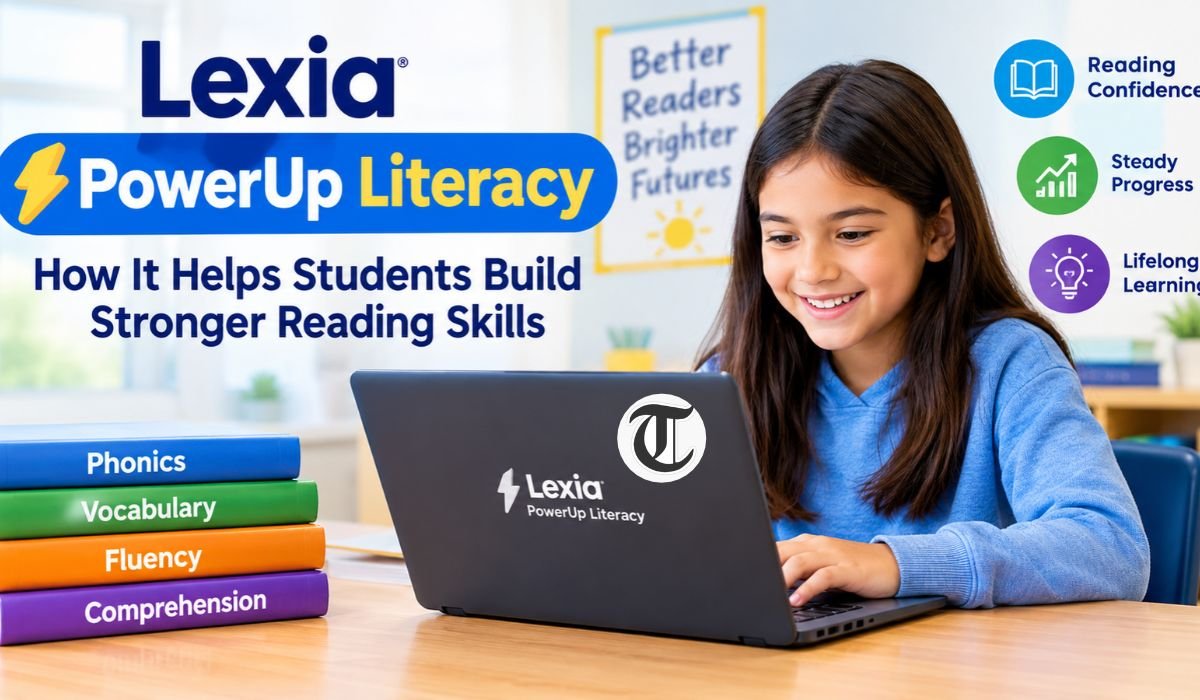
Reading doesn’t become less important once students leave elementary school. In many ways, it becomes more demanding. By middle and high school, students are expected to work through complex texts, understand unfamiliar vocabulary, evaluate evidence, connect ideas, and learn new information largely through reading. For students who are still dealing with significant literacy gaps, those expectations can make everyday schoolwork much harder.
That’s where Lexia PowerUp Literacy, also commonly searched as Lexia Power Up, comes in. Designed for students in grades 6–12, the program is a literacy intervention that combines personalized digital learning with teacher-directed instruction and offline activities. It’s intended for secondary students who need additional literacy support, including those who are several grade levels behind or at risk of not meeting college- and career-ready standards.
Lexia describes PowerUp as being rooted in the science of reading. Rather than giving every student exactly the same sequence of activities, the program uses an adaptive approach to identify areas where a learner needs more support and direct instruction toward those skills.
But what does that look like in practice? And does the research support the claims made about the program?
This guide takes a closer look at Lexia PowerUp Literacy, including how it works, the reading skills it targets, its role in supporting teachers, the research behind it, and the factors schools should consider before adopting it.
Quick Bio Information
| Fact | Details |
|---|---|
| Program | Lexia PowerUp Literacy |
| Common Search Term | Lexia Power Up |
| Grades | 6–12 |
| Program Type | Blended Learning Literacy Intervention |
| Primary Audience | Secondary Students With Literacy Needs |
| Learning Model | Personalized And Adaptive |
| Instruction | Online And Teacher-Directed |
| Approach | Rooted In The Science Of Reading |
| Main Goal | Accelerate Literacy Development |
| Skill Focus | Fundamental Literacy And Higher-Order Analytical Skills |
| Student Design | Adolescent-Focused |
| Educator Support | Performance Data And Targeted Instruction |
| Research Base | Multiple PowerUp And Precursor Studies |
| Strong ESSA Evidence | Reported In Lexia’s Evidence Summary |
| Reported 5× Claim | Based On A 2020 Experimental Study |
| Canadian Usage Reported | 34,000 Students |
| Canadian Schools Reported | 2,249 |
| Canadian School Year | 2024–2025 |
| School Focus | Primarily Designed For Educational Settings |
What Is Lexia PowerUp Literacy?
Lexia PowerUp Literacy is a blended learning literacy intervention created for students in grades 6–12. It’s aimed at secondary learners who need help strengthening their reading skills, whether they’re struggling with foundational literacy or need support with more advanced analytical abilities.
One of the program’s defining features is personalization. Instead of assuming that all students in a particular grade have the same needs, PowerUp uses information about student performance to help identify areas where additional instruction or practice may be useful.
That can be particularly valuable in secondary classrooms. Two students sitting in the same eighth-grade class may have very different reading profiles. One might have difficulty with fundamental reading skills, while another can read words accurately but struggles to understand complex passages or analyze evidence.
PowerUp is designed to account for those differences while helping students develop the literacy skills required for the demands of grades 6–12.
Why Secondary Reading Skills Matter
The role of reading changes as students move through school. In the early grades, much of the focus is on learning how reading works. Later, students increasingly rely on reading to learn about subjects ranging from history and science to mathematics and English.
A student may understand a concept when it’s explained verbally but struggle to learn the same material from a dense textbook passage. Similarly, a student might know how to solve a mathematical problem but have difficulty understanding a lengthy word problem because of the reading demands involved.
That’s why the shift from learning to read to reading to learn is so important.
Reading difficulties can follow students into multiple areas of their education. When a learner has trouble understanding written information, the challenge isn’t necessarily limited to English language arts. It can affect how easily that student accesses the curriculum as a whole.
The National Assessment of Educational Progress has continued to show significant reading challenges among U.S. students. The source material associated with PowerUp highlights the gap between students who are proficient readers and those who are not, underscoring the need for effective literacy support during the secondary years.
How Lexia PowerUp Works
It’s easy to think of a digital literacy program as a collection of reading exercises, but Lexia PowerUp is designed to go beyond that model.
The program uses an adaptive, blended learning approach. Students complete online activities while teachers provide offline instruction and activities based on individual student needs.
The adaptive component is intended to help identify areas where a student needs additional support. Instead of forcing every learner through an identical path, the system can direct students toward skills that require more attention.
At the same time, educators receive information about student performance. That information can help teachers understand where a learner currently stands and decide where targeted instruction may be appropriate.
The balance between technology and teacher involvement is a central part of PowerUp. The software provides personalized learning and data, while educators remain responsible for teaching, interpreting that information, and providing the support students need.
The Science Of Reading Behind PowerUp
The phrase science of reading appears frequently in conversations about literacy, but it’s important to understand what it actually means.
The science of reading isn’t the name of one curriculum, teaching method, or software platform. Instead, it refers to a broad body of research examining how reading develops and how different components of literacy can be taught.
Lexia positions PowerUp within this research-based approach. The company says it has more than 40 years of experience developing literacy solutions rooted in the science of reading.
Its January 2026 efficacy summary describes an evidence base that includes research on PowerUp as well as its predecessor, Lexia Strategies for Older Students.
That distinction is worth keeping in mind. A program shouldn’t be considered effective simply because it uses the words “science of reading.” Educators and school leaders still need to examine the actual instructional approach, supporting evidence, implementation requirements, and student outcomes.
What Reading Skills Does PowerUp Target?
PowerUp is designed to work on both fundamental literacy skills and higher-order analytical skills. That combination is particularly relevant for older students who may have entered middle or high school without fully developing important reading abilities.
Secondary literacy involves much more than being able to recognize words on a page. Students need to understand information, identify central ideas, interpret evidence, analyze texts, and think critically about what they’ve read.
PowerUp’s stated goals include improving reading proficiency and helping students handle the literacy demands of the secondary curriculum.
For a student with a particular skill gap, the aim is to provide support where it’s needed rather than simply adding more general reading practice. Over time, those skills can help students become more comfortable working with the increasingly complex material they encounter in school.
A Learning Experience Designed For Teenagers
Designing literacy intervention for adolescents comes with its own challenges.
Older students often know when they’re struggling academically. If an intervention feels too young or disconnected from their interests, it can be difficult to keep them engaged.
PowerUp is designed specifically for adolescent learners. Lexia describes the program as using high-interest, authentic texts along with motivational elements intended to make the experience appropriate for older students.
That focus matters. Literacy intervention isn’t only about identifying what a student does poorly. Students also need an environment that encourages them to keep working, particularly when they’re being asked to practice skills they may have found difficult for years.
PowerUp’s personalized approach is intended to help students focus on appropriate skills without requiring them to repeatedly work through material they’ve already mastered.
How PowerUp Supports Educators
Technology may provide the platform, but teachers remain an important part of the PowerUp model.
The program gives educators information about student performance and skill levels, which can help them determine where additional instruction may be needed. Lexia says educators can use this information without stopping instruction to administer a separate formal test.
That can potentially make the intervention process more efficient. Lexia has reported that PowerUp can save educators up to a month of instructional time by reducing the need to stop instruction for testing.
That figure should be understood as a vendor-reported benefit, not a guarantee that every teacher or school will save the same amount of time.
The broader advantage is the access to ongoing student information. Rather than waiting for occasional assessments to reveal a problem, educators can use available performance data to help guide instruction as students progress.
Key Features Of Lexia PowerUp
Several characteristics define the Lexia PowerUp Literacy experience. These include personalized learning, adaptive instruction, online student activities, teacher-directed offline instruction, student performance data, and a strong focus on adolescent learners.
Its blended model is especially important. PowerUp isn’t designed to function as a completely independent replacement for classroom teaching. Online activities are intended to work alongside teacher-led instruction and offline activities.
That approach can make the program easier to incorporate into a broader literacy intervention plan. Instead of separating technology from teaching, schools can use the digital component alongside the work educators are already doing with students.
For school leaders, that also means implementation deserves careful attention. The value of the program depends not only on the software itself but on how effectively it fits into the school’s wider instructional strategy.
How It Can Help Build Stronger Reading Skills
The potential value of Lexia PowerUp Literacy lies in its combination of targeted instruction, adaptive learning, and ongoing information about student performance.
Consider a student who has a specific literacy gap. Giving that learner more reading material doesn’t necessarily address the underlying problem. A personalized intervention can instead direct attention toward the skills that require additional practice or instruction.
PowerUp is also designed to connect foundational literacy development with higher-order skills. That matters for secondary students because the ultimate goal isn’t simply to finish a series of digital activities. Students need to become better readers who can understand, evaluate, and analyze the information they encounter across their classes.
Of course, no intervention program can guarantee identical results for every learner. Student engagement, implementation, instructional support, starting skill level, and consistency of use can all influence outcomes.
For that reason, PowerUp is best considered as one component of a broader literacy strategy rather than a stand-alone answer to every reading challenge.
What Does The Research Say?
The research behind Lexia PowerUp is an important part of evaluating the program, particularly for schools that need to make evidence-based decisions.
Lexia’s January 2026 efficacy summary says its evidence base includes 14 studies, covering both PowerUp and earlier research involving its precursor program. According to the company, seven of those studies are peer-reviewed publications, while three meet the highest Strong Evidence standard described under the Every Student Succeeds Act.
One of the most frequently cited findings comes from a 2020 experimental study. Lexia reports that students using PowerUp were nearly five times as effective as the average middle school reading intervention when comparing the program’s impact with the average effect of middle school reading interventions. The study found that students using PowerUp significantly outperformed control students on a state reading assessment, and the study was reviewed under the ESSA evidence framework.
The wording is important here. The “nearly five times” figure comes from a specific study comparison. It shouldn’t be interpreted as meaning that every student will improve five times more than another student using a different intervention.
More recent research provides additional context. A 2024 district-level quasi-experimental evaluation reported a statistically significant effect, with an average effect size of 0.14 and an effect size of 0.25 for English Learners.
Another Lexia study involving 33 non-proficient middle school readers found that one-third of students using PowerUp moved to proficient scores on the following year’s state ELA assessment.
That smaller study offers another useful data point, but its sample size means it shouldn’t be treated as proof of a universal outcome.
Taken together, the research gives schools meaningful evidence to examine. Still, responsible evaluation means looking beyond headline statistics. Study design, sample size, comparison groups, student populations, and implementation conditions all matter when deciding how broadly a finding can be applied.
Real-World School Experiences
Research studies aren’t the only way to understand how a literacy intervention performs. Real-world implementation can also show educators what using a program looks like in different settings.
Lexia reports research involving more than 45,000 students across schools and districts in more than 10 states in correlational reports examining relationships between PowerUp measures and established reading assessments.
The company has also published case studies involving schools and districts working with different student populations and literacy challenges. Examples include work involving older English Learners in Kentwood, Michigan, as well as implementation experiences reported in Bryant, Arkansas, and Fort Worth, Texas.
These case studies can help illustrate how schools have used literacy technology in practice. However, they shouldn’t be treated as interchangeable evidence. Results from one district can be shaped by factors such as student demographics, instructional time, teacher support, implementation quality, and local conditions.
That’s why case studies work best when read alongside formal research rather than used as a substitute for it.
PowerUp In Canada
PowerUp’s reach extends beyond the United States.
According to Lexia’s supplied product information, 34,000 Canadian students in grades 6–12 across 2,249 schools used PowerUp during the 2024–2025 school year.
Those figures offer a useful sense of the program’s scale. They also show that PowerUp has been implemented across a substantial number of schools serving secondary students.
Still, adoption and effectiveness are two different things. A large user base demonstrates that a product is being used, but it doesn’t by itself establish how much students improve.
For schools considering the program, implementation data can therefore be helpful context, while research evidence remains essential for evaluating effectiveness.
Who Can Benefit From Lexia PowerUp?
PowerUp is designed for students in grades 6–12 who need additional literacy support. That includes learners who may be several grade levels behind as well as students who are at risk of not meeting college- and career-ready standards.
The program may also be relevant for schools supporting older English Learners. Research published by Lexia has examined PowerUp among both English Learners and non-English Learners, including a randomized study in which both groups showed comparable gains on a reading fluency measure.
Even so, being in the target grade range doesn’t automatically mean PowerUp is the right choice for a particular student.
Schools should first understand the learner’s reading profile and specific areas of need. Language needs, existing intervention services, instructional time, and the school’s broader literacy plan all deserve consideration.
Is PowerUp Right For Every Student?
No literacy intervention is the perfect fit for every student.
Before adopting PowerUp, schools should consider a learner’s current reading level, specific skill gaps, language needs, existing services, available instructional time, and teacher capacity.
Implementation is another major factor. A digital platform can provide useful practice and performance information, but educators need to understand that information and use it effectively. Because PowerUp follows a blended model, teacher involvement remains an important part of the process.
Schools should also look at technology requirements, privacy practices, curriculum alignment, professional support, and cost.
A good intervention should fit naturally into the school’s existing approach to literacy rather than create another disconnected system for teachers and students to manage.
Pricing And Access
There isn’t a standard public price for Lexia PowerUp Literacy in the supplied product information.
That’s important for anyone researching the program online. Unofficial pricing figures shouldn’t be treated as current or authoritative, particularly because school and district agreements can vary.
Schools and districts interested in PowerUp should request up-to-date pricing and implementation information directly from Lexia.
The company also offers a self-guided experience for people who want to explore the program. However, viewing a demonstration is different from evaluating the full product in a real classroom environment.
Privacy And Student Data
Student privacy deserves close attention whenever a school introduces a digital learning platform.
The original product information states that Lexia PowerUp is FERPA and COPPA compliant. FERPA addresses the privacy of education records, while COPPA establishes specific online privacy requirements relating to children under 13.
Those statements provide an important starting point, but schools should still conduct their own review before implementation. Current privacy documentation, contracts, data-handling practices, security measures, and local requirements should all be examined.
Compliance shouldn’t be interpreted as meaning there are no privacy considerations. Schools remain responsible for understanding how student information is handled and ensuring that the product fits their own policies and obligations.
What Schools Should Ask Before Choosing PowerUp
A product demonstration can be useful, but it shouldn’t be the only factor in a purchasing decision.
Schools should find out which literacy skills PowerUp addresses, how much instructional time students are expected to spend with the program, how teachers receive student data, what training is available, and how progress is measured.
It’s equally important to ask how the intervention fits with the school’s existing English language arts curriculum and other support services.
Decision-makers should also take a close look at the research. Rather than relying only on broad effectiveness claims, they should examine the study designs, student populations, comparison groups, outcome measures, and implementation conditions behind those findings.
In the end, the most useful question isn’t simply whether Lexia Power Up works. It’s whether the program is a good evidence-supported fit for the students, educators, and instructional environment where it will be used.
Final Thoughts
Lexia PowerUp Literacy addresses a significant challenge in secondary education: students can reach middle and high school with reading gaps that make it harder to keep up with increasingly demanding academic material.
Its main strengths include its focus on grades 6–12, personalized and adaptive learning model, combination of online and teacher-directed instruction, adolescent-focused design, and growing research base.
Lexia’s evidence includes experimental, quasi-experimental, correlational, and other studies. That gives educators several forms of evidence to consider rather than relying on a single evaluation.
At the same time, the program’s strongest marketing claims need to be read in context. The frequently cited “nearly five times” finding comes from a specific 2020 experimental study, while other research has produced different effect sizes and outcomes. That doesn’t make the evidence unhelpful; it simply means schools should examine the details behind each study before applying its findings to their own students.
Ultimately, Lexia Power Up is best understood as a tool within a larger literacy strategy. Technology can personalize practice, identify areas for additional support, and provide educators with useful information. But meaningful reading growth still depends on appropriate instruction, engaged students, skilled educators, and consistent support.
For schools looking for a secondary literacy intervention, PowerUp may be worth serious consideration. The strongest decision, however, will come from matching the program’s evidence, features, and implementation requirements with the specific needs of the students it is intended to serve.
Frequently Asked Questions About Lexia PowerUp
What Is Lexia PowerUp?
Lexia PowerUp Literacy is a blended learning literacy intervention for students in grades 6–12. It combines online activities with teacher-directed instruction and is designed to address fundamental literacy gaps as well as higher-order analytical skills.
What Grades Does Lexia PowerUp Support?
Lexia PowerUp is designed for students in grades 6 through 12. Its focus is on the reading demands students face during middle and high school.
How Does Lexia PowerUp Work?
PowerUp uses personalized and adaptive instruction to respond to individual student needs. Students complete online activities while educators can use performance information to provide targeted instruction and offline activities.
Is Lexia PowerUp Based On The Science Of Reading?
Yes. Lexia describes PowerUp as a science-of-reading-based solution. However, that label alone shouldn’t be treated as proof of effectiveness. Schools should also examine the research supporting the specific program and its instructional approach.
Is Lexia PowerUp Effective?
Research provides evidence supporting the program’s effectiveness, including an experimental study that contributed to its Strong ESSA evidence rating. Lexia’s current evidence summary also includes multiple additional studies. Results can still vary depending on students, implementation, instructional support, and other circumstances.
Can Lexia PowerUp Help Struggling Readers?
Yes. Supporting students with literacy gaps is one of the program’s primary purposes. PowerUp is specifically designed for secondary students who need additional literacy support or are at risk of not meeting college- and career-ready standards.
Does Lexia PowerUp Replace Teachers?
No. PowerUp is a blended learning program that combines online learning with teacher-directed instruction. Teachers remain important for interpreting student information, providing targeted instruction, and supporting students beyond what the software can do independently.
How Much Does Lexia PowerUp Cost?
The supplied product information doesn’t provide a standard public price. Schools and districts should contact Lexia for current pricing and implementation details.
Learn more and explore exciting content on: Gout Treatment: Effective Ways to Relieve Pain and Prevent Future Attacks
[…] Learn more and explore exciting content on: Lexia PowerUp Literacy: How It Helps Students Build Stronger Reading Skills […]