
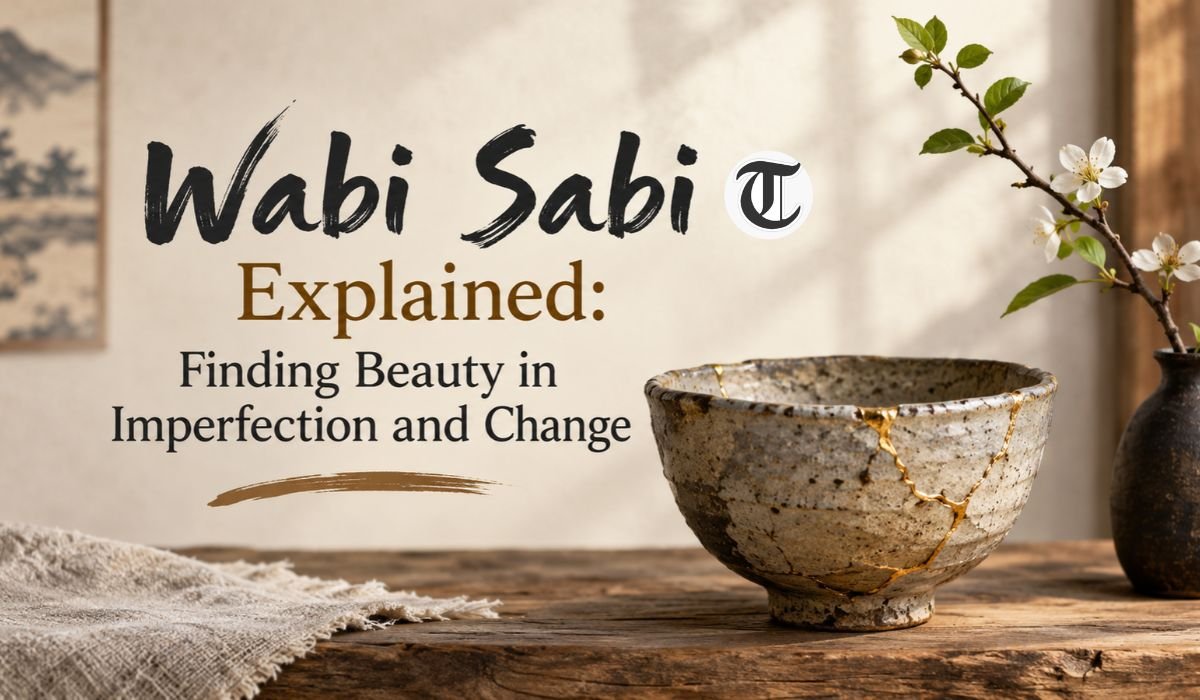
Introduction: Why Wabi Sabi Matters Today
Modern life often encourages us to chase perfection. We edit photographs before sharing them, replace things as soon as they show signs of wear, and compare our homes, careers, and lifestyles with carefully presented images online. Against that background, Wabi Sabi offers a very different way of looking at the world.
Rooted in Japanese aesthetics, Wabi Sabi encourages an appreciation of imperfection, impermanence, simplicity, and the marks that naturally appear through use and time. It isn’t simply about liking old or damaged objects. More deeply, it asks us to notice beauty without demanding that everything be flawless, permanent, or complete.
That idea feels surprisingly relevant today. In a culture built around optimization and constant improvement, Wabi Sabi creates space for acceptance. A handmade bowl doesn’t have to be perfectly symmetrical. A weathered wooden table can become more interesting because of its scratches. A fleeting moment in nature can be meaningful precisely because it won’t last.
Understanding Wabi Sabi, however, requires more than reducing it to the popular phrase “beauty in imperfection.” Its history, artistic traditions, and related concepts are more nuanced than that simple definition suggests.
Quick Bio Information
Concept: Wabi Sabi
Origin: Japan
Type: Japanese aesthetic and cultural concept
Core Themes: Imperfection, Impermanence, Incompleteness, Simplicity, Naturalness
Related Area: Japanese Tea Culture
Important Historical Figure: Sen no Rikyū
Artistic Connection: Japanese Ceramics
Related Artistic Comparison: Chinese Xieyi Painting
Literary Connection: Haiku
Important Writer: Tanizaki Jun’ichirō
Notable Work: In Praise of Shadows
Related Concept: Kintsugi
Related Japanese Idea: Hara Hachi Bu
Related Japanese Idea: Ikigai
Philosophical Context: Zen And Japanese Buddhism
Useful Comparison: Daoist Wu Wei
Key Theme: Appreciation Of Imperfection And Change
Modern Application: Art, Design, Interiors, Everyday Life
What Is Wabi Sabi?
Wabi Sabi is a Japanese aesthetic approach associated with the appreciation of imperfection, impermanence, simplicity, naturalness, and the effects of time. Rather than judging an object only by how polished or flawless it looks, Wabi Sabi encourages attention to its character, history, and relationship with the natural world.
The concept developed gradually through Japanese cultural and artistic traditions. Its associations became especially important in areas such as tea culture, ceramics, poetry, gardens, and architecture.
Wabi Sabi isn’t a strict design formula. There isn’t one official shape, color palette, or decorating rule that makes something Wabi Sabi. A handmade ceramic cup, a faded textile, an uneven wooden surface, or an aging building might express qualities associated with the aesthetic.
What matters is the attitude behind the appreciation. Instead of hiding every irregularity, Wabi Sabi can invite us to see those irregularities as part of an object’s identity.
What Do Wabi And Sabi Mean?
The words Wabi and Sabi have their own histories, and their meanings have changed over time. That’s important because Wabi Sabi wasn’t always treated as one fixed concept with a single definition.
Wabi has been associated with simplicity, austerity, solitude, and a restrained way of living. Over time, especially within Japanese tea culture, it became connected with an appreciation for quietness, modesty, and understated beauty.
Sabi has been associated with aging, wear, patina, and the beauty that emerges through the passage of time. An object doesn’t necessarily become less valuable because it has aged. In some circumstances, its age can give it greater character.
Together, Wabi Sabi is often used to describe an aesthetic sensitivity toward things that are simple, incomplete, weathered, temporary, or naturally imperfect. The modern combined expression is useful, but its historical development was gradual rather than the result of one ancient definition.
The Three Core Ideas Behind Wabi Sabi
Three ideas are particularly useful when trying to understand Wabi Sabi: imperfection, impermanence, and incompleteness.
Imperfection means accepting that things don’t have to be symmetrical, polished, or technically flawless to be beautiful. Handmade objects are a natural example because the maker’s touch can remain visible.
Impermanence recognizes that everything changes. Materials age, seasons shift, flowers bloom and fade, and human experiences pass. Wabi Sabi doesn’t necessarily treat this change as something negative. Instead, it encourages awareness of the beauty contained within temporary experiences.
Incompleteness points toward the idea that something doesn’t need to feel finished in every possible sense. A work of art can leave room for interpretation. A quiet room can feel meaningful without being filled with decoration. A simple object can invite the viewer to participate through imagination.
These ideas overlap, but they aren’t identical. Together, they create a broader way of seeing beauty as something connected to change, time, and natural variation.
How Zen And Daoism Relate To Wabi Sabi
Wabi Sabi is strongly associated with Japanese Buddhist and especially Zen traditions, although it shouldn’t simply be described as another word for Zen Buddhism.
Zen influenced Japanese approaches to simplicity, awareness, discipline, and direct experience. These qualities helped shape artistic and cultural practices in which restraint and attentiveness became important.
Daoism provides another useful comparison. The Daoist idea of Wu Wei, often translated as “effortless action” or action without unnecessary force, emphasizes naturalness and avoiding excessive interference. This can help explain why spontaneous and unforced qualities are sometimes discussed alongside Wabi Sabi.
Still, the traditions shouldn’t be collapsed into one another. Wabi Sabi is a Japanese aesthetic concept with its own historical development. Zen and Daoism can provide valuable context, but neither is simply a translation of Wabi Sabi.
Wabi Sabi And The Beauty Of Imperfect Things
One of the easiest ways to understand Wabi Sabi is to look at ordinary objects.
Imagine a ceramic bowl made by hand. Its surface may contain slight variations. One side might be a little higher than the other. The glaze may have developed differently in different parts of the vessel. Instead of treating these characteristics as defects, a Wabi Sabi perspective can recognize them as evidence of the object’s making and material history.
The same principle can apply to a wooden floor that has developed marks from years of use or a metal object that has acquired a natural patina.
This doesn’t mean every damaged or poorly made object is automatically beautiful. Wabi Sabi isn’t a rule that says imperfections must always be admired. The point is to become more receptive to character, materiality, aging, and the circumstances through which an object has developed.
Wabi Sabi In Japanese Art And Tea Culture
Japanese tea culture played an important role in the development of ideas associated with Wabi aesthetics. During the history of the tea ceremony, practitioners increasingly valued simplicity, restraint, and objects that appeared natural rather than excessively ornate.
The Metropolitan Museum of Art notes that tea masters, including Sen no Rikyū, helped establish an appreciation for rustic Korean and Japanese ceramics and for forms that could appear unrefined or imperfect. Tea gatherings were carefully arranged, yet their settings could be remarkably austere.
This apparent contradiction is central to understanding the tradition. Simplicity doesn’t necessarily mean a lack of skill. A modest-looking tea room or irregular ceramic vessel may represent considerable thought and craftsmanship.
Some Japanese ceramics used in tea culture were originally utilitarian objects. Their irregularities could come from the way they were formed or fired. Ash from the kiln could create unpredictable surface effects, while heat could produce changes in shape, color, or glaze. Tea practitioners came to value these qualities as part of the objects’ character.
Wabi Sabi And Xieyi Painting
Wabi Sabi can also be compared with xieyi, a Chinese painting tradition whose name is commonly translated as “writing the idea.” Xieyi emphasizes expressive, freehand brushwork rather than painstakingly reproducing every visible detail.
The comparison is useful because both approaches can value spontaneity and restraint. In xieyi painting, excessive correction can sometimes weaken the energy of a brushstroke. The painter’s confidence and understanding are visible through relatively simple marks.
However, Wabi Sabi and xieyi aren’t the same tradition. Xieyi belongs to the history of Chinese painting, while Wabi Sabi developed within Japanese aesthetics. The connection is better understood as a comparison between different artistic attitudes toward naturalness, expression, and restraint.
Both also challenge the assumption that visible simplicity means a lack of expertise. A seemingly effortless result can require years of practice.
Wabi Sabi And The Beauty Of Shadows
The relationship between light and shadow is another important way to think about Japanese aesthetics. Writer Tanizaki Jun’ichirō, particularly in In Praise of Shadows, explored the beauty created by subdued light, darkness, texture, and traditional materials.
Instead of assuming that every surface should be brightly illuminated, this perspective allows shadows to become part of the visual experience. Silver, paper, wood, jade, and other materials can appear different depending on the quality of light surrounding them.
That sensitivity fits naturally with Wabi Sabi’s broader appreciation for subtle details. Beauty doesn’t always have to announce itself. Sometimes it becomes visible only when we slow down enough to notice it.
This is also why a simple room can feel richer than an aggressively decorated one. Texture, aging materials, muted light, and empty space can create an atmosphere without demanding attention.
Wabi Sabi, Nature, And The Passage Of Time
Nature provides some of the clearest examples of impermanence. Flowers open and fade. Leaves change color before falling. Wood dries and changes tone. Stone is gradually shaped by weather.
Wabi Sabi encourages awareness of these processes rather than asking us to ignore them. The beauty of a moment can become more meaningful when we recognize that it is temporary.
This idea is closely related to the Japanese appreciation of fleeting experiences found in poetry and other arts. Haiku, for example, often focuses on brief moments in nature, seasonal changes, and observations that might otherwise pass unnoticed.
A haiku doesn’t need to explain everything. Its power can come from capturing a small moment and allowing the reader to experience its significance. That openness shares an important quality with Wabi Sabi: the recognition that beauty can exist in something brief, quiet, and incomplete.
Wabi Sabi Vs. Modern Perfectionism
Modern culture can make imperfection feel like a problem that needs fixing. Digital editing, filters, optimization tools, artificial intelligence, and highly polished commercial imagery make it easier than ever to remove flaws from what we see.
There’s nothing inherently wrong with improving an image, repairing an object, or pursuing high standards. The problem begins when perfection becomes the only acceptable form of beauty.
Wabi Sabi offers another possibility. It suggests that signs of use, age, variation, and change can carry meaning.
A scratched table may remind us of years spent around it. An old photograph may feel valuable because it shows a particular period that can’t be recreated. A handmade object may feel personal precisely because it isn’t identical to every other object produced by a machine.
In this sense, Wabi Sabi isn’t an argument against quality. It’s an argument against believing that flawless appearance is the only measure of quality.
Wabi Sabi In Interior Design And Home Decor
Wabi Sabi has become increasingly visible in conversations about interior design, but its principles are broader than a particular decorating trend.
A Wabi Sabi-inspired home might use natural materials, handmade pieces, subdued colors, visible textures, and objects that show their age. Wood, stone, ceramics, linen, paper, and other tactile materials can help create a quieter atmosphere.
The goal isn’t to make a room look artificially old. Buying perfectly manufactured objects that are designed to imitate wear doesn’t automatically create Wabi Sabi.
Instead, the emphasis is on authenticity and restraint. A room can contain fewer possessions while giving greater attention to the pieces that remain. Small irregularities can be allowed to exist rather than being hidden.
Shadows and changing natural light can also become part of the room’s character. In that sense, Wabi Sabi interior design is less about copying a visual style and more about creating an environment where materials, time, and everyday use are allowed to show themselves.
Wabi Sabi In Everyday Life
Wabi Sabi doesn’t have to remain an artistic concept. It can also influence how we respond to ordinary experiences.
That might mean keeping a well-used object instead of replacing it simply because it no longer looks new. It could mean accepting that a handmade meal won’t always look perfect or allowing a quiet afternoon to be meaningful without turning it into a carefully planned experience.
The same attitude can apply to personal growth. People change over time, and not every stage of life will look polished or complete. Wabi Sabi can encourage a more patient relationship with those changes.
Importantly, this isn’t about giving up on improvement. It is about recognizing that growth doesn’t require us to reject everything that is unfinished, imperfect, or different from what we originally imagined.
Wabi Sabi, Moderation, And Related Japanese Ideas
Wabi Sabi is sometimes grouped with other Japanese concepts such as Hara Hachi Bu and Ikigai, but they should not be treated as interchangeable.
Hara Hachi Bu, traditionally associated with eating until one is around 80 percent full, is connected with moderation in eating. It can be discussed alongside Wabi Sabi when exploring broader ideas about restraint and balance, but it isn’t another definition of Wabi Sabi.
Ikigai is generally associated with a sense of purpose or a reason for being. It concerns meaning and purpose in life rather than an aesthetic appreciation of imperfection.
These distinctions matter because popular discussions sometimes combine Japanese concepts simply because they sound philosophically similar. Each idea has its own history and context.
Common Misconceptions About Wabi Sabi
One of the biggest misconceptions is that Wabi Sabi simply means “old things are beautiful.” Age can contribute to beauty, but it isn’t the only consideration.
Another common misunderstanding is that Wabi Sabi means deliberately making things imperfect. That’s not necessarily the case. A handmade object may contain natural irregularities, but intentionally creating random flaws doesn’t automatically make it Wabi Sabi.
Wabi Sabi also shouldn’t be confused with minimalism. Minimalist design often emphasizes reduction, clean forms, and visual simplicity. Wabi Sabi may share some of those qualities, but its focus extends further into impermanence, material character, aging, and acceptance of natural change.
Kintsugi is another concept that is frequently presented as a synonym for Wabi Sabi. It isn’t. Kintsugi is a Japanese technique and art of repairing broken ceramics, traditionally using lacquer and powdered metal. It can express values associated with appreciating an object’s history and repair, but the two terms describe different things.
Finally, Wabi Sabi shouldn’t be presented as a single timeless philosophy that every Japanese person follows. Like many cultural concepts, its meaning and significance have developed over time and can vary according to context.
Why Wabi Sabi Matters In The Digital Age
The appeal of Wabi Sabi may be especially strong in a digital environment where so much of what we see has been selected, edited, corrected, and optimized.
Social media can make ordinary life appear unusually polished. Advertising presents idealized products and lifestyles. Digital tools can remove imperfections with a few clicks. Even artificial intelligence can generate images that have no physical history at all.
Wabi Sabi offers a useful counterbalance. It reminds us that real objects have textures, histories, limitations, and signs of use. Real experiences are also temporary and unpredictable.
That doesn’t mean technology is the enemy or that everything digital should be rejected. Instead, Wabi Sabi can encourage a healthier question: what happens when we stop expecting every part of life to look perfect?
The answer may be surprisingly simple. We become more attentive to what is already around us.
Final Thoughts On Wabi Sabi
Wabi Sabi is often introduced as the Japanese art of finding beauty in imperfection, and that description is useful as a starting point. But the concept becomes much richer when we consider impermanence, incompleteness, simplicity, natural materials, aging, and the passage of time.
Its history is connected with Japanese artistic and cultural traditions, including tea culture and ceramics, while related ideas from Zen, Buddhism, poetry, and comparisons with Daoist thought can help explain some of its broader appeal.
Perhaps its most valuable lesson is also its simplest: not everything meaningful needs to be flawless.
A worn object can carry memories. A quiet room can feel complete without being full. A fleeting moment can matter because it won’t last forever. And an imperfect piece of art can sometimes leave more room for the imagination than a technically perfect one.
In a world that constantly asks us to improve, correct, upgrade, and optimize, Wabi Sabi offers permission to pause. It asks us to look more carefully at what is already there—and to recognize that change and imperfection aren’t always problems to solve.
FAQs About Wabi Sabi
What Is The Simple Meaning Of Wabi Sabi?
Wabi Sabi is a Japanese aesthetic approach that appreciates imperfection, impermanence, simplicity, naturalness, and the character that develops through time and use.
What Are The Three Main Principles Of Wabi Sabi?
The three ideas most commonly used to explain Wabi Sabi are imperfection, impermanence, and incompleteness. Together, they encourage a broader appreciation of things that are temporary, irregular, and unfinished.
Is Wabi Sabi The Same As Kintsugi?
No. Kintsugi is a Japanese method of repairing broken ceramics, traditionally with lacquer and powdered metal. It can reflect values associated with Wabi Sabi, but Kintsugi and Wabi Sabi aren’t synonyms.
Is Wabi Sabi The Same As Minimalism?
No. The two can overlap in their appreciation of simplicity, but Wabi Sabi also focuses on impermanence, natural variation, aging, material character, and incompleteness.
How Is Wabi Sabi Used In Art?
Wabi Sabi can influence the appreciation of handmade objects, irregular forms, natural materials, restrained compositions, and visible signs of age or use. Japanese tea ceramics are an important historical example.
Can Wabi Sabi Be Used In Interior Design?
Yes. Wabi Sabi-inspired interiors often emphasize natural materials, understated decoration, tactile surfaces, handmade objects, and the authentic signs of time and use.
Is Wabi Sabi Relevant To Modern Life?
Yes. Its emphasis on accepting change and imperfection can provide a useful contrast to the highly edited and optimized images common in modern digital culture.
How Can Someone Practice Wabi Sabi?
Start by paying closer attention to ordinary things. Notice the texture of an aging object, the changing light in a room, a handmade item’s irregularities, or a brief moment in nature. The practice is less about following strict rules and more about learning to appreciate what is already present.
Learn more and explore exciting content on: Milomagazine.co.uk USA: What Readers Should Know About Milo Magazine
[…] Learn more and explore exciting content on: Wabi Sabi Explained: Finding Beauty in Imperfection and Change […]