
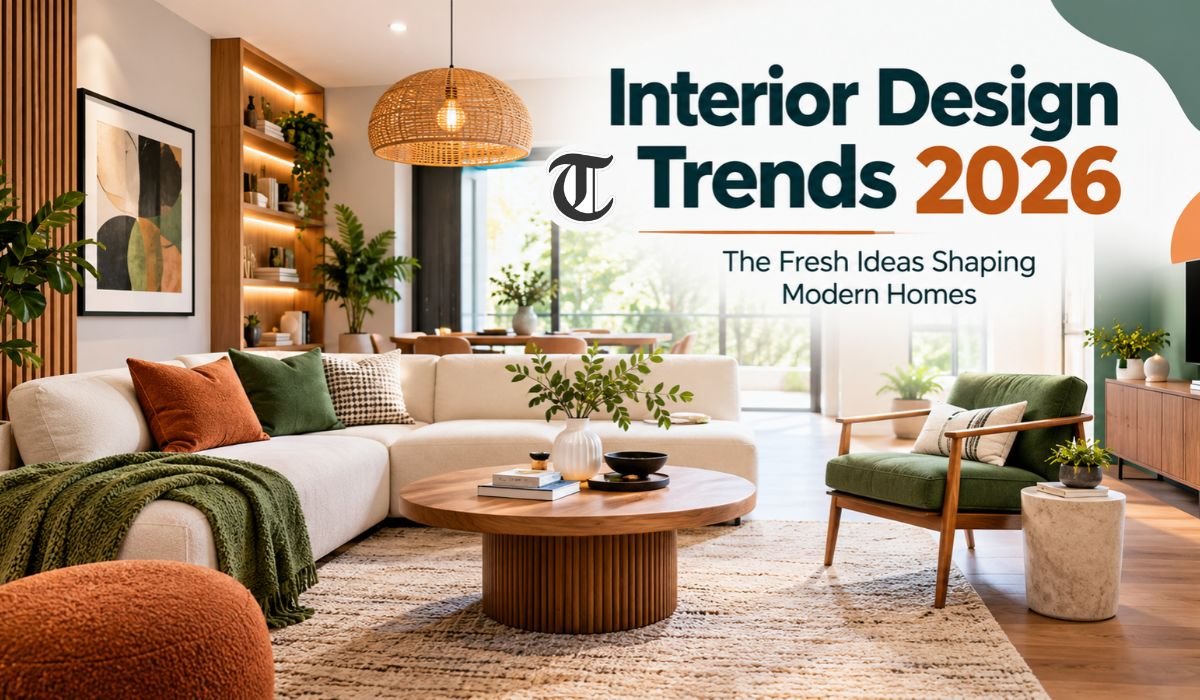
Interior Design Trends in 2026 are taking homes in a warmer, more personal direction. Instead of spaces that feel perfectly coordinated or carefully staged for photographs, designers and homeowners are increasingly embracing rooms that look comfortable, collected, and genuinely lived in. Natural materials, richer colors, vintage furniture, handmade details, tactile surfaces, and traditional influences are all playing a bigger role.
That doesn’t mean contemporary design has disappeared. Far from it. Modern architecture and conveniences still have an important place, but they’re being softened with elements that bring character and personality into the home. A clean-lined kitchen might now feature aged timber, handmade tiles, stone, or furniture that looks as though it could have been collected over many years.
Current design reporting also points to growing interest in wellness areas, biophilic design, sustainable materials, nostalgic interiors, curved forms, and traditional details. Houzz’s 2026 U.S. Emerging Summer Trends Report, for example, found increased interest in tactile materials, earthy colors, wellness spaces, traditional forms, and nature-inspired design.
Taken together, these developments suggest that the meaning of a modern home is changing. It doesn’t necessarily need to look brand-new or follow one recognizable aesthetic. More than anything, it needs to function well, feel inviting, and reflect the people who live there.
Quick Bio Information
| Information | Details |
|---|---|
| Topic | Interior Design Trends |
| Main Year | 2026 |
| Core Direction | Personal, Warm, Layered Interiors |
| Major Material | Natural Wood |
| Popular Wood Direction | Warm, Medium, And Darker Tones |
| Popular Colors | Earthy Greens, Browns, Taupes, Terracotta, And Dusty Blues |
| Kitchen Direction | Furniture-Like And Natural Wood Kitchens |
| Wall Trend | Textile And Tactile Wall Treatments |
| Decorative Trend | Fringe, Tassels, And Detailed Trims |
| Furniture Trend | Vintage And Occasional Seating |
| Tile Direction | Hand-Painted And Decorative Tiles |
| Shape Trend | Curves, Arches, And Soft Geometry |
| Lifestyle Trend | Purpose-Specific Rooms |
| Wellness Trend | Biophilic And Restorative Spaces |
| Sustainability Trend | Reuse, Durable Materials, And Efficient Design |
| Style Shift | Less Perfect, More Personal |
| Design Philosophy | Character Over Uniformity |
| Key Material Mix | Wood, Stone, Metal, Textile, And Ceramic |
| Overall Mood | Comfortable, Expressive, And Lived-In |
2026 Interior Design Trends At A Glance
The biggest Interior Design Trends for 2026 have something important in common: personality comes first. Lived-in rooms, natural wood, earthy palettes, decorative detailing, textile wall treatments, romantic influences, traditional layouts, and handcrafted finishes are helping homes feel less standardized.
That doesn’t mean every trend belongs in every room. In fact, trying to use them all at once can make a space feel forced. A single vintage chair, a warmer wall color, an unusual light fixture, or a handmade backsplash may be enough to change the atmosphere.
The smartest approach is to treat trends as inspiration rather than a checklist. Start with the way you live, then choose the ideas that genuinely make sense for your home.
Lived-In Interiors Feel More Personal
One of the clearest shifts in Interior Design Trends 2026 is the growing appreciation for homes that look as though they’re actually being used.
For years, highly styled interiors dominated social media. Matching furniture, carefully positioned accessories, and spotless rooms created beautiful images, but they didn’t always communicate what it felt like to live there. Now there’s more interest in rooms with visible personality and evidence of everyday life.
Dining chairs are a good example. They’re not simply decorative pieces. They’re where people gather for meals, conversations, celebrations, homework, and long evenings around the table. The same principle applies throughout the home.
Furniture can have practical imperfections. Different materials can sit beside one another. Vintage pieces can share a room with newer purchases. Bathrooms can combine several types of stone rather than using exactly the same surface everywhere.
The result is an interior that feels collected instead of manufactured. In 2026, character often matters more than perfection.
Natural Wood Is Returning With Character
Wood continues to be one of the defining materials in Interior Design Trends 2026, but the emphasis has shifted beyond simply adding timber to a room. Designers are paying close attention to grain, age, tone, texture, and craftsmanship.
Darker woods are making a return after years in which lighter finishes dominated many contemporary interiors. Walnut, elm, oak, cherry, and other character-rich varieties can bring depth and warmth to an otherwise restrained room.
Reclaimed furniture, burl wood, vintage plinths, and visibly aged pieces are particularly useful when the goal is to create a home that feels established rather than newly assembled.
There’s also a practical design lesson here: don’t make every piece of wood in a room identical. Matching everything too closely can produce a catalogue-like effect. Slight differences in grain, color, and finish create more visual interest and help the room feel naturally collected.
Wood also works beautifully alongside other materials. Stone, marble, metal, linen, and ceramic can all provide contrast while allowing timber to remain the warmer element within the composition.
Unfitted Kitchens Create A More Collected Look
The conventional fitted kitchen is being reconsidered in 2026. Instead of making every cabinet, cupboard, and storage unit appear to belong to one continuous system, designers are increasingly introducing freestanding furniture and individual pieces.
Dressers, standalone cupboards, open shelving, furniture-style islands, and vintage storage can make a kitchen feel more like another room in the house rather than a purely functional workspace.
The appeal goes beyond appearance. Individual pieces can give homeowners more freedom to mix proportions, materials, finishes, and periods. A traditional dresser might sit comfortably beside contemporary appliances, while a wooden island can provide a visual connection to the dining or living area.
Natural timber is especially effective. Oak, Douglas fir, and walnut can be combined with marble, other stones, stainless steel, and additional metals to create a kitchen that feels warm but still thoroughly modern.
Modern appliances and storage don’t have to disappear. The difference is that functionality no longer needs to dictate the entire visual identity of the room.
Earthy Colors Are Replacing Cold Minimalism
Color is becoming warmer and more expressive in 2026. Earthy greens, chocolate brown, terracotta, taupe, cream, ochre, dusty blue, and other muted shades are appearing throughout contemporary interiors.
Houzz’s 2026 U.S. design data found increased interest in colors including rust, chocolate brown, mushroom, sage, taupe, and cream. These shades work particularly well alongside natural wood and stone because they reinforce the connection with organic materials.
Dusty blue is another interesting addition to the palette. It can soften deeper shades such as chocolate brown without making a room feel overly bright or stark.
Color drenching is also worth considering. Rather than using one shade on a single feature wall, homeowners can carry a color across the walls and trim and, in some cases, the ceiling. This creates a more immersive effect and can give a room greater emotional weight.
For homes with strong architectural features, contrasting colors on doors, window frames, or other woodwork can also add drama while highlighting details that might otherwise disappear.
The Anti-Algorithm Home Puts Personality First
Perhaps one of the more interesting developments in Interior Design Trends 2026 is the growing desire to escape predictable, social-media-driven interiors.
Online platforms have made design inspiration easier than ever to find. At the same time, that constant exposure can lead to what designers describe as aesthetic convergence: the same colors, furniture shapes, layouts, and decorative objects appearing again and again.
The response is an approach sometimes described as “anti-algorithm.” Instead of reproducing a room seen online, homeowners are choosing objects that feel personally meaningful.
That might mean combining a family table with contemporary lighting, placing a travel find beside modern artwork, or using a vintage chair with an unconventional fabric. The pieces don’t need to belong to the same period or style.
The objective isn’t to make a room deliberately unusual. It’s simply to allow personal history, interests, memories, and taste to have a visible place in the design.
Romantic Interiors Bring Back Softness
Romantic interiors are also finding new life, particularly as designers and homeowners move away from strict minimalism.
Floral fabrics, climbing-rose imagery, vintage furniture, decorative lighting, patterned walls, and garden-inspired details can make a home feel softer and more imaginative. These elements introduce a sense of escapism without necessarily turning an entire house into a period-style interior.
A floral upholstered chair, an antique mirror, traditional wallpaper, or a decorative lamp can be enough to introduce the mood.
This renewed interest in traditional influences doesn’t mean modern living has to be abandoned. Current design is increasingly combining classic architectural references and familiar silhouettes with contemporary furniture, updated colors, and modern functionality.
The result can feel nostalgic without becoming a recreation of the past.
Textile Wall Hangings Add Depth
Walls are becoming more tactile, too. Instead of relying exclusively on paint and conventional framed artwork, designers are turning to tapestries, rugs, woven textiles, fabric panels, and textured wallcoverings.
Textiles bring both visual depth and physical texture to a room. They’re particularly useful on large walls that might otherwise feel empty or flat.
Vintage textiles can be sourced from auctions or even repurposed from fabrics already stored at home. Decorative rugs can sometimes work as wall art, while tapestries can be suspended directly from a wall or hung from a simple metal pole.
The choice of presentation matters. Some textiles look particularly striking when placed in a floating frame, while leaving the material uncovered can make its texture more apparent.
Grasscloth and other natural-fiber wallcoverings offer another option. Because the fibers catch changing daylight differently throughout the day, the color can appear to shift subtly in tone and sheen.
For homeowners who don’t want a major renovation, a textile wall hanging can provide an easier way to experiment with this direction.
Handmade Details Make Rooms Feel Human
Handcrafted objects have particular relevance in 2026 because they reveal something that mass-produced interiors often conceal: the process of making.
Hand-blown glass, carved wood, forged metal, handmade ceramics, irregular tiles, woven materials, and painted furniture all carry small variations. Those differences can become part of their appeal.
An imperfect line or uneven surface doesn’t necessarily need to be corrected. In many cases, it gives an object a stronger sense of authorship and individuality.
This renewed interest in craftsmanship also reflects a wider desire for authenticity. As digital tools and AI become increasingly influential in visual culture, physical qualities such as texture, variation, age, and evidence of human workmanship can feel especially meaningful.
Objects that show how they were made can give a room a sense of history. Painted furniture is one example. Small traces of wear, changes in color, and visible patina can make a piece look as though it has naturally belonged in the room for years.
Occasional Sofas Add Personality
The occasional sofa has emerged as another distinctive idea within Interior Design Trends 2026.
Unlike the large sofa designed for everyday family use and movie nights, an occasional sofa is usually smaller and placed somewhere less expected. It might sit in a hallway, bedroom, kitchen, landing, or secondary sitting area.
Because it doesn’t have to perform as the home’s main workhorse, it offers more freedom. Strong upholstery, unusual shapes, vintage frames, and playful fabrics can all be explored without committing the entire living room to a bold design decision.
Vintage and antique sofas are particularly suited to this approach. Their smaller proportions can work well in contemporary homes, and reupholstering an older frame can give it a completely new role.
It’s a relatively simple way to introduce personality without replacing the main sofa or undertaking a major redesign.
Rooms Are Becoming More Purposeful
The enthusiasm for completely open floor plans is being balanced by renewed interest in rooms with clearer purposes.
Rather than asking one huge space to function simultaneously as a kitchen, dining room, office, lounge, entertainment area, and workspace, homeowners are increasingly creating dedicated environments for particular activities.
Libraries, reading rooms, dining rooms, game rooms, home offices, wellness areas, and quiet sitting spaces can each provide a different atmosphere.
Houzz’s 2026 U.S. search data supports this shift, with increased interest in dedicated spaces such as libraries, mahjong rooms, card rooms, playrooms, wellness rooms, yoga rooms, and sensory rooms.
This doesn’t necessarily mean returning to a rigid traditional floor plan. Flexible partitions, furniture arrangements, pocket doors, curtains, and partial walls can create separation while preserving a sense of openness.
Sometimes a room simply becomes more enjoyable when it has one clear job.
Hand-Painted And Decorative Tiles Are Growing
Kitchen backsplashes are becoming more expressive. Rather than treating the backsplash purely as a practical surface, designers are using decorative, patterned, handmade, and hand-painted tiles as focal points.
Floral designs, heritage-inspired motifs, Delft-style influences, painterly patterns, and irregular ceramic surfaces can give a kitchen a much stronger sense of personality.
The appeal is partly nostalgic. Handmade-looking tiles can soften contemporary cabinetry and make a kitchen feel less standardized.
There’s no need to cover an entire kitchen wall, either. A smaller section behind the cooktop or around the sink can provide enough visual interest to make the feature noticeable without overwhelming the space.
This is particularly useful for homeowners who want a distinctive update without completely remodeling the kitchen.
Curves And Tactile Materials Are Shaping Modern Spaces
Soft geometry is another important part of Interior Design Trends 2026. Curves are appearing not only in furniture but also in architecture and built-in elements.
Arched doors, curved kitchen islands, rounded peninsulas, sculptural staircases, curved furniture, and wave-like surfaces can soften the hard lines often associated with contemporary interiors.
Houzz reported strong year-over-year increases in searches for features including arched range hoods, arched pantry doors, rounded kitchen islands, curved peninsulas, and curved staircases.
At the same time, homeowners are showing more interest in surfaces that can be felt as well as seen. Sandstone, linen wallpaper, seagrass wallpaper, Venetian plaster, terracotta, limewash, and wainscoting are among the tactile materials highlighted in current 2026 Houzz data.
The combination is powerful. Rounded forms can make a space feel gentler, while textured materials prevent it from becoming visually flat.
Wellness And Nature Are Becoming Design Priorities
The modern home is increasingly expected to support everyday wellbeing as well as aesthetics.
Natural light, plants, natural materials, calming colors, outdoor connections, comfortable furniture, and dedicated wellness areas can all contribute to a more restorative environment.
Biophilic design is particularly relevant. It brings nature-related elements into indoor spaces through plants, natural materials, daylight, organic forms, nature-inspired colors, and visual connections with the outdoors.
Houzz reported a 112% year-over-year increase in U.S. searches for biophilic design in its early-2026 dataset. The same report found growing interest in wellness rooms, calming interiors, home gyms, and yoga rooms.
You don’t necessarily need a dedicated spa or meditation room to apply the idea. Better daylight, a few plants, natural textures, comfortable seating, and a calmer palette can change how an everyday room feels.
Sustainable And Long-Lasting Choices Matter
Sustainability is becoming increasingly connected with how people furnish and renovate their homes. Instead of treating sustainable design as a separate visual style, homeowners can approach it through durability, reuse, repair, and thoughtful material selection.
Vintage and secondhand furniture can extend the useful life of existing objects. Restoring an older table or reupholstering a chair may also create a more distinctive result than buying a brand-new matching set.
Other approaches include selecting durable materials, using efficient lighting, considering natural finishes, and choosing furniture that can adapt as household needs change.
Houzz’s 2026 data showed increased U.S. searches for repurposed materials, solar energy, low-voltage lighting, recycled-glass countertops, bamboo flooring, sustainable design, and passive-house concepts.
Sustainable choices don’t have to mean compromising on appearance. In many cases, longevity and character can actually make a home feel more personal.
How To Use Interior Design Trends Without Overdoing Them
The easiest mistake is to treat Interior Design Trends as a shopping list.
A room filled with every fashionable color, material, shape, and accessory can quickly feel dated or disconnected. A better starting point is the room itself and the people who use it.
Think about what isn’t working. Is the space too cold? Does it lack storage? Does it feel visually empty? Is there nowhere comfortable to read, work, eat, or relax?
Once the problem is clear, choose a design response.
Natural wood can add warmth. A textured wall can introduce depth. Earthy paint can change the atmosphere. A vintage piece can provide history. Decorative tiles can become a focal point. A dedicated seating area can make a large room feel more purposeful.
The strongest interiors usually aren’t the ones where everything matches. They’re the ones where different elements relate to one another while still retaining their own character.
Final Thoughts
Interior Design Trends 2026 point toward a broader change in the way people think about their homes. The emphasis is moving away from perfectly coordinated spaces and toward environments that feel warmer, more tactile, more useful, and more personal.
Natural wood, earthy colors, handmade objects, decorative tiles, textile wall treatments, curved forms, vintage furniture, romantic details, wellness spaces, and purposeful rooms all fit into that larger movement.
But trends are most useful when they’re treated as inspiration rather than instructions. A design that works beautifully in one home may not suit another. Architecture, climate, lifestyle, budget, maintenance needs, and personal taste all matter.
The most lasting choices are often the ones that solve real problems while adding character. A home can be thoroughly modern without feeling cold. It can be expressive without becoming chaotic. And it can be carefully designed without looking as though it was designed for an algorithm.
In 2026, the modern home is increasingly about living well in a space that feels unmistakably your own.
FAQs About Interior Design Trends 2026
What Are The Biggest Interior Design Trends In 2026?
Major Interior Design Trends in 2026 include lived-in interiors, natural wood, earthy colors, tactile materials, vintage furniture, decorative tiles, textile wall treatments, curved forms, traditional details, wellness-focused rooms, and more personalized spaces. Current design reporting points toward greater interest in warmth, craftsmanship, nature-inspired materials, and individual expression.
Are White Interiors Going Out Of Style In 2026?
White isn’t disappearing, but it’s increasingly being used alongside warmer neutrals, natural wood, earthy colors, textured surfaces, and stronger accents. Current 2026 design reporting suggests a broader move toward warmer, layered palettes rather than a complete rejection of white.
Is Dark Wood Popular In 2026?
Yes. Darker and medium-toned woods are receiving renewed attention after years in which lighter finishes were prominent in many interiors. Walnut, elm, oak, cherry, and other character-rich woods can add depth and warmth to kitchens, bedrooms, living rooms, and furniture.
What Colors Are Trending For Interior Design In 2026?
Earthy shades are particularly prominent, including chocolate brown, rust, terracotta, sage, olive, taupe, cream, dusty blue, ochre, and warm neutrals. Current 2026 Houzz search data shows increased interest in several of these colors in the U.S.
Are Traditional Interiors Coming Back?
Traditional details are being reinterpreted rather than simply copied from the past. Arches, paneling, stained wood, plate racks, vintage silhouettes, patterned surfaces, and classic architectural elements are being combined with contemporary furniture, modern conveniences, and updated color palettes.
What Is Biophilic Interior Design?
Biophilic Interior Design brings nature-related elements into built environments. Plants, natural materials, daylight, nature-inspired colors, organic shapes, and visual connections to outdoor spaces can all contribute to a biophilic interior. Interest in this approach has increased significantly in recent 2026 Houzz search data.
How Can I Follow Interior Design Trends On A Budget?
You don’t need a complete renovation to refresh a room. Paint, lighting, textiles, artwork, secondhand furniture, cabinet hardware, cushions, rugs, and decorative objects can all change a room’s character. Choosing one or two meaningful updates can often make a bigger difference than replacing everything at once.
Should I Follow Every Interior Design Trend?
No. Trends are best used as sources of ideas rather than strict rules. Consider how you use the room, how long you expect to live with the design, which materials suit your lifestyle, and which colors and objects you genuinely enjoy. A home that’s comfortable and personal is more likely to remain satisfying than one designed entirely around what happens to be fashionable.
Learn more and explore exciting content on: Innøve Meaning: What This Norwegian Word Really Means
[…] Learn more and explore exciting content on: Interior Design Trends 2026: The Fresh Ideas Shaping Modern Homes […]