
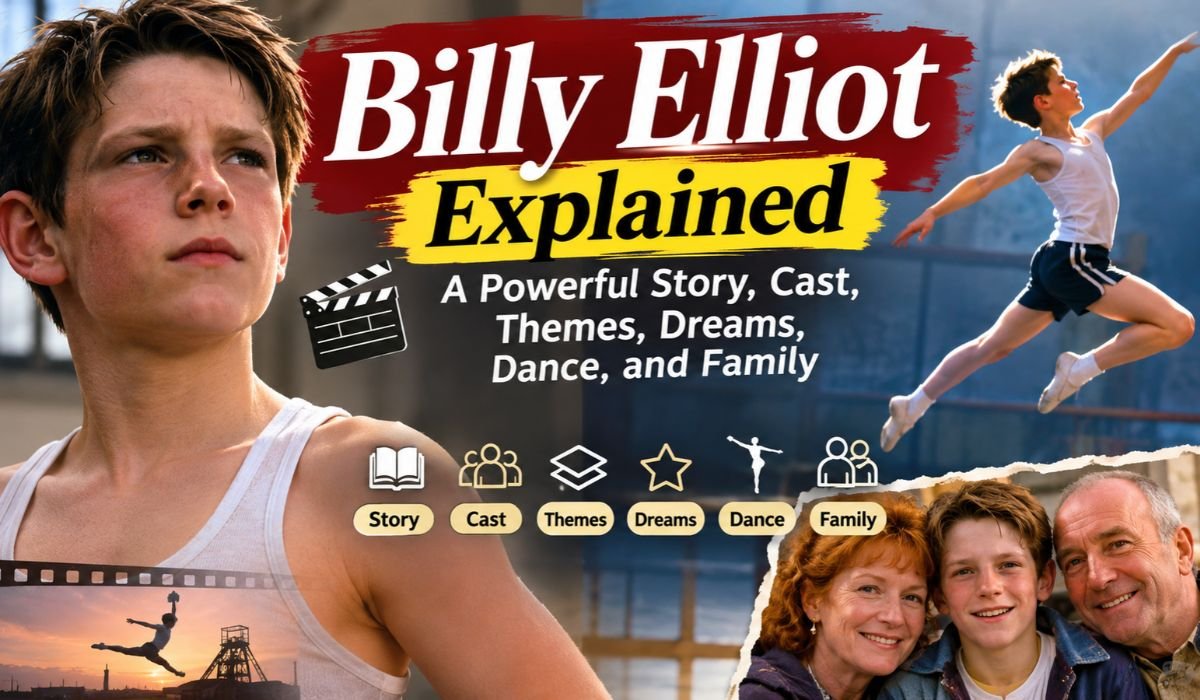
Introduction: Why Billy Elliot Is More Than Just a Dance Movie
Some films entertain for a couple of hours and then fade from memory. Others stay with us because they touch on something bigger than their plot. Billy Elliot belongs firmly in the second category.
Released in 2000, the British coming-of-age drama follows an 11-year-old boy whose discovery of ballet opens the door to a future he had never imagined. The trouble is that Billy grows up in a working-class mining community where ballet doesn’t fit comfortably with traditional expectations of what a boy should do.
Directed by Stephen Daldry from a screenplay by Lee Hall, Billy Elliot stars Jamie Bell in the title role, alongside Julie Walters, Gary Lewis, Jamie Draven, Jean Heywood, and Stuart Wells. The story unfolds against the British miners’ strike of 1984–1985, giving Billy’s personal struggle a much larger social and economic backdrop.
Yet the film never becomes simply a history lesson or a conventional dance drama. At its heart, it’s about a child trying to discover who he is while his family struggles to understand what his dream means.
More than 25 years after its release, Billy Elliot still feels relevant. Its questions about family, opportunity, masculinity, class, and personal freedom haven’t disappeared. If anything, they help explain why new audiences continue to connect with Billy’s story.
Billy Elliot Quick Bio Information
Film Title: Billy Elliot
Release Year: 2000
Country: United Kingdom
Genre: Coming-Of-Age Drama
Director: Stephen Daldry
Screenwriter: Lee Hall
Lead Actor: Jamie Bell
Main Character: Billy Elliot
Billy’s Age: 11 Years
Father: Jackie Elliot
Father’s Actor: Gary Lewis
Ballet Teacher: Mrs. Wilkinson
Teacher’s Actor: Julie Walters
Older Brother: Tony Elliot
Brother’s Actor: Jamie Draven
Best Friend: Michael Caffrey
Historical Setting: 1984–1985 Miners’ Strike
Running Time: 110 Minutes
Music Composer: Stephen Warbeck
Main Ambition: Royal Ballet School
What Is Billy Elliot About?
Billy Elliot lives in County Durham in northeastern England with his widowed father, Jackie, his older brother, Tony, and his grandmother. The family is already under considerable pressure. Jackie and Tony are miners involved in the bitter 1984–1985 strike, and money is scarce.
Jackie sends Billy to boxing lessons, partly because boxing fits his idea of what a young boy ought to be doing. Billy, however, isn’t much of a boxer. His attention soon drifts toward a ballet class being held in the same building.
What begins as curiosity quickly develops into something more serious.
Mrs. Wilkinson, the ballet teacher, notices that Billy has natural ability and an unusual determination to improve. Billy begins taking lessons, but he keeps them hidden from his family because he knows his father won’t approve.
When Jackie eventually discovers the truth, the conflict becomes unavoidable. For Billy, ballet offers freedom and the possibility of a different future. For his father, at least initially, it challenges deeply rooted beliefs about masculinity, family, and the life expected of a working-class boy.
That tension drives much of the film.
Billy Elliot Story Explained: From Boxing To Ballet
Billy’s path toward ballet begins almost by accident. His father expects him to box, but Billy never feels comfortable in the ring. The sport seems to represent someone else’s idea of who he should become rather than something he genuinely wants.
Then he sees the ballet class.
The movement, rhythm, and music immediately interest him. Before long, he’s joining in and discovering that dancing comes far more naturally to him than boxing ever did.
Mrs. Wilkinson sees potential beneath Billy’s lack of formal training. She doesn’t pretend he’s already a finished dancer. Instead, she recognizes his physical ability, musical instinct, and willingness to keep working. Eventually, she begins preparing him for an audition at the Royal Ballet School.
Billy knows that telling his family could end everything, so he keeps his training secret. When Jackie discovers what his son has been doing, his reaction is angry and immediate. Billy is ordered to stop.
For a time, his dream appears to have reached a dead end.
But Billy can’t simply switch off the part of himself that comes alive when he dances. His persistence eventually forces Jackie to confront an uncomfortable possibility: perhaps supporting his son matters more than protecting the expectations he has always taken for granted.
Billy Elliot Cast And Main Characters
A story this emotional depends heavily on its performances, and the Billy Elliot cast gives the film much of its warmth and credibility.
Jamie Bell makes Billy feel like a real child rather than an inspirational symbol. He can be stubborn, awkward, funny, angry, and vulnerable, sometimes within the same scene. Just as importantly, Bell’s physical performance allows Billy’s dancing to communicate emotions that he can’t easily put into words.
Julie Walters brings considerable depth to Mrs. Wilkinson. She’s encouraging without becoming sentimental and demanding without turning into a caricature of the strict teacher. Her own disappointments and frustrations remain visible beneath her determination to help Billy.
Gary Lewis gives Jackie Elliot a similarly layered quality. Jackie begins the film with rigid assumptions, but Lewis makes his eventual change of heart believable rather than sudden.
Jamie Draven plays Tony, Billy’s politically committed older brother, while Jean Heywood appears as Billy’s grandmother. Stuart Wells plays Michael Caffrey, Billy’s friend, whose individuality introduces another dimension to the film’s exploration of identity and acceptance.
Together, the characters make Billy’s community feel lived-in rather than merely constructed around his journey.
Billy Elliot And His Family: Love, Conflict, And Sacrifice
It’s tempting to describe Jackie simply as the father standing in the way of Billy’s dream. The film is more thoughtful than that.
Jackie is a widower trying to hold his family together during a period of enormous economic uncertainty. The mining industry has shaped his livelihood, community, and understanding of masculinity. From his perspective, ballet belongs to a world he neither knows nor trusts.
That doesn’t excuse his early rejection of Billy’s passion, but it gives his reaction context.
The relationship changes when Jackie begins to see Billy’s ability for himself. Gradually, the question stops being whether ballet fits his idea of masculinity and becomes whether he can bear to stand between his son and a rare opportunity.
That transformation gives the film some of its most powerful moments.
Tony complicates matters further. He is deeply committed to the miners’ struggle and sees the strike as a fight for his community’s survival. Billy, meanwhile, represents the possibility of leaving that world behind.
The family therefore isn’t merely arguing about dance. They’re wrestling with loyalty, identity, money, tradition, and what kind of future remains possible.
Mrs. Wilkinson And The Importance Of Mentorship
Billy has talent, but talent by itself wouldn’t take him very far. Mrs. Wilkinson is the person who recognizes that his ability deserves serious attention.
She doesn’t simply tell Billy that he’s gifted. She trains him, challenges him, corrects him, and expects him to work. Her support comes with standards.
That distinction matters.
The film understands that opportunity often depends on someone being willing to notice potential before it has been fully developed. Billy has no obvious route into elite ballet training. His family doesn’t have the money, connections, or experience to guide him through that world.
Mrs. Wilkinson helps bridge that gap.
In doing so, she becomes more than a ballet instructor. She gives Billy permission to imagine a life outside the boundaries of his immediate circumstances. Her role is a reminder that a good teacher can sometimes change a student’s future simply by seeing possibilities others have missed.
Billy Elliot And The British Miners’ Strike
The 1984–1985 British miners’ strike isn’t decorative background. It’s central to the emotional and economic reality of Billy Elliot.
The dispute involved miners opposing widespread pit closures and the threat those changes posed to jobs and mining communities. It became one of the most divisive industrial conflicts in modern British history, bringing financial hardship, political confrontation, policing disputes, and deep tensions to coalfield areas.
For Billy’s family, the consequences are immediate. Jackie and Tony are on strike, household money is extremely limited, and even the cost of helping Billy reach an audition becomes a serious problem.
The historical setting also creates one of the film’s most interesting contrasts.
Jackie and Tony are fighting to preserve a way of life built around coal mining. Billy is moving toward a future that could carry him far beyond that community. One generation is trying desperately to protect its livelihood while the next discovers that its future may lie somewhere entirely different.
Seen this way, Billy’s ballet training isn’t separate from the miners’ strike. Both stories concern uncertainty, dignity, identity, and what happens when familiar ways of life begin to change.
Major Themes In Billy Elliot And Their Deeper Meaning
The Billy Elliot themes reach well beyond dance. The film deals with personal freedom, class, gender expectations, family loyalty, identity, and the unequal availability of opportunity.
Perhaps its clearest theme is the right to pursue a passion even when that passion doesn’t fit other people’s expectations.
Billy’s interest in ballet challenges the assumption that activities should be divided according to gender. The film doesn’t present his dancing as a rejection of masculinity. Instead, it asks why masculinity should be defined so narrowly in the first place.
Class is equally important. Billy may have talent, but talent isn’t enough. Professional training costs money. Auditions require travel. Success depends partly on access to institutions that feel distant from his everyday world.
The film also handles questions of identity through Billy’s friendship with Michael. Their relationship allows the story to explore individuality and acceptance without suggesting that a boy’s interest in ballet automatically defines his sexuality.
Running through all of these ideas is a broader message: becoming yourself can be difficult when everyone around you already has an idea of who you’re supposed to be.
Why Dance Is So Important In Billy Elliot
Dance is more than the subject of Billy Elliot. It’s one of the film’s main storytelling languages.
Billy isn’t always able to explain what he’s feeling, particularly when anger and frustration overwhelm him. Movement fills that gap.
One of the film’s most memorable sequences shows Billy dancing furiously through the streets after being forbidden to continue ballet. His body expresses what ordinary conversation cannot: resentment, energy, confusion, and an intense desire to break free.
Elsewhere, his rehearsals with Mrs. Wilkinson reveal a different side of dance. A sequence set to T. Rex’s I Love to Boogie captures enjoyment, confidence, and the developing connection between teacher and pupil.
These scenes prevent ballet from becoming an abstract symbol. Viewers can see what dancing actually does for Billy.
It gives him a place where the pressures of family, class, and expectation briefly disappear. More importantly, it gives him a way to imagine himself differently.
Billy Elliot Ending Explained: Does Billy Achieve His Dream?
Spoiler Warning: This Section Reveals The Film’s Ending.
Eventually, Jackie sees enough of Billy’s dancing to understand that his son’s ability is real. Once that happens, his priorities begin to shift.
Billy gets the chance to audition for the Royal Ballet School in London. The experience places him in an unfamiliar environment, far removed from his mining community.
During the audition process, Billy is asked what dancing feels like. His answer matters because it expresses something the film has been showing all along: dance gives him a sensation of transformation and freedom that he struggles to describe in ordinary language.
Billy is ultimately accepted.
The story then jumps forward several years. Jackie and Tony attend a performance of Matthew Bourne’s Swan Lake, where the adult Billy, played by dancer Adam Cooper, appears on stage.
The final sequence doesn’t need a lengthy explanation. Billy has reached the world that once seemed impossibly distant.
Yet the emotional payoff belongs to his family as much as to him. Jackie is there to see what his son’s unusual childhood passion became. The father who once tried to stop Billy from dancing now watches him perform professionally.
That’s what makes the ending so effective. It’s not merely about achievement. It’s about acceptance arriving through sacrifice, growth, and love.
Billy Elliot Movie Review: Strengths And Limitations
As a film, Billy Elliot works because it rarely separates its emotional story from its social setting.
Jamie Bell’s performance remains central to its success. He makes Billy lively and imperfect rather than unrealistically heroic. Julie Walters provides humor and toughness as Mrs. Wilkinson, while Gary Lewis gives Jackie enough emotional complexity to make his transformation convincing.
Stephen Daldry’s direction also deserves attention. The film moves comfortably between kitchen-table realism, political tension, comedy, and highly expressive dance sequences without completely losing its balance.
In his September 2000 review for The Guardian, critic Peter Bradshaw praised the film’s charm, humor, emotional generosity, and sensitive handling of masculinity.
His review also raised worthwhile reservations. Turning the miners’ strike into the backdrop for an uplifting story about individual success risks simplifying a complicated political struggle. There’s also room to question the gender dynamics of a story in which the boy in a largely female ballet class becomes the exceptional talent receiving special attention.
Those criticisms don’t erase the film’s strengths. They make a fuller reading possible.
Billy Elliot can be emotionally uplifting while still inviting questions about class, politics, gender, and whose stories receive attention.
Billy Elliot Awards And Cultural Impact
The film’s impact was quickly reflected during awards season.
At the 2001 Academy Awards, Billy Elliot received three nominations. Stephen Daldry was nominated for Best Director, Julie Walters for Best Supporting Actress, and Lee Hall for Best Original Screenplay. The film didn’t win in those categories.
Its performance at the BAFTA Film Awards was stronger. Jamie Bell won Leading Actor, Julie Walters won Supporting Actress, and Billy Elliot won Outstanding British Film.
Bell’s victory was particularly notable because his performance carried much of the film’s emotional and physical demands despite his young age.
The story’s influence didn’t end with the movie. It was later adapted into Billy Elliot the Musical, with music by Elton John and a book and lyrics by Lee Hall.
The stage version allowed the story to lean even further into music and movement while preserving its central themes of family, class, ambition, and self-expression.
By 2026, the film remains closely associated with British coming-of-age cinema and continues to introduce new viewers to Billy’s story.
Is Billy Elliot Based On A True Story?
Despite its convincing historical setting, Billy Elliot isn’t the biography of a real dancer. Billy is a fictional character created by screenwriter Lee Hall.
The miners’ strike surrounding him, however, was very real.
The 1984–1985 dispute affected mining communities across Britain and caused severe economic and social disruption. By placing a fictional family inside that historical moment, the film connects Billy’s private ambitions with genuine pressures faced by working-class communities.
That distinction is important.
Viewers shouldn’t treat Billy’s individual experiences as documented history, but the social tensions around him reflect a real period of industrial and political upheaval.
The film also draws its emotional credibility from experiences that aren’t unique to Billy: young people discovering interests their families don’t understand, talented children facing financial barriers, and parents struggling to choose between familiar traditions and unfamiliar opportunities.
Final Thoughts: Why Billy Elliot Still Matters In 2026
More than 25 years after its release, Billy Elliot still works because its central conflict remains easy to understand.
A child discovers something he loves. His family doesn’t understand it. Money makes pursuing it difficult. Social expectations make it harder still. Eventually, the people around him must decide whether protecting old assumptions matters more than supporting his potential.
Billy’s eventual success is inspiring, but the film doesn’t suggest that talent alone is enough. His journey depends on discipline, a committed teacher, family sacrifice, access to training, and an opportunity to be seen.
That’s one of the film’s most valuable ideas.
Dreams matter, but so do the people and institutions that make those dreams possible.
Billy Elliot also reminds audiences that changing your mind can be an act of love. Jackie’s development is powerful precisely because he doesn’t begin as the perfect supportive parent. He has to question beliefs that once seemed obvious to him.
The result is a film about dance that ultimately reaches far beyond ballet. It’s about discovering who you are, recognizing potential in others, and finding the courage to imagine a future different from the one you inherited.
Frequently Asked Questions About Billy Elliot
What Is The Main Message Of Billy Elliot?
The central message of Billy Elliot is that people deserve the freedom to discover and pursue their abilities even when those interests challenge social expectations. The film also stresses the importance of family support, mentorship, hard work, opportunity, and learning to question limiting assumptions.
How Old Is Billy Elliot In The Movie?
Billy is 11 years old during the main events of the film. He lives with his family in County Durham in northeastern England during the British miners’ strike of 1984–1985.
Who Plays Billy Elliot?
Jamie Bell plays young Billy Elliot. His performance received significant critical recognition, including the BAFTA Award for Leading Actor. In the film’s final sequence, the adult Billy is portrayed by professional dancer Adam Cooper.
Why Does Billy’s Father Disapprove Of Ballet?
Jackie initially views ballet through traditional ideas about masculinity and believes it isn’t an appropriate activity for his son. His attitude changes after he recognizes Billy’s genuine ability and understands that dancing could offer him an extraordinary opportunity.
Is Billy Elliot Based On A Real Person?
No. Billy Elliot is a fictional character created by screenwriter Lee Hall. The story does, however, take place against the real British miners’ strike of 1984–1985, giving the fictional family’s experiences a historically grounded setting.
Does Billy Elliot Become A Professional Dancer?
Yes. The ending jumps forward to show an adult Billy performing in Matthew Bourne’s Swan Lake. His father and brother are in the audience, confirming that Billy has successfully turned the passion he discovered as a child into a professional career.
Is Billy Elliot Suitable For Children?
That depends on the child’s age and the standards used in their country. The film contains strong language as well as mature discussions of social conflict, gender expectations, family grief, and economic hardship. Parents should check the relevant local age classification and content guidance before watching it with younger children.
Why Is Billy Elliot Still Popular?
Its story remains relatable because the central themes haven’t aged. Audiences can still connect with Billy’s struggle to pursue something he loves, his family’s gradual acceptance, and the wider questions the film raises about class, opportunity, masculinity, and personal freedom.
Learn more and explore exciting content on: Tatiana Maslany Movies and TV Shows: Her Best Roles and Career Highlights
[…] Learn more and explore exciting content on: Billy Elliot Explained: A Powerful Story, Cast, Themes, Dreams, Dance, and Family […]