
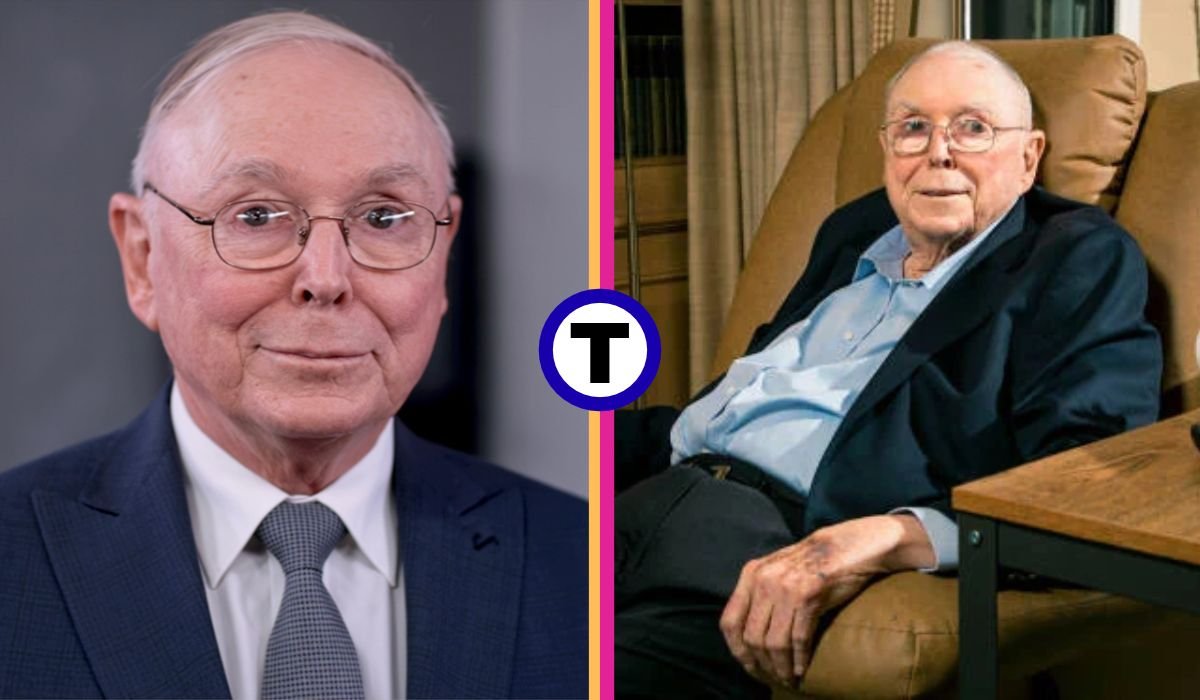
Charlie Munger wasn’t simply one of America’s wealthiest investors. He was a sharp-minded businessman, accomplished lawyer, generous philanthropist, and influential thinker who spent much of his life challenging conventional wisdom. As Warren Buffett’s closest business partner and the longtime vice chairman of Berkshire Hathaway, Munger helped shape an investment philosophy that continues to influence financial markets.
What made Charlie Munger remarkable wasn’t just his ability to build wealth. It was his understanding of human behavior, his willingness to question popular opinions, and his belief that good decisions often come from avoiding obvious mistakes.
Born in Omaha, Nebraska, in 1924, Munger lived through economic uncertainty, personal tragedy, professional success, and extraordinary changes in the business world. Yet he remained committed to the same basic principles: keep learning, think independently, and never underestimate the value of patience.
Although Munger died in November 2023, his ideas remain relevant in 2026. His life offers an engaging story about ambition, family, financial success, and the importance of developing sound judgment.
Charlie Munger Quick Bio Information
| Personal Detail | Information |
|---|---|
| Full Name | Charles Thomas Munger |
| Popular Name | Charlie Munger |
| Date of Birth | January 1, 1924 |
| Birthplace | Omaha, Nebraska, United States |
| Nationality | American |
| Profession | Investor, Lawyer, Businessman, Philanthropist |
| Father | Alfred Case Munger |
| Mother | Florence Russell Munger |
| High School | Omaha Central High School |
| University Attended | University of Michigan |
| Law School | Harvard Law School |
| Graduation Year | 1948 |
| Military Service | U.S. Army Air Forces |
| Famous Position | Vice Chairman of Berkshire Hathaway |
| Business Partner | Warren Buffett |
| First Wife | Nancy Huggins |
| Second Wife | Nancy Barry |
| Estimated Net Worth at Death | Approximately $2.6 Billion |
| Date of Death | November 28, 2023 |
| Age at Death | 99 Years |
Who Was Charlie Munger?
Charles Thomas Munger was an American billionaire investor, lawyer, businessman, and philanthropist who became one of the most respected figures in modern finance.
He was best known for his decades-long partnership with Warren Buffett and his position as vice chairman of Berkshire Hathaway, a multinational holding company with businesses spanning insurance, transportation, energy, manufacturing, and retail.
Munger joined Berkshire Hathaway’s leadership in 1978 and remained vice chairman until his death in 2023. Throughout those years, he helped influence the company’s investment decisions and encouraged a greater emphasis on buying exceptional businesses at sensible prices.
Outside investing, Munger developed a reputation for intellectual curiosity and unusually direct advice. He frequently discussed psychology, economics, mathematics, history, and human behavior, believing that knowledge from different fields could improve everyday decisions.
His influence reached far beyond professional investors. Students, entrepreneurs, business leaders, and ordinary readers continue to study his ideas about learning, discipline, and long-term success.
Charlie Munger’s Early Life and Family Background
Charlie Munger was born on January 1, 1924, in Omaha, Nebraska, to Alfred Case Munger and Florence Russell Munger. His father worked as a lawyer, and education played an important role in the family’s life.
Growing up in Omaha during the Great Depression meant living in a country where financial uncertainty was part of everyday life. Businesses struggled, families faced difficult choices, and economic security couldn’t be taken for granted.
One interesting connection from Munger’s childhood involved Warren Buffett’s family. As a teenager, Munger worked at Buffett & Son, a grocery store owned by Warren Buffett’s grandfather.
Despite this early connection, Munger and Buffett didn’t become friends until adulthood. Their eventual partnership would become one of the most celebrated relationships in American business.
Munger attended Omaha Central High School, graduating in 1941. His early years provided the foundation for a life marked by intellectual curiosity, independence, and a willingness to examine problems from different perspectives.
Charlie Munger’s Education and Military Service
Charlie Munger’s educational journey was anything but conventional.
After graduating from high school, he enrolled at the University of Michigan, where he studied mathematics. However, World War II interrupted his college education, and he entered the U.S. Army Air Forces.
During his military service, Munger trained in meteorology, studying weather systems and atmospheric conditions. His coursework included training at the California Institute of Technology, where scientific reasoning and mathematical analysis were essential.
Following the war, Munger pursued a legal education at Harvard Law School. Remarkably, he gained admission despite not having completed a traditional undergraduate degree.
He graduated magna cum laude in 1948, demonstrating exceptional academic ability.
His education later influenced his investment philosophy. Mathematics encouraged logical thinking, science emphasized evidence, and law strengthened his ability to analyze complicated situations.
Munger eventually became convinced that understanding several disciplines was more useful than relying entirely on one area of expertise.
Charlie Munger’s Early Career as a Lawyer
Long before Charlie Munger became famous on Wall Street, he was building a successful career in law.
After completing his studies at Harvard, he moved to Los Angeles and began practicing as an attorney. His work involved business matters, legal agreements, and complex commercial disputes.
The profession demanded careful research, clear reasoning, and an ability to recognize potential problems before they became serious.
In 1962, Munger helped establish the law firm that eventually became Munger, Tolles & Olson. The firm developed a strong reputation in corporate law and litigation.
Yet Munger’s ambitions gradually moved beyond legal practice.
He became increasingly interested in investing, business ownership, and the possibility of building wealth through carefully selected opportunities.
His legal background proved valuable. Understanding contracts, business structures, and financial risks gave him an analytical foundation that would serve him throughout his investment career.
How Charlie Munger Met Warren Buffett
The friendship between Charlie Munger and Warren Buffett began in 1959, when mutual acquaintances introduced them in Omaha.
Both men had grown up in the same city and shared a fascination with business. They also appreciated independent thinking, financial discipline, and straightforward communication.
Their investment approaches, however, weren’t identical.
Buffett had been strongly influenced by Benjamin Graham, the pioneering investor who emphasized purchasing stocks for less than their estimated intrinsic value.
Munger saw an opportunity to build on that approach. Rather than searching only for deeply discounted companies, he believed investors should also consider the long-term advantages of owning outstanding businesses.
That perspective gradually influenced Buffett’s thinking.
Their relationship developed into a friendship built on trust, intellectual honesty, and mutual respect. They could disagree without allowing differences of opinion to damage their partnership.
Over the following decades, their collaboration became a defining part of Berkshire Hathaway’s success.
Charlie Munger’s Career at Berkshire Hathaway
Charlie Munger became vice chairman of Berkshire Hathaway in 1978, beginning a leadership role that would continue for 45 years.
Alongside Warren Buffett, he helped evaluate investment opportunities, assess business management, and develop the company’s long-term approach to capital allocation.
Berkshire Hathaway eventually grew into a vast collection of operating businesses and investments. Its interests included insurance companies, railroads, utilities, manufacturing operations, and major publicly traded corporations.
Munger’s influence was especially important in the company’s approach to business quality.
The acquisition of See’s Candies in 1972, before Munger formally became vice chairman, illustrated a principle he strongly supported: a trusted brand with loyal customers and pricing power can be more valuable than a seemingly cheap business with weak prospects.
Munger also served as chairman of Wesco Financial Corporation, where he became known for his thoughtful responses to shareholder questions.
His role went beyond selecting investments. He helped reinforce a corporate culture that valued honesty, patience, capable management, and disciplined financial decisions.
Following Munger’s death, Buffett described him as the architect of modern Berkshire Hathaway in the company’s 2023 annual shareholder letter.
Charlie Munger’s Investment Philosophy and Mental Models
Charlie Munger believed that successful investing wasn’t about predicting every movement in the stock market. It was about understanding businesses, controlling emotions, and making fewer serious mistakes.
He preferred companies with strong competitive advantages, reliable earnings, capable leadership, and business models that could remain profitable over time.
Instead of constantly trading stocks, he encouraged investors to think like business owners.
One of his most influential ideas involved mental models, which are frameworks for understanding problems through knowledge from different disciplines.
Psychology, for example, can explain why people become overconfident or follow crowds. Economics helps reveal how incentives influence behavior, while mathematics provides tools for evaluating probability and risk.
Munger believed that combining these perspectives could lead to more thoughtful decisions.
He also warned against excessive borrowing, speculation, and investing in businesses that were difficult to understand.
His philosophy didn’t promise guaranteed profits. Instead, it offered a practical approach to improving judgment and reducing avoidable financial mistakes.
Charlie Munger’s Net Worth and Sources of Wealth
Charlie Munger built an extraordinary fortune through decades of investing, business ownership, and long-term financial discipline.
At the time of his death in November 2023, Forbes estimated his net worth at approximately $2.6 billion.
Earlier estimates were somewhat lower. Forbes listed his fortune at approximately $2.2 billion in April 2023, reflecting how billionaire valuations can change with stock prices and other financial factors.
Much of Munger’s wealth came from his investment holdings, including Berkshire Hathaway shares. His earlier investment partnerships and other business interests also contributed to his financial success.
Unlike investors who frequently buy and sell securities, Munger believed that owning excellent businesses for extended periods could produce substantial returns.
He understood the power of compounding, where investment gains generate additional gains over time.
Although his wealth made him a billionaire, Munger was often more interested in explaining how people could make better financial decisions than in discussing his personal fortune.
His financial achievements also allowed him to support universities and educational initiatives through major charitable contributions.
Charlie Munger’s Wife, Children, and Personal Life
Behind Charlie Munger’s professional achievements was a personal life shaped by family relationships, difficult experiences, and considerable resilience.
He married his first wife, Nancy Huggins, in 1945. Their marriage ended in divorce in 1953.
One of the most painful experiences of his life was the death of his young son Teddy from leukemia. The loss was a devastating family tragedy.
In 1956, Munger married Nancy Barry. Their marriage lasted more than five decades, ending with her death in 2010.
Together, they raised a blended family that included children from previous relationships and children from their marriage.
Munger also faced serious medical challenges. Complications from eye surgery eventually left him without sight in one eye.
Despite these hardships, he maintained an active professional and intellectual life.
He loved reading, enjoyed discussing complex ideas, and developed a strong interest in architecture. His curiosity remained evident even as he approached his hundredth birthday.
Charlie Munger’s Books and Famous Quotes
Charlie Munger became almost as famous for his wisdom as he was for his investment achievements.
His best-known collection of ideas appears in Poor Charlie’s Almanack, edited by Peter D. Kaufman. The book brings together speeches, commentary, and lessons about investing, psychology, business, and decision-making.
Rather than offering a simple formula for becoming wealthy, the book explores how people can improve their thinking.
Munger repeatedly emphasized the importance of learning from mistakes. He believed that understanding why people fail could help others avoid similar outcomes.
He also encouraged intellectual humility. In his view, changing an opinion when presented with stronger evidence was a sign of good judgment, not weakness.
His direct language and dry humor made complicated ideas memorable.
For readers interested in investing or personal development, his writings provide a broader lesson: knowledge becomes more valuable when people understand how to apply it.
Charlie Munger’s Philanthropy and Educational Contributions
Education held a special place in Charlie Munger’s life, and he donated substantial amounts of money to universities and academic institutions.
Among the institutions he supported were the University of Michigan, Stanford University, and the University of California, Santa Barbara.
In 2013, Munger made a $100 million commitment to support graduate student housing at the University of Michigan.
He believed that university facilities could encourage students to interact, exchange ideas, and develop intellectually.
His interest in architecture also influenced his charitable projects.
However, some of his proposals generated controversy. A planned student residence known as Munger Hall at UC Santa Barbara attracted criticism because many bedrooms were designed without conventional windows.
Critics raised concerns about natural light, student well-being, and living conditions. The university ultimately moved away from the proposed design in 2023.
Munger’s philanthropic record therefore reflects both significant generosity and a willingness to pursue unconventional ideas that sometimes faced public opposition.
Charlie Munger’s Biggest Achievements and Career Milestones
Charlie Munger’s professional accomplishments covered several industries and extended across more than seven decades.
He began as a talented law graduate, established himself in California’s legal community, and helped create a respected law firm.
His transition into investing brought further success through investment partnerships and business ownership.
At Wesco Financial, he demonstrated his ability to manage investments while maintaining a disciplined, long-term perspective.
His most significant professional contribution, however, was arguably his influence on Berkshire Hathaway.
By encouraging Warren Buffett to focus more closely on business quality and durable competitive advantages, Munger helped refine an investment approach that became influential around the world.
He also earned a reputation as an educator through his public speeches and shareholder meetings.
His career showed that professional success doesn’t always follow a straight path. Munger combined lessons from law, mathematics, psychology, and business to develop an approach that was distinctly his own.
Charlie Munger’s Death and Final Years
Charlie Munger died on November 28, 2023, at the age of 99.
Berkshire Hathaway announced that he had passed away peacefully at a California hospital. The company did not publicly disclose a specific medical cause of death.
His death came just 33 days before his hundredth birthday.
Even in his final years, Munger remained intellectually engaged. He continued discussing investing, economic conditions, corporate leadership, and the mistakes people make when managing money.
His appearances at shareholder meetings attracted considerable attention because he rarely avoided difficult questions.
Following his death, Warren Buffett and members of the business community paid tribute to his judgment, friendship, and contributions to Berkshire Hathaway.
Although his passing ended one of the longest and most influential partnerships in modern investing, the principles he helped establish remain part of Berkshire Hathaway’s history.
Charlie Munger’s Lasting Legacy in Business and Investing
Charlie Munger’s legacy cannot be measured by his personal fortune alone.
His greatest influence may have been teaching investors and business leaders to approach decisions with patience, curiosity, and intellectual honesty.
He believed that understanding human behavior was essential because poor decisions often result from emotional reactions, misplaced confidence, or failure to recognize obvious risks.
His partnership with Warren Buffett demonstrated how two people with complementary strengths could build a productive professional relationship over many decades.
Munger also encouraged lifelong learning. He believed that knowledge from history, psychology, economics, science, and mathematics could help people understand complicated situations more clearly.
In 2026, his ideas continue to appeal to readers seeking practical financial knowledge and better decision-making skills.
His life suggests that lasting success often depends less on finding shortcuts and more on developing good habits, recognizing mistakes, and remaining patient when others become distracted by short-term opportunities.
Final Thoughts
Charlie Munger lived a remarkable life, but his story was never simply about becoming wealthy.
From his early years in Omaha to his legal career in California and his decades at Berkshire Hathaway, he consistently demonstrated the importance of independent thinking and continuous learning.
His partnership with Warren Buffett helped influence modern investment practices, while his advice about human behavior and decision-making reached audiences far beyond the financial world.
Munger also experienced personal tragedies, health challenges, and professional disagreements. Those experiences add depth to his story, showing that even highly successful individuals face difficult circumstances.
What makes Charlie Munger’s legacy especially meaningful in 2026 is the practical nature of his ideas. He didn’t believe that success required predicting every market movement or discovering a secret formula.
Instead, he encouraged people to understand what they’re doing, recognize their limitations, build trustworthy relationships, and avoid unnecessary mistakes.
His life remains a powerful reminder that wealth may attract attention, but wisdom, character, and thoughtful decisions are what create a lasting legacy.
FAQs About Charlie Munger
Who Was Charlie Munger?
Charlie Munger was an American billionaire investor, businessman, lawyer, and philanthropist. He became widely known as Warren Buffett’s longtime business partner and Berkshire Hathaway’s vice chairman. His reputation was built on disciplined investing, rational decision-making, and a strong belief in lifelong learning.
What Was Charlie Munger’s Net Worth?
Charlie Munger’s estimated net worth was approximately $2.6 billion when he died in November 2023, according to Forbes. His wealth came from Berkshire Hathaway shares, earlier investment partnerships, and other business interests. The figure was an estimate rather than an exact accounting of his assets.
How Old Was Charlie Munger When He Died?
Charlie Munger was 99 years old when he died on November 28, 2023. He was born on January 1, 1924, in Omaha, Nebraska, and passed away just over a month before his hundredth birthday.
Who Was Charlie Munger’s Wife?
Charlie Munger was married twice. His first wife was Nancy Huggins, whom he married in 1945. They divorced in 1953. He later married Nancy Barry in 1956, and their marriage continued until her death in 2010.
How Many Children Did Charlie Munger Have?
Charlie Munger had a large blended family that included biological children and stepchildren. Published biographical accounts sometimes differ in how they count his children. His son Teddy died of leukemia during childhood, an experience that deeply affected the family.
How Did Charlie Munger Meet Warren Buffett?
Charlie Munger met Warren Buffett in Omaha in 1959 through mutual acquaintances. Their shared interest in investing, business, and independent thinking helped establish a friendship that developed into a decades-long professional partnership.
What Was Charlie Munger’s Investment Strategy?
Charlie Munger believed in purchasing financially strong businesses at reasonable prices and holding them for long periods. He emphasized understanding business fundamentals, recognizing competitive advantages, managing risk, and avoiding decisions driven by fear or excitement.
What Is Charlie Munger’s Greatest Legacy?
Charlie Munger’s greatest legacy is his influence on modern value investing and rational decision-making. His partnership with Warren Buffett helped shape Berkshire Hathaway, while his speeches and writings continue to teach readers about patience, intellectual curiosity, and sound judgment.
Learn more and explore exciting content on: Taylor Swift Net Worth in 2026: How She Built Her Billion-Dollar Fortune
[…] Learn more and explore exciting content on: Charlie Munger: Biography, Net Worth, Family, Career, and Lasting Legacy […]