
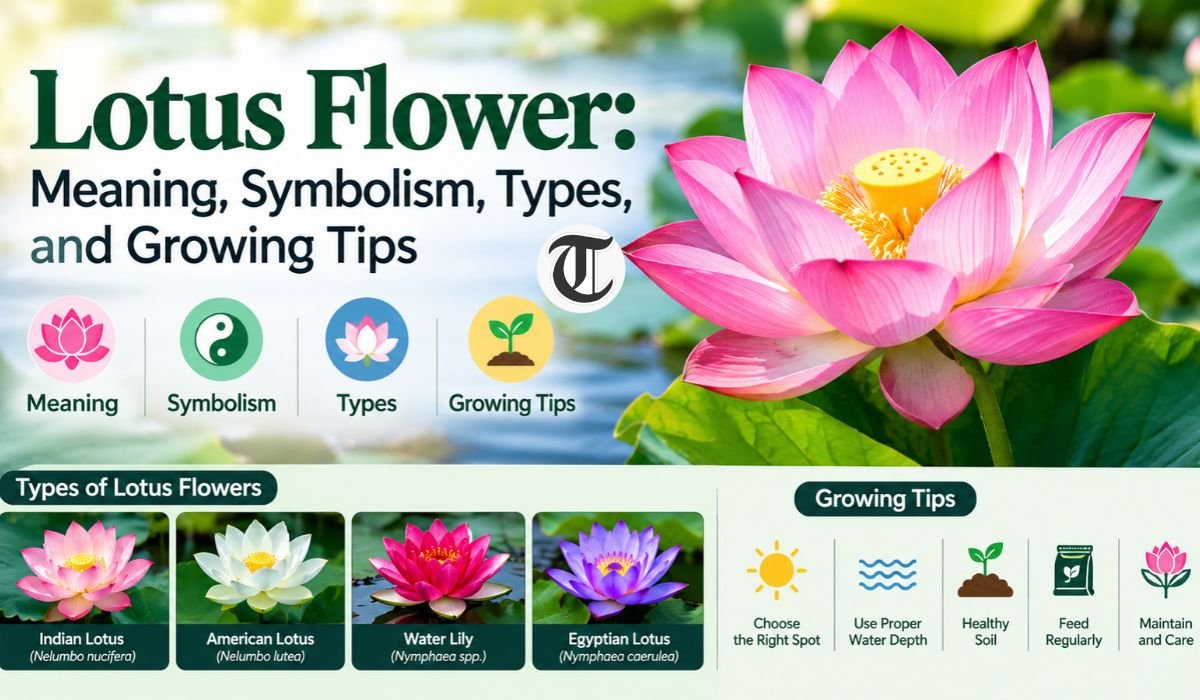
The Lotus Flower is one of those plants that seems to carry a story with it. Its beauty is obvious, but there’s much more to this aquatic perennial than its striking blooms. For centuries, the Lotus has been associated with Purity, Renewal, Enlightenment, and Spiritual Growth, particularly in Asian religious and cultural traditions.
Part of its appeal comes from the way it grows. Its thick Rhizomes remain anchored in wet, muddy soil while its leaves and flowers rise toward the surface and open in the sunlight. That natural journey from beneath the water to a beautiful bloom has made the Lotus a lasting symbol of transformation, resilience, and renewal.
It’s also a fascinating choice for gardeners. Given enough Sunlight, suitable Soil, warm conditions, and the right Water Depth, Lotus can become an impressive feature in a pond, Water Garden, or large container. The key is understanding what the plant needs before planting it.
Quick Bio Information
| Quick Fact | Information |
|---|---|
| Common Name | Lotus Flower |
| Botanical Genus | Nelumbo |
| Family | Nelumbonaceae |
| Plant Type | Aquatic Perennial |
| Major Species | Sacred Lotus And American Lotus |
| Sacred Lotus | Nelumbo nucifera |
| American Lotus | Nelumbo lutea |
| Growing Environment | Ponds, Water Gardens, And Large Containers |
| Light Requirement | Full Sun |
| Blooming Period | Mainly Summer And Warm Growing Months |
| Common Flower Colors | White, Pink, Red, And Yellow |
| Underground Structure | Rhizome |
| Preferred Soil | Heavy Loam Or Clay-Rich Soil |
| Water Preference | Still Or Slow-Moving Water |
| Propagation | Seed Or Rhizome Division |
| Main Symbolism | Purity, Rebirth, Enlightenment, And Renewal |
| National Flower | India |
| Container Growing | Possible With Suitable Equipment |
| Important Care Need | Plenty Of Sunlight And Adequate Space |
What Is A Lotus Flower?
The Lotus Flower belongs to the genus Nelumbo and the family Nelumbonaceae. It’s an Aquatic, Herbaceous Perennial that grows from thick underground Rhizomes. Two of the best-known species are the Sacred Lotus, Nelumbo nucifera, and the American Lotus, Nelumbo lutea.
The Sacred Lotus is especially well known for its large, round leaves and elegant flowers, which can appear in shades such as White and Pink. The leaves may float on the water or rise above it on long, sturdy stalks. After flowering, the plant produces distinctive seed heads that can remain attractive even after the blooms have faded.
American Lotus is another important species, particularly in North America. It produces large Yellow Flowers and can become a substantial aquatic plant when growing conditions are favorable.
Lotus is often mistaken for Water Lily because both plants live in aquatic environments. However, they belong to different plant families and have noticeably different growth habits. Once you know what to look for, telling them apart becomes much easier.
What Does The Lotus Flower Symbolize?
The Lotus Flower Meaning is closely tied to the way the plant grows. Its roots and Rhizomes remain beneath the water, often in muddy conditions, while the leaves and flowers reach toward the surface and sunlight. That striking contrast has inspired associations with Purity, Renewal, Transformation, and Spiritual Development.
In Buddhism, the Lotus is strongly connected with Purity and Enlightenment. In Hindu traditions, it has long been associated with ideas such as Divinity, Beauty, Fertility, and Prosperity. These meanings come from particular cultural and religious traditions, so there isn’t one universal definition of what the Lotus represents.
Resilience is another common theme. The plant doesn’t need perfect-looking surroundings to produce an impressive flower. Instead, it grows from wet, muddy conditions and sends its blooms into the open air. For many people, that makes the Lotus a natural symbol of overcoming difficulty and moving toward something better.
Lotus Flower Meaning In Different Cultures
The Lotus has an especially important place in Buddhism and Hinduism. In Buddhist art, Lotus Flowers frequently appear beneath spiritual figures and are associated with Purity and the journey toward Enlightenment. The flower’s ability to emerge from water has helped make it a powerful visual representation of spiritual growth.
Hindu traditions also give the Lotus a wide range of meanings. It can represent Purity, Beauty, Fertility, Prosperity, and Divinity. Lotus imagery is particularly associated with Lakshmi and appears throughout Hindu religious art and iconography. Its exact meaning can depend on the deity, story, or cultural setting, so it’s more accurate to think of the Lotus as carrying several related meanings rather than one fixed message.
The flower also has a long history in ancient Egyptian symbolism. However, historical references to the Egyptian “lotus” need some care because the word has sometimes been used for plants that are botanically different from today’s Sacred Lotus. Ancient imagery should therefore be understood in its historical context rather than automatically being identified with Nelumbo nucifera.
In modern India, the Lotus remains an important cultural symbol and is the country’s National Flower. Its influence extends well beyond religious traditions, appearing in art, architecture, cultural practices, and everyday symbolism.
Lotus Flower Color Meanings
Lotus Flower Colors are often given their own symbolic meanings, although these interpretations can differ between cultures and traditions.
A White Lotus is commonly associated with Purity, Peace, and Spiritual Awakening. The Pink Lotus has particularly strong connections with Buddhism and is often associated with the Buddha and higher spiritual ideals.
A Red Lotus is traditionally linked with Love, Compassion, Passion, and qualities associated with the Heart. Blue Lotus imagery is commonly connected with Wisdom and Knowledge. However, the term “Blue Lotus” can refer to different plants or cultural traditions, so it shouldn’t automatically be treated as a standard color of the Sacred Lotus.
Yellow flowers are characteristic of the American Lotus, and Yellow varieties can also be found among cultivated Lotus forms. While color symbolism can be meaningful, it isn’t universal. The same color may carry different associations depending on the cultural or historical context.
The Main Types Of Lotus Flowers
For gardeners, the two major species to know are the Sacred Lotus, Nelumbo nucifera, and the American Lotus, Nelumbo lutea.
The Sacred Lotus is native across parts of Asia and Australia and is the species most closely associated with many Asian religious and cultural traditions. It has also been widely cultivated as an ornamental plant, resulting in numerous cultivated forms and varieties.
The American Lotus is native to North America. Its large Yellow Flowers make it easy to recognize, but its size can also become an important consideration for gardeners. Like vigorous forms of Sacred Lotus, it may need considerable space to grow well.
There are also many Lotus cultivars with different flower colors, forms, sizes, and growth habits. Some are more suitable for smaller Water Gardens, while vigorous varieties can spread considerably. Before buying one, check its mature size and recommended growing depth. A variety that looks perfect in a nursery may become difficult to manage if it outgrows its container or pond.
Lotus Flower Vs. Water Lily
At first glance, Lotus and Water Lily can look remarkably similar. Both are aquatic plants with attractive flowers and broad leaves, but they’re actually members of different plant families.
Lotus leaves are generally round and may rise well above the surface on strong stalks. Many Water Lily leaves, on the other hand, float directly on the water and have a noticeable notch that extends toward the center.
The flowers provide another useful clue. Lotus Flowers can stand considerably above the water, whereas many Water Lily Flowers float at or close to the surface. Tropical Water Lilies can rise somewhat higher, so flower height alone isn’t always enough for identification.
Lotus Leaves also have a distinctive water-repellent surface. Water tends to form droplets that bead up and roll away rather than soaking into the leaf.
Knowing the difference isn’t just useful for identification. Lotus and Water Lily have different growth habits and shouldn’t automatically be given the same care.
Where Does Lotus Grow Best?
A Lotus Flower needs a warm, sunny, relatively sheltered environment to thrive. Full Sun is particularly important if you want reliable flowering. Around six hours or more of direct sunlight is a practical target for many gardeners, although conditions can vary depending on the variety and local climate.
The plant generally prefers still or slow-moving water. Strong currents and constant wave action can damage leaves and make it harder for young plants to establish themselves.
Soil is equally important. Lotus grows from Rhizomes that need to remain anchored, so a heavy Loam or Clay-Rich Soil is generally more suitable than a loose, lightweight potting mix. The plant also needs plenty of horizontal room because its Rhizomes spread sideways.
Before planting, consider the mature size of the variety. Giving a vigorous Lotus too little space can quickly turn into a maintenance problem.
How To Grow Lotus From Seed
Growing Lotus From Seed can be a rewarding project, although it takes patience. Lotus Seeds have an exceptionally hard outer coating, so they typically need Scarification before they can absorb water effectively.
Scarification involves carefully weakening or nicking the outer seed coat. The goal isn’t to cut deeply into the seed. Instead, you want to create a small opening that allows moisture to reach the inside without damaging the living tissue.
After Scarification, the Seeds can be placed in warm water and watched for signs of swelling and germination. Once a root and shoot begin to develop, the young plant can be moved into a small container filled with suitable heavy soil.
At this early stage, keep the water relatively shallow. As the plant develops stronger growth, its container and Water Depth can gradually be increased. Young Lotus shouldn’t simply be placed immediately into the same deep water used for a mature plant.
There’s another point worth remembering if you’re growing a named cultivar. Plants grown from Seed may not produce flowers or growth characteristics identical to the parent plant. If keeping a particular cultivar’s characteristics is important, starting with a healthy Rhizome is generally the better option.
How To Grow Lotus From A Rhizome
For many gardeners, starting with a healthy Rhizome is easier and faster than beginning with Seed. The most important thing is to handle the Rhizome carefully. Its growing tips are delicate, and damaging them can prevent successful establishment.
The Rhizome should generally be planted horizontally in heavy soil, with the growing tip positioned so that it has room to develop. Avoid burying it too deeply or pressing it tightly against the container wall.
Start with relatively shallow water while new growth is developing. Once the plant becomes established and begins producing stronger leaves, the container can gradually be placed deeper.
Rhizome Division is another way to propagate Lotus. A divided section needs a healthy growing point to produce new growth, so simply cutting any piece of Rhizome doesn’t guarantee a new plant.
Because Lotus can spread vigorously, propagation should be approached with the plant’s eventual size in mind.
Can Lotus Grow In A Pot?
Yes, Lotus can grow successfully in a pot, and container growing is often an excellent choice for gardeners who want more control over the plant.
The container should be wide and watertight rather than tall and narrow. That’s because Lotus Rhizomes spread horizontally. A container that provides plenty of surface area gives the plant more room to develop.
For a newly planted Rhizome, begin with shallow water over the Soil. As the plant grows stronger, gradually increase the Water Depth. The ideal depth isn’t identical for every Lotus, so the variety’s growing requirements should always be considered.
Larger Sacred Lotus plants may eventually require roughly 40 to 60 centimeters of water, while smaller cultivars can need significantly less. Starting shallow and increasing the depth as the plant grows is safer than placing a young plant immediately into deep water.
Container growing also offers an important practical advantage: it helps keep vigorous Lotus under control. Once a Lotus becomes established directly in pond soil, its Rhizomes can spread and become difficult to remove.
Lotus Plant Care And Fertilizing
Successful Lotus Plant Care doesn’t require constant attention, but the basic conditions need to be right. Strong Sunlight, suitable Soil, stable Water Conditions, warm temperatures, and adequate growing space form the foundation of healthy growth.
During the active growing season, Lotus can benefit from an Aquatic Plant Fertilizer. Because fertilizer products vary, follow the directions provided for the specific product rather than assuming that more fertilizer will produce more flowers.
In fact, overfeeding can create other problems. Excess nutrients can contribute to poor water quality and encourage unwanted algae, particularly in ponds.
Keep an eye on old or damaged foliage and remove it when appropriate. At the same time, avoid unnecessary disturbance of the Rhizome. A healthy Lotus generally benefits more from good growing conditions than from constant handling.
How To Encourage More Lotus Blooms
A Lotus that produces plenty of leaves but few or no flowers can be frustrating. Before adding more fertilizer, take a closer look at its growing conditions.
Start with Sunlight. Lotus needs strong direct light for reliable flowering, and insufficient light is one of the first things worth checking.
Plant maturity is another factor. A newly established Seedling may simply need more time before it begins flowering consistently. Water Depth, temperature, nutrition, container size, and Rhizome health can all influence blooming.
Warm conditions during the growing season are especially helpful. A sheltered location can also protect the plant from strong winds and excessive water movement.
The best approach is to correct the growing environment first. Extra fertilizer can’t make up for inadequate Sunlight, unsuitable Water Depth, poor planting, or an unhealthy Rhizome.
Common Lotus Problems And Winter Care
Lotus is generally a hardy aquatic plant when grown under appropriate conditions, but it isn’t completely free from pests and diseases. Aphids and Mites can occasionally affect the plant, while leaf damage and fungal or bacterial issues may also occur.
Fortunately, serious disease isn’t considered especially common when Lotus is growing well. Good growing conditions and avoiding unnecessary stress can go a long way toward maintaining healthy plants.
Winter Care requires more attention in colder climates. Many Lotus Plants survive winter by entering a dormant state, with the Rhizome serving as the plant’s protected underground structure.
The main concern in very cold regions is preventing the Rhizome from freezing. Container-grown plants may need to be moved to a protected location, placed deeper in water, or otherwise sheltered from severe frost, depending on the climate and growing setup.
There’s no single winter routine that works everywhere. The cold tolerance of the particular species and cultivar, as well as the local climate, should determine how the plant is protected.
Final Thoughts
The Lotus Flower combines natural beauty with a remarkable depth of cultural meaning. Its Rhizomes grow beneath the water while its leaves and flowers rise toward the light, creating a growth pattern that has inspired ideas of Purity, Renewal, Resilience, and Enlightenment for generations.
For gardeners, growing Lotus successfully is much less mysterious than its symbolism might suggest. Give the plant plenty of Sunlight, heavy and stable Soil, appropriate Water Depth, warmth, adequate nutrition, and enough room for its Rhizomes to spread.
Container growing can make the plant easier to manage, particularly when working with vigorous varieties. It also gives gardeners greater control over the plant’s eventual spread.
Most importantly, choose a Lotus that matches the space available. A compact cultivar may be an excellent choice for a smaller Water Garden, while a vigorous variety may need a much larger pond or a carefully managed container.
When the variety and growing conditions are right, the reward is hard to miss. A healthy Lotus can transform an ordinary Water Garden into a striking display while carrying centuries of symbolism into a modern garden.
FAQs About Lotus Flowers
What Does The Lotus Flower Symbolize?
The Lotus Flower is traditionally associated with Purity, Enlightenment, Rebirth, Renewal, and Spiritual Growth. These meanings are strongly connected with Buddhist and Hindu traditions, although the symbolism can vary depending on the cultural or religious context.
Can Lotus Flowers Grow In Pots?
Yes. Lotus can grow in suitable wide, watertight containers. Because its Rhizomes spread horizontally, a broad container is generally more useful than a narrow, deep one. Growing Lotus in a container can also help prevent vigorous plants from spreading into the surrounding pond.
Does Lotus Need Full Sun?
Yes. Lotus grows best in Full Sun and needs strong direct light for reliable flowering. Around six hours or more of direct sunlight is a useful target, although the exact requirement can vary with the cultivar and growing environment.
How Long Does It Take A Lotus Flower To Bloom?
There isn’t one flowering timeline for every Lotus Plant. An established Rhizome can generally produce a flowering plant sooner than a newly germinated Seed. Variety, plant maturity, Sunlight, warmth, nutrition, Water Depth, and Rhizome health can all affect when flowering begins.
What Is The Difference Between Lotus And Water Lily?
Lotus and Water Lily are different plants from different families. Lotus leaves are commonly round and may rise above the water, while many Water Lily leaves float on the surface and have a noticeable notch. Lotus Flowers can also rise well above the water, whereas many Water Lily Flowers sit at or near the surface.
Why Is My Lotus Not Flowering?
Insufficient Sunlight is one possible reason, but it isn’t the only one. Young plants may not yet be mature enough to flower. Incorrect Water Depth, cool temperatures, insufficient nutrition, overcrowding, an unsuitable container, or an unhealthy Rhizome can also affect flowering.
Can Lotus Survive Winter?
Many Lotus Plants can survive winter by going dormant, but cold tolerance varies between species and cultivars. In colder climates, protecting the Rhizome from severe freezing is particularly important. Container-grown plants may need to be moved, placed deeper in water, or protected from frost depending on local conditions.
How Do You Grow Lotus From Seed?
To grow Lotus From Seed, the hard outer coating is usually Scarified before the Seeds are soaked in warm water. After germination, young plants can be transferred into heavy soil and kept in relatively shallow water. As they become established, their container size and Water Depth can gradually be increased. Seed-grown plants may not reproduce the exact characteristics of a named cultivar.
Learn more and explore exciting content on: What Is InternetChicks? A Clear Guide to the Website and Its Online Meaning
[…] Learn more and explore exciting content on: Lotus Flower: Meaning, Symbolism, Types, and Growing Tips […]