
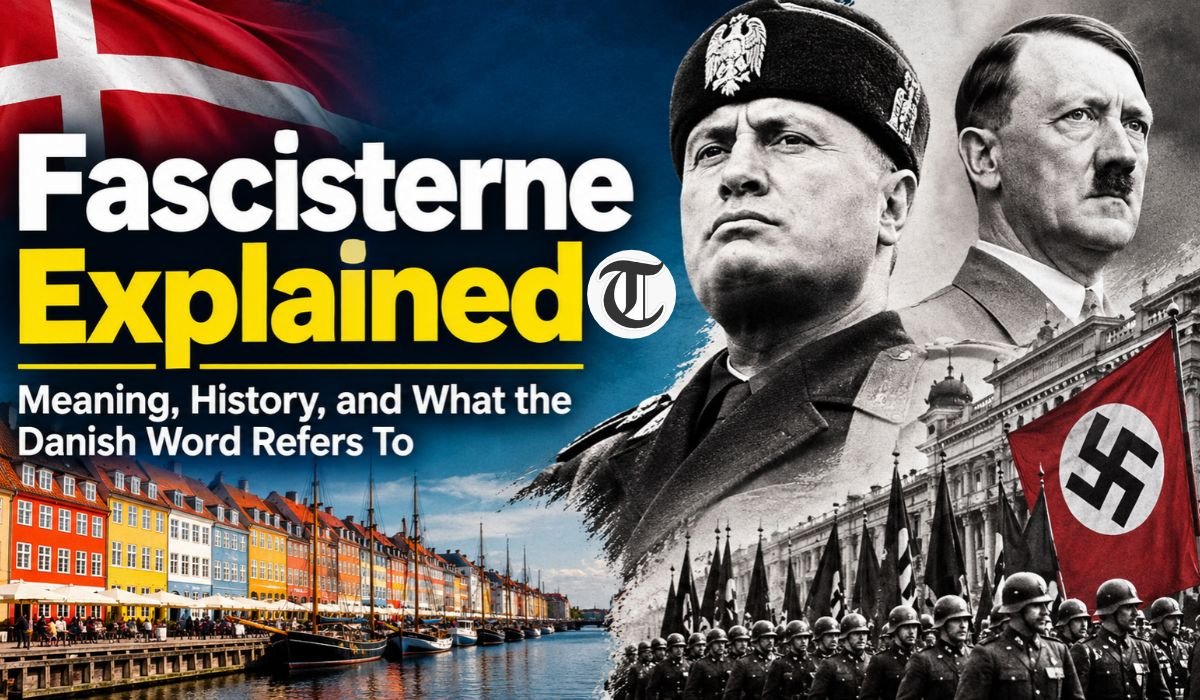
Introduction: What Does Fascisterne Mean?
The Danish word Fascisterne is easy to translate, but understanding what it refers to can take a little more context. In English, the word means “the fascists.” It is the definite plural form of the Danish word fascist, which describes a person associated with or supportive of fascism.
What makes the term interesting is that Fascisterne isn’t the Danish word for fascism itself. That word is fascisme. Instead, Fascisterne refers to people. Which people, exactly, depends on the surrounding text, the country being discussed, and the historical period.
A Danish history book might use Fascisterne when discussing followers of Benito Mussolini in Italy. A text about Denmark during the 1930s or World War II could use it when referring to Danish fascists or National Socialists. In modern political writing, the word may also appear in a broader or rhetorical sense.
So, while the basic translation is straightforward, the full meaning comes from context. Understanding that distinction also leads into the much wider history of Fascism, Nazism, Danish National Socialism, and Europe during the turbulent first half of the twentieth century.
Fascisterne Meaning in English
The most direct English translation of Fascisterne is “the fascists.” It refers to a group of people rather than to an ideology.
For anyone searching for the Fascisterne Meaning, this is the key point to remember. The Danish word fascist means “a fascist,” while fascisten means “the fascist.” The plural form is fascister, and the definite plural is fascisterne, or “the fascists.”
The related Danish word fascisme means “fascism.” This difference may seem small, but it matters when translating Danish accurately. Replacing Fascisterne with “fascism” changes the subject from people to an ideology.
The Danish dictionary Den Danske Ordbog defines fascist primarily as a person who supports fascism. It also records a broader transferred meaning connected with strongly nationalist or authoritarian ideas. That wider usage helps explain why the word can appear in both historical and contemporary discussions.
In short, Fascisterne means “the fascists,” while Fascism refers to the political ideology or movement associated with them.
How the Danish Word Fascisterne Is Formed
The structure of Fascisterne becomes much clearer once its grammatical forms are compared.
The basic noun is fascist. Its definite singular form is fascisten, meaning “the fascist.” The plural is fascister, meaning “fascists,” while fascisterne means “the fascists.”
The ending -erne is important because Danish commonly uses noun endings to indicate definiteness. English normally puts the word “the” before a noun, whereas Danish can attach that meaning directly to the noun.
The same pattern helps explain why fascisterne shouldn’t be mistaken for the name of an ideology or organization. It is simply a grammatical form of the noun.
There are also closely related Danish terms. Fascisme means fascism, and fascistisk is an adjective meaning fascist or relating to fascism. The Danish dictionary connects fascist with the Latin fascis, a word that is also part of the historical story behind the term fascism.
Is Fascisterne the Name of a Political Group?
Generally, no. Fascisterne is normally an ordinary Danish noun meaning “the fascists,” not the formal name of one political party.
The group being described depends on the context. A passage about Italy in the 1920s could use the word for supporters of Mussolini’s Fascist movement. A Danish history text could use it for Danish fascists or National Socialist activists. A modern article might use the word while discussing a political group whose ideas are being compared with historical Fascism.
This is worth remembering when reading headlines. If Fascisterne appears with a capital letter, that doesn’t necessarily mean it’s the official name of an organization. Capitalization may simply result from the way a title has been written.
The surrounding sentence is usually much more useful than capitalization for figuring out who is actually being discussed.
Where Did the Word Fascism Come From?
To understand the background of Fascisterne, it helps to look at the origins of the word fascism itself.
The Danish dictionary traces fascisme to the Latin fascis, meaning a bundle of rods. This is connected with the Roman fasces, a symbol associated with authority. The Italian word fascio, which could mean a bundle, group, or association, later became linked to political organizations.
Modern Fascism developed as a major political movement in Italy after World War I. The country was experiencing serious political and social tensions. Economic difficulties, political instability, social conflict, and fear of revolutionary socialism all contributed to an atmosphere in which radical movements could gain attention.
Still, those conditions alone don’t explain Fascism. The movement also promoted a distinct political vision built around intense nationalism, strong authority, rejection of liberal democracy, political violence, and the belief that individual or class interests should be subordinated to the nation and state.
That combination of ideas is essential to understanding why the word later became associated with some of the most consequential political movements in modern European history.
How Italian Fascism Developed
Benito Mussolini was the central figure in the early development of Italian Fascism. In 1919, he founded the Fasci Italiani di Combattimento, establishing the movement that would eventually become the Fascist Party’s political base.
The early movement attracted war veterans, nationalists, and people who opposed socialism and aspects of the existing political system. It also became associated with organized political violence. Fascist squads attacked socialist organizations, trade unions, political opponents, and other targets.
The movement’s power increased during a period of intense political uncertainty. In October 1922, Fascist supporters took part in the March on Rome. King Victor Emmanuel III subsequently appointed Mussolini prime minister.
That appointment didn’t instantly turn Italy into a fully developed dictatorship. Instead, Mussolini’s government gradually dismantled democratic checks and weakened political opposition. Restrictions on political freedoms increased, opposition parties were suppressed, and political power became increasingly concentrated around Mussolini and the Fascist Party.
By the middle of the 1920s, Italy had become a dictatorship dominated by Mussolini. He became known as Il Duce, meaning “the leader.”
What Did Historical Fascists Believe?
Fascist movements weren’t carbon copies of one another. Their beliefs and policies varied from country to country. Even so, historians identify several recurring characteristics.
One of the most important was an intense emphasis on national unity. Fascists generally argued that the nation should take precedence over competing individual, class, or political interests. Political disagreement could therefore be portrayed as a threat to national strength.
Another recurring feature was strong, centralized leadership. Fascist movements often presented a powerful leader as the personification of national unity and political direction. Institutions capable of limiting that authority could subsequently be weakened.
Fascists also generally rejected liberal democracy and political pluralism. Rather than viewing competing parties and political disagreement as normal elements of political life, they often portrayed them as evidence of division and weakness.
Many fascist movements were strongly anti-communist and anti-socialist. They rejected Marxist class struggle and instead promoted cooperation between different social groups under the authority of the nation and state.
Political violence was another important feature. Paramilitary groups, intimidation, organized street violence, military imagery, discipline, and sacrifice were used in different fascist movements to build political loyalty and suppress opponents.
Propaganda also played a major role. Newspapers, radio, films, political symbols, uniforms, rallies, speeches, and youth organizations helped movements reach large audiences and encourage active identification with their political cause.
Finally, many fascist movements promoted restrictive ideas about national belonging. Certain ethnic, religious, political, or other groups could be portrayed as outsiders or threats. The precise form of exclusion differed considerably between countries.
For this reason, Fascism is best understood through a combination of political characteristics rather than a single defining feature.
Fascism vs. Nazism: Are They the Same?
Fascism and Nazism are closely related, but they’re not interchangeable terms.
Italian Fascism developed under Mussolini, while German National Socialism, or Nazism, developed under Adolf Hitler. Both movements rejected liberal democracy, embraced authoritarian leadership, promoted intense nationalism, used propaganda, and relied heavily on political repression and violence.
Nazism, however, placed racial ideology and antisemitism at the center of its worldview. Nazi ideology promoted racial hierarchy and the supposed superiority of an “Aryan” race. Jews were targeted as a racial enemy, while other groups were also persecuted.
The Nazi concept of Lebensraum, or “living space,” was tied to territorial expansion and became part of the ideological justification for German conquest.
Italian Fascism did not begin with precisely the same racial system. Nevertheless, Mussolini’s government later introduced antisemitic racial laws in 1938 and increasingly aligned Italy with Nazi Germany.
This historical difference is important when interpreting the Danish terms Fascisterne and Nazisterne. Fascisterne means “the fascists,” while Nazisterne means “the Nazis.” The two traditions shared important features, but their political development and ideological emphasis weren’t identical.
Fascisterne and Fascism in Denmark
Denmark had fascist and National Socialist movements during the 1930s and the German occupation, but none succeeded in establishing a fascist government.
The best-known Danish National Socialist organization was Danmarks Nationalsocialistiske Arbejderparti, generally known as DNSAP. The party was founded in 1930 and became the country’s principal National Socialist political organization.
DNSAP was strongly influenced by Hitler’s German Nazi Party. Its ideology included nationalism, anti-communism, opposition to liberal democracy, and antisemitism.
Frits Clausen became party leader in 1933 and remained the central figure in Danish National Socialism for much of the occupation period.
The existence of DNSAP shouldn’t be confused with Denmark itself becoming a fascist state. The party never achieved enough electoral support or political power to form the Danish government.
That distinction is particularly important when discussing Fascisterne in Denmark, because the presence of extremist political groups doesn’t mean that those groups controlled the country’s political system.
DNSAP and Frits Clausen
Frits Clausen was the most prominent leader of DNSAP. Under his leadership, the party attempted to strengthen Danish National Socialism and increase its political influence.
Its election results reveal how limited that influence remained. In the 1939 Danish parliamentary election, DNSAP received 31,032 votes, equal to 1.83% of the vote, and won three seats in the Folketing.
The party received more votes in the 1943 election, but its parliamentary representation remained limited. This difference illustrates why votes, parliamentary seats, and party membership should be treated as separate measures.
DNSAP had a committed organizational base, but it did not develop the broad electoral support required to take control of Denmark through normal parliamentary politics.
Its history therefore provides a useful example of why a politically active extremist organization shouldn’t automatically be described as representing the views of the wider population.
Fascisterne During the German Occupation
Germany invaded Denmark on April 9, 1940, beginning the German occupation.
For DNSAP, the occupation appeared to create a possible route to greater political influence. The party sought German support and hoped that the changing political situation would improve its position.
That didn’t happen in the way DNSAP wanted. German authorities did not simply install the party as Denmark’s government. The existing Danish political and administrative system remained useful to the occupation authorities because it helped maintain order and facilitate cooperation.
DNSAP therefore remained outside direct control of the Danish government.
The period also requires careful distinctions between different forms of wartime involvement. DNSAP membership, collaboration with German authorities, and military service for Germany weren’t automatically the same thing. Individual people could have different motivations and different levels of involvement.
That nuance is important when discussing Danish National Socialism because a broad label can otherwise obscure significant differences between individuals and organizations.
Danish Jews, Resistance, and the Occupation
The occupation was also marked by growing Danish resistance. Resistance activities included illegal newspapers, intelligence gathering, sabotage, and assistance to Allied efforts.
One of the most significant events took place in 1943, when German authorities prepared to deport Denmark’s Jewish population. Danish citizens, resistance networks, fishermen, police personnel, and others helped thousands of Jews escape across the water to neutral Sweden.
The United States Holocaust Memorial Museum records that approximately 7,200 Danish Jews and around 680 to 700 non-Jewish relatives were helped to reach Sweden. Approximately 500 Jews were captured and deported to the Theresienstadt ghetto.
The rescue is an important part of Denmark’s World War II history. It demonstrates the role played by ordinary citizens and organized networks in helping people escape Nazi persecution.
It also provides essential context for understanding the occupation as a whole. Danish society included collaborators and National Socialists, but it also included people who resisted German rule and helped those being persecuted.
What Happened to DNSAP After World War II?
DNSAP collapsed after Denmark was liberated in 1945. People involved in collaboration and other wartime activities could be investigated or prosecuted, with legal consequences depending on their individual conduct.
Frits Clausen was arrested following liberation and remained in custody until his death in December 1947. He died before his legal case reached a final judgment.
The end of DNSAP didn’t completely eliminate National Socialist ideas in Denmark. Later organizations adopted National Socialist or neo-Nazi beliefs, but these belonged to different periods and shouldn’t be confused with the original wartime party.
This distinction is especially important in historical research. A later neo-Nazi organization may share ideological elements with DNSAP, but it isn’t automatically the same organization or part of the same historical circumstances.
How Is Fascisterne Used Today?
The word Fascisterne can still appear in Danish historical writing, journalism, political discussion, and online conversations.
In historical writing, its meaning is often easier to establish because the author usually identifies a particular country, movement, leader, or time period. A modern political discussion can be more complicated because the word may sometimes be used rhetorically.
Den Danske Ordbog records both the historical meaning of fascist and a broader transferred use connected with strongly nationalist or authoritarian ideas. This helps explain why the term can appear outside discussions of twentieth-century European Fascism.
When the word is used today, it’s useful to examine what the writer actually means. What beliefs are being described? What actions or policies are involved? Is a particular organization being identified? Is the word being used historically, analytically, or as a political accusation?
Looking at those details gives readers a much clearer understanding than relying on the label alone.
Fascisterne vs. Other Political Terms
Fascism shouldn’t be used as a catch-all term for every form of nationalism, conservatism, authoritarianism, or right-wing politics.
Nationalism focuses on the political importance of the nation or national identity and can exist in many different ideological traditions.
Authoritarianism broadly describes systems in which political power is concentrated and political freedoms are restricted. An authoritarian government isn’t automatically fascist.
Dictatorship describes a political system in which power is concentrated without normal democratic competition. Dictatorships can have very different ideological foundations.
Populism is another broad political concept that can appear in different ideological settings and on different parts of the political spectrum.
Nazism has a particularly close historical relationship with Fascism, but its own racial ideology, antisemitism, German setting, and historical development make it a distinct political tradition.
Keeping these terms separate makes historical writing more precise and helps readers understand what a source actually means.
How to Understand Fascisterne in a Danish Text
If you encounter Fascisterne while reading Danish, begin with the direct translation: “the fascists.”
Then look at everything around it.
Who is being discussed? Which country is involved? What period is the text describing? Has the author already mentioned a particular political party or movement?
A passage about Mussolini’s Italy will usually have a very different reference from a passage about Denmark during the 1930s or the German occupation. The same Danish word can appear in both contexts while referring to different groups.
It’s also useful to determine whether the writer is making a historical description or using the term in a modern political debate.
This is particularly helpful for anyone translating Danish articles or researching Scandinavian history. A dictionary can tell you what Fascisterne means, but context tells you who the writer means.
Common Misunderstandings About Fascisterne
One of the most frequent mistakes is translating Fascisterne as “fascism.” The direct meaning is “the fascists,” while fascisme means fascism.
Another misconception is that Fascisterne must be the official name of a political party. In ordinary Danish usage, it is a grammatical form of the noun fascist and can describe members or supporters of different movements.
It’s also incorrect to assume that the term always means followers of Mussolini. The historical context determines which people are being discussed.
Fascists and Nazis shouldn’t automatically be treated as identical, either. The two movements shared important characteristics, but Nazism developed a particularly central racial and antisemitic ideology.
Danish wartime history also requires care. Not every Danish collaborator was a DNSAP member, and DNSAP membership doesn’t by itself describe every form of wartime involvement.
Final Thoughts
Fascisterne is a simple Danish word that carries a considerable amount of historical context. Its direct translation is “the fascists,” but the people it refers to can only be identified accurately by looking at the surrounding text.
The word is linguistically connected to fascist and fascisme, while its historical background reaches into the rise of Italian Fascism, Mussolini’s dictatorship, German Nazism, Danish National Socialism, and the political upheavals of twentieth-century Europe.
In Denmark, the subject also connects with DNSAP and Frits Clausen, the German occupation beginning in 1940, collaboration and resistance, and the rescue of thousands of Danish Jews in 1943.
Ultimately, the best way to understand Fascisterne is to start with its simple meaning and then add the necessary context. Translate it as “the fascists,” identify the country and historical period, and determine which group the writer is actually describing. That approach keeps the language accurate while also giving the history the careful treatment it deserves.
FAQs About Fascisterne
What Does Fascisterne Mean?
Fascisterne means “the fascists” in English. It is the definite plural form of the Danish word fascist and refers to a group of people described as fascists.
Is Fascisterne the Same as Fascism?
No. Fascisterne refers to people, while fascisme refers to fascism, the political ideology and movement.
Is Fascisterne a Political Party?
No. Fascisterne is normally an ordinary Danish noun, not the official name of one political party. The surrounding context identifies the particular people or movement being discussed.
What Is the Difference Between Fascisterne and Nazisterne?
Fascisterne means “the fascists,” while Nazisterne means “the Nazis.” Fascism and Nazism are historically related, but they’re not exact synonyms.
Did Denmark Have Fascist or Nazi Movements?
Yes. Denmark had fascist and National Socialist organizations during the 1930s and World War II. DNSAP was the country’s best-known National Socialist party.
Did DNSAP Rule Denmark?
No. DNSAP never formed the Danish government. It remained a relatively limited political force, including during the German occupation.
Is Fascisterne Still Used Today?
Yes. The word can still appear in Danish historical writing, journalism, political discussions, and online debates. Its exact meaning depends on the context.
Why Does Context Matter When Understanding Fascisterne?
Because Fascisterne is a general definite plural term, not the official name of one specific organization. The country, historical period, political movement, and surrounding text help establish exactly who is being described.
Learn more and explore exciting content on: Thealitekeepsafe .com: A Closer Look at Its Content, Purpose, and Online Presence
[…] Learn more and explore exciting content on: Fascisterne Explained: Meaning, History, and What the Danish Word Refers To […]